

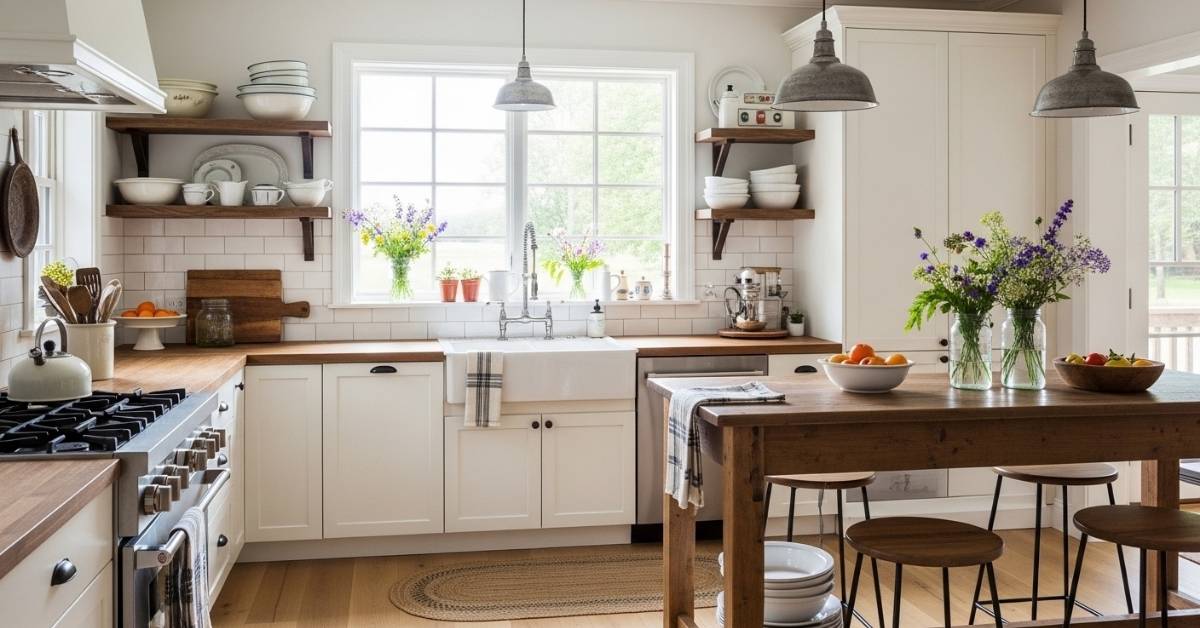
Farmhouse kitchens have stayed relevant for a reason and it’s not just the shiplap. There’s something genuinely functional about the style: open shelving that forces you to stay organized, apron sinks deep enough to handle a full pot, and a material palette that hides wear better than most modern finishes. In 2026, the look has evolved past the all-white, mason-jar-on-every-surface version most people picture. Farmhouse Kitchen Decor Ideas It’s warmer now, more layered, and a lot more practical.
If your kitchen feels either too sterile or just visually scattered like it has pieces but no cohesion, farmhouse decor gives you a clear framework to work within. The style naturally balances texture, function, and warmth without requiring you to gut the space.
This is especially useful if you’re working with a mid-sized or smaller kitchen where every decision needs to pull double duty: look good and do something. Whether you rent, own, or are somewhere in between, most of these ideas work without major renovation.
Open Wood Shelving Instead of Upper Cabinets

Replacing upper cabinets with open wood shelves is one of the more committed farmhouse moves but the payoff is real. A pair of thick walnut or pine shelves mounted with black iron brackets creates instant visual depth, especially against white or light gray walls. Stack white or cream dishware on the lower shelf, keep glassware up top, and leave enough breathing room between items so it reads curated rather than crammed.
The reason this works spatially is that it opens up the upper half of the kitchen wall, which makes the ceiling feel higher and the room less boxed in. It also forces a level of organization that closed cabinets let you avoid. In my experience, this works best when you commit to a neutral dishware palette mixing too many colors or styles up there creates visual noise fast. Best for kitchens with good natural light and owners (no renters wall anchoring required).
Apron Front Sink as the Kitchen’s Focal Point
An apron front sink also called a farmhouse sink is one of those pieces that immediately shifts the character of a kitchen. The exposed front panel adds a structural, almost furniture-like quality that standard undermount sinks don’t have. Pair it with an aged brass or unlacquered brass faucet and a simple linen roman shade over the window above, and the whole sink area reads like an intentional vignette.
Practically, the depth is the real advantage. Most apron sinks are 8–10 inches deep, which means large pots, sheet pans, and even baby baths all fit comfortably. The tradeoff is cabinet reconfiguration underneath, so this is more of a renovation-level decision. Go for it if your kitchen layout already has a window above the sink position. That combination of natural light, deep basin, and textured hardware is hard to beat.
Shiplap Accent Wall Behind Open Shelving

You don’t need shiplap everywhere; one accent wall behind open shelving or along a breakfast nook is enough to establish the farmhouse tone without overdoing it. Horizontal white or off-white shiplap behind dark shelving creates strong contrast that makes both elements read more intentionally. The linear texture also draws the eye along the wall rather than straight up, which can make narrow kitchens feel wider.
This works especially well in rentals if you use peel-and-stick shiplap panels the quality has improved significantly, and on a painted or lightly textured wall, the result is convincing. The key is keeping everything else on that wall simple. One or two shelves, a few well-chosen objects, and the shiplap does the rest of the visual work.
A Butcher Block Island or Countertop Section
Butcher block adds warmth to a kitchen in a way that quartz and granite simply don’t; it ages visibly, and it brings an organic quality that fits the farmhouse palette naturally. You don’t need to redo all your counters. One butcher block section typically on an island or a lower prep counter is enough to introduce the material without a full commitment.
Functionally, it’s a legitimate prep surface. You can cut directly on it (with maintenance), and the wood softens the acoustic environment slightly compared to hard stone. It does require oiling every few months and isn’t great next to a sink without proper sealing, so placement matters. Honestly, this is one I’d recommend trying first if you want a farmhouse feel without touching cabinets or walls. It’s the single highest-impact, lowest-disruption move in this style.
Black Hardware Throughout the Kitchen

Swapping out cabinet hardware is one of the fastest and cheapest ways to shift a kitchen’s entire character. In a farmhouse kitchen, matte black pulls, bin handles, and cup knobs create definition against white or cream cabinetry; the contrast is sharp without being cold. Extend the black into the faucet, light fixtures, and window hardware for a cohesive material thread throughout the space.
The visual logic here is about grounding. Farmhouse kitchens lean soft lots of white, wood, linen and black hardware to prevent the palette from feeling washed out or too cottagecore. It also photographs extremely well, which matters if Pinterest is part of your planning process. This is a weekend project for most kitchens: new hardware, a screwdriver, and about two hours.
Read More About : 21 Kitchen Lighting Ideas Modern Homes Actually Need (No Electrician Required for Most)
Floating Pot Rack Above the Island
A ceiling-mounted pot rack above the island solves two things at once: it clears out lower cabinet space, and it adds the kind of lived-in, functional aesthetic that farmhouse style is rooted in. A rectangular black iron or wrought iron rack with S-hooks works best. Hang cast iron, stainless, or copper pots or an intentional mix of all three.
The height matters. The rack should sit at least 7 feet from the floor to avoid head clearance issues and still allow pendant lights to do their job nearby. This works best in kitchens with higher ceilings (9 feet or more) and an island that’s not too close to the perimeter walls. If the ceiling is lower, a wall-mounted version above the stove achieves a similar effect with less spatial commitment.
Vintage-Style Open Pantry With a Curtain

In smaller kitchens without a dedicated pantry, converting a deep cabinet or alcove into an open pantry with a gathered linen or cotton curtain is a clever farmhouse workaround. Pull the curtain back and you have full access to shelving; close it and the visual clutter disappears. The soft fabric adds texture to what would otherwise be a flat cabinet face.
This is a particularly good solution for renters with no holes, no permanent changes. A simple tension rod or removable bracket holds the curtain in place. Use uniform glass or labeled canisters for dry goods inside so it looks intentional even when the curtain is open. The combination of organized storage behind fabric is a practical setup that holds up in real, daily-use kitchens.
A Chalkboard or Framed Chalkboard Wall Panel
A framed chalkboard panel either freestanding, leaned against a wall, or mounted serves as a functional and visual anchor in a farmhouse kitchen. Use it for a weekly menu, grocery list, or just simple seasonal text. The matte black surface pairs naturally with black hardware and adds a purposeful, slightly vintage quality.
The frame makes the difference. A thick wood or painted white frame turns a basic chalkboard into something that reads more like art and less like a leftover school supply. Position it near the main prep or dining area so it’s actually usable. This is one of those ideas that works across styles; it doesn’t require a fully committed farmhouse kitchen to land well.
Woven Baskets for Lower Cabinet Storage

Woven baskets, seagrass, rattan, or water hyacinth used as drawer or shelf organizers give the lower kitchen storage a relaxed, organized quality. Label each one with a simple tag for onions, potatoes, bread, or linens. On open lower shelves especially, a row of matching woven baskets looks collected and functional rather than chaotic.
The material contrast is what makes this work in a farmhouse kitchen natural fiber against white cabinetry or painted wood reads as warm and textured rather than sparse. Choose a consistent basket style across the space rather than mixing shapes and weaves. Rectangular baskets with flat bases stack and pull out more practically than round ones.
Vintage or Antique Wood Stools at the Island
Counter stools are functional furniture, but in a farmhouse kitchen they’re also one of the first things you see. Vintage-style or genuinely antique wood stools Windsor backs, cross-back designs, or simple turned-leg styles add character and a sense of history that new furniture rarely replicates. A slightly worn or distressed finish is fine; it fits the aesthetic rather than working against it.
The scale matters: stools should leave about 10–12 inches between the seat and the underside of the counter. Three stools at a standard island read more grounded than two, but two works in tighter spaces. Avoid mixing drastically different stool styles if you’re going for cohesion, stay within one design family even if the pieces aren’t identical.
Linen or Cotton Cafe Curtains on the Kitchen Window

Cafe curtains, half-length panels that cover only the lower portion of the window, are a farmhouse classic that actually makes practical sense in a kitchen. They provide privacy without blocking natural light from the upper half of the window. In white or cream linen, they add softness to a space that’s often all-hard surfaces: tile, stone, stainless.
The installation is simple enough for renters: a tension rod or small removable cup hooks. Keep the fabric light and unlined so it moves naturally and lets light diffuse through. Avoid heavy blackout styles the whole point is that gauzy, sun-filtered quality that works especially well over a sink or breakfast area.
A Statement Range Hood in Wood or Painted Finish
The range hood is one of the largest visual surfaces above a stove, and in a farmhouse kitchen, a custom-style wood or MDF hood with a painted or stained finish makes a real architectural statement. It doesn’t need to be structural; many decorative hoods are boxes that wrap a standard insert. A cream or white painted hood with a simple ogee or straight profile reads as built-in and intentional.
Flank it with open shelving on either side for symmetry and the hood becomes the kitchen’s focal centerpiece. If budget is a constraint, premade hood covers from home improvement stores can be painted and trimmed out for a fraction of the custom cost. This is one of the higher-effort ideas here, but the visual return is significant: it shifts the whole kitchen from assembled to designed.
Exposed Brick or Faux Brick Backsplash

Real exposed brick behind a stove or along a backsplash wall adds texture and depth that tile rarely matches. In older homes, it’s worth investigating what’s behind the drywall original brick is a real find. In newer construction or rentals, high-quality faux brick panels or peel-and-stick brick tile achieve a similar visual effect with far less commitment.
The color of the brick matters for tone. Red brick with white grout reads more traditional farmhouse; whitewashed or German smear brick is softer and works better with modern or Scandinavian-leaning farmhouse styles. Keeping the surrounding cabinets simple brick is a strong visual element and doesn’t need competition.
A Large Farmhouse Table in the Kitchen Eating Area
If your kitchen opens to a dining area, the table is the anchor and a large, rectangular farmhouse table in natural pine or oak sets the whole tone. Mismatched chairs, a bench on one side, chairs on the other are both practical and visually interesting. The combination of different seat types reads relaxed and collected rather than overly matched.
Scale is the most important variable. A table that’s too small for the space will make the room feel underutilized; one that’s too large will block movement flow. Leave at least 36 inches between the table edge and the nearest wall or cabinet run to allow chairs to pull out comfortably. If the ceiling height allows, a low-hanging pendant or two above the table reinforces the dining zone and adds warmth.
Mason Jar Herb Garden on the Windowsill

This one earns its reputation. A small lineup of mason jars holding fresh herbs basil, thyme, and rosemary on the kitchen windowsill is functional, visually grounded, and genuinely farmhouse in origin. The clear glass catches light, the green of the herbs adds color without disrupting a neutral palette, and it uses vertical windowsill space that often goes unused.
Keep the jars the same size and style for visual consistency, and don’t overcrowd the sill. Three to four jars with one herb variety each is cleaner than a crowded mix. This setup works in almost any kitchen with a south- or east-facing window. herbs need at least 4–6 hours of direct light daily to stay productive.
Read More About : 27 Home Coffee Bar Setup Ideas That Actually Work in Real Spaces
Vintage Enamelware as Functional Decor
Enamelware, the white-with-blue-trim mugs, pitchers, and bowls you associate with camping and old farmhouses, has come back strongly as both functional kitchen equipment and decor. Display a small collection on open shelves or hooks. The material is durable, dishwasher safe, and adds a nostalgic, tactile quality that contemporary ceramics don’t quite replicate.
A cohesive collection in one or two colorways looks intentional on shelving. Mix sizes: a large pitcher, a few mugs, a stacked set of bowls to create visual variety within the uniformity of the material. Look for genuine vintage pieces at thrift stores and estate sales; the real thing holds up significantly better than some reproduction versions.
Subway Tile Backsplash With a Dark Grout

White subway tile is standard. White subway tile with dark gray or charcoal grout is a more modern take that adds graphic quality and reads as more intentional in 2026. The dark grout lines create a grid pattern that gives the backsplash visual structure without additional cost or complexity. It also hides staining and discoloration better over time, which is a practical advantage in a kitchen.
This works best with white or light gray cabinetry where the contrast is most visible. With very dark lower cabinets, the effect can feel heavy in that case, staying with a lighter grout. Pair with matte black hardware and fixtures to carry the dark tone across the space cohesively.
Wainscoting or Board-and-Batten on the Lower Walls
Board-and-batten paneling on the lower half of kitchen walls painted white or in a contrasting soft sage or navy adds architectural detail that makes a plain kitchen feel more finished. The vertical lines draw the eye upward and give the lower wall a structured quality that flat paint doesn’t have.
This works well in kitchens where the upper cabinets are minimal or absent. The paneling provides visual weight on the lower half so the room feels balanced. It’s also a practical surface painted wood that is easier to wipe down than drywall in a high-splatter zone. For renters, premade beadboard panels can be attached with adhesive mounting strips and removed without wall damage.
A Farmhouse-Style Pendant Light Over the Sink

Pendant lighting over the sink is a detail most kitchens skip, and it makes a disproportionate difference. In a farmhouse kitchen, a single black metal cage or wire pendant with an Edison or warm globe bulb creates focused task lighting while adding a decorative element to an area that tends to be underlit.
The pendant should hang roughly 30–36 inches above the sink basin for effective light distribution without obstructing the window view. In kitchens with lower ceilings, a flush-mount in a matching farmhouse style achieves a similar effect. This is especially impactful in kitchens where the sink is positioned away from natural light; it prevents that grey, shadowy feel that makes dish-washing a particularly uninviting chore.
Open Crock or Utensil Holder on the Counter
A large ceramic crock matte white, cream, or earthenware holding wooden spoons, spatulas, and ladles is a farmhouse staple that genuinely improves counter workflow. It keeps the most-used tools within arm’s reach without requiring a drawer pull, and the combination of ceramic and wood handles is visually warm and grounded.
Choose a crock with enough diameter to hold 8–10 tools without them falling over. Position it near the stove rather than in a corner placement affects whether it functions or just decorates. Pair it with a wooden cutting board leaned against the backsplash nearby and the whole counter vignette reads cohesive.
Layered Lighting: Overhead, Under-Cabinet, and Pendant

Most kitchens are lit with one overhead fixture and nothing else, which creates flat, unflattering light that makes even well-designed spaces feel institutional. Layered lighting overhead recessed or flush-mount, under-cabinet LED strips, and pendants above the island creates warmth and spatial definition that a single source can’t.
The under-cabinet layer is the most overlooked and arguably most practical: it illuminates the counter directly, which is where you actually work. Warm-white bulbs (2700–3000K) throughout all three layers keep the tones consistent and avoid that mixed-temperature look that can make a space feel unresolved. This is an upgrade that works in any kitchen style but reads especially well in farmhouse interiors where warmth is a core aesthetic goal.
Reclaimed Wood Floating Shelves
Reclaimed wood shelves genuinely reclaimed or artificially aged have a grain pattern and color variation that new wood doesn’t replicate. Mounted with simple black iron brackets, they bring a raw, tactile quality that softens modern kitchens and adds depth to already-farmhouse ones. The knots, checks, and weathering in the wood read as authentic rather than decorative.
Source from architectural salvage yards, Etsy sellers who specialize in reclaimed material, or lumber yards that carry barn wood. Thickness matters; a shelf under 2 inches can feel flimsy visually; go for 2.5 — 3 inches for a substantial, furniture-like presence. These work in almost any room with a wall strong enough to support them.
A Farmhouse-Style Kitchen Runner Rug

A runner rug in front of the main counter run or sink is practical first it reduces fatigue during long prep sessions but it also defines the kitchen zone visually and adds texture underfoot. In a farmhouse kitchen, natural fiber rugs (jute, sisal, cotton stripe) work best. They’re low-pile enough for easy cleaning and the material fits the palette without competing with other textures.
Choose a runner that’s the right proportion: it should span most of the counter length, not just a small patch in the center. In kitchens with light or white flooring, a warm jute or black-and-white striped cotton runner creates grounding contrast. Avoid high-pile or heavily patterned rugs in the kitchen; they collect crumbs and visually fragment the space.
Display Wooden Cutting Boards as Wall Art
A grouping of wooden cutting boards hung on the wall or leaned on open shelving functions as both art and accessible kitchen equipment. Choose a mix of shapes: rectangular, paddle, round. Different wood tones (walnut, maple, cherry) add color variation within a cohesive material story.
The arrangement doesn’t need to be perfectly symmetrical; an organic, slightly asymmetric grouping looks more natural and less retail. Leave them out when you’re not using them; the beauty of this idea is that there’s no separation between the decorative and functional. This works on any blank kitchen wall, above a counter, or as part of a larger open-shelf vignette.
A Farmhouse-Style Coffee or Beverage Station

Carving out a dedicated coffee or beverage corner even in a small kitchen creates a functional micro-zone that reduces counter clutter elsewhere. A small open shelf unit or a section of counter with a few hooks underneath for mugs, a crock for spoons, and a basket for pods or tea bags is all it takes.
The farmhouse version of this uses ceramic mugs, a wood tray to organize the machine and accessories, and open storage rather than a closed cabinet above. Keep it contained to one section ideally a corner or the end of a counter run so it feels intentional rather than sprawling. I’ve noticed this setup tends to actually get used more when it’s visible and accessible, which is the whole point.
Potted Greenery and Dried Botanicals
Live plants and dried botanicals bring an organic layer to a farmhouse kitchen that no manufactured decor quite replicates. A small potted eucalyptus or trailing pothos on the counter, combined with dried lavender or wheat bundles hung from a hook or resting in a pitcher, introduces natural color and scent without visual clutter.
Dried botanicals in particular are low-maintenance and long-lasting; a bundle of dried lavender in a stoneware vase can look intentional for months. Place live plants where they’ll actually receive enough light rather than as pure decoration in a dark corner. Position near windows, above shelves with indirect light, or on the windowsill with other herbs.
A Chipped or Limewash Finish on a Kitchen Island
[Image: farmhouse kitchen island with limewash painted finish in warm white, black hardware, butcher block top, texture visible on surface, beautiful and lived-in]
Limewash paint applied to a kitchen island or a lower cabinet run creates a softly weathered, chalky texture that reads as genuinely aged rather than artificially distressed. It’s one of the more interesting trends picking up in 2026 farmhouse interiors because it adds depth without color, which keeps the palette clean while avoiding the flat, commercial look of standard paint.
The application technique involves layering diluted paint and wiping back for variation. It’s achievable as a DIY project on a weekend, especially on an island that’s isolated from the main cabinetry. The result is a surface that looks like it’s been in the kitchen for decades, which is very much the point. Pair with a butcher block top and black hardware for the full effect.
What Actually Makes These Farmhouse Ideas Work Together
The ideas that land in real farmhouse kitchens share a few consistent qualities. First, they balance hard and soft materials. Every farmhouse kitchen needs both the hardness of iron, wood, and stone alongside the softness of linen, ceramic, and natural fiber. Without that tension, the space tips into either too rustic or too sterile.
Second, the color palette is restricted, not absent. Farmhouse kitchens that feel cohesive typically work within three or four tones: a neutral base (white, cream, or greige), one wood tone, one metal (black or brass), and a single muted accent if needed. More than that and the style reads as cluttered rather than collected.
Third, function drives the aesthetic. The best farmhouse kitchens look the way they do because the materials and objects are genuinely used. An apron sink isn’t decorative, it’s utilitarian. Open shelving isn’t styling its storage. When the function is real, the aesthetic follows naturally.
Farmhouse Kitchen Setup Guide by Space Type
| Setup | Best For | Space Type | Key Benefit | Difficulty |
| Open wood shelving | Organized households | Medium to large kitchens | Opens upper wall, adds warmth | Medium |
| Butcher block island | Daily cooks | Any size | Warmth, texture, prep surface | Low–Medium |
| Apron front sink | Renovation-ready owners | Any layout with window above | Focal point, deep utility | High |
| Shiplap accent wall | Renters, DIYers | Any wall with shelving | Farmhouse tone, low cost | Low |
| Layered lighting | All kitchens | Any size | Warmth, function, depth | Medium |
| Limewash island finish | Weekend DIYers | Kitchens with a standalone island | Aged texture, visual depth | Medium |
| Linen cafe curtains | Renters, natural light lovers | Kitchens with street-facing windows | Privacy + soft light | Very Low |
Common Farmhouse Kitchen Mistakes That Flatten the Look
Overloading open shelves.
Open shelving only works when it’s edited. Too many objects especially in mixed colors or materials reads as clutter rather than curated. The rule: if you can’t see wall space between items, it’s too full.
Using cold white instead of warm white.
Cool, blue-toned whites make farmhouse kitchens feel clinical. The style reads best in warm whites, cream, and off-white thin linen, bone, and antique rather than bright white. This applies to paint, tile, and dishware.
Matching everything too precisely.
Farmhouse kitchens have a collected, evolved-over-time quality. When every element is perfectly matched identical wood tones, perfectly symmetrical shelving, exact hardware across every surface it looks assembled from one store rather than lived-in. Introduce variation intentionally: two wood tones, one vintage piece, mixed chair styles.
Ignoring scale.
A small pendant over a large island, a tiny rug in a large kitchen, or a petite cutting board display on a wide wall scale mismatches undercut even well-chosen pieces. Before buying, measure and sketch placement relative to surrounding furniture and wall area.
Neglecting the floor.
Light or white tile floors without a runner rug look cold and unfinished in a farmhouse kitchen. A jute or cotton stripe runner grounds the space and makes the kitchen feel more like a room and less like a hallway.
FAQ’s
What is farmhouse kitchen decor?
Farmhouse kitchen decor is a style rooted in functional, natural materials wood, ceramic, iron, linen combined with a neutral, warm color palette. It emphasizes lived-in warmth, practical storage, and a balance between rustic texture and clean simplicity. The modern version leans less heavily on country clichés and more toward organic, grounded design.
How do I make my kitchen look like a farmhouse without renovating?
Start with hardware swaps (matte black pulls), a runner rug, open shelving on one wall, and linen window treatments. These four changes shift the character of a kitchen significantly without touching the structure. Add a ceramic crock, wood cutting board display, and a few woven baskets for storage and the transformation is complete.
What colors work best in a farmhouse kitchen?
Warm white, cream, soft greige, sage green, and navy are the most effective farmhouse kitchen colors. Pair any of these with natural wood tones and black or brass hardware. Avoid cool grays or stark bright whites they read as modern or clinical rather than farmhouse.
Is open shelving practical in a real kitchen?
It can be, with the right approach. Open shelving works best when you keep frequently used items on display (daily dishes, glasses) and store everything else elsewhere. The biggest challenge is dust and grease accumulation, which means regular wiping. If you cook heavily and aren’t inclined to tidy frequently, open shelving will frustrate more than it rewards.
What’s the difference between a modern farmhouse and traditional farmhouse?
Traditional farmhouse kitchens lean heavily on worn wood, antique pieces, warm reds and navy, and heavily textured surfaces. Modern farmhouses keeps the material palette (wood, iron, ceramic) but strips back the ornamentation cleaner lines, a more restrained color palette, and less clutter. Most successful farmhouse kitchens in 2026 sit closer to the modern end of that spectrum.
How do I add farmhouse style on a tight budget?
Prioritize: new cabinet hardware (under $50 for most kitchens), a runner rug, and one or two open shelves. These three moves carry significant visual weight for minimal cost. Add a ceramic crock, a few woven baskets, and linen curtains over time. Thrift stores and estate sales are reliable sources for vintage enamelware, wooden cutting boards, and antique stools.
What lighting works best in a farmhouse kitchen?
Layered warm-white lighting is the goal: overhead recessed or flush-mount in 2700–3000K, under-cabinet LED strips for task lighting, and a pendant or two above the island or sink. Black metal cage pendants, lantern-style fixtures, and exposed bulb designs all fit the farmhouse palette well.
Conclusion
A farmhouse kitchen doesn’t require a full renovation or a perfectly matched set of decor purchases. The style builds well incrementally starting with hardware and lighting, adding a runner and some open shelving, and layering in natural materials over time. The spaces that feel most genuinely farmhouse are the ones that look used and considered, not curated for a photoshoot.
Pick one or two ideas from this list that fit your current space and the constraints you’re working with budget, rental restrictions, kitchen size. Make those work well first. From there, each addition will feel more natural and less like guesswork.
