

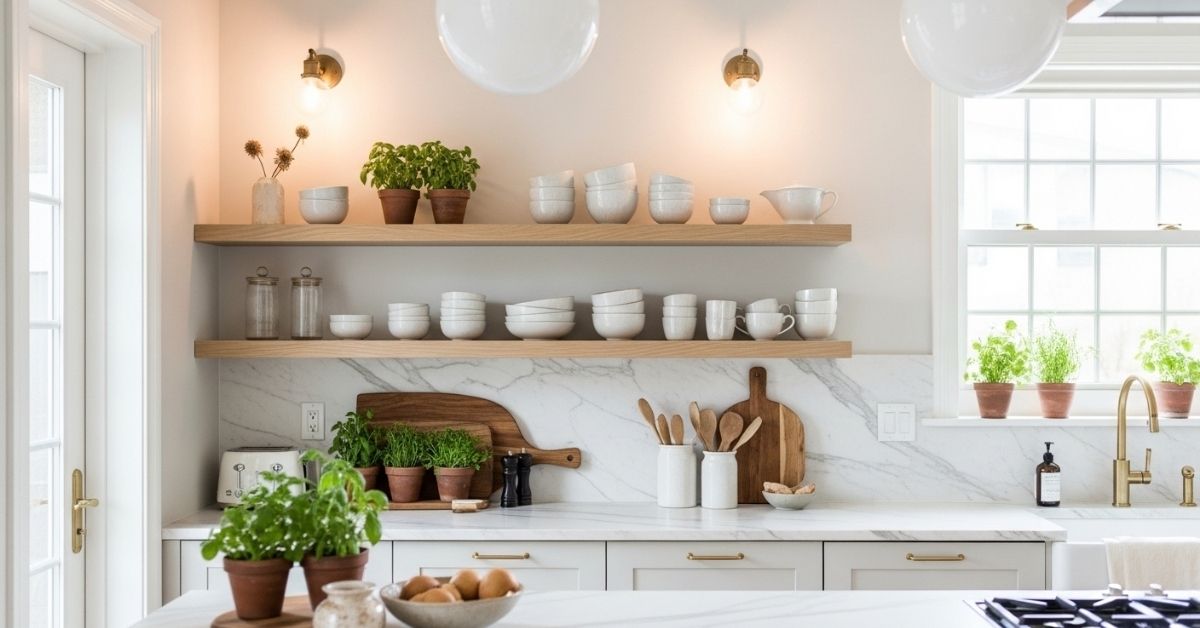
Your kitchen is one of those spaces that quietly shapes how your whole day feels and yet it’s often the last room people think to decorate intentionally. Most kitchens end up somewhere between functional and forgettable: the appliances are there, the cabinets do their job, but nothing really clicks. If that sounds familiar, you’re not alone.
The good news is that kitchen decor doesn’t require a renovation budget or a designer’s eye. In my experience, the most impactful changes usually come from rethinking how a space is layered Kitchen Decor Ideas lighting, materials, open versus closed storage rather than adding more stuff to the counter. This list focuses on ideas that solve real problems: awkward layouts, cluttered surfaces, kitchens that feel cold or choppy or just too small.
If your kitchen needs to work harder whether it’s a compact apartment galley, an open-plan space that blends into the living room, or just a room that feels unfinished there’s something here for you.
Open Shelving on One Wall to Break Up Heavy Cabinetry

Heavy cabinetry on all four walls can make a kitchen feel like a bunker. Swapping out just one section, usually the wall opposite the main counter for open floating shelves, immediately changes the visual weight of the room. Wooden shelves in a warm oak or walnut tone add texture without competing with everything else. The key is restraint on what you display: two to three ceramic items, a small plant, and everyday glasses keep it looking intentional rather than cluttered. This works especially well in galley kitchens where both walls are cabinetry, creating the feeling of a tunnel. It solves the claustrophobia problem without losing storage.
A Statement Backsplash Behind the Stove Only
You don’t need to retile the entire kitchen to get a dramatic backsplash moment. Limiting the decorative tile to the area directly behind the stove, usually a 24–36 inch section creates a focal point without the cost or commitment of a full kitchen overhaul. Zellige tile, handmade terracotta, or even bold geometric cement tile work particularly well here because the stove gives it a logical boundary. The rest of the backsplash can stay in a simple, neutral tile, which actually makes the feature wall read stronger by contrast. For renters, peel-and-stick tile panels have improved significantly in the last few years and work as a convincing stand-in. This idea is best for kitchens where the stove sits on an otherwise blank wall.
Warm Pendant Lighting Over an Island or Peninsula

Overhead fluorescent or recessed lighting alone makes a kitchen feel clinical, especially in the evening. Adding pendant lights over an island or peninsula creates a defined zone visually separating the cooking and dining areas in open-plan homes while also introducing warmth. Go for pendants with an exposed bulb or warm amber shade rather than cool white. The fixtures themselves add a layer of texture: ceramic, rattan, brass, and matte black all bring something different. In terms of placement, the bottom of the pendant should sit roughly 30–36 inches above the counter surface for both visual balance and practical clearance. This setup works in any kitchen with a hanging point, including rentals where you can swap existing light fittings.
A Dedicated Coffee Station Kitchen Decor Ideas Space
Most kitchens have at least one corner or counter stretch that doesn’t really do much. Turning that into a dedicated coffee or tea station does two things at once: it frees up the rest of the counter from appliance sprawl, and it gives that dead zone an actual purpose. A small tray anchors the whole setup and keeps it from looking scattered. Stack mugs on a riser or a simple open shelf above. If the counter is near a window, a small trailing plant or herb pot ties it into the rest of the kitchen’s mood. This is one I’d actually recommend trying first because the investment is minimal; it’s mostly reorganization but the day-to-day payoff is real. Works particularly well in small kitchens where counter real estate is limited.
Matte Black Hardware to Unify Mismatched Cabinets

If your kitchen cabinets aren’t matching well with different wood tones, a mix of painted and stained, or just visually noisy changing the hardware is one of the fastest ways to create cohesion. Matte black is the most forgiving option because it reads as a neutral in almost any palette and doesn’t show fingerprints the way brass or chrome does. The consistency of the hardware pulls the eye across the whole room in a clean rhythm. This takes about an hour with a screwdriver and costs far less than repainting. It’s especially useful in rental kitchens where you can’t change much else and the original hardware can be stored and reinstalled when you leave.
Read More About : 23 Bedroom Decor Ideas That Actually Make Your Space Feel Calm, Cozy, and Put-Together
A Wooden Cutting Board as Permanent Counter Display
This is a simple visual trick that works better than it sounds. A large, good-quality wooden cutting board propped against the backsplash rather than lying flat adds warmth and organic texture to a counter that might otherwise look cold or sterile. It functions as both a decor object and a practical tool you’re already using. The vertical orientation is what makes it work as decor; it fills the blank wall space between the counter and the upper cabinets, which is often an awkward in-between zone. End-grain boards have the best visual texture for this. A small bowl of citrus or a few garlic bulbs beside it keeps the composition grounded and kitchen-specific.
A Herb Garden on the Windowsill Over the Sink

The strip of windowsill above the kitchen sink is one of the most underused surfaces in any home. A small collection of terracotta pots with herbs basil, thyme, and rosemary introduces greenery, natural material, and a practical function all at once. The south- or east-facing exposure most kitchen windows have is good for herbs that need moderate light. It softens what can otherwise be a hard, utilitarian corner of the room without cluttering the counter below. In smaller kitchens where the only window is over the sink, this becomes especially impactful because it draws the eye upward and outward, which creates a subtle sense of more space.
A Neutral Rug Under the Kitchen Island
Most people skip rugs in the kitchen entirely, usually out of practicality concerns. A low-pile, flat-weave rug in a natural fiber jute, cotton, or a synthetic flatweave is actually easy to clean and adds a layer of warmth that hard flooring alone can’t give. Placing it under the island defines the zone, particularly in open-plan layouts where the kitchen bleeds into the dining or living area. A rug acts as a visual anchor that stops the kitchen from feeling like it’s floating in the middle of a larger room. Go for a size where the rug extends at least 12 inches beyond each side of the island to avoid looking like a postage stamp.
Vintage or Ceramic Canisters for a Counter That Doesn’t Look Like a Store

Functional items don’t have to be visual noise. Swapping out plastic containers and brand-labeled packaging for a matching set of ceramic or stoneware canisters immediately brings quiet cohesion to a counter. The key is a consistent color palette of three canisters in the same tone (warm cream, sage, matte black) read as a considered set rather than clutter. Label them simply or not at all. This works especially well in kitchens with a lot of open counter space, where the eye tends to bounce around looking for somewhere to land. It also solves the problem of ugly-but-necessary packaging living on display.
A Gallery Wall on the Narrow Wall Between Windows or Cabinets
Kitchens usually have at least one awkward narrow wall that doesn’t fit a cabinet but sits empty and unresolved. Rather than ignoring it, a small gallery wall with three to five framed prints at the right scale transforms it into something intentional. Botanical prints, recipe illustrations, or simple black-and-white photography work well because they feel appropriate to the kitchen context. In a narrow space, keeping all frames the same finish (all brass, all matte black, all natural wood) maintains order without looking too precious. This is also a good spot for a single large-format print if the wall is slightly wider; a single oversized piece often reads better than multiple small ones in a tight space.
Woven or Rattan Pendant Light for Texture in a Minimalist Kitchen

Minimalist kitchens are clean, but they can also feel a little cold and flat if everything is the same material. A woven rattan or natural fiber pendant introduces a different texture that warms the room without adding color or clutter. The light filtering through the weave creates a soft dappled effect on nearby surfaces, which shifts the mood of the whole space especially noticeable in the evening. Rattan sits comfortably between coastal, Japandi, and Scandi aesthetics, so it works in a range of kitchen styles. It’s best used when the rest of the kitchen is deliberately restrained it reads as a feature because nothing else is competing for attention.
Painting the Kitchen Island an Accent Color
If a full kitchen repaint isn’t practical, the island is the one piece you can treat as a stand-alone canvas. Painting it in a contrasting color deep navy, sage green, warm terracotta while keeping the surrounding cabinetry neutral creates a visual anchor point without overwhelming the room. The island becomes furniture rather than built-in, which actually makes the kitchen feel more layered and considered. This approach is gaining traction in 2026 as more homeowners move away from matchy-matchy all-white kitchens toward spaces with a mix of tones. Matte or eggshell finishes hold up better than gloss in a working kitchen and hide scuffs more forgivingly.
Under-Cabinet Lighting to Eliminate Counter Shadows

Standard overhead lighting casts shadows directly onto the counter where you’re actually working which is both a practical annoyance and a visual problem. Under-cabinet lighting, whether LED strip lights or small puck lights, eliminates that shadow zone and makes the kitchen feel professionally considered. It also adds a warm ambient layer in the evenings when you don’t need full overhead brightness. Plug-in LED strips are an easy renter-friendly solution with no hardwiring, no electrician. Warm white (2700K–3000K) rather than cool white is the right call for kitchens; cool white makes food look less appealing and the space feels more clinical.
A Pull-Out Spice Drawer or Wall-Mounted Spice Rack to Clear the Counter
Spice jars are one of the most persistent sources of kitchen counter clutter, and they tend to spread. Relocating them to a pull-out drawer insert, a wall-mounted magnetic rack on the side of the fridge, or a narrow cabinet shelf beside the stove does more for a kitchen’s visual clarity than most decor additions. The counter reads as calmer, and the spices are actually more accessible when organized and labeled vertically. Magnetic jars on the side of a refrigerator are a great small-kitchen solution because they use otherwise dead vertical space. Matching jars with simple labels also turn storage into something that looks deliberate rather than functional.
Read More About : 24 Renter-Friendly Apartment Bathroom Decor Ideas That Actually Work in Small Spaces
A Statement Clock or Oversized Wall Art Above the Refrigerator

The wall above the refrigerator is almost always underutilized. It’s not a natural gathering point, so it tends to get ignored but it’s actually the largest uninterrupted wall surface in many kitchens. A large round clock, a single big framed print, or a ceramic plate grouping gives the space vertical presence and pulls the eye upward, which makes the room feel taller. Scale is the main thing to get right: one piece at 24–36 inches will work better than three small pieces that look like afterthoughts at that height.
Floating Wooden Shelves in the Dead Space Above the Refrigerator
Rather than leaving the fridge alcove as wasted airspace, floating shelves installed above it create storage and visual continuity with the rest of the kitchen. Baskets, decorative bowls, and infrequently used items work well up here; it’s not the most accessible spot, but it’s useful for occasional pieces. Wooden shelves in a warm finish soften what can otherwise look like a blank white rectangle (the fridge) floating in the middle of the cabinetry. This works particularly well in kitchens with tall ceilings where the gap above a standard fridge is especially noticeable.
A Bowl of Fruit or Vegetables as the Primary Counter Centerpiece

This is the simplest idea on the list and consistently one of the most effective. A wide bowl or shallow basket filled with seasonal fruit lemons, oranges, green apples adds color, texture, and life to a counter in a way that doesn’t require any shopping for decor. The bowl itself becomes the decor object; go for ceramic, wood, or woven rattan over plastic. It’s impermanent (the fruit gets eaten, the bowl gets refilled), which keeps the display from going stale. Honestly, more kitchen counters would look better with less decor and more of this something real, edible, and proportional to the space.
Matching Dish Towels and Oven Mitt for Instant Visual Cohesion
The textiles hanging from your oven handle or sitting by the sink are highly visible in any kitchen photo and in daily life. Matching or coordinating your dish towels and oven mitt doesn’t require much investment, but it removes a surprising amount of visual noise. Linen or cotton in neutral tones (stone, dusty sage, terracotta, or natural white) work with almost every kitchen palette. Hanging one clean towel over the oven handle and keeping another folded beside the sink creates a composed, editorial quality that’s much harder to achieve with mismatched or brand-heavy kitchen textiles.
A Pegboard or Magnetic Knife Strip to Reclaim a Full Drawer

One of the most common kitchen problems is that utensil drawers become a jumble of overlapping tools. Mounting a pegboard section or a magnetic strip on an available wall removes the need for that drawer entirely and puts the tools within easy reach while cooking. A pegboard painted in the wall color disappears visually while still functioning; a raw wood pegboard adds texture. A magnetic knife strip keeps blades more accessible and better maintained than a knife block on the counter. Both solutions use vertical space that’s usually empty between countertop height and upper cabinet height. For small kitchens, this is one of the most practical layout decisions you can make.
A Chalk or Linen Message Board for a Functional, Low-Key Feature
Kitchens are high-traffic rooms where notes, lists, and reminders accumulate on every surface. Giving that function a dedicated spot, a small chalk panel, a linen pinboard, or a framed whiteboard removes the visual scatter of sticky notes while adding something that looks considered. Placed near the entry to the kitchen or beside the refrigerator, it becomes a practical zone that the whole household uses. Linen boards with clips have a warmer, more textural look than glossy whiteboards and sit better in a designed kitchen. It solves the clutter problem without trying to hide the fact that real life happens in this room.
Replacing Plain Cabinet Knobs with Ceramic or Handmade Options

Hardware stores both online and in person now have a huge range of handmade ceramic, stone, and artisan-cast cabinet knobs at accessible prices. Swapping out flat plastic or stamped-metal knobs for something with a handmade quality adds a layer of craft to a kitchen that mass-produced fittings can’t replicate. Ceramic knobs in soft white, sage, or terracotta suit a huge range of kitchen styles; they look at home in both a modern kitchen and a more traditional one. The change takes under an hour and is fully reversible, making it one of the best renter-friendly updates available.
A Counter Herb Pot (Single) as a Living Focal Point
Rather than a full windowsill garden, a single oversized herb pot, a large rosemary plant or a full basil plant in a terracotta or glazed pot sits better as a standalone decor object on a counter. It’s bigger than a standard grocery-store herb pot, which means it reads as intentional decor rather than a leftover plant. The height and fullness of a mature rosemary in a quality pot is surprisingly striking against a neutral kitchen backdrop. This works in kitchens where you want a single natural element without the maintenance or visual busyness of a row of small pots.
A Dark or Richly Colored Paint on the Kitchen Ceiling

This is a trend worth paying attention to in 2026: painting the ceiling a deep, saturated tone in an otherwise neutral kitchen. It sounds counterintuitive won’t it make the room feel smaller? but in practice, a dark ceiling with white walls and cabinets creates a cocooning effect that makes the kitchen feel intimate and considered rather than claustrophobic. It works best in kitchens with good overhead lighting (pendants or recessed lights) and some natural light, because the fixtures become feature elements against a dark ceiling. Deep green, navy, and warm charcoal are the strongest choices.
Decorative Plates or Ceramics on an Open Shelf for Gallery-Style Storage
Kitchenware doesn’t have to live entirely behind cabinet doors. Displaying a curated selection of ceramics on one open shelf mixing plates, bowls, and mugs with different shapes but a consistent color palette creates a gallery-style moment that also functions as everyday storage. The key is to avoid overcrowding: leave breathing room between pieces so each one reads individually. White and cream ceramics with irregular edges and hand-finished glazes have the most visual interest at a distance. This is also one of the best ways to display ceramics you actually love and use, rather than keeping them hidden and pulling out “the nice ones” only for company.
A Narrow Kitchen Cart for Extra Storage and Surface Space

In kitchens where counter space is the primary constraint, a narrow rolling cart does a huge amount of work. It adds a secondary prep surface, extra storage below, and when chosen carefully doubles as a piece of furniture that looks like it belongs rather than an appliance. A wooden cart with an open lower shelf and a butcher block top warms up a kitchen in a way that a metal utility cart doesn’t. Rolling it under the counter when not in use keeps floor space clear. This is especially useful in studio apartments or galley kitchens where every square foot of horizontal surface matters.
Cloth-Front or Roman Shade in the Kitchen Window Instead of Venetian Blinds
Most kitchen windows end up with the same practical but uninspiring venetian blinds and they read as a placeholder rather than a considered choice. A Roman shade or roller blind in a natural linen, cotton stripe, or textured white fabric adds softness that hard blinds don’t have. Light filters through natural fibers differently; it scatters rather than slices which feels warmer and more diffuse. It’s also easier to clean than venetian blinds in a cooking environment (one fabric panel versus dozens of individual slats). A neutral linen shade is a low-commitment upgrade that changes the character of the room without demanding attention.
A Consistent Countertop Clear Zone to Let the Decor Land

This last one isn’t about adding something, it’s about protecting space. The most common reason kitchen decor ideas fall flat in real homes is that there’s no clear surface to let them breathe. Every good kitchen decor setup benefits from a dedicated clear zone: a stretch of counter (even 18–24 inches) that stays free of appliances, mail, and miscellaneous objects. This is the canvas that makes the pendant lights, the open shelves, and the ceramic canisters actually register as choices rather than noise. If your kitchen feels busy despite having “decor,” the fix is usually subtractive rather than additive. In my experience, this single discipline changes how a kitchen reads more than almost anything else.
What Actually Makes Kitchen Decor Ideas Work
Before narrowing down which ideas to try, it helps to understand what’s actually driving the visual problems in your kitchen. Most kitchen decor challenges fall into a few categories: too much visual noise at counter level, too little light in the working zone, a lack of material warmth (too much tile, stainless steel, or laminate), or a layout that feels disconnected especially in open-plan homes where the kitchen floats without clear edges.
The ideas that solve these problems most reliably are the ones that address multiple issues at once. Open shelving, for example, solves visual weight and adds material warmth and creates a display opportunity. Under-cabinet lighting solves functional shadows and adds ambient warmth in the evenings. A consistent hardware finish solves visual noise and creates cohesion across mismatched cabinets.
Start by identifying your kitchen’s main issue: clutter, coldness, disconnection, or just an unfinished quality and then look for one or two ideas that address it directly. Layering too many changes at once makes it difficult to understand what’s actually working. The kitchens that look best usually have a clear anchor (a statement backsplash, a well-lit island, a curated open shelf) and clean, restrained everything else.
Kitchen Decor Ideas: Quick-Reference Guide
| Idea | Best Space Type | Main Problem It Solves | Renter-Friendly? | Difficulty |
| Open shelving | Galley, small kitchens | Heavy cabinet feel | Partially | Medium |
| Statement backsplash (partial) | All types | Blank walls, no focal point | Yes (peel-and-stick) | Low–Medium |
| Pendant lighting | Island or peninsula kitchens | Flat lighting, no zones | Yes (swap fixtures) | Medium |
| Coffee station | Small kitchens | Appliance sprawl | Yes | Low |
| Matte black hardware | All types | Visual noise, mismatched cabinets | Yes | Low |
| Under-cabinet lighting | All types | Counter shadows, cold feel | Yes (plug-in strips) | Low |
| Herb windowsill | Kitchens with sink window | Empty surfaces, lack of life | Yes | Low |
| Pegboard or knife strip | Small kitchens | Cluttered drawers, no wall use | Partially | Low–Medium |
| Island accent color | Kitchens with island | Monotone, unfinished feel | No (paint) | Medium |
| Neutral kitchen rug | Open-plan kitchens | Undefined zones, hard flooring | Yes | Low |
Common Kitchen Decor Mistakes That Make the Space Feel Cluttered or Cold
Decorating around the clutter instead of removing it first.
This is the single most common pattern. New pendant lights and a fresh herb pot won’t read well if the counter has three appliances, random mail, and an overflowing dish rack competing for space. The decor needs a cleared surface to land on.
Mixing too many metal finishes.
Brushed nickel faucet, gold cabinet handles, chrome appliances, and black pendant lights in the same kitchen create visual tension that’s hard to resolve. Keeping to one or two metal finishes or deliberately unifying them with a consistent hardware update is almost always worth the effort.
Under-scaling light fixtures.
A pendant light that’s too small for the island looks like it was chosen from the wrong room. As a general rule, the diameter of the pendant should be at least one-third the width of the island below it. Two smaller pendants hung in a pair are often a better solution than one pendant that’s not quite big enough.
Treating open shelves like cabinets.
Open shelving fails visually when it’s packed the same way a cabinet would be dense, functional, and overloaded. If you’re going with open shelves, plan for at least 30–40% open space on each shelf. The negative space is part of the composition.
Ignoring the cabinet interiors when painting.
If you repaint your cabinets or island but leave the original color visible when doors are open, the effect reads as unfinished. A quick coat of a coordinating interior color (even just white) ties the whole thing together.
FAQ’s
What is the easiest kitchen decor upgrade that makes the most visual difference?
Hardware replacement swapping cabinet knobs and pulls for a consistent finish is one of the highest-impact, lowest-effort changes in any kitchen. It takes under an hour, costs relatively little, and immediately creates visual cohesion, especially in kitchens with mismatched or dated existing hardware. Choose matte black, brushed brass, or matte white depending on your existing color palette.
How do I decorate a small kitchen without making it feel more cluttered?
Focus on vertical space and single focal points rather than spreading decor across the counter. One open shelf, one pendant light, and one area of organized storage (a pegboard, magnetic knife strip, or matching canister set) reads far cleaner than multiple small decorative items on the counter. Less is genuinely more in a compact kitchen.
Should kitchen decor match the rest of the home’s style?
Not perfectly but there should be some material or color continuity. If the rest of your home uses warm wood tones and linen textures, carrying those into the kitchen (wooden shelves, linen blinds, ceramic accessories) creates a sense that the kitchen belongs to the same space. A kitchen that feels like a completely different aesthetic is a common reason open-plan homes feel disjointed.
What kitchen decor works best in a rental where I can’t make permanent changes?
Plug-in under-cabinet lighting, peel-and-stick backsplash tiles, a kitchen cart, matching textiles, hardware swaps (store the originals), open shelving with removable brackets, and counter organization all work without drilling or painting. These can transform a rental kitchen significantly without any alterations to the space itself.
Open shelves vs. upper cabinets: which is better for a small kitchen?
It depends on what the primary issue is. If the kitchen feels closed-in or visually heavy, replacing one section of upper cabinets with open shelves creates breathing room. If storage is the main constraint, keep the cabinets and add a rolling cart or pegboard for supplementary storage. The hybrid approach of one wall of cabinets, one wall of open shelves tends to work best in small kitchens.
How do I choose a kitchen rug that’s practical enough for everyday use?
Low-pile flatweave rugs in cotton, jute, or synthetic material are the most kitchen-appropriate. They lie flat (reducing trip hazards), are easier to sweep or shake out, and tolerate spills better than high-pile options. Avoid wool rugs directly under a cooking area. A washable cotton flatweave is the most practical choice and now comes in a good range of textures and patterns.
Is it worth repainting kitchen cabinets as a DIY project?
For upper cabinets and the island, yes with the right preparation. The key is proper sanding, a quality primer, and a hard-wearing cabinet-specific paint or enamel. Rushing the prep is where most DIY cabinet paint jobs fail. Lower cabinets take more wear and are worth approaching more carefully, or leaving to a professional if budget allows. The result, done well, is one of the highest-ROI kitchen changes available.
Conclusion
A kitchen that functions well and feels considered doesn’t require a gut renovation; it requires a clear eye for what’s working, what isn’t, and what’s getting in the way. Most of the ideas in this list cost less than a dinner out, take an afternoon at most, and address real-world constraints like rental restrictions, limited counter space, and layouts that weren’t designed with decor in mind. Small, intentional changes, a consistent hardware finish, under-cabinet lighting, a cleared counter stretch accumulate into a kitchen that reads as pulled together without trying too hard.
Start with one or two ideas that match your biggest frustration. If the kitchen feels dark, go straight to lighting. If it feels cluttered, start with the counter clear zone and spice organization before adding anything new. Not every idea will fit every kitchen, but the right one for your space will be obvious once you know what problem you’re actually trying to solve.
