

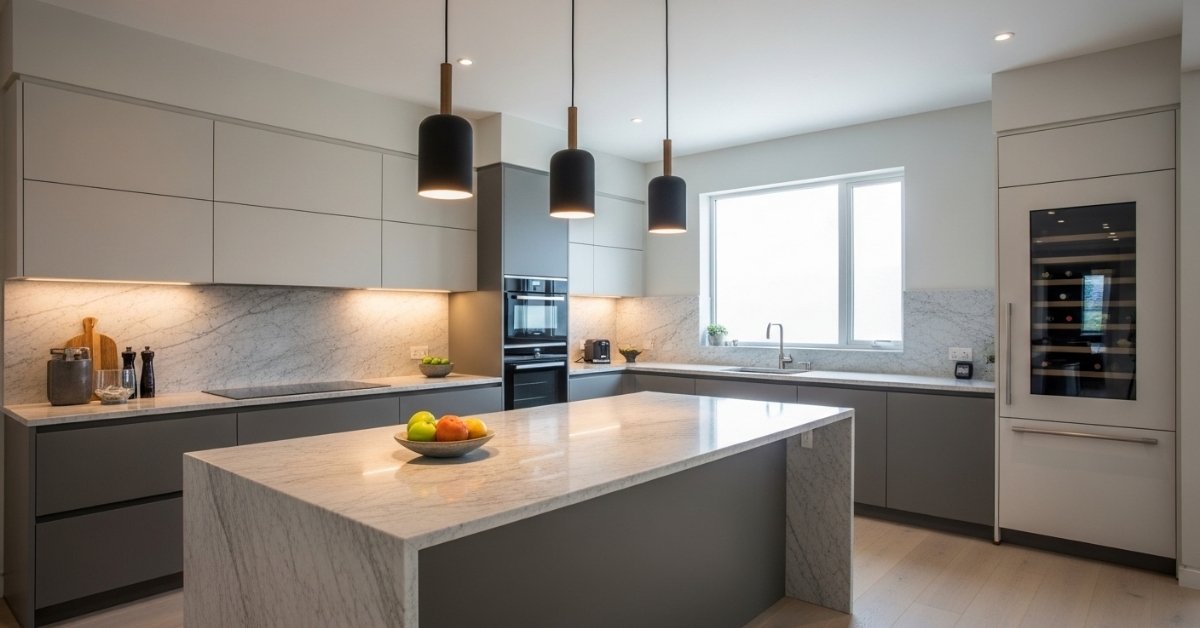
Modern kitchens in 2026 are being designed around light just as much as layout. And if your kitchen feels dim, flat, or just visually off despite decent furniture and finishes, lighting is almost always the reason. The right setup doesn’t just brighten the room, it defines zones, adds depth, Kitchen Lighting Ideas Modern and makes the space feel intentional rather than accidental.
If you’re working with a standard rental kitchen, a galley layout, or a combined kitchen-dining space, this list is built for exactly that. These aren’t showroom setups that require a full renovation. Most of these ideas work with plug-in fixtures, smart bulbs, or simple under-cabinet strips with no rewiring needed.
The goal here is layered, functional light: ambient for the room, task lighting where you actually cook, and accent lighting that pulls the whole thing together. Get that balance right, and even a builder-grade kitchen starts to feel considered.
Warm-White LED Strip Lights Under Upper Cabinets

Under-cabinet lighting is the single most underused upgrade in kitchen lighting. A strip of warm-white LEDs (around 2700K–3000K) mounted flush to the underside of your upper cabinets throws direct light onto your prep surface without casting shadows from above. The warmth also prevents that cold, clinical feel that bright overhead lighting tends to create. This works best in kitchens where the primary ceiling light is centered and doesn’t reach the counter edges which is most kitchens, honestly. If you’re always squinting while chopping, this is the fix.
A Statement Pendant Over the Kitchen Island
A single overhead ceiling light can’t do everything in a kitchen with an island; it creates a flat, even wash that doesn’t differentiate cooking zones from gathering zones. Two or three pendants hung low over the island (roughly 30–36 inches above the surface) draw the eye down, create a natural focal point, and give the island its own visual weight. Matte black, brushed brass, and smoked glass are dominating kitchens in 2026 for good reason; they contrast cleanly against light cabinetry and don’t compete with the rest of the room. Go for this if your island doubles as a dining or work surface; the lower light makes both activities more comfortable.
Recessed Lighting in a Grid Layout for Even Coverage

Recessed lights get a bad reputation for being boring, but placement is everything. A poorly spaced grid creates dark pockets near the counters and harsh brightness in the center. When spaced properly roughly 4 feet apart and offset from the cabinet line recessed lights deliver clean, even ambient light that works as a neutral base for every other fixture. In my experience, this setup works best when paired with at least one other light layer (pendants, under-cabinet strips) rather than used alone. It’s the foundation, not the whole system.
A Flush-Mount Semi-Flush Fixture for Low Ceilings
Standard pendant lights can overwhelm a kitchen with low ceilings or create a visual choke point in narrow galley layouts. A well-designed semi-flush fixture sits 4–8 inches below the ceiling, gives you diffused light across the room, and doesn’t interrupt sightlines or movement. Look for ones with frosted glass or linen shades; they soften the light output significantly compared to open-bulb designs. This is a particularly useful solution for renters who can swap out the standard builder fixture without major modifications.
Puck Lights Inside Glass-Front Cabinets

Cabinet interior lighting is as much about spatial perception as it is about aesthetics. When the inside of a glass-front cabinet is lit, it creates depth the eye travels through the cabinet rather than stopping at the door. It also makes the kitchen feel wider because lit zones in the periphery visually expand a room’s perceived edges. Battery-powered or rechargeable LED puck lights make this completely renter-friendly. Best suited for kitchens that feel boxy or narrow, or anywhere you want to break up a solid wall of cabinetry.
Read More About : 27 Home Coffee Bar Setup Ideas That Actually Work in Real Spaces
Dimmer Switches for Existing Overhead Lights
Most people never think of this as a lighting upgrade, but it functionally is. Replacing a standard switch with a compatible dimmer (many work with existing LED bulbs, no rewiring required) gives you control over light intensity throughout the day. Full brightness for morning prep, mid-level for cooking, low for when the kitchen transitions into a social or dining space. This is one I’d actually recommend trying first because the cost is under $20 and the difference in atmosphere is immediate and significant. Check bulb compatibility before buying; not all LEDs are dimmable.
Pendant Lights Over a Kitchen Sink Window

The sink area is one of the most actively used spots in a kitchen and one of the most poorly lit in standard layouts. A single pendant or a pair hung 28–32 inches above the sink basin gives you direct task light without the overhead glare that makes dishwashing or food prep uncomfortable. During the day, this setup creates a nice interplay between natural window light and warm artificial light. At night, it anchors the sink visually so the kitchen doesn’t feel like it has a dark corner. Works especially well in kitchens with a window above the sink; the pendant frames the window rather than competing with it.
Linear Suspension Lights Over a Kitchen Table or Breakfast Bar
A single bulb pendant rarely covers a long rectangular dining surface evenly; one end stays dim. A linear suspension fixture (essentially a bar-shaped pendant) solves this without requiring multiple junction boxes. They’re available in plug-in versions that hook to a ceiling canopy, making them surprisingly accessible for renters. The long horizontal form also visually balances a room where vertical elements (tall cabinets, high ceilings) dominate. This layout works best in open-plan kitchens where the dining space flows directly from the cooking area.
Toe-Kick Lighting for Subtle Ambient Glow at Floor Level

Toe-kick lighting LED strips fitted along the base of lower cabinets does something no overhead light can: it introduces light at floor level, which grounds the room and creates a sense of floating cabinetry. During the day it’s barely noticeable; at night it works as low-level ambient light that keeps the kitchen functional without harsh overhead brightness. It’s also genuinely useful for middle-of-the-night kitchen visits without switching on full lighting. Adhesive LED strips in this zone are low-cost and require no professional installation in most cases.
Track Lighting on a Single Ceiling Rail for Flexible Direction
Track lighting offers directional control that fixed recessed lights don’t. A single rail with 3–5 adjustable heads can cover your prep area, your island, and your open shelving simultaneously and you can redirect them if your layout changes. This is particularly useful in rental kitchens where you can’t add new ceiling boxes but you can replace the existing central fixture with a track system. The industrial aesthetic also works well in modern and transitional kitchens. Just avoiding overloading the rail spacing heads evenly and directing them at specific work zones prevents the scattered look that makes track lighting feel chaotic.
Warm Globe Bulbs in Open Shelving Fixtures

Open shelving is a layout choice that depends heavily on how well it’s lit. Harsh or cool-toned light makes shelved items look flat and the shelving itself feel cluttered. A warm globe bulb (amber or soft white, around 2200K–2700K) in a simple wall sconce mounted near open shelving creates a warm halo effect that makes even basic kitchenware feel intentional. This works especially well in kitchens that lean toward organic, Japandi, or warm minimalist aesthetics where the goal is a “calm and considered” feel rather than bright and clinical.
Smart Bulbs Paired with a Voice or App Control System
The appeal of smart bulbs in kitchens isn’t novelty, it’s precision. Being able to shift from a cool 4000K prep light to a warm 2700K ambient light without replacing any fixture is genuinely useful in a room that serves multiple functions throughout the day. Most smart bulb ecosystems (Philips Hue, LIFX, Govee) are compatible with standard screw-base fittings, making this an easy upgrade. For kitchens that also function as a casual dining or social area, this flexibility is especially useful if you’re not locked into one lighting mode for a space that changes purpose every few hours.
Cove Lighting Along the Ceiling Perimeter

Cove lighting refers to LED strips concealed in a recess or ledge along the ceiling perimeter, so the light source is hidden and only the glow is visible. The effect is a soft, even wash of light that covers the ceiling and upper walls without any glare or harshness. It’s particularly effective in kitchens with dark cabinetry or limited natural light; the indirect light opens up the room without the clinical brightness of standard overhead fixtures. This does typically require some carpentry to build the cove, but in kitchens with existing crown molding, it can be integrated more easily than you’d expect.
Rattan or Woven Pendant Shades for Textural Warmth
The shade material of a pendant light affects the quality and warmth of light output more than most people realize. Rattan, wicker, and woven fiber shades filter light as it passes through, creating a dappled, warm pattern on surrounding surfaces. The texture also introduces a natural, organic element that balances the hard surfaces (tile, stone, metal) typical of modern kitchens. This style works best in kitchens with warm neutral color palettes beige, cream, warm white and doesn’t suit very cool or ultra-modern finishes particularly well. The trade-off: they diffuse rather than direct light, so pair them with under-cabinet lighting for task coverage.
Read More About : 21 Minimalist Kitchen Setup Ideas That Actually Work in Real Homes
Bar-Style Sconces on Either Side of a Range Hood

Flanking a range hood with wall sconces is a layout approach borrowed from bathroom mirror lighting and it works for the same reason. Sconces mounted symmetrically on either side of a hood provide balanced, shadow-free light across the cooking zone. It also creates a sense of intentional design around the range area, which is typically the kitchen’s visual focal point. Most wall sconces can be hardwired to an existing kitchen circuit or installed as plug-in models where cord management allows. Best suited for kitchens where the range sits against a wall, not on an island.
A Cluster of Micro-Pendants for Visual Layering
A cluster of small pendant lights hung at slightly varying heights creates visual rhythm without the weight of a large statement fixture. This works particularly well over compact islands or peninsula bars where a full-size pendant would feel oversized. The staggered heights add depth; the eye moves up and down slightly, which makes the kitchen feel more dynamic. Keep the finish consistent across all fixtures in the cluster (all black, all brass, all chrome) or it reads as random rather than intentional. IMO, this is one of the most underrated setups for small kitchens with high ceilings.
Color-Temperature Tunable LEDs for Day-to-Night Shift

Standard fixed-color LEDs force you to choose one light temperature for all hours and activities which means you’re either cooking under uncomfortably warm light or eating dinner under a bright white that feels clinical. Tunable white LEDs (also called dual-white or CCT-adjustable LEDs) let you shift across the warm-to-cool spectrum within the same fixture. For kitchens that serve as the household hub from breakfast through dinner, this flexibility matters. I’ve noticed this style tends to make the biggest difference in open-plan kitchen-living spaces where the lighting needs to work for both active cooking and relaxed evenings.
Backlit Open Shelving Using LED Strips Behind a Diffuser Panel
Standard open shelving with a light strip taped to the back wall often creates a harsh, uneven band of light. Using a frosted acrylic diffuser panel between the LED strip and the shelf interior evens out the light output, removing hot spots and creating a clean, even glow across the whole shelf. The result looks significantly more considered than exposed strips. This is a DIY-friendly build using channel-mounted LED strips and cut-to-size acrylic from most hardware stores. Particularly effective in display-oriented kitchens where the shelving is as much about aesthetics as storage.
A Lantern-Style Pendant for an Organic Modern Feel

The lantern pendant is having a significant moment in 2026 kitchen design not the traditional black iron farmhouse version, but updated forms in aged brass, smoked glass, or handblown organic shapes. What makes it work in modern kitchens is the contrast: a fixture with historical references set against clean-lined cabinetry and simple hardware creates visual tension that makes a kitchen feel less generic. The exposed bulb inside a lantern also gives you some control over light quality; a warm Edison or globe bulb reads completely differently than a standard LED. Best suited for kitchens with mixed material palettes (wood, stone, metal) where the lantern can bridge warm and cool finishes.
Magnetic Track Lighting Systems for Modular Flexibility
Magnetic low-voltage track lighting is one of the more significant developments in residential kitchen lighting over the last two years. Unlike traditional track systems, magnetic rails allow you to attach and reposition different fixture types spotlights, pendants, flood lights anywhere along the rail without tools. You can reconfigure the whole setup if your layout changes or if you move. It’s an especially practical investment for renters who want a high-design solution they can take with them. The systems are more expensive upfront than traditional track lighting, but the flexibility and clean aesthetic justify the cost if you’re planning to stay in a space for more than a year or two.
Layered Lighting Zones Using Three Distinct Sources

The most functional kitchen lighting setups don’t rely on one fixture to do everything; they layer three distinct sources: ambient (overhead), task (under-cabinet or pendant), and accent (toe-kick, cabinet interior, or shelving). Each layer serves a specific purpose: ambient covers the room for general movement and cooking; task light targets prep and cooking surfaces directly; accent light adds depth and makes the space feel finished. You don’t need to install all three at once. Start with whatever your kitchen is currently missing most usually task lighting and build from there. This is the framework behind every kitchen that feels good to be in, even if you can’t immediately explain why.
What Actually Makes Kitchen Lighting Work
The most common mistake in kitchen lighting isn’t choosing the wrong fixture, it’s relying on a single source to do everything. A kitchen is a multi-functional space: it’s a cooking workspace, a social area, sometimes a home office, and always a high-traffic zone. One centered ceiling light simply can’t serve all of those modes well.
The second issue is color temperature. Most kitchens default to cool white (4000K+) because it feels “clean,” but cool light makes warm materials wood, stone, and warm-painted cabinetry look flat and slightly grey. A 2700K–3000K range works better for most kitchen palettes and shifts the space from functional to comfortable without sacrificing clarity.
Scale matters more than people expect. A pendant that works beautifully in a showroom with 12-foot ceilings can feel oppressive in an 8-foot ceiling kitchen. The general rule: hang pendants so the bottom of the fixture sits 30–36 inches above the surface it’s lighting. For ceiling fixtures, aim for at least 7 feet of clearance from floor to fixture bottom.
Finally, light direction affects perception of space. Downward-facing fixtures draw the eye down and make rooms feel smaller. Lights that bounce off ceilings (upward-facing cove lights, semi-flush fixtures with upward components) make a room feel taller. For small kitchens, mixing directions, some light going up, some going down, tends to create a more balanced, open feel than all-directional overhead lighting.
Kitchen Lighting Ideas: Setup Comparison Guide
| Setup | Best For | Space Type | Problem Solved | Difficulty |
| Under-cabinet LED strips | Task lighting, prep work | All kitchens | Shadowed countertops | Very easy |
| Island pendants | Visual focus, task + ambiance | Kitchens with islands | Flat, undifferentiated light | Easy–moderate |
| Recessed grid | Even ambient coverage | Medium–large kitchens | Dark corners | Moderate (may need electrician) |
| Track lighting | Flexible directional light | Rentals, oddly laid-out kitchens | Fixed overhead position | Easy–moderate |
| Toe-kick lighting | Night-mode ambiance | All kitchens | Harsh overhead-only setup | Easy |
| Cove lighting | Indirect glow, high-end feel | Kitchens with crown molding or high ceilings | Glare, clinical feel | Moderate–difficult |
| Smart bulbs | Multi-mode flexibility | Any kitchen | Single fixed light setting | Very easy |
| Magnetic track system | Modular, renter-friendly | Apartments, rentals | Fixed layout constraints | Easy |
Common Kitchen Lighting Mistakes That Make the Space Feel Smaller or Dimmer
Using only one centered overhead light.
This is probably the most widespread issue in standard kitchens. A single flush-mount ceiling light creates one bright spot directly below it and leaves everything else counters, corners, and under cabinets noticeably darker. The contrast between that central brightness and the peripheral shadow makes the room feel smaller, not larger.
Choosing the wrong color temperature.
Cool white (5000K+) is often marketed as “daylight” and feels appropriately bright, but in kitchens with wood, stone, or warm-painted surfaces, it creates a visual disconnect. The room looks lit, but it doesn’t feel right. Matching your light temperature to your material palette (warm materials → warm light, cool finishes → neutral or cool light) creates coherence.
Hanging pendants too high.
A pendant hung too close to the ceiling loses its function as a task light and becomes a visual element without a practical purpose. The 30–36 inch rule above work surfaces exists for a reason: it puts the light close enough to the task to be genuinely useful.
Ignoring the corners.
Kitchens have a lot of vertical surfaces, upper cabinets, range hoods, tall pantry units and ceiling-only lighting rarely reaches the corners well. This is where wall sconces, cabinet interior lights, or open shelving lighting becomes structurally useful rather than decorative.
Buying fixtures for looks without checking lumens.
A beautiful pendant with a tiny socket and a 40W-equivalent bulb might look perfect and light almost nothing. Check lumen output, not just wattage. For kitchen task areas, aim for at least 300–500 lumens per fixture; for ambient, 1,500–3,000 lumens across the room depending on size.
FAQ’s
What is layered lighting in a kitchen and why does it matter?
Layered lighting means using three types of light sources together: ambient (general overhead light), task (directed at work surfaces), and accent (highlighting shelving, architecture, or zones). It matters because no single fixture can serve all of these functions well; layering gives you flexibility and makes the kitchen feel more considered and functional.
How many pendant lights should I hang over a kitchen island?
The general guideline is one pendant per 2 feet of island length for smaller fixtures, or two pendants for islands between 4–6 feet long. Spacing matters more than quantity; evenly spaced pendants hung at the same height look intentional; uneven spacing looks accidental.
What color temperature is best for kitchen lighting?
For most kitchens, 2700K–3000K (warm white) works best. It’s bright enough for cooking but doesn’t produce the harsh clinical feel of cool white. If your kitchen has very white or grey finishes, you can go up to 3500K without it feeling too cold.
Can I improve kitchen lighting without rewiring anything?
Yes. Under-cabinet LED strips, plug-in pendant lights with cord covers, smart bulbs in existing sockets, battery-powered puck lights inside cabinets, and toe-kick LED strips are all no-rewire options that meaningfully improve light quality and layering.
Which kitchen lighting setup works best in a small kitchen?
In small kitchens, prioritize under-cabinet task lighting first (solves the shadow problem on counters), then add a semi-flush ceiling fixture for even ambient coverage. Avoid large pendants that crowd the visual space. Toe-kick lighting or cabinet interior lights add depth without taking up space.
Is track lighting a good option for rental kitchens?
Yes, especially magnetic low-voltage track systems, which are modular and can be taken with you when you move. Standard track lighting that replaces an existing ceiling fixture is also a practical rental option, as it uses the same electrical box and can be swapped back when you leave.
How do I make a dark kitchen feel brighter without adding overhead fixtures?
Focus on reflective surfaces and layered light. Under-cabinet strips bounce light off the countertop and backsplash. Light-colored backsplash tiles (especially gloss or subway tiles) reflect existing light effectively. Lit glass-front cabinets and open shelving lighting add peripheral brightness. Together, these can significantly improve perceived brightness without touching the ceiling.
Conclusion
Kitchen lighting is one of those things that’s almost invisible when done well; the space just feels right, functional, and comfortable. But when it’s wrong, it’s the first thing that makes a kitchen feel off, even when everything else is in order. The ideas in this list work across different budgets, layouts, and skill levels, so there’s no need to overhaul everything at once.
Start with whatever your kitchen is missing most. If prep work is uncomfortable, begin with under-cabinet lighting. If the room feels flat, add a pendant or a dimmer. If it feels cold, shift your bulbs warmer. Build the layers gradually and you’ll end up with a kitchen that actually works the way you use it.
