

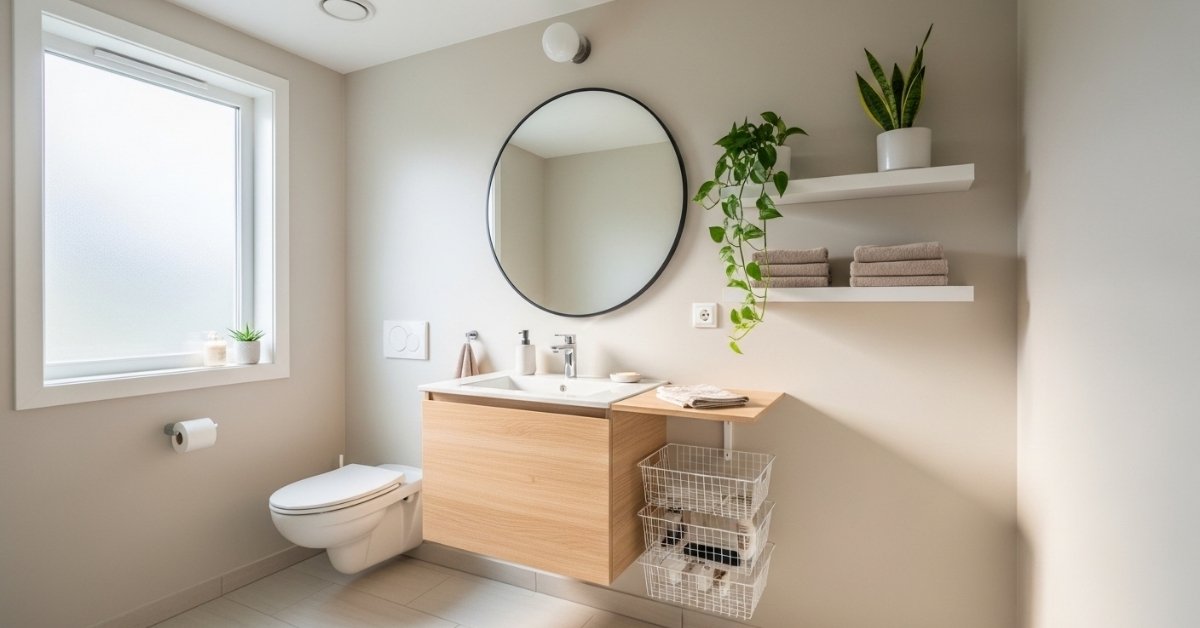
Small bathrooms have a way of exposing every design decision: the wrong mirror, one too many products on the counter, a shower curtain that cuts the room in half visually. If your bathroom feels more cramped than calm, it’s usually not about square footage. It’s about how space is being used.
For studio apartments, older homes, or any rental where the bathroom was clearly an afterthought, the goal isn’t to fake more space, it’s to make the space you have feel intentional and functional. That shift alone changes how the room reads.
If your style leans minimal, cozy, or somewhere in between, these 27 small bathroom decor ideas cover everything from layout logic to lighting to storage with real setups that work in actual homes, not just staged ones.
Mount a Frameless Mirror Wider Than Your Vanity

Most people default to a mirror that matches the vanity width exactly and that’s precisely what makes small bathrooms feel boxed in. A frameless mirror that extends a few inches past each side of the sink creates a horizontal pull that visually stretches the wall. Pair it with side-mounted sconces rather than overhead lighting, and you eliminate the harsh shadows that make tight spaces feel even more closed off. This works especially well in bathrooms with low ceilings, where vertical space is limited and you need width to create balance. The frameless edge keeps it from feeling heavy.
Use a Floating Vanity to Open Up Floor Space

The floor is the most underused visual asset in a small bathroom. A floating vanity mounted directly to the wall with no base cabinet touching the ground exposes that floor line and immediately makes the room feel less cluttered. Even just a few inches of visible floor beneath the vanity changes the spatial perception significantly. It also makes cleaning easier, which matters in a small bathroom where dust and moisture collect fast. Go for a light wood tone or matte white finish to keep it from reading as bulky.
Add a Slim Ladder Shelf Next to the Toilet

The wall beside or above the toilet is almost always wasted. A slim ladder shelf leaning or wall-mounted turns that dead zone into functional storage without requiring any drilling if you use the leaning version (ideal for renters). Use it for rolled towels on the lower rungs and a small plant or candle on top. The vertical orientation draws the eye upward, which helps in rooms where the ceiling feels low. I’ve noticed this setup tends to make a bathroom feel more considered without adding visual weight the open rungs let the wall breathe through.
Swap a Shower Curtain for a Clear Glass Panel
A fabric shower curtain is functional, but in a small bathroom it acts like a visual wall that stops the eye and compresses the space. A clear glass panel or frameless glass shower screen lets your eye travel through the entire room without interruption. If you have decent tile work in the shower, it also gets to be part of the decor rather than hidden. This works best in bathrooms where the shower or tub takes up a significant portion of the room. It’s not a budget option, but if you’re doing one upgrade, this one has the most spatial impact.
Choose a Pedestal Sink in Tight Layouts

Counter space feels sacred in a small bathroom, but sometimes the vanity itself is the problem: too wide, too deep, eating into the walking space. A pedestal sink uses a fraction of the footprint and keeps the floor completely open on all sides. You lose under-sink storage, so pair it with a wall-mounted cabinet or a slim ladder shelf to compensate. This setup works best in powder rooms or bathrooms where storage isn’t the primary concern. The silhouette is also genuinely nice clean lines, a bit classic, and it photographs well for a reason.
Install Recessed Shelving Between Wall Studs
Standard shelving projects into the room and takes up floor or counter space. Recessed shelving cut between wall studs sits flush with the wall surface and gives you 3–4 inches of depth without sacrificing a single inch of walking space. In a shower niche this is standard, but it works just as well on the wall beside the vanity or above the toilet. It’s a more involved project, but for anyone doing a partial renovation, it’s one of the highest-value additions for small bathrooms. The result looks intentional and keeps products organized without a cluttered counter.
Read More About : 27 Farmhouse Kitchen Decor Ideas That Actually Work in Real Homes
Use Vertical Tile Patterns to Add Height

Horizontal tile patterns ground a space vertical ones to lift it. If you’re retiling or working with peel-and-stick tile options, running rectangular tiles vertically (stack bond rather than traditional horizontal offset) draws the eye upward and makes ceilings feel higher than they are. This is especially useful in older apartments where ceiling heights are standard or below. The grout color matters too; a close match to the tile reads as seamless and airy, while a contrasting grout emphasizes the pattern more visually. Go seamless if height is the goal.
Layer Lighting Instead of Relying on One Overhead Fixture
A single overhead light in a small bathroom creates flat, unflattering light that also flattens the room. Layered lighting, a ceiling fixture for general light, sconces for task lighting at the mirror, and something ambient like a battery candle or a plug-in accent light creates depth and warmth without requiring a full electrical renovation. Sconces on either side of the mirror are the most practical addition because they eliminate face shadows while also making the mirror area feel more finished. In my experience, this works best when the overhead light is dimmer-compatible so you can dial it back in the evenings.
Hang Towels on a Wall-Mounted Bar, Not a Ring

Towel rings are fine functionally, but a towel bar mounted horizontally and slightly lower than you’d expect keeps towels flat, reduces that crumpled look, and gives the wall a more intentional feel. In a small bathroom, a neat wall is a calmer wall. If your bathroom doesn’t have wall space near the shower, consider a door-mounted hook bar instead. A longer bar also lets you hang two towels side by side, which is useful in shared bathrooms. The spacing and height matter aim for 48 inches from the floor for standard towel clearance.
Add a Small Potted Plant on the Tank or Sill
Bathrooms rarely have much greenery, and that absence is part of why they can feel sterile rather than calm. One or two small plants, a pothos, a snake plant, or a peace lily add life and color without adding clutter. The toilet tank is a surprisingly effective display spot for a small pot, and a windowsill works even better if there’s natural light. Go for plants that tolerate humidity and lower light. This is a low-cost, high-impact move that genuinely changes the mood of the room more than most decor swaps.
Try a Wall-Mounted Faucet to Free Up Counter Space

A wall-mounted faucet shifts the hardware off the sink deck entirely, which frees up counter space and makes the vanity surface look much cleaner. It works best with a vessel sink or a more minimalist vanity design. There’s a practical benefit too: without a faucet hole in the countertop, the surface is easier to clean and less prone to water pooling around the base. This is more of a renovation-level change, but it’s one of those decisions that looks intentional in a way that’s hard to achieve with accessories alone.
Use a Tray to Group Counter Items
Scattered products on a counter read as a mess. The same products arranged on a tray read as a styled vignette. A small tray marble, wood, or ceramic corrals everything in one zone and gives the counter a defined, edited look. This works in any size bathroom but is especially effective in small ones where every surface is visible. The key is editing down what goes on the tray three to four items maximum. Anything that doesn’t belong on the tray goes into a drawer or cabinet. Honestly, this is one of the easiest changes with one of the most immediate visual payoffs.
Paint the Ceiling the Same Color as the Walls

In small rooms, the line where the wall color ends and the white ceiling begins creates a visual box that caps the room and makes it feel exactly as small as it is. Painting the ceiling the same color as the walls removes that line and creates a more enveloping, continuous feel. It’s counterintuitive, but it actually makes the room feel larger because the eye doesn’t stop at the ceiling boundary. This works best with softer, lighter tones sage, warm beige, dusty blue and looks particularly good in bathrooms with architectural detail like crown molding.
Install Open Floating Shelves Above the Toilet
The space above the toilet is often completely blank, which is a missed opportunity in a small bathroom. Two floating shelves spaced about 10 inches apart provide real storage without enclosing the space the way an over-toilet cabinet does. Use the top shelf for decor and the lower shelf for actual storage: folded towels, a small basket for supplies, a candle. Keeping it edited crowded shelves defeat the purpose. This is especially useful in bathrooms that have no linen closet or under-sink storage.
Choose a Round Mirror Over a Rectangular One

A round mirror softens the hard lines that tend to dominate small bathrooms, the rectangular vanity, the straight tile lines, the angular sink. It adds visual interest without competing for space, and it breaks the boxy feeling that tight bathrooms often have. In 2026, round and organic-shaped mirrors are still one of the strongest design choices for small bathrooms precisely because they do double duty, they’re functional and they change the room’s geometry. Size up slightly from what feels intuitive; a mirror that feels almost too large is usually the right call.
Use a Shower Curtain That Hits the Ceiling
Most shower curtains are hung at the standard rod height somewhere around 72 inches. Raising the rod and using a longer curtain that goes all the way (or close) to the ceiling does for a bathroom what high curtains do for a living room: it makes the walls feel taller. The visual line goes up instead of stopping mid-wall. Using a lightweight fabric in a neutral tone, heavy pattern or color can work against you in a tight space. This is a renter-friendly change and one of the more underused tricks for adding height without construction.
Add a Medicine Cabinet to Replace a Flat Mirror

If your mirror is purely decorative, swapping it for a medicine cabinet gives you reflection plus storage in the same footprint. A recessed medicine cabinet sits into the wall and doesn’t project into the room at all. A surface-mounted version projects slightly but still keeps everything organized and behind closed doors. Either way, the counter clears out. This is one of the most practical upgrades for a small bathroom not because it looks dramatic, but because it solves the daily problem of product clutter with zero additional square footage.
Use Warm Bulbs Instead of Cool or Bright White
The color temperature of your lighting changes how a small bathroom feels more than almost any decor choice. Cool white or daylight bulbs (5000–6500K) tend to feel clinical and expose every imperfection in a small space. Warm bulbs (2700–3000K) create a calmer, softer atmosphere, the kind that makes a small bathroom feel intentional rather than cramped. This doesn’t require any renovation, just replace the bulbs. If you want accurate light for getting ready, warm-toned bulbs at the mirror level plus a slightly brighter overhead works well as a combination.
Hang a Small Piece of Art at Eye Level

Bathrooms are often the last room to get any wall art, which leaves them feeling unfinished. One framed print botanical, abstract, a simple photograph at eye level above the towel bar or beside the mirror gives the room a finishing detail that signals intention. In a small bathroom, one piece is enough. Go with a white mat and a frame that ties into the hardware finish (brushed gold, matte black, chrome). Make sure it’s in a spot that isn’t directly hit by shower steam directly across from the shower is a better location than on the shower wall.
Choose Light-Colored Grout in Small Tile Layouts
Dark grout in a small bathroom creates a grid effect every tile gets outlined, which multiplies the visual pattern and makes the room feel busier. Light or matching grout on the same tile creates a smoother, more continuous surface. The tile texture reads, but the individual units don’t dominate. This matters most when you’re using small format tiles penny tile, hex, or anything with frequent grout lines. If you’re working with existing dark grout, grout paint is a real option and works better than most people expect.
Place a Small Bench or Stool in the Corner

A small stool or bench 12 to 14 inches wide tucked into a bathroom corner serves several purposes without taking up meaningful floor space. It holds a towel, a robe, or a basket of supplies. It gives you a surface to set things on while getting ready. And it adds a warm, layered material (wood, rattan, painted metal) that makes the room feel more like a curated space. The key is keeping it edited one or two items on the stool, not six. This works especially well in bathrooms that lack shelf or counter space.
Use a Tall, Narrow Cabinet for Vertical Storage
When floor space is limited, go vertical. A tall, narrow freestanding cabinet 12 to 14 inches deep and 70+ inches tall uses the room’s height rather than its width. It can hold significantly more than it looks like it should, especially when outfitted with small baskets inside. Place it in a corner where it doesn’t interrupt traffic flow. This is one of the most practical pieces for bathrooms that have zero storage and because it’s freestanding, it works for renters.
Use a Cohesive Finishes Palette Across Hardware

Mixed hardware finishes don’t inherently look bad, but in a small bathroom where everything is in close visual proximity, inconsistency reads as chaotic. Choosing one hardware finish and using it across the faucet, towel bar, mirror frame, and light fixture creates a pulled-together look without changing anything structural. Brushed gold and matte black are both strong choices in 2026 gold runs warmer, black runs more graphic. Neither is wrong; the point is to pick one and stick to it throughout the space.
Install a Corner Shower Caddy Instead of Using the Shelf
Products scattered across the shower floor or balanced on a soap dish make even a large shower feel chaotic. A corner tension caddy with no drilling required holds everything organized and off the floor while keeping the tile visible. In a small shower, visible tile is important the more surface you can see, the more open the space reads. Look for a caddy with open basket construction rather than solid shelves, so water drains and the setup doesn’t look heavy. This is a small fix, but the before-and-after difference in how the shower reads is real.
Read More About : 21 Kitchen Lighting Ideas Modern Homes Actually Need (No Electrician Required for Most)
Add a Woven Basket Beneath a Pedestal Sink

If you’ve opted for a pedestal sink and lost your under-sink cabinet, a woven basket tucked underneath compensates for some of that storage while adding texture and warmth. Round baskets work especially well with the curved pedestal form. Use it for rolled hand towels, extra toilet paper, or cleaning supplies anything you need nearby but don’t want on the counter. The natural material contrast against a white pedestal reads as intentional rather than improvised.
Go Monochromatic With Wall and Accessory Color
A monochromatic palette one color across walls, towels, bath mat, and accessories removes the visual competition between elements that breaks up a small room. The eye doesn’t jump from one color to another; it moves through the space smoothly. This doesn’t mean everything has to be identical depending on the materials (matte wall, terry towel, woven mat) while keeping the tone consistent. Soft sage, warm stone, and dusty blue are all working well right now and hold up better over time than trend-driven colors.
Use a Backlit Mirror for Both Function and Ambiance

A backlit mirror is a two-in-one solution that’s genuinely useful in a small bathroom. The integrated lighting around the edge provides even, flattering task lighting without requiring separate sconces which means fewer holes in the wall and a cleaner look overall. The glow it creates also makes the mirror feel like it’s floating slightly off the wall, which adds depth to what might otherwise be a flat surface. Look for a version with adjustable color temperature so you can shift from warm to neutral depending on the task. This is one of those upgrades that feels more elevated than the price point suggests.
What Actually Makes These Small Bathroom Ideas Work
It’s tempting to treat a small bathroom like it just needs more storage or better accessories but most of the time, the real issue is layout logic and visual weight. Here’s what actually moves the needle:
In small bathrooms, the space above eye level is often completely blank. Floating shelves, tall cabinets, ceiling-height shower curtains, and floor-to-ceiling tile all make use of that vertical real estate. Once you start thinking upward rather than outward, the spatial options expand significantly.
Light is the most overlooked element.
In a larger bathroom, mismatched finishes or a few extra accessories blend in. In a small one, everything is in close visual proximity so inconsistency reads louder. Choosing one hardware finish, one wood tone, and one or two accent materials (rather than five) creates visual coherence without any structural changes.
A small bathroom with well-layered lighting at the right color temperature can feel genuinely calm. The same bathroom with a single harsh overhead bulb feels clinical and cramped regardless of what decor you add. Lighting decisions bulb temperature, placement, fixture type have more spatial impact than most people expect.
Small Bathroom Decor: Setup at a Glance
| Idea | Space Type | Key Benefit | Problem Solved | Renter-Friendly |
| Floating vanity | Any small bath | Opens floor line | Visual clutter | No (requires install) |
| Wide frameless mirror | Low ceiling bath | Adds width | Boxed-in feel | Yes |
| Ceiling-height curtain | Shower bath | Adds height | Flat, short walls | Yes |
| Recessed shelving | Any bath | Zero floor impact | No storage | No (renovation) |
| Backlit mirror | Small vanity area | Task light + depth | Harsh/flat lighting | Yes |
| Monochromatic palette | Any size | Visual flow | Chaotic color | Yes |
| Ladder shelf | Next to toilet | Vertical storage | Dead wall space | Yes |
| Tall narrow cabinet | Corner spaces | Max vertical storage | No storage | Yes |
How to Arrange a Small Bathroom for Better Flow and Function
The biggest layout mistake in small bathrooms is treating storage, lighting, and decor as separate problems to solve. They’re not interacting. Here’s how to think through the space as a system:
Start with the traffic path.
In any bathroom, there’s a natural movement pattern: door to sink, sink to toilet, toilet to shower. Any furniture, shelf, or accessory that interrupts that path even slightly makes the room feel smaller than it is. Keep the floor clear along those routes before adding anything.
Identify your dead zones.
The wall above the toilet, the corner beside the vanity, the area above the door these are consistently underused. Before adding anything to counter space (which is almost always limited), look at the vertical and corner zones first. That’s where storage gains come from in small bathrooms.
Decide on one focal point.
A small bathroom works best visually when one element anchors it, usually the mirror, a piece of wall art, or an interesting tile. When everything competes equally for attention, the room reads as chaotic. Pick the element you want the eye to land on first, then let the rest support it.
Layer your lighting from two directions.
Overhead light for general use, mirror-level light for tasks. If you can only do one, mirror-level wins it’s where you actually use the bathroom most actively. A backlit mirror or flanking sconces at about 60 inches from the floor covers the task lighting efficiently.
Edit continuously.
Small bathrooms don’t tolerate excess. Once a month, scan the surfaces and remove anything that doesn’t belong there: the product you haven’t used in three weeks, the candle that’s already burned down, the extra soap. The room you designed and the room you actually live in tend to diverge quickly, and small spaces make that gap visible fast.
FAQ’s
How do I make a small bathroom look bigger without renovating?
Focus on three things: extend your mirror wider than the vanity, raise your shower curtain rod to ceiling height, and switch to warm-toned bulbs. Together these changes create the impression of more width, more height, and a calmer atmosphere without touching a single tile.
What color is best for a small bathroom?
Soft, light tones work best with warm white, light sage, pale stone, or dusty blue. The key is to use the same tone (or very close to it) on walls, ceiling, and larger accessories to reduce visual interruption. A single cohesive color palette reads as more spacious than a high-contrast one.
Is a floating vanity worth it in a small bathroom?
Yes, if budget allows it’s one of the highest-impact changes for a small bathroom. Exposing the floor line beneath the vanity creates a visual spaciousness that no accessory can replicate. It also makes the floor easier to clean, which matters in tight spaces.
What’s the best storage solution for a small bathroom with no cabinet space?
A combination of a tall narrow freestanding cabinet (for bulk storage), floating shelves above the toilet (for frequently used items), and a medicine cabinet mirror (to clear the counter) covers most storage needs without requiring renovation. Renters can implement all three without permanent changes.
Should I use open or closed storage in a small bathroom?
Closed storage (cabinets, medicine cabinet) for products and supplies open storage (shelves, baskets) for styled items like towels and plants. Open storage only works when the items on it are curated. If a shelf has more than four or five items on it, it starts reading as clutter rather than decor.
How do I add warmth to a small bathroom that feels cold and clinical?
Layer in natural materials a woven basket, a wooden stool, a small plant and switch to warm-toned lighting. A bath mat in a textured natural fiber (cotton boucle, woven cotton) also helps. You don’t need many elements; two or three warm materials and the right bulb temperature usually do it.
What’s the most common small bathroom decorating mistake?
Overcrowding the counter. It’s the most visible surface in a small bathroom, and every item on it adds visual weight. A tray with three to four curated items reads as designed. Twelve products scattered across the counter makes even a well-designed bathroom look chaotic. Edit the counter first before adding anything else to the room.
Conclusion
A small bathroom doesn’t need to be a compromise. The ideas here aren’t about creating illusions, they’re about making real decisions around layout, light, storage, and visual weight that improve how the space actually functions and feels. Even small, well-considered adjustments: a wider mirror, a ceiling-height curtain, warm lighting compound into a noticeably different room.
Start with the one or two ideas that address your biggest frustration: too cluttered, too dark, too cramped. Build from there. The key is finding what works for your specific layout, not replicating a Pinterest setup that was shot in a bathroom three times the size of yours.
