

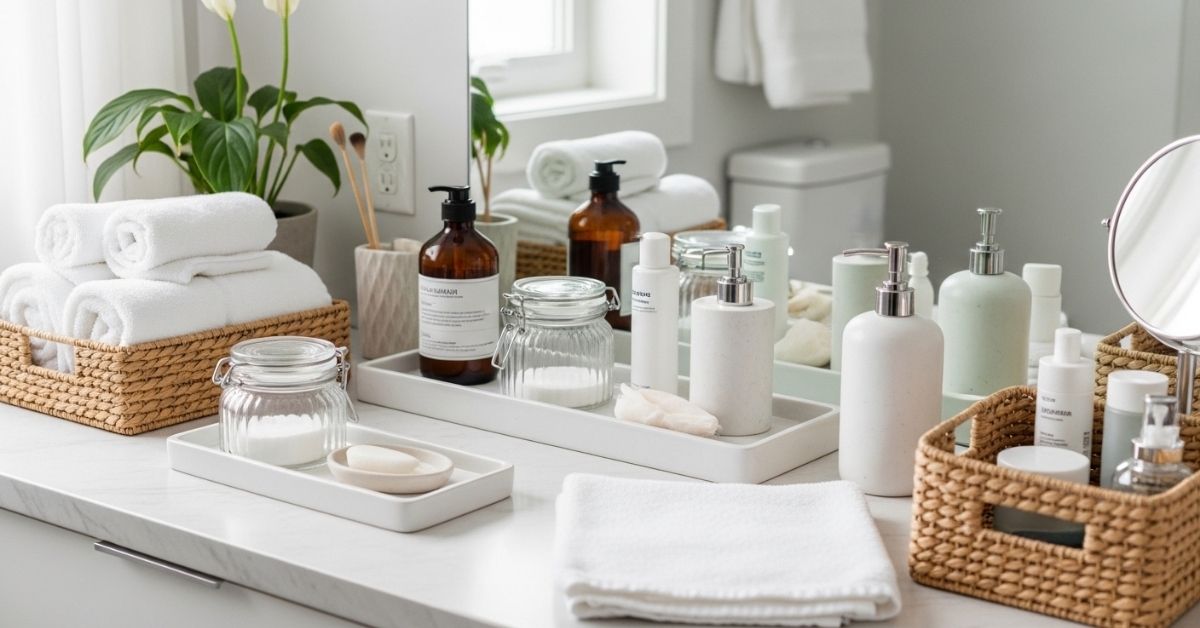
Your bathroom counter isn’t just a surface, it’s one of those spots that quietly affects how your morning goes. When it’s cluttered, getting ready feels chaotic. When it’s organized, even a Bathroom Counter Organization Ideas small bathroom starts to feel intentional and calm. If you’re working with a tight vanity, a shared bathroom, or just more products than counter space, these ideas are built around real constraints.
Most “organization” content shows pristine counters with three products on them. That’s not most people’s reality. This list covers practical setups the kind that hold up on a Monday morning, work for renters, and don’t require a full renovation.
A Deep Tray to Corral Daily Essentials Without Spreading

Instead of products scattered across the counter, a single deep tray creates an invisible boundary for what lives on the surface. The visual containment makes the whole counter feel deliberately arranged even when it’s full. Rectangular acrylic or stone trays work especially well because they don’t trap moisture. The tray signals: everything inside belongs here, nothing outside does which is a surprisingly effective system for stopping counter creep. This setup works best on single vanities where you want a curated, intentional look with minimal storage overhead.
Tall Apothecary Jars for Cotton Products and Loose Items
Open containers seem counterintuitive for organization, but glass apothecary jars solve a specific problem: you can see exactly what you have and grab it without rooting through a drawer. Tall, lidded versions work well for cotton pads; shorter open jars are good for hair ties or bobby pins. Place them in a cluster to create a visual focal point rather than scattering them individually. The height variation adds structure without requiring a shelf. This setup is particularly practical in shared bathrooms where multiple people need quick access to the same supplies.
A Mounted Shelf Just Above the Counter for Vertical Storage

If your counter feels overrun but your walls are bare, this is the first thing I’d actually recommend trying. A single floating shelf positioned 10–12 inches above the counter surface pulls products up and off the vanity without eliminating them from your routine. It works especially well for skincare those tall serums and toners that take up more footprint than they need to. The counter below clears up for daily essentials and cleaning. Renters can use adhesive shelves that hold up to 20 lbs without wall damage.
A Two-Tiered Bamboo Organizer for Multi-Step Skincare Routines
For anyone running a 5+ step skincare routine, a two-tier riser brings logic to the counter. Products you use last (SPF, finishing moisturizer) go on top; ones used first (cleanser, toner) go on the lower level. The bamboo material handles bathroom humidity better than MDF and looks more refined than plastic. The tiered height creates depth on the counter without requiring extra horizontal space; it compresses a wide spread of bottles into a tighter footprint. This is a genuinely useful setup for small vanities where every inch matters.
Under-Counter Tension Rods for Hair Tool Storage

This one surprises people. A tension rod installed horizontally inside the cabinet beneath your sink can hold hair dryers, flat irons, and curlers in a hanging position which frees up the counter completely. The tools stay accessible but stop taking up surface space. Two rods at slightly different depths work even better, one for the dryer and one for styling tools. It costs under $5, requires zero drilling, and works in practically any vanity cabinet. In my experience, this is the easiest single change that has the biggest visible impact on counter clutter.
Read More About : 27 Modern Bathroom Decor Ideas That Actually Work in Real Homes
A Lazy Susan for Corner Counter Spots That Collect Clutter
Corner counter space is almost always wasted products get pushed there and forgotten. A rotating lazy Susan reclaims that zone and makes everything accessible with a single spin. It works well for taller items like serums, toners, or perfume that don’t sit well in drawers. The rotation means nothing hides behind anything else. This is a particularly good fix in bathrooms with L-shaped counters or double vanities where one side tends to become a product graveyard.
Magnetic Strips for Bobby Pins, Tweezers, and Metal Tools

Small metal tools are some of the hardest things to organize. They slide to the back of drawers and disappear. A thin magnetic strip mounted on the inside of a cabinet door or on a small strip of wall beside the mirror solves this completely. Bobby pins, tweezers, nail clippers, and metal nail files all adhere without any extra steps. It takes 30 seconds to mount and keeps those items in exactly one place every time. This works especially well in small bathrooms where drawer space is limited.
A Clear Acrylic Drawer Organizer for the Items That Always Migrate to the Counter
Most counter clutter exists because there’s no logical home for it inside the drawer. Clear acrylic dividers with adjustable compartments solve that, specifically they let you carve out a slot for lip balm, a spot for hair ties, a section for face tools, so nothing has to live on the counter by default. The transparency means you can see everything without opening multiple compartments. Honestly, organizing the drawer is usually more impactful than buying a new counter organizer, because it changes where things naturally end up after use.
A Small Tray Dedicated Just to Hand Soap and Lotion Near the Sink

The area immediately around the faucet tends to get the messiest because it’s used constantly. A small ceramic or stone tray placed right beside the tap creates a designated zone for hand soap and lotion and catches the water drips and residue that would otherwise sit directly on the counter. Containing these two items separately from everything else also makes wiping down the counter faster. For shared family bathrooms, it signals what’s meant to stay on the counter versus what gets put away.
A Wall-Mounted Cup for Toothbrushes That Clears the Counter Entirely
Toothbrushes sitting on the counter are one of the least space-efficient setups in most bathrooms. A wall-mounted ceramic or stainless cup positioned beside the mirror moves them off the surface entirely and keeps them upright and dry, better for hygiene anyway. The counter directly beside the sink opens up significantly. This is especially impactful in smaller bathrooms where counter space around the sink is genuinely limited. Combined with a wall-mounted soap dispenser, you can clear almost everything from that immediate zone.
A Medicine Cabinet With Interior Organization for Visible Items

If you have a medicine cabinet, most of the organization value is in how you set up the inside, not what sits on the counter. Small clear bins in two sizes handle the variety of product heights inside a cabinet. Group by use: one section for dental care, one for daily medications, one for skincare. The items that are used daily can stay at eye level on the lowest shelf. The counter below becomes mostly clear. This setup works particularly well in smaller bathrooms where a medicine cabinet is doing double duty as both a mirror and the primary storage solution.
A Decanted Pump Dispenser System for Lotion and Cleansers
Product packaging is one of the main reasons counters look cluttered even when they’re organized. Different sizes, fonts, and colors create visual noise. Decanting serums, cleansers, and lotions into matching frosted glass or matte pump dispensers removes that noise completely. You get the same products in a visually cohesive system that takes up less horizontal space. The pump format is also faster to use in a morning routine than dealing with multiple caps. This works best for products you use consistently enough to refill regularly.
Read More About : 27 Modern Bathroom Decor Ideas That Actually Work in Real Homes
A Riser-and-Tray Combination for Layered Counter Organization

Combining a low tray with a small riser inside or beside it introduces height variation to the counter arrangement, which helps the eye differentiate between product zones visually. The riser lifts shorter items like a face roller or a compact so they’re visible without pushing other things aside. The tray beneath handles the daily essentials. This setup is less about creating a perfect grid and more about building a practical hierarchy: what you reach for most is easiest to access. In my experience, this kind of layered approach works better long-term than flat layouts because it naturally resists counter creep.
Rolling Drawer Units That Slide Under the Vanity
If your vanity sits on legs with open space underneath, a slim rolling cart with two or three drawers fits neatly in that gap. It effectively doubles your storage without touching the counter and doesn’t require any installation. The rolling function means you can pull it out when you need it and tuck it away when you don’t. This is especially practical in shared bathrooms where each person can have their own drawer in the cart. Narrow carts (around 6–8 inches wide) are available specifically sized for these vanity gaps.
A Small Mirror Tray for Perfume and Daily Jewelry

Perfume bottles and a ring dish have a way of ending up directly on the counter surface with nothing around them taking up space without any organizational logic. A small mirrored tray contains them in one coherent zone and does something extra: it reflects light slightly, which can make a small bathroom counter feel a touch more open. This is particularly useful in bathrooms with limited natural light. Keep it to three or four items maximum or the tray loses its organizing effect.
Clear, Stackable Bins Inside the Vanity Cabinet
What happens inside the cabinet directly determines how much ends up on the counter. Clear stackable bins, the kind that slide in and out, give you a system for products that don’t need to be visible every day. Extra skincare, backup toiletries, and medicine can each get their own bin and stay accessible without needing to be out on the counter. The stackable format works with vertical cabinet space that often goes unused. For renters or those in apartments with minimal built-in storage, this is one of the more practical changes available.
A Countertop Organizer With a Built-In Mirror for Smaller Bathrooms

In bathrooms without great lighting or mirror positioning, a countertop organizer that incorporates a small standing mirror serves two purposes at once. The storage compartments on either side or below hold makeup brushes, tools, or skincare and the mirror itself removes the need to lean over the sink to see clearly. This setup tends to work well for shared bathrooms where people are getting ready simultaneously and counter space is being split across two people’s routines.
A Pegboard Panel Behind the Counter for Maximum Flexibility
Pegboards aren’t just for garages. A painted pegboard panel mounted on the wall behind or beside the counter gives you a fully customizable surface for hooks, small shelves, and baskets all at eye level, all off the counter. The layout can shift as your routine changes. It works especially well for people who need to access a lot of tools quickly: hair dryers, styling brushes, and accessories can all hang within arm’s reach. This setup is particularly good in shared bathrooms or in bathrooms used as a primary getting-ready space.
A Single Open Bowl for Items That Need to Be Grabbed Quickly

Sometimes the simplest systems work best. One shallow bowl near the bathroom exit area becomes the designated home for the items you grab on the way out: hair tie, lip balm, a single hair clip. Everything else goes somewhere else. The single bowl prevents “just this once” sprawl because the capacity constraint is visible. It’s also the easiest system to maintain because it doesn’t require any categorization thinking. This works especially well in smaller bathrooms where you need fast access to a handful of items without any organizational overhead.
A Slim Organizer Tower for Tight Spaces Between the Sink and Wall
The narrow gap between a sink and the wall or a toilet tends to go completely unused. A slim tower organizer (4–6 inches wide) fits into that gap and creates multiple shelving levels out of dead space. This is particularly useful in galley-style bathrooms or small powder rooms where counter space is extremely limited and every square inch of floor space is accounted for. The vertical orientation means it adds storage without expanding the footprint. Look for free-standing versions that don’t require installation.
A Dedicated Hair Tools Station With Heat-Safe Holder

Styling tools are one of the most counter-disruptive items in most bathrooms because they’re large, have cords, and need to cool down before storage. A dedicated heat-safe silicone holder positioned at one end of the counter addresses all three problems: it holds the tool upright while it cools, keeps the cord contained, and defines the tool zone so it doesn’t spread across the counter. Pair it with a small hook or clip for the cord when stored. This is the kind of setup that’s especially practical for daily users who don’t have time to fully stow tools between uses.
Wall-Mounted Dispensers for Shampoo and Body Wash (in Shower-Adjacent Bathrooms)
In bathrooms where the shower and the counter share the same visible space, the visual clutter of shampoo bottles and body wash can spill onto how the whole room feels. Moving those products to wall-mounted dispensers either inside the shower or on the adjacent wall removes the packaging noise and frees up any ledge or counter space that’s been holding overflow. Matching dispensers in one color reduce visual interruption significantly. The counter, in turn, can focus on just what belongs on a bathroom vanity.
A Charging Station Hidden in the Vanity Drawer for Devices

Phones, electric toothbrushes, and facial tools that need charging often end up on the counter because the charging setup lives there. A single power strip routed into the vanity drawer (where local code and vanity construction allow) creates a charging zone inside the cabinet devices that charge in the drawer, cords stay invisible, and the counter loses its charging clutter. Check vanity construction first; some cabinets have pre-drilled cord holes specifically for this. This setup is most impactful in bathrooms that have become secondary work or routine stations.
Matching Labels for Consistent System Maintenance
Organization systems break down when it’s unclear where things go back to. Simple labels either printed or handwritten on minimal label holders solve the maintenance problem, not just the initial organization problem. Label clarity matters more in shared bathrooms where multiple people are putting items back. Chalkboard labels work for items that shift seasonally; printed labels work for permanent categories. The labels don’t have to be elaborate, just specific enough that there’s no ambiguity about where things return.
A Folded Linen Basket for Towels That Takes Counter Pressure Off

In bathrooms where towels tend to end up draped over counter edges or piled on the surface, a small basket or low shelf beside the vanity specifically for folded or rolled hand towels moves them to an intentional spot. It’s a small shift, but removing towels from the counter changes how much visible surface area you actually have. Rolled towels in a basket also create a visual softness that feels more finished than folded stacks. This works well in guest bathrooms where appearance matters alongside function.
A Morning Routine Tray Versus an Evening Routine Tray
2026 is seeing a shift in bathroom organization toward routine-based systems rather than product-type systems and it makes practical sense. Instead of organizing by category (skincare vs. hair vs. dental), organizing by when you use something removes the decision-making from your routine entirely. A morning tray holds SPF, toner, and deodorant; an evening tray holds cleansing oil, night cream, and retinol. The tray not in use can slide to the back or into a cabinet. This setup works especially well on double vanities or wide counters where the extra footprint doesn’t cause crowding.
A Habit Anchor One Fixed “Landing Zone” for Items Dropped on Entry

The items that end up scattered across a bathroom counter usually share one trait: they were set down without a specific destination. A single small tray or bowl positioned just inside the bathroom door acts as a deliberate landing zone for exactly those items. The tray’s presence signals: this is where things get deposited when you come in. It won’t contain everything, but it removes the randomness from the first drop and that’s usually where counter clutter starts. This works in any size bathroom and requires no storage infrastructure.
What Actually Makes These Bathroom Counter Organization Ideas Work
The difference between a counter that stays organized and one that collapses back to chaos within a week usually comes down to three things: friction, visibility, and system fit.
Low friction matters more than aesthetics.
If returning an item to its designated spot takes more effort than just setting it down somewhere on the counter, it will land on the counter. Every solution in this list works because the organized option is the easy option. The tray is right there. The drawer organizer has a clear slot. The hook is at arm’s reach. Design the system so the path of least resistance is also the organized path.
Visibility determines whether the system gets used.
Open storage trays, jars, bowls works for items used daily. Enclosed storage works for backup products and things with lower access frequency. Problems arise when high-use items get tucked into opaque drawers and people stop bothering to find them, pulling out a replacement and leaving it on the counter instead.
System fit means the solution matches the actual routine.
Organizing by routine (morning vs. evening) works better for some people than organizing by category. Shared bathrooms need labeled systems. Small bathrooms need vertical thinking. There’s no universal setup; the one that works is the one that aligns with how the space is actually used.
Bathroom Counter Organization Ideas at a Glance
| Setup | Best For | Space Type | Problem Solved | Effort Level |
| Deep organizing tray | Daily essentials | Any size | Product sprawl | Very low |
| Apothecary jars | Cotton & loose items | Any size | Drawer overflow | Low |
| Floating shelf above counter | Skincare bottles | Small bathrooms | Counter surface overload | Medium |
| Two-tier bamboo riser | Multi-step routines | Small–medium | Too many products, limited space | Low |
| Under-sink tension rod | Hair tools | Any with cabinet | Counter space + cord clutter | Very low |
| Lazy Susan | Corner zones | Medium–large | Dead corner space | Very low |
| Magnetic strip | Bobby pins, tweezers | Small bathrooms | Drawer disappearing act | Very low |
| Rolling drawer unit | Extra storage | Open-leg vanities | No storage beyond counter | Low |
| Routine-based trays | AM/PM routines | Wide or double vanity | Decision fatigue, product overlap | Low |
| Pegboard panel | High-tool users | Wall space available | Limited hooks and counter zones | Medium |
How to Set Up Your Bathroom Counter for Better Flow and Function
Start with a clear counter and work backward. Take everything off the surface, wipe it down, and then only put back what you actually use in a given morning. Most bathrooms have 40–60% of counter space occupied by products that are used occasionally at best.
Once you know what’s daily-use, group by access frequency: things used every day go on or immediately beside the counter; things used a few times a week go in a drawer or cabinet. This separation alone reduces visible clutter significantly without buying anything.
From there, look at your counter’s specific limitations. A small counter? Go vertical: a shelf, a tower, a wall mount. Shared bathroom? You need labeled zones so each person has a designated section. Wide counter? Use tray groupings to prevent the surface from becoming one undifferentiated spread.
The last piece is maintenance design. Every system needs a reset mechanism, a Sunday tidy, a monthly purge of expired products, and a rule about how many items can live outside of a designated zone at once. The most organized counters aren’t that way because someone has extraordinary discipline. They’re that way because the system is easy enough to maintain without thinking about it.
FAQ’s
What’s the easiest way to organize a small bathroom counter?
Start by moving everything you don’t use daily off the counter entirely. Then use one deep tray to contain what remains. The tray creates a visual boundary that prevents spread and makes the counter look intentional even when it’s not empty.
How do I keep a shared bathroom counter from getting cluttered?
Assign each person a specific zone: a tray, a section of counter, or a dedicated drawer organizer. Label the zones clearly. When everyone knows where their items live and where they return, shared counter clutter reduces significantly without requiring constant negotiation.
Are open organizers (trays, jars, bowls) better than closed ones for bathroom counters?
Open containers work best for items used daily. You can see and grab them without opening anything. Closed containers and drawers work better for backup products, medications, and items used occasionally. The most functional setups use both: open storage near the sink for daily items, enclosed storage for everything else.
What actually works for organizing hair tools on a bathroom counter?
A heat-safe silicone tool holder positioned at one end of the counter is the most practical solution for daily users. It holds the tool upright while it cools, keeps the cord from spreading, and defines a contained zone. Under-sink tension rods are a better option if you want tools off the counter entirely.
Countertop organizer vs. drawer organizer which should I prioritize?
Start with the drawer. Most counter clutter exists because the drawer has no system, so items default to the surface. A well-organized drawer with acrylic dividers removes the root cause of counter clutter. Countertop organizers are most useful after the drawer is set up and you’ve identified what genuinely needs to stay on the surface.
How do I make a bathroom counter look less cluttered without removing everything?
Group products into trays so they read as organized zones rather than scattered items. Use matching dispensers or decant products to reduce packaging noise. Add a small riser to create height variation; it makes the counter feel more deliberately arranged. Contain hair tools and loose small items in dedicated spots rather than leaving them free-floating.
Is it worth buying a countertop organizer if I rent my apartment?
Yes freestanding organizers, trays, and drawer inserts work without any installation and go with you when you move. Tension rods for under-sink hair tool storage and adhesive wall shelves rated for 20 lbs are also renter-friendly. Avoid anything requiring screws into tile.
Conclusion
A well-organized bathroom counter doesn’t require a renovation or an expensive overhaul; it usually just needs a clear system for where things go and why. Even two or three of the ideas in this list, applied consistently, can shift how the space feels and how smoothly your routine runs.
Start with the idea that fits your biggest pain point: counter sprawl, hair tool clutter, shared bathroom chaos, or limited storage options. Try one setup for a week before adding another. The goal isn’t a perfect counter, it’s a counter that’s easy to reset when it gets messy, because it always will.
