

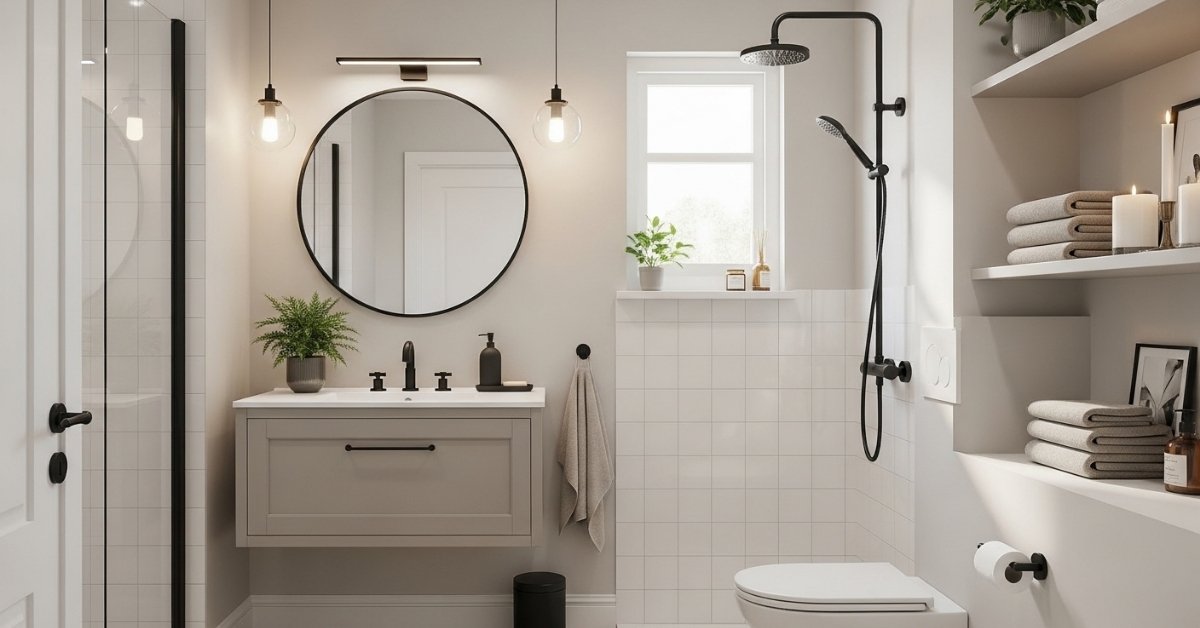
That feeling when your bathroom functions fine but somehow feels like it’s working against you cramped, dim, every surface cluttered is one of the most fixable problems in a home. Small bathrooms are genuinelySmall Bathroom Makeover Ideas one of the best rooms to makeover because the footprint is limited, which means even one well-chosen change has a visible impact. You’re not redecorating an entire living room here. You’re editing a small canvas.
For anyone renting or working with a tight layout, this list is built around ideas that skip major renovation. No contractors, no tile removal, no structural changes. What these ideas do rely on is an understanding of how light, scale, and storage interact in compact spaces and how shifting even one of those elements changes how a bathroom feels to use every single day.
Replace the Mirror with a Full-Width Frameless One

Most small bathrooms have a medicine cabinet or a single round mirror hanging above the sink and that’s exactly what’s making the room feel smaller than it is. A wide, edge-to-edge frameless mirror effectively doubles the perceived width of the wall it’s on. The reflection carries the room outward, bouncing both natural and artificial light back across the space. This works especially well in windowless bathrooms where the mirror becomes the primary source of visual depth. Mount it as close to the ceiling as the room allows, and the vertical stretch adds height too. In rental situations, frameless mirrors can be leaned against the wall or secured with adhesive strips rather than wall anchors.
Swap Out Builder-Grade Lighting for Warm Sconces on Either Side of the Mirror
Overhead vanity bars cast shadows downward, which flattens faces and makes the room feel clinical. Side-mounted sconces at roughly eye level create balanced, diffused light that illuminates the space and the person in it much more evenly. For small bathrooms specifically, two smaller sconces feel visually lighter than one large overhead bar. Warm white bulbs (2700–3000K) shift the room from sterile to inviting without any paint or renovation. This is one I’d actually recommend trying first because the swap is inexpensive and the difference is immediately noticeable. Use plug-in sconces if hardwiring isn’t an option.
Add a Floating Vanity to Expose Floor Space

The visual floor space visible beneath a floating vanity makes a bathroom feel considerably larger. When tile runs continuously under the vanity without interruption, the eye reads the floor as one unbroken plane which registers as more space, even if the square footage is identical. This is particularly useful in bathrooms with patterned or lighter-toned tiles because it lets the floor work as a design feature instead of being hidden by cabinetry. From a practical standpoint, floating vanities also make cleaning the floor faster and more thorough. If replacing the vanity isn’t in the budget, adding legs to an existing floor-standing unit (when structurally possible) creates a similar visual effect.
Use Vertical Tongue-and-Groove Paneling on One Wal
Vertical lines on a wall draw the eye upward, which makes low-ceilinged bathrooms feel taller. Tongue-and-groove paneling installed vertically is one of the most effective architectural tricks for small spaces because it adds texture and visual interest while doing spatial work at the same time. It also gives a bathroom a finished, custom look without the complexity of full tile work. Paint it the same tone as the surrounding walls to keep the effect subtle and airy, or go slightly darker to create a focused accent wall. Peel-and-stick shiplap panels are a solid renter-friendly option that installs over existing walls and removes cleanly.
Replace Shower Curtains with a Clear Glass Panel or Panel Set

Shower curtains, even nice ones, visually cut the bathroom in half. A clear glass panel or frameless shower screen keeps the line of sight unobstructed, so the shower doesn’t feel like a separate enclosed compartment within the room. This is one of the higher-investment ideas on this list, but the spatial payoff is significant in bathrooms under 50 square feet. In spaces where the shower tile or floor tile is particularly attractive, the glass lets that become part of the overall room design rather than hiding behind a curtain. A single fixed panel (rather than a full enclosure) is a middle-ground option that costs less and still removes the visual barrier.
Paint the Ceiling the Same Color as the Walls
One of the most underused techniques in small space design: painting the ceiling the same color as the walls eliminates the hard visual line where the wall meets the ceiling. That line is what makes rooms feel boxed-in. When the color wraps continuously, the room reads as a unified volume rather than a small rectangle with a lid. This works especially well with light, earthy tones, dusty sage, warm greige, soft terracotta. It also means you don’t have to worry about a perfect ceiling cut-in line, which makes this a genuinely easy DIY. Keep the trim white to maintain contrast and give the color somewhere to stop.
Install Open Shelving Above the Toilet

The wall space above a toilet is nearly always underutilized. Two floating shelves in that zone add meaningful storage without taking any floor space which matters a lot in bathrooms where the floor plan is fixed. Keep shelves to around 8 inches deep to avoid an overcrowded visual. The key is editing what goes on them: rolled towels, a small plant, and one or two functional items. Overfilling this space makes it look like a storage overflow area rather than an intentional design choice. Bracket-style shelves in matte black or antique brass add a decorative touch while keeping the look current for 2026’s leaning-toward-warm-metals aesthetic.
Swap Plastic or Chrome Hardware for Unlacquered Brass
Hardware is the jewelry of a bathroom. Swapping out chrome or brushed nickel fixtures for warm-toned hardware unlacquered brass or antique gold shifts a bathroom’s entire temperature. In a small space where there aren’t many design elements to layer, this one swap carries a disproportionate amount of visual weight. Faucet, drawer pulls, toilet paper holder, towel ring: when all of these match, the bathroom reads as intentionally designed rather than assembled. Unlacquered brass develops a slight patina over time, which only deepens the effect. The budget approach is to replace one or two accent pieces at a time rather than everything at once.
Hang Artwork or a Single Large Print at Eye Level

Bathrooms are often treated as purely functional rooms which is exactly why adding one considered art piece makes such a difference. A single large print (rather than a gallery wall of small frames) anchors the room visually without creating clutter. Choose something that fits the moisture environment: a framed digital print behind glass, a watercolor reproduction, or a sealed poster. Hang it at eye level on whatever wall faces the door so it’s the first thing you see when entering. In my experience, this works best when the print shares at least one color with existing towels or the vanity makes the room feel coordinated without feeling matchy.
Read More About : 21 Bathroom Spa Decor Ideas That Make Even a Small Space Feel Like a Retreat
Use Large-Format Tiles to Minimize Grout Lines
Grout lines visually divide a floor into small sections, and the more sections there are, the busier and smaller the floor reads. Large-format tiles (24×24 or larger) dramatically reduce grout line frequency, which creates a calmer, more expansive floor plane. This is a renovation-level change, but if you’re already considering a floor update, the tile format is worth prioritizing over pattern or color. Light matte finishes in cream, warm white, or soft greige reflect light without the glare of polished tile. For renters, large-format peel-and-stick tile in similar tones achieves a quieter visual effect than small-grid vinyl options.
Add a Recessed Medicine Cabinet for Hidden Storage

Surface clutter is one of the fastest ways a small bathroom starts to feel unmanageable. A recessed medicine cabinet solves this by moving items skincare, medications, dental care behind a flush-mounted door rather than onto the counter. Recessing it into the wall (even partially) keeps it from projecting into the room. This is especially useful in bathrooms with pedestal sinks where there’s no under-vanity storage at all. Many recessed cabinets double as mirrors, which adds a layer of functionality without requiring a separate mirror installation. Frameless models in particular disappear into the wall visually.
Introduce Warmth with a Teak or Bamboo Shower Mat
Hard, cold floors are part of what makes small bathrooms feel utilitarian rather than inviting. A slatted teak or bamboo mat introduces a natural material into the room that immediately adds warmth and texture without any installation. The slats also allow water to drain through rather than pooling, which is more hygienic than standard bath mats in wet zones. Visually, the horizontal wood lines contrast well with vertical tile or paneling. This is a low-effort, high-impact addition that works in rentals, small powder rooms, and full bathrooms alike. Budget-conscious alternatives include bamboo mats, which offer a similar look at a lower price point.
Layer the Lighting with a Dimmer Switch

Most small bathrooms have one light source controlled by one switch, which means there’s no way to adjust the atmosphere based on how the room is being used. Adding a dimmer to even one fixture changes that completely. Bright, cool light for getting ready in the morning; low, warm light for a bath at night in the same room, the same fixtures, but a fundamentally different experience. Dimmer switches are a one-hour DIY project in most homes and cost under $20. In bathrooms with multiple circuits, start with the fixture closest to the vanity mirror where the impact will be most felt.
Mount Towel Bars Behind the Door
In bathrooms where wall real estate is genuinely limited, the back of the door is often the most overlooked storage surface. Two or three horizontal towel bars mounted at different heights on the door hold full-size bath towels without consuming a single square inch of floor or wall space. Over-the-door hooks work without any drilling, but wall-mounted bars installed on the door itself (secured with longer screws into the door frame) are more stable for heavier towels. This is particularly useful in bathrooms where the existing wall-mounted bar placement is awkward relative to the shower or vanity.
Paint the Vanity a Deep, Moody Color

Painting just the vanity not the whole room a deep color is a contained, lower-risk way to introduce a strong design statement. Navy, forest green, charcoal, and warm black are all working well in bathrooms right now and have enough visual depth to make a mass-produced vanity look custom. The contrast between a dark vanity base and lighter walls draws attention to the piece as a furniture item rather than a built-in fixture. This reframe is especially effective in bathrooms where the vanity is the central piece of furniture. Use a cabinet-specific paint (Rust-Oleum Cabinet Transformations or similar) for a durable finish that holds up in humid environments.
Swap Standard Towel Hooks for Decorative Robe Hooks
Decorative robe hooks particularly in matte black, brushed gold, or unlacquered brass are doing a lot of visual work in smaller bathrooms right now. Unlike towel bars, hooks allow towels to hang in a more relaxed, layered way that reads as intentional rather than functional. A row of two or three hooks placed at the same height creates a clean, considered look on an otherwise plain wall. They also accommodate different items at once: bath towels, hand towels, and robes without requiring multiple different fixtures. The hardware size matters here; oversized hooks designed for robes hold bath towels without the towel folding awkwardly.
Read More About : 25 Bathroom Storage Ideas for Small Spaces That Actually Make a Difference
Use a Patterned Floor Tile to Anchor the Space

In a small bathroom where the walls are neutral and the fixtures are simple, a patterned floor tile becomes the room’s entire personality. Geometric cement tiles, classic black and white hex, or Moroccan-inspired encaustic tiles all work well in small footprints because the pattern has room to be read clearly without overwhelming the space. Honestly, small bathrooms are actually better for bold floor tiles than large ones; the pattern is contained and purposeful rather than repetitive. The rest of the room should stay quiet: white walls, simple fixtures, minimal accessories. The floor does the work so nothing else has to.
Add a Small Side Table or Stool Next to the Tub
A small side table, even a simple wood or marble-topped stool beside the tub transforms the functional act of bathing into something more considered. It provides a surface for candles, a drink, a book, or toiletries, keeping those items off the tub ledge and organized within reach. In terms of scale, a table between 16 and 20 inches tall works best next to most standard tubs. Round tops are preferable to square ones in tight bathrooms because they’re easier to navigate around. This addition works even in smaller bathrooms because it’s narrow and doesn’t project far into the room; it reads as an accessory rather than furniture.
Introduce Texture with a Woven or Rattan Basket

Texture is what distinguishes a bathroom that feels designed from one that feels functional. A woven basket rattan, seagrass, or water hyacinth introduces a tactile, organic element that breaks the hardness of tile, porcelain, and chrome. Practically, it’s an open storage solution for rolled towels, spare toilet paper, or hair tools that don’t need to be hidden. Unlike plastic bins, woven baskets improve with use and work across multiple aesthetics: coastal, minimalist, warm neutral, earthy. Place it on the floor beside the vanity or next to the tub where it functions as both storage and visual grounding for the room.
Install a Pocket Door or Barn Door to Reclaim Floor Space
Standard hinged bathroom doors require a 3-foot swing arc to open fully in a small bathroom, that’s a significant portion of the usable floor space. A pocket door (which slides into the wall) or a barn door (which slides along the wall on external hardware) eliminates that swing zone entirely. This is particularly impactful in bathrooms where the door swing conflicts with the vanity, toilet, or towel storage. Barn doors are the more accessible renovation since they don’t require opening up the wall. They also add a strong architectural element, especially in matte black hardware which suits the hardware direction many small bathrooms are moving toward in 2026.
Add a Plant (That Will Actually Survive)

Plants in bathrooms work when the plant and the environment are actually compatible. Pothos, spider plants, peace lilies, and ZZ plants all tolerate low light and high humidity the exact conditions most small bathrooms offer. A single plant at varying height (on a shelf, on the tank lid, hanging from a hook) introduces color and life in a room that’s almost entirely hard surfaces. This isn’t about creating an indoor jungle; one well-placed plant is enough to shift the feel of the room. The trailing varieties work especially well in bathrooms because the drape adds vertical interest without requiring additional shelf space.
Regrout or Refresh Existing Tile with Grout Paint
If the tile itself is in good shape but the grout has yellowed or stained, regrouting or applying grout paint is one of the highest-impact, lowest-cost updates available for a small bathroom. Bright white grout against white or light tile makes a bathroom feel recently renovated without replacing a single tile. The process for grout paint is straightforward, clean, applied with a narrow brush, seal and the results hold for several years in a well-ventilated bathroom. This is especially worth doing in showers or around sinks where grout discoloration is most visible. The difference between yellowed and freshly whitened grout is significant enough that people often assume the tile was replaced.
Hang a Eucalyptus Bundle from the Showerhead

This one requires no renovation, no tools, and no permanent change which makes it useful for renters specifically. A bundle of dried or fresh eucalyptus tied with twine and hung from the showerhead releases its scent in steam, creating a sensory experience that immediately shifts the bathroom into a more spa-like register. Visually, the green of the eucalyptus against white or light tile is a clean, organic contrast. Fresh bundles last one to three weeks; dried bundles last several months. This is a detail that guests notice and that photographs well which explains why it’s one of the most-saved bathroom ideas on Pinterest right now.
Use a Monochromatic Color Scheme
A monochromatic bathroom where walls, tiles, towels, and accessories all exist in the same color family feels more expansive than a bathroom with multiple competing colors. The reason is straightforward: when the eye doesn’t have to jump between contrast points, it reads the space as a unified whole. This works especially well with warm whites, creams, soft taupes, and dusty greiges. The variation comes through texture (matte tile against glossy, linen towels against smooth tile) rather than color contrast. It’s also a surprisingly forgiving approach because you don’t have to perfectly coordinate items, just need to belong to the same general tonal range.
Create a Built-In Niche in the Shower

A shower niche, a recessed shelf cut into the shower wall, eliminates the need for shower caddies that hang from the showerhead or suction-cup to the wall. Both types of caddies create visual clutter and tend to rust or fall. A tiled niche built flush with the shower wall keeps products organized and completely out of the walking path. In new construction or during renovation, this is a standard addition. If you’re renovating an existing shower, the niche can often be added where a stud bay already exists without structural changes. Even a single niche at mid-height holds shampoo, conditioner, and body wash which covers the majority of what most people need within reach.
Layer Rugs for Warmth and Texture
A single bath mat in front of the tub or shower is standard. Layering two a longer runner in front of the vanity and a smaller mat at the tub creates a more finished, intentional feel without adding any furniture. The rugs also define different zones within the bathroom (washing vs. dressing), which makes a small bathroom feel more organized in use. Natural materials work best here: cotton flatweave, jute, or a washable wool blend. Avoid thick, high-pile rugs in small bathrooms where the rug trapping moisture is a real concern. Opt for low-pile or flatweave options that dry quickly and launder easily.
Add Under-Vanity Lighting for Depth

LED strip lighting mounted under a floating vanity creates a warm glow that makes the floor appear to recede which reinforces the floating effect and adds visual depth to the room. In practical terms, it also functions as a soft night light for middle-of-the-night bathroom use. Warm white (2700K) strips work best; cool white LEDs make the room feel clinical rather than inviting. Peel-and-stick LED strips are inexpensive and attach directly to the underside of the vanity without any wiring. The effect is subtle during the day but becomes a notable design feature in the evening, which makes this one of the more versatile finishing touches available for a small bathroom.
What Actually Makes These Small Bathroom Makeover Ideas Work
Most small bathroom updates focus on aesthetics, new paint, new accessories without addressing the root issue, which is usually one of three things: inadequate light, insufficient storage, or a layout that feels crowded because of furniture or fixture placement.
Light is almost always the most impactful lever to pull first. In bathrooms without windows, artificial light does all the work, and a single overhead fixture positioned behind where you stand at the mirror is a fundamental problem. Side-mounted lighting, warm color temperatures, and dimmable circuits address this at the source.
Storage is the second variable. Clutter on the counter makes every bathroom feel smaller, and the solution isn’t always a full vanity replacement. Recessed cabinets, over-toilet shelving, and behind-the-door towel storage all add capacity without changing the room’s footprint.
The third variable is visual complexity: too many competing materials, too many colors, too many small objects on display. Editing down to a coherent palette and fewer, better-chosen accessories doesn’t cost anything, but it changes how the room reads as much as any renovation would.
Small Bathroom Makeover Ideas: Setup Comparison Guide
| Idea | Space Type | Problem Solved | Budget Level | Renter-Friendly |
| Wide frameless mirror | Any | Room feels narrow | Low–Mid | Yes (adhesive mount) |
| Floating vanity | Mid-size bathroom | No floor visibility | High | No |
| Side-mounted sconces | Any | Poor vanity lighting | Low–Mid | Yes (plug-in option) |
| Clear shower screen | Shower/bath combo | Visual wall from curtain | High | No |
| Ceiling-to-wall color match | Low-ceiling bathroom | Boxed-in feel | Low | Yes |
| Recessed medicine cabinet | Pedestal sink bathroom | No storage | Mid | No |
| Pocket or barn door | Small-entry bathroom | Door arc eats floor space | Mid–High | Barn door only |
| Grout refresh | Dated tile bathroom | Discolored grout | Low | Yes |
| Open over-toilet shelving | Any | Wasted vertical space | Low | Yes (command strips) |
| Large-format floor tile | Renovation | Busy, small-looking floor | High | No |
Common Small Bathroom Mistakes That Make the Space Feel Smaller
Hanging the mirror too low.
A mirror that starts at counter height and ends just below eye level cuts the wall in half visually. Mirrors should extend toward the ceiling or at minimum, end at or above average eye level to pull the room upward.
Using multiple small rugs in competing colors.
Two rugs in different tones create visual chaos in a tight floor plan. Either commit to one rug or choose two that are the same tone and material so they read as a coordinated set.
Overcrowding open shelves.
Open shelving above the toilet or beside the vanity works beautifully with three to five items. Beyond that, it becomes a visual burden. The eye has to process too many objects in a room where there’s no room to let things breathe.
Keeping the shower caddy.
Over-the-showerhead caddies that hold six products in a chromium rack are one of the fastest ways to make a bathroom look unintentional. Consolidate to a niche, a corner shelf, or a minimal caddy that holds only what’s used daily.
Mismatched hardware finishes.
Three different metal finishes in a small bathroom chrome faucet, nickel towel bar, brass hooks creates a scattered look that no amount of styling can resolve. Pick one finish and run it consistently through all touchable hardware in the room.
Ignoring the ceiling.
A white ceiling in a bathroom with colored walls creates a hard line that lowers the room visually. Extending the wall color to the ceiling (or painting the ceiling a closely related tone) removes that line and makes the room feel taller.
FAQ’s
What is the most impactful small bathroom makeover change?
Lighting is typically the single highest-impact change in a small bathroom. Replacing a single overhead fixture with warm, side-mounted vanity lights or adding a dimmer to existing fixtures changes the feel of the room dramatically. It affects how the space looks, how it functions, and how the person using it feels in it, without requiring any structural change.
How do I make a small bathroom look bigger without renovating?
The most effective no-renovation strategies are: installing a wide mirror that reflects more of the room, painting the ceiling the same color as the walls to remove the hard horizontal line, using light and warm-toned colors consistently, and removing countertop clutter so visual complexity decreases. Each of these changes how the brain processes the room’s dimensions.
What color makes a small bathroom feel larger?
Light, warm neutrals, soft white, warm cream, dusty greige tend to feel most spacious in small bathrooms because they reflect light without adding contrast. A monochromatic approach (same tone across walls, tile, and accessories) typically reads as more expansive than a room with multiple competing colors, regardless of the specific color chosen.
Are open shelves a good idea in a small bathroom?
Open shelves work in small bathrooms when they’re kept to a maximum of 8 inches deep and lightly loaded three to five items maximum per shelf. The risk is overcrowding, which makes open shelving look like overflow storage. When edited carefully, open shelves add visual interest and accessible storage without taking floor space.
Floating vanity vs. floor-standing vanity: which is better for small bathrooms?
Floating vanities are better for visual space in small bathrooms because they expose the floor beneath, making the room feel larger. Floor-standing vanities offer more storage and are easier to install. The choice depends on whether the priority is visual spaciousness (floating) or maximum storage (floor-standing). In very tight bathrooms, the visual benefit of a floating vanity is usually worth the trade-off.
How do I add storage to a small bathroom without taking up floor space?
Focus on vertical and behind-door storage: floating shelves above the toilet, a recessed medicine cabinet, hooks or bars mounted on the back of the door, and shallow ledge shelving above the vanity mirror. All of these add significant storage capacity without reducing the usable floor area, which is the most critical resource in a small bathroom.
Can renters do a small bathroom makeover?
Yes, many of the most effective small bathroom updates require no permanent changes. Wide peel-and-stick mirrors, plug-in sconces, command-strip shelves, grout paint, woven baskets, and over-the-door towel bars are all renter-safe and removable. The most impactful renter change is often simply editing what’s on display, removing non-essential items from counters and shelves clears visual noise without any installation.
Conclusion
Small bathrooms respond well to focused changes. A wide mirror, better lighting, and a more edited counter can shift the entire feel of the room without a single renovation. The key isn’t adding more it’s making what’s already there work better spatially and visually.
Start with one or two ideas that address your bathroom’s most specific friction point: if it’s dark, start with lighting; if it’s cluttered, start with storage; if it feels small, start with the mirror. Build from there gradually. The most effective small bathroom makeovers tend to be layered over time rather than done all at once, because each change reveals what the next most useful step actually is.
