

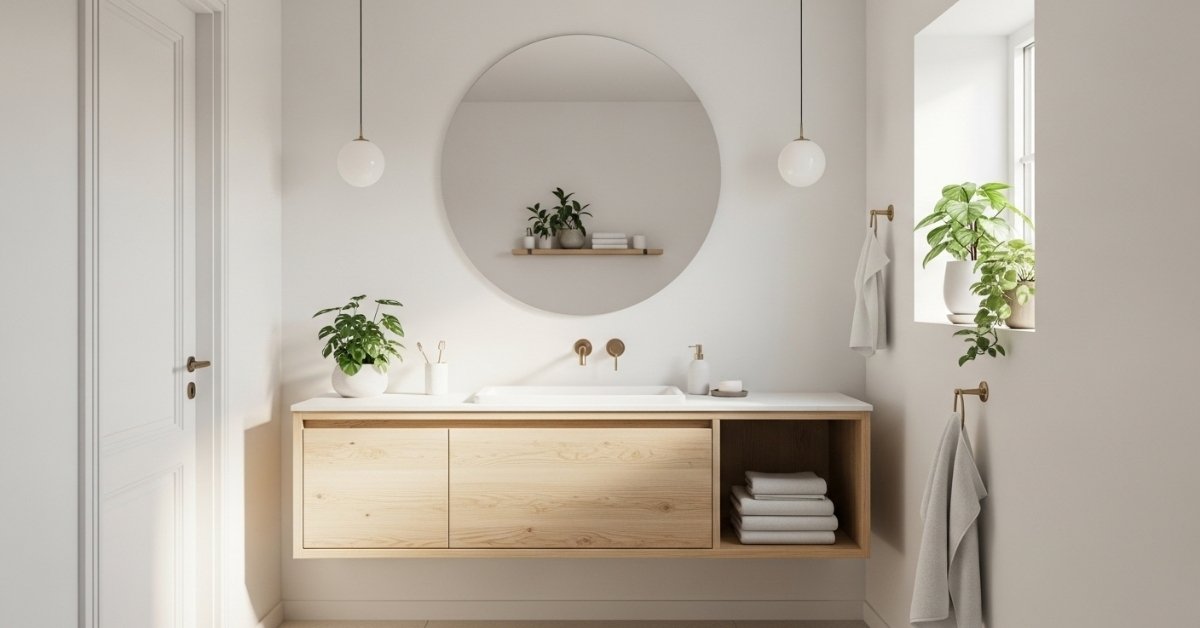
There’s a specific kind of frustration that comes with a bathroom that feels cluttered even when it’s technically clean. Too many products on the counter, mismatched storage, lighting that’s either too harsh or too dim and suddenly a room that should feel like a reset feels like just another mess to manage.
Minimalist bathroom decor isn’t about having almost nothing. It’s about having exactly what you need, Minimalist Bathroom Decor Ideas placed well, in a space that actually works. For small apartments especially, this approach does something that maximizing storage alone can’t: it makes the room feel bigger without moving a single wall.
If your style leans calm, neutral, and intentional or if you’re just tired of a bathroom that never quite looks put-together these ideas are worth bookmarking.
A Floating Vanity That Clears the Floor Completely

When floor space is visible, the room reads as a larger full stop. A floating vanity mounted 15–18 inches off the ground creates that visual gap that makes even a narrow bathroom feel less boxed in. Pair it with a simple undermount sink and a single-lever faucet in matte black or brushed nickel, and the whole countertop area looks cleaner without any extra effort. This works especially well in bathrooms under 50 square feet where every visual inch matters. The open floor also makes cleaning easier, which is a practical bonus that’s easy to underestimate.
A Single Large Mirror Instead of a Small Cabinet Mirror
Most standard bathroom mirrors are too small for the wall they’re on, which makes the room feel chopped up and dim. Swapping it for a mirror that spans the full width of the vanity or close to it bounces more light around the space and creates a sense of openness that’s hard to achieve any other way. In my experience, this is one of the highest-impact changes you can make without touching plumbing or tile. Frameless mirrors work best for a truly minimal look; thin metal frames in matte black or warm brass work if you want a subtle edge. Either way, go wider than feels comfortable; it almost always looks better.
Recessed Shelving Built Into the Shower Wall

A shower niche eliminates the need for caddies, corner shelves, or suction-cup organizers that eventually fall off at 2am. Built flush into the wall, it keeps products contained without adding any visual bulk to the shower space. The niche itself becomes a design detail tile in a contrasting material or a small mosaic to break up a large expanse of plain tile. This is a renovation-level change, but for anyone doing a bathroom refresh, it’s worth prioritizing over almost any decorative upgrade. It solves the clutter problem permanently rather than managing it.
Neutral Tile in Large Format to Minimize Grout Lines
Smaller tiles mean more grout lines, and more grout lines visually fragment a surface making walls and floors look busier than they are. Large format tile in a warm greige, soft white, or pale stone creates a calmer, more continuous surface that reads as intentional rather than filler. The key is keeping the grout color close to the tile color so the lines recede rather than stand out. This approach works in both large and small bathrooms, but it’s particularly effective in compact spaces where visual noise is harder to ignore.
Open Wooden Shelving With Negative Space Built In

The mistake most people make with bathroom shelving is filling every inch. One well-placed shelf real wood, not laminate with a few carefully chosen items and deliberate empty space reads as considered, not sparse. Stack two or three folded towels, one small plant, and one or two amber or matte glass containers for everyday products. That’s it. The negative space around and between items is what makes the shelf look styled rather than crammed. This is a renter-friendly option that costs very little and photographs well if that matters to you.
A Freestanding Tub as the Room’s Only Statement Piece
Minimalism isn’t the absence of focal points, it’s the absence of competing ones. A freestanding tub, positioned with clear floor space on all sides, becomes the room’s only visual anchor. Everything else, walls, floors, fixtures should stay quiet to let it hold the space. This setup requires enough square footage to walk around the tub comfortably (at least 18–24 inches on each side), so it’s not a small bathroom solution. But in a medium-to-large bathroom, it removes the need for any other decorative layer.
Wall-Mounted Faucets to Keep the Countertop Clear

Deck-mounted faucets take up countertop real estate and create awkward zones around the base that collect water and soap residue. Wall-mounted faucets move the hardware to the wall, leaving the entire counter surface open. This is a small functional shift with a significant visual effect: the counter looks like a surface instead of a hardware installation. It requires some plumbing adjustment during a renovation but pairs well with any vanity style, from concrete to wood to white lacquer.
Read More About : 29 Small Bathroom Decor Ideas That Make Every Inch Work Harder
A Monochromatic Color Palette Across Surfaces
Choosing one base tone and repeating it across tiles, walls, towels, and accessories removes the visual competition that makes rooms feel restless. This doesn’t mean everything matches exactly warm white tile, off-white walls, and ivory towels all read as cohesive without being identical. Add one material in a different category (wood, rattan, stone) for enough contrast that the room doesn’t feel sterile. Monochromatic schemes are especially forgiving in small bathrooms because they don’t create hard visual breaks that chop the space up.
Linen or Cotton Towels in a Single Neutral Tone

Mismatched towels are one of the fastest ways to undercut an otherwise calm bathroom. A matching set, even budget-friendly ones in one neutral tone (warm white, soft sand, or stone grey) creates instant visual order. Waffle-weave or ribbed textures add enough tactile interest that the look doesn’t feel flat. This is one I’d actually recommend trying first because it costs very little, takes ten minutes, and makes a noticeable difference to how organized the space feels.
Concealed Storage Behind a Simple Flush Door
Visible storage, open shelving, freestanding cabinets, countertop organizers adds visual weight. Concealed storage behind a flush-mounted cabinet or a door that matches the wall removes that weight entirely. The products still exist; you just don’t see them. Push-to-open mechanisms eliminate the need for handles, which makes the cabinet essentially disappear into the wall. This is especially useful in bathrooms where clutter tends to live on the counter because there’s nowhere else to put it.
A Simple Teak or Bamboo Bath Mat Instead of Fabric

Fabric bath mats get wet, develop mildew, and need constant washing which means they’re often left damp on the floor, adding a visual messiness that undermines an otherwise clean space. A teak or bamboo mat is self-draining, long-lasting, and visually simple. The warm wood tone works naturally against tile in most neutral palettes. It’s a small swap that removes an ongoing maintenance problem while adding a material that photographs well and holds up to daily use.
Minimal Hardware in One Consistent Finish
Mixing hardware finishes, chrome faucet, gold towel bar, nickel hooks is one of the quieter sources of visual chaos in bathrooms. Choosing one finish and applying it consistently across every metal surface (faucet, drain, towel bar, toilet paper holder, hooks) creates cohesion without requiring any design skill. Matte black, brushed nickel, and warm brass are the finishes working best in 2026, particularly as chrome loses ground in contemporary spaces. The effect is subtle but immediate the room feels like it was designed rather than assembled over time.
Tall Vertical Storage to Draw the Eye Upward

In bathrooms with low ceilings or limited floor space, vertical storage does two things at once: it adds functional square footage without extending the footprint, and it draws the eye upward, which makes the ceiling feel higher than it is. A slim cabinet 12 to 14 inches deep fits against most walls without interrupting traffic flow. Keep the top shelf open with a small plant or a stack of folded washcloths to soften the visual line at the top.
Integrated Lighting Around the Mirror Instead of an Overhead Bar
Overhead lighting in bathrooms is almost always unflattering and rarely functional. Lighting that comes from the sides or behind the mirror either through a backlit mirror or flanking sconces illuminates the face evenly and removes the harsh shadows that overhead fixtures cast. It also makes the mirror itself a light source, which adds ambient warmth to the room. This setup works best when the overhead light is on a dimmer, giving you the option of functional task lighting when needed and softer ambient light the rest of the time.
Read More About : 27 Farmhouse Kitchen Decor Ideas That Actually Work in Real Homes
A Glass Shower Enclosure to Open Up the Visual Field

In small bathrooms, a shower curtain or frosted glass panel cuts the room in half visually. A frameless or semi-frameless clear glass enclosure keeps the entire floor visible, which makes the space read as larger and more unified. The tradeoff is that the shower interior is always visible, which means keeping it clean matters more. Squeegee the glass after each use it takes about 30 seconds and prevents the water spotting that makes glass enclosures look high-maintenance.
One Ceramic or Stone Tray to Corral Counter Items
Countertop clutter isn’t usually about having too many items, it’s about having items without edges. A single ceramic or stone tray creates a defined zone for the things that live on the counter, which immediately organizes the visual space even if the number of items stays the same. Keep it to three items maximum: a soap dispenser, a small plant, and one other thing. Everything else goes in a drawer or cabinet. The tray becomes a considered object rather than a dumping ground.
Plants That Thrive in Humidity Without Taking Over

A single plant in a bathroom does more visual work than in almost any other room because the contrast between organic form and hard surfaces is higher. Pothos, snake plants, and ferns handle bathroom humidity well and grow in low to medium light. The key is keeping it to one or two plants not a collection and choosing a pot in a material that works with the rest of the palette (terracotta for warm schemes, white ceramic for cool ones). More than two plants and the bathroom starts to feel like a greenhouse, which is a different aesthetic entirely.
A Ladder Towel Rack Instead of Mounted Bars
A wooden ladder rack leans against the wall without requiring any hardware installation, which makes it a natural fit for renters or anyone who doesn’t want to commit to mounted bars. It holds more than a single towel bar and creates a staggered layering effect that reads as intentional. A light oak or walnut finish works well in most neutral palettes. Position it at an angle slightly away from the wall to make towels easier to grab and to prevent the flat-against-the-wall look that can feel staged rather than lived-in.
Matte Fixtures Instead of Glossy Chrome

Chrome fixtures reflect everything around them, which in a busy bathroom means they amplify the visual noise. Matte finishes black, nickel, or brass absorb light rather than reflecting it, which keeps the fixture from drawing too much attention to itself. They also show fewer water spots than chrome, which means the bathroom maintains its clean look longer between cleanings. The shift from chrome to matte is one of the cleaner indicators of where bathroom design has moved in recent years, and it pairs well with almost any tile or vanity choice.
A Built-In Bench in the Shower for Function and Form
A shower bench does something a chair can’t: it integrates into the space rather than sitting on top of it. Tiled in the same material as the shower walls, it disappears as furniture and becomes architecture. Functionally, it holds products, provides a place to sit, and makes the shower more usable for a wider range of people. For anyone doing a bathroom renovation, this is worth including in the initial design rather than adding a freestanding stool later.
Soft Warm Lighting on a Dimmer for Evening Use
Bathrooms are used in two very different modes: bright and functional in the morning, calm and winding-down at night. A single lighting circuit at one fixed brightness can’t serve both. Installing a dimmer on the main light and layering in one small lamp or wall sconce on a separate switch gives you control over the atmosphere without adding complexity. Warm bulbs in the 2700–3000K range work best for minimalist spaces where the goal is calm rather than clinical.
A Pocket Door to Recover Lost Floor Space

A standard hinged door needs 9–12 square feet of clear swing space to open fully. In a small bathroom, that zone is often awkward; it blocks the vanity or crowds the toilet. A pocket door slides into the wall and recovers that entire footprint, making movement in the room noticeably easier. It’s a structural change, but for bathrooms where floor space is genuinely limited, it’s more impactful than almost any decorative decision.
Woven or Rattan Baskets for Under-Sink Storage
Open vanities look great until the under-sink area becomes a product graveyard. Two matching woven or rattan baskets, one for cleaning supplies, one for overflow products keep the area contained while adding a material contrast that softens an otherwise hard-surface space. The woven texture reads as intentional rather than utilitarian, especially against tile or painted walls. This is one of the most budget-friendly ways to add organization and warmth simultaneously.
A Skylight or Frosted Window for Natural Light Without Sacrificing Privacy

Natural light changes a bathroom more than any fixture can, but privacy limits where windows can go. A skylight or a high frosted window brings in daylight without exposing the interior. In bathrooms where artificial lighting has always felt flat, this is a renovation worth prioritizing. It affects how every other surface looks, how colors read, and how the room feels at different times of day. For renters or anyone who can’t alter the structure, a full-spectrum daylight bulb is a workable middle ground.
Seamless Grout That Matches the Tile Tone

Grout color is a design decision that most people don’t make intentionally and it shows. Contrasting grout (dark grout with light tile) draws the eye to the grid pattern of the tile, which adds visual texture. For a minimalist bathroom, matching the grout as closely as possible to the tile creates a more seamless surface that reads as calm and continuous. Honestly, this is one of those details that’s invisible when done right and distracting when it isn’t.
Towel Hooks Instead of Rings for Easier Daily Use
Towel rings look clean but require threading the towel through a loop every time, which means they’re often skipped and towels end up draped over the door or piled on the counter. Simple wall hooks are faster to use, hold the towel more fully open (which means it dries better), and can be arranged in a horizontal row that looks intentional. Three hooks in a row, spaced evenly, in one consistent finish is a setup that looks considered and works better in daily use than most alternatives.
A Decluttered Counter as the Design Statement Itself

In 2026, the most recognizable signal of a truly minimal bathroom isn’t a specific material or fixture, it’s a counter with almost nothing on it. Every product that can live in a drawer or cabinet should. What stays out earns its place: a soap dispenser, one small object, maybe a plant. The clear surface isn’t emptiness, it’s the result of intentional storage decisions made everywhere else in the room. When the counter is clear, everything else in the bathroom gets to breathe.
What Actually Makes Minimalist Bathroom Decor Work
Minimalism in bathrooms fails when it’s treated as a styling exercise rather than a systems problem. If there’s nowhere to put the products, they end up on the counter. If the storage isn’t sized correctly, it gets abandoned. The ideas in this list work because they address the underlying organization first then let the visual simplicity follow naturally.
The other factor is material consistency. A bathroom with five different textures, four hardware finishes, and three tile patterns isn’t minimal regardless of how little furniture it has. Narrowing the material palette to two or three elements: one tile, one hardware finish, one wood tone does more for the overall look than any individual decorative item.
Light matters more in bathrooms than most rooms because the space is typically small and enclosed. Warm lighting at dimmable levels, combined with at least one source of natural light, changes how calm the room feels in a way that tile and accessories can’t replicate on their own.
Minimalist Bathroom Decor: Setup Guide by Space Type
| Setup | Best For | Space Type | Key Benefit | Difficulty |
| Floating vanity + clear counter | Daily clutter control | Small bathrooms | Floor visibility, easier cleaning | Medium |
| Full-width mirror | Light and space expansion | Any size | Reflects light, unifies wall | Easy |
| Recessed shower niche | Product storage without bulk | Shower areas | Permanent clutter solution | Renovation |
| Monochromatic palette | Cohesion without effort | Any size | Visual calm, no design skill needed | Easy |
| Glass shower enclosure | Openness in tight layouts | Small bathrooms | Removes visual barrier | Medium–High |
| Pocket door | Floor space recovery | Very small bathrooms | Gains usable square footage | Renovation |
| Vertical slim cabinet | Storage without footprint | Narrow bathrooms | Draws eye up, adds capacity | Easy |
| Integrated bench | Function + form in shower | Medium+ bathrooms | Architectural feel, practical use | Renovation |
Common Minimalist Bathroom Mistakes That Undercut the Whole Look
Over-decluttering without adequate storage.
Removing everything from the counter only works if there’s somewhere for those items to go. If the cabinet is full and the drawer is jammed, products come back to the counter within a week. Solve the storage problem first.
Choosing too many “neutral” tones that don’t work together.
Cool grey tile, warm beige walls, and yellow-white fixtures look like three different bathrooms colliding. True minimalist palettes are deliberate to pick one undertone (warm or cool) and commit to it across every surface.
Ignoring scale.
A small mirror on a large wall, or an oversized vanity in a narrow bathroom, creates proportion problems that no amount of styling fixes. Measure before purchasing anything and check the scale against the room dimensions, not the product photos.
Buying minimal-looking accessories instead of reducing actual items.
A matching set of marble soap dishes, a tray, three coordinated bottles, and a sculptural toothbrush holder is still clutter; it just has better branding. Minimalism reduces the number of objects, not just their aesthetic.
Neglecting the ceiling and upper wall.
In small bathrooms especially, the upper half of the room is underused and often painted a jarring white against colored walls below. Extending tile or wall color higher or simply painting the ceiling the same tone as the walls creates a more enclosed, spa-like effect.
FAQ’s
What is minimalist bathroom decor?
Minimalist bathroom decor is a design approach focused on keeping only what’s functional, using a limited material palette, and eliminating visual clutter through intentional storage and clean surfaces. It prioritizes spatial calm over decorative layering.
How do I make a small bathroom look minimalist without making it feel empty?
Focus on material warmth rather than decoration wood accents, soft towels in a single tone, and warm lighting add presence without adding objects. One plant and one well-chosen accessory are usually enough. The goal is intentional, not bare.
What colors work best for a minimalist bathroom?
Warm whites, soft greiges, pale stone tones, and warm greys are the most versatile. The key is choosing one undertone (warm or cool) and maintaining it across tile, walls, and accessories. Mixing undertones is the most common reason neutral palettes look off.
Is a floating vanity worth the cost for a minimalist bathroom?
For small bathrooms, yes the visual floor space it creates is significant and hard to replicate any other way. For larger bathrooms where floor space isn’t the primary concern, it’s more of an aesthetic choice than a functional one.
What’s the difference between minimal and sterile in bathroom design?
Sterile spaces feel cold because they lack material warmth and human scale. Minimal spaces feel calm because the objects that are present are chosen well and placed intentionally. Texture (wood, linen, stone), warm lighting, and one organic element (a plant) are usually enough to keep minimal from tipping into clinical.
How do I keep a minimalist bathroom looking clean daily?
The systems matter more than the willpower. A place for every product (in a drawer or cabinet), a hook for every towel (so it dries properly and doesn’t pile up), and a squeegee in the shower (30 seconds after each use) keep the space looking maintained without significant effort.
Can renters achieve a minimalist bathroom without renovations?
Yes. Renter-friendly changes: a wooden ladder rack, matching towels, a full-width mirror leaned against the wall or hung with standard hardware, a decluttered counter, and consistent hardware swaps with the originals stored safely deliver most of the visual effect without any permanent changes.
Conclusion
A minimalist bathroom doesn’t require a renovation budget or an architect. Most of what makes these spaces work is a combination of consistent material choices, better storage decisions, and lighting that suits the time of day. Small adjustments: a cleared counter, a matching towel set, a wider mirror add up quickly when each one removes a source of visual noise.
Start with one or two changes that fit your actual space and constraints. If the counter is the problem, solve the storage first. If the lighting feels harsh, swap in a dimmer. Minimalism in a bathroom is cumulative; each decision makes the next one easier, and the overall effect builds without requiring everything to change at once.
