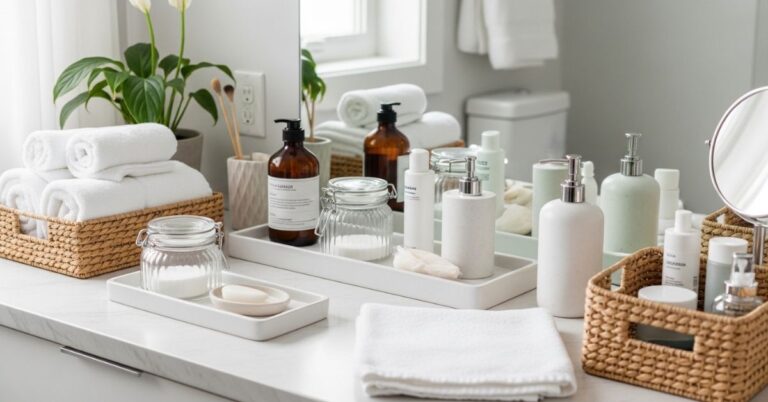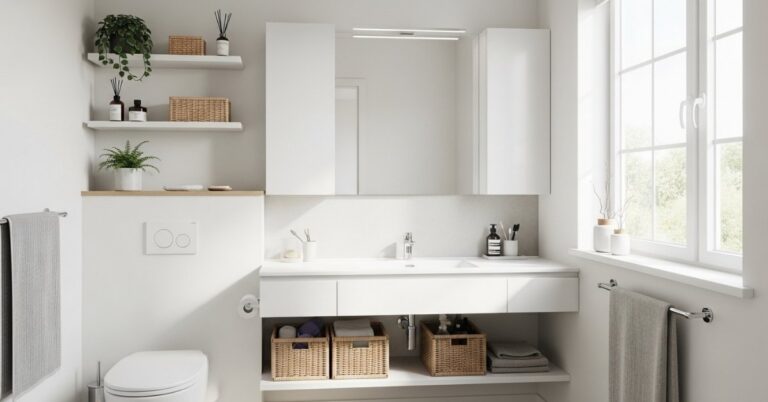
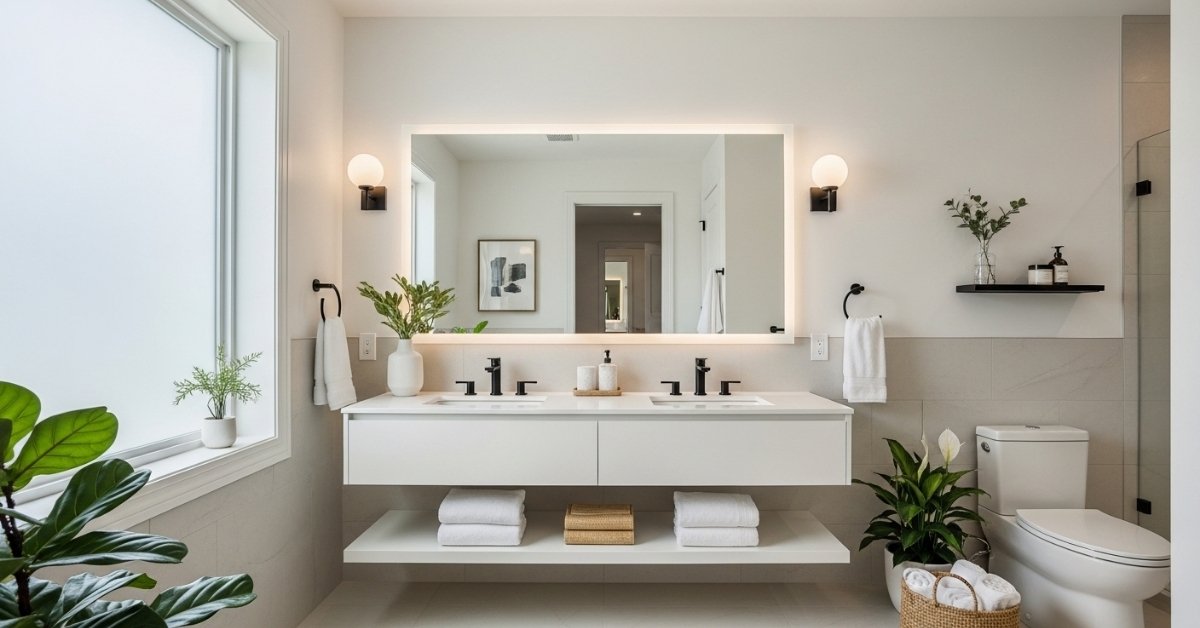
27 Modern Bathroom Decor Ideas That Actually Work in Real Homes
There’s something quietly frustrating about a bathroom that functions perfectly but feels like an afterthought. The layout is fine. The fixtures work. But the space lacks any personality, warmth, or visual logic and every morning you notice it.
Modern bathroom decor in 2026 has shifted away from the stark, cold minimalism that dominated the early 2020s. The new direction is warmer, more layered, and far more practical:Modern Bathroom Decor Ideas matte textures over high-gloss, mixed materials over matched sets, and lighting that feels intentional rather than just functional. If your style leans toward clean lines, neutral tones, and spaces that feel curated without looking like a showroom, this list was built for you.
For anyone working with a small bathroom, a rented apartment, or a tight renovation budget most of these ideas don’t require structural changes. They work with what you already have.
Warm-Toned Vanity With a Floating Mirror and Layered Lighting
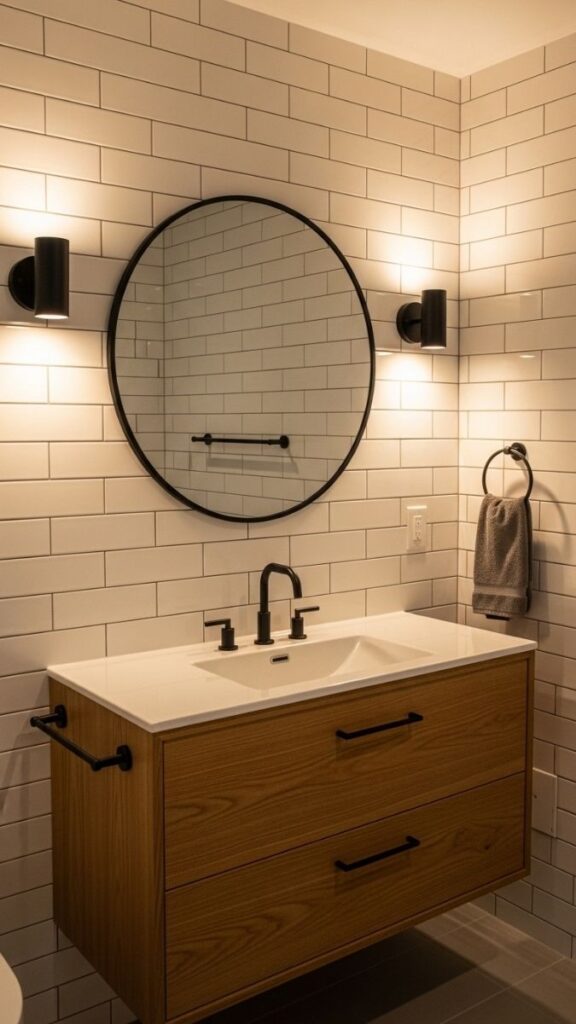
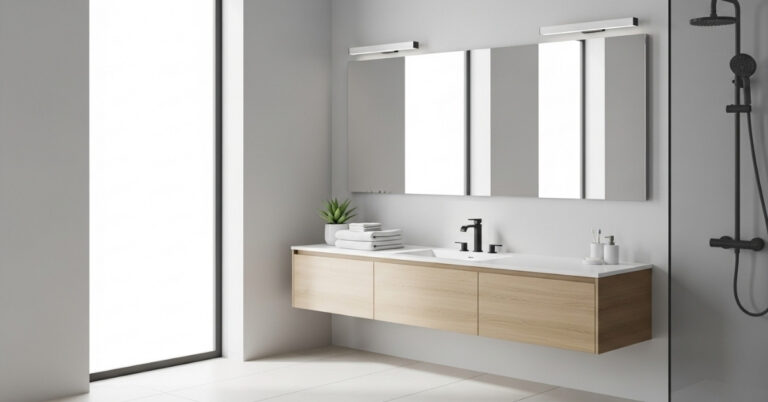
Wall sconces flanking a mirror solve one of the most common bathroom frustrations: overhead lighting that casts shadows exactly where you don’t want them. Pair this with a warm-toned wood vanity oak, walnut, or even a convincing laminate and you shift the room from clinical to considered. The floating vanity keeps the floor visible, which reads as more square footage whether the room is 50 or 150 square feet.
This setup works especially well in narrow bathrooms where standard vanity lighting creates harsh shadows on the face. The sconces distribute light horizontally, making the mirror more functional as a grooming space. For renters: adhesive sconces connected to a plug-in cord are a legitimate option and require zero installation.
Matte Black Hardware Throughout Including Towel Bars and Drain Covers
Swapping out builder-grade chrome hardware for matte black throughout the entire bathroom creates visual continuity that makes a space feel intentionally designed rather than assembled in pieces. The matte finish resists fingerprints better than polished chrome, which is a practical point worth noting in a high-use room.
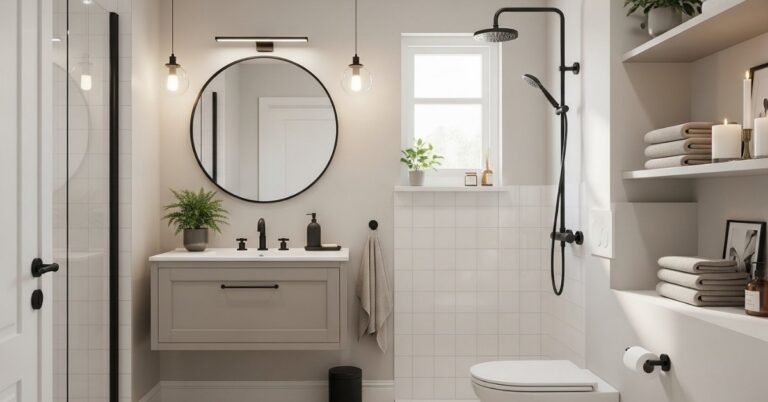
This approach works in bathrooms of all sizes, but it’s especially effective in smaller spaces where a consistent finish pulls the eye across the room without creating visual noise. The key is consistency mixing matte black with chrome knobs or silver towel bars breaks the effect. Budget tip: toilet paper holders and towel rings are inexpensive starting points before committing to full faucet replacement.
Curved Mirror Above a Rectangular Sink The Shape Contrast Rule
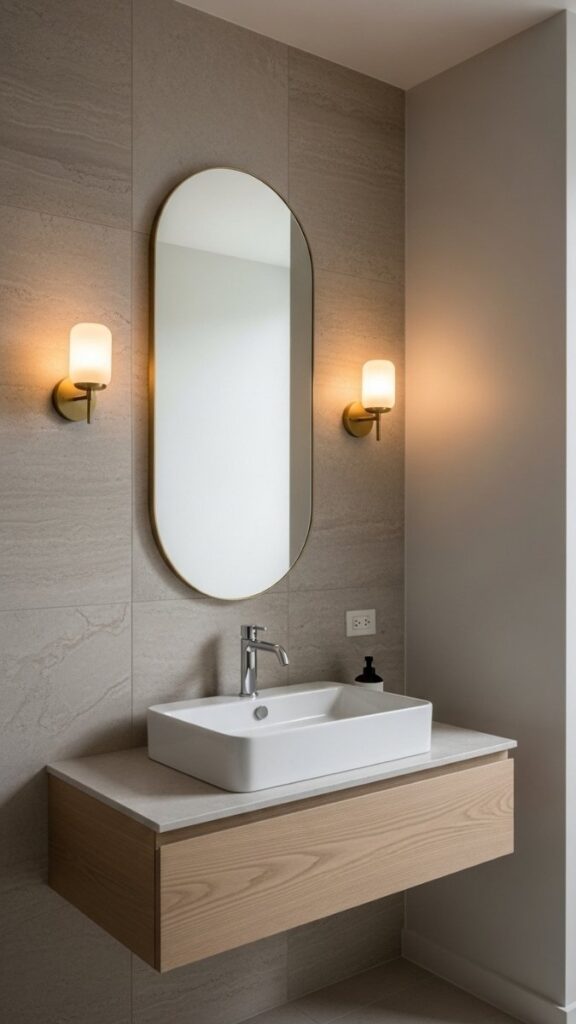
A rectangular vanity topped with an arched or oval mirror is one of the most reliable visual upgrades in modern bathroom design. The curved shape softens the hard geometry of a typical bathroom with squared tiles, rectangular countertops, linear shelving and creates a focal point that reads as intentional rather than generic.
This works best in bathrooms where the vanity wall is the first thing you see when entering. The mirror becomes an anchor without needing anything else on that wall. In my experience, this combination tends to photograph well and gives small powder rooms the sense of being designed, not just functional.
Open Wood Shelving Below or Beside the Vanity
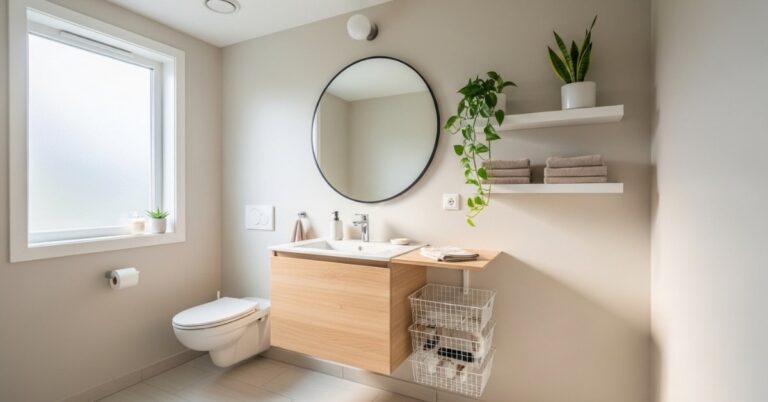
Open shelving under or beside a sink creates accessible, visible storage that forces a certain amount of organization and that visibility is the point. When the storage is open, you tend to curate it more carefully, which means fewer things end up on the counter. Rolled towels, a small plant, a couple of ceramic vessels this is practical storage that also reads as decor.
This setup is especially useful in bathrooms where under-sink cabinets have been removed or where a pedestal sink leaves dead space below. A solid wood shelf with clean brackets (or a floating mount) works here at most price points. It’s one of the few changes that simultaneously solves a storage problem and improves the visual texture of the room.
Vertical Tile Laid in a Herringbone or Stacked Pattern
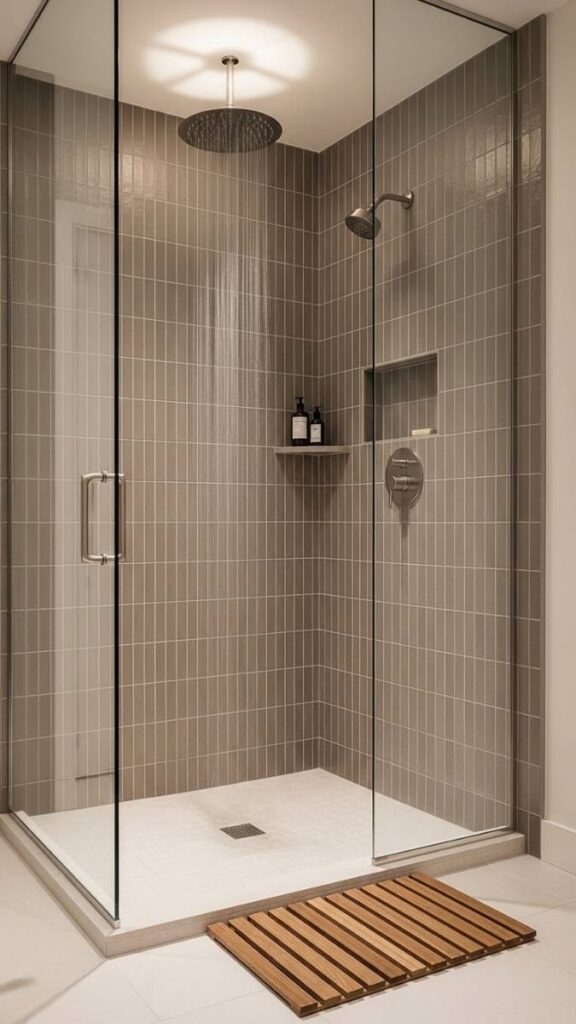
The direction your tile is laid matters more than most people realize. Vertical stacking in a shower or accent wall draws the eye upward, which makes ceilings read higher, a useful trick in rooms where the actual ceiling height is standard or low. Herringbone in a vertical orientation adds rhythm without requiring a second material or color.
This works particularly well in narrow shower enclosures where horizontal tile tends to compress the visual width of the space. The added installation cost is modest, but the spatial effect is substantial. If you’re renovating a rental or working with a tile contractor, it’s worth requesting the material cost is identical, only the labor changes slightly.
A Statement Bathtub Positioned as the Room’s Focal Point
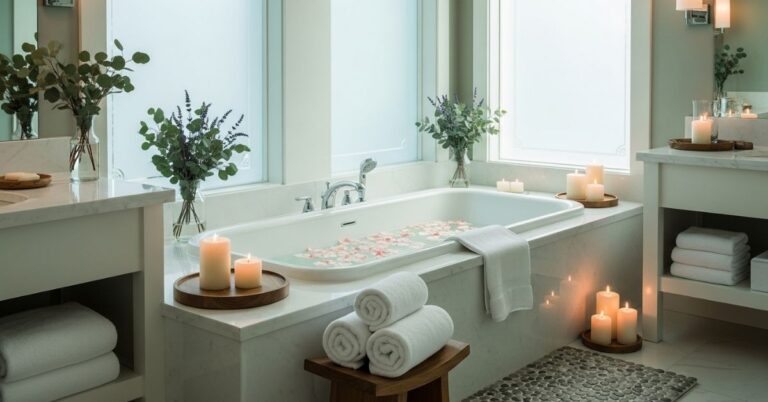
When a freestanding tub is placed intentionally centered against an accent wall, backed by floor-to-ceiling tile it shifts from a fixture to the architectural centerpiece of the room. The space around the tub matters as much as the tub itself: 18 to 24 inches of clearance on each side keeps the room from feeling crowded, and enough floor space for a bath mat and small side tray signals that the area is meant to be used and enjoyed.
This is primarily a large bathroom move, though some elongated bathroom layouts can accommodate a freestanding tub in a way that doesn’t sacrifice movement. The wall-mounted floor filler faucet (positioned at the side rather than the foot) takes up less visual real estate than a traditional deck-mount.
Limewash or Mineral Paint on One Bathroom Wall
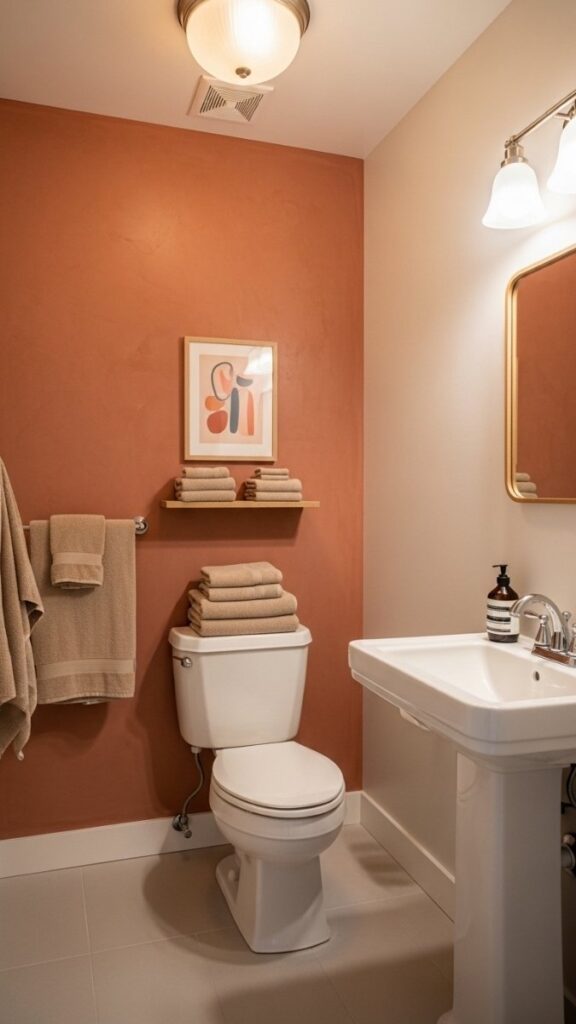
Limewash paint has moved from boutique to mainstream in 2025–2026, and the bathroom is one of the best applications for it. The textured, slightly uneven finish adds depth to a wall without the commitment of tile and it works even in humid environments if properly sealed. One limewash wall in a bathroom dominated by flat, matte surfaces creates the kind of visual contrast that makes a small room feel less like a utility space and more like a considered environment.
This is an excellent option for renters who own their space or for those who want to experiment with a warmer aesthetic without a full renovation. The application is DIY-friendly with the right tools, and the color range from warm terracotta to aged sage to dusty off-white fits naturally with modern neutral palettes.
Frameless Glass Shower Door Instead of a Curtain Rod Setup
A frameless glass shower panel or door opens up sight lines in a bathroom more effectively than almost any other single change. Unlike shower curtains, which visually cut the room in half when drawn, frameless glass lets the eye travel through to the tile behind making the whole room read as larger. The minimal hardware also reduces visual clutter compared to curtain rings, tension rods, and hooks.
This is a medium-investment change (typically $300–$800+ depending on size and installation), but the spatial effect justifies it in bathrooms where the shower is positioned along one of the main visual axes. In smaller bathrooms especially, this can be one of the most impactful upgrades relative to cost.
Read More About : 27 Modern Bathroom Decor Ideas That Actually Work in Real Homes
Recessed Wall Niche in the Shower for Minimal Clutter
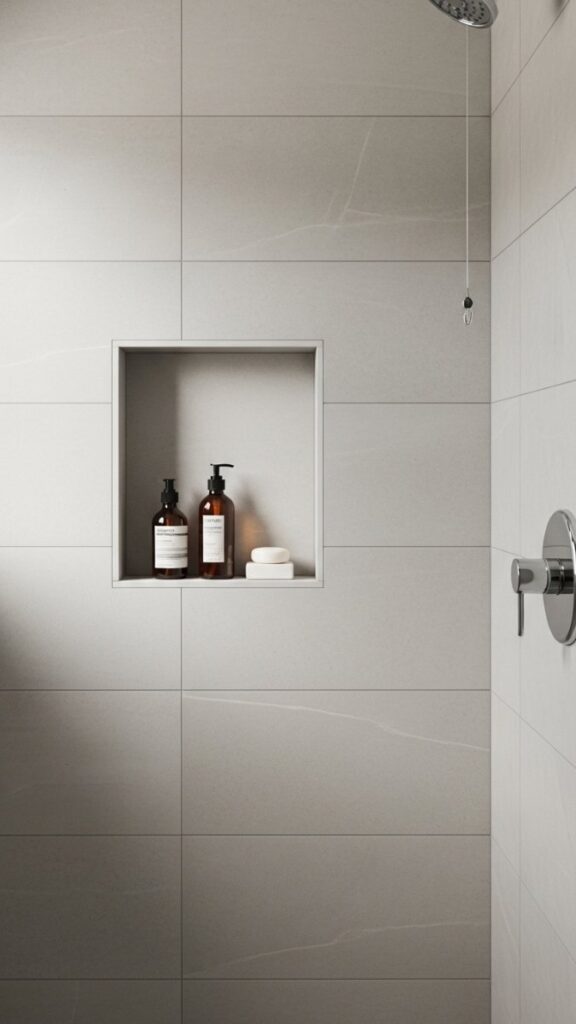
A shower niche tiled to match the surround and set flush with the wall eliminates the bottle accumulation that makes most showers look disorganized within a week of cleaning. It’s built into the wall plane, so it doesn’t project into the shower space, and it reads as a designed detail rather than a storage solution.
This is a renovation item (requires cutting into the wall before tile installation), but it’s worth planning for if you’re doing any tile work. The niche itself adds minimal material cost. Standard size is 12 inches wide by 24 inches tall between studs, though wider niches spanning two stud bays also work if planned ahead.
Warm Wood Accents: Bath Mat, Tray, and Mirror Frame
Wood in the bathroom specifically teak or bamboo, both naturally water-resistant adds material warmth that no amount of tile or paint fully replicates. A teak bath mat brings texture at floor level, which breaks the monotony of a fully tiled or fully white bathroom floor. A wood tray on the vanity counter corrals items that would otherwise scatter across the surface and creates an organized grouping that reads as curated.
This is a no-installation approach that works for renters and apartment dwellers. The wood-to-white contrast is the mechanism here; it’s the material difference that creates visual interest, not the size or price of the items.
Matte Ceramic or Concrete-Look Countertop Instead of Gloss Surfaces
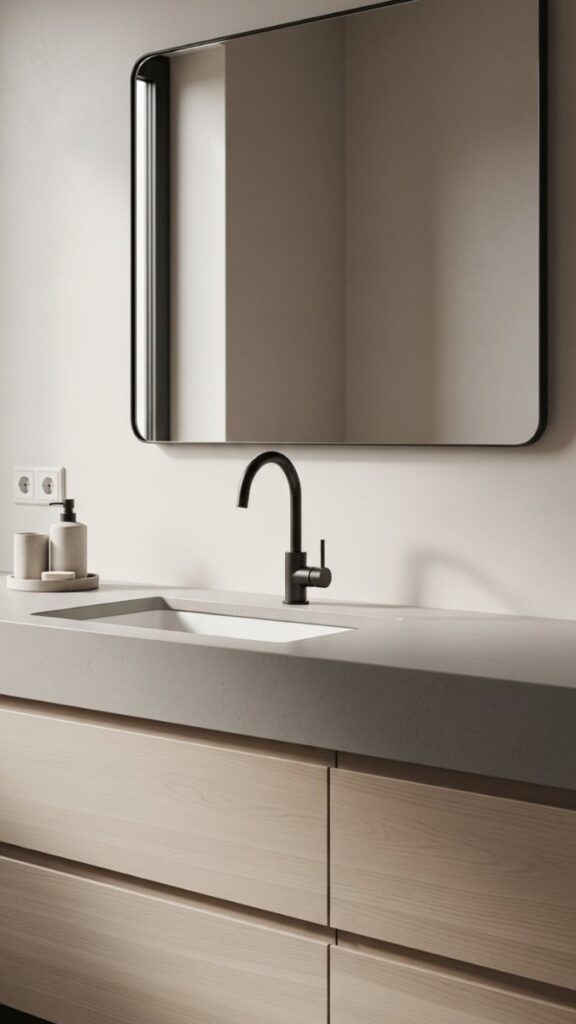
Matte and concrete-look surfaces have a quieter visual presence than high-gloss countertops; they absorb light rather than reflect it, which reduces the stark, clinical feel that many bathrooms carry. Flat-front cabinetry paired with a matte countertop surface is one of the cleaner expressions of modern bathroom design right now, and it photographs significantly better than polished alternatives.
From a practical standpoint, matte surfaces also show water spots and toothpaste less visibly than high-gloss, which matters in a heavily used room. Many of these surfaces are now available as porcelain slabs, which are more durable and moisture-resistant than actual concrete.
Vertical Towel Ladder Leaning Against the Wall
A towel ladder is one of the most functional small-space solutions for a bathroom that can’t (or shouldn’t) have mounted towel bars whether due to rental restrictions or wall configuration. The vertical format takes up minimal floor space (roughly 12 to 18 inches of depth) while providing hanging capacity for multiple towels. Positioned beside a bathtub or next to the vanity, it integrates naturally into the room without requiring installation.
This setup works especially well in bathrooms with limited wall space or in layouts where standard towel bar placement would land awkwardly between fixtures. The ladder adds visual height, which benefits rooms with lower ceilings.
A Single Large-Format Floor Tile Instead of Grout-Heavy Small Tiles
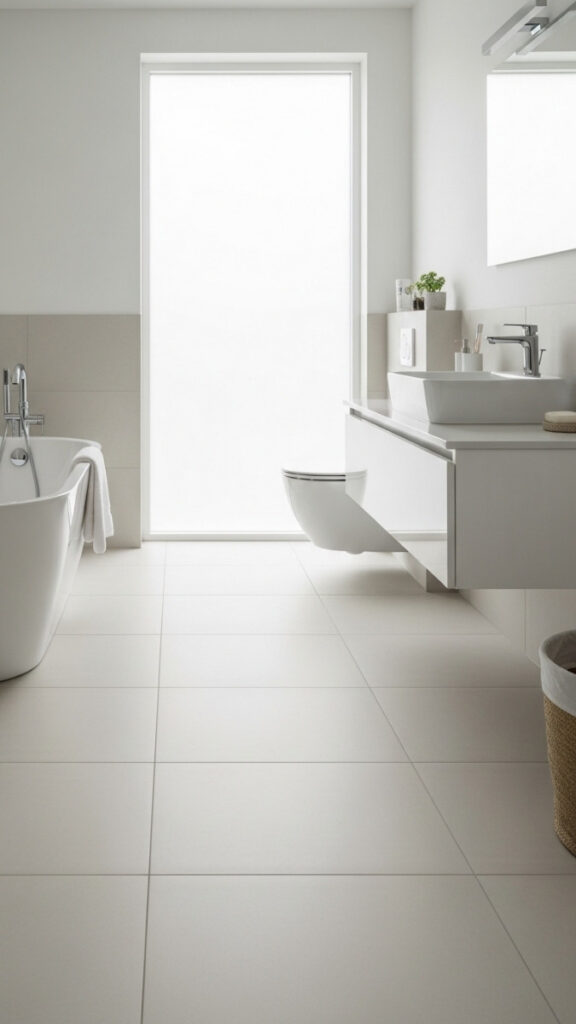
Fewer grout lines on the floor create a cleaner visual surface that reads as more spacious, especially in bathrooms under 60 square feet where a grid of 4-inch tiles fragments the floor visually. A large-format tile (18×18 or 24×24) also reduces cleaning time, since grout lines are where most of the maintenance effort goes.
The limitation is cost: larger tiles typically require more precise floor preparation and cost more to install. They’re also less forgiving on uneven subfloors. But for bathrooms undergoing any renovation, large-format tile is worth the upgrade from standard sizing; the spatial and maintenance benefits are real.
Backlit Mirror for Functional and Ambient Light
A backlit mirror serves two purposes that a standard mirror doesn’t: it provides usable light at face level (critical for anything involving makeup, skincare, or grooming), and it acts as a soft ambient light source when the overhead is too harsh or switched off. The glow from behind the mirror creates a halo effect that adds depth to the wall without any additional lighting fixture.
This is particularly effective in bathrooms with no natural light, where the standard overhead fixture creates a flat, unpleasant quality of light. Many backlit mirrors now include dimmable settings and adjustable color temperature, which makes them genuinely adaptable across different times of day.
Neutral Linen or Waffle-Weave Towels as Visual Elements
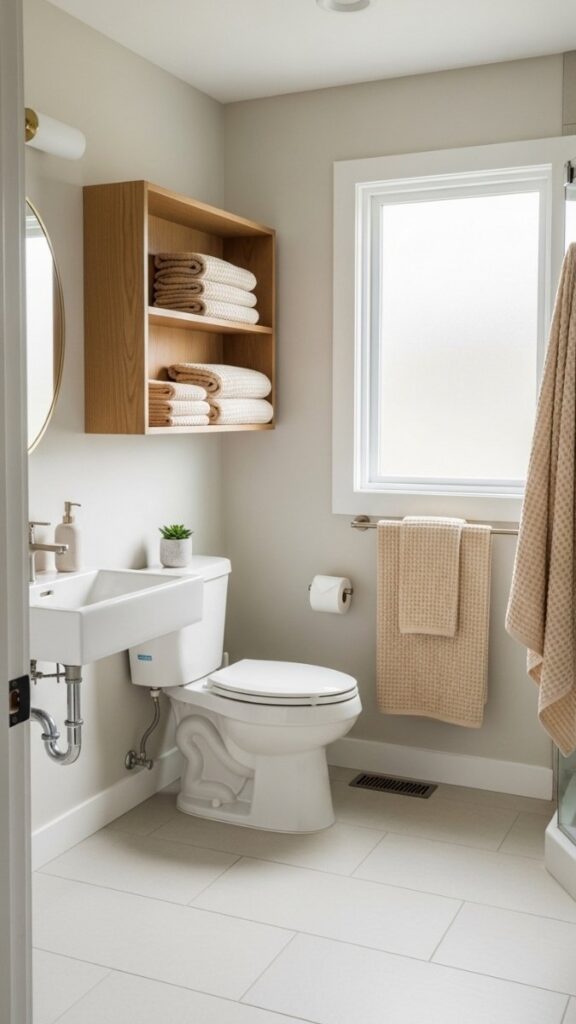
Towels are one of the fastest, most affordable ways to shift the visual temperature of a bathroom. Waffle-weave and linen-look towels in neutral tones oatmeal, bone, warm white, dusty sage photograph more softly than fluffy white hotel towels and age more gracefully than bright colors. Arranged simply on open shelving or a towel bar, they contribute to the room’s visual texture without competing with tile or wall color.
This is purely an aesthetic and tactile move, not a spatial one. But in a bathroom where most surfaces are hard (tile, porcelain, glass), soft textiles carry more visual weight than most people account for.
Monochromatic Color Scheme With One Material Contrast
A fully monochromatic bathroom all white, all warm beige, or all soft gray creates a sense of visual calm that a mixed-color bathroom rarely achieves. The key is introducing one material contrast: a wood shelf in an all-white room, a black matte fixture in an all-neutral room, or a terracotta pot in an all-white room. That single contrast becomes the focal point and prevents the monochromatic scheme from reading as sterile.
This setup is well-suited to small bathrooms where too many competing colors make the space feel busier than it is. The fewer the elements, the more intentional each one appears.
Integrated Shelf Above the Toilet for Vertical Storage
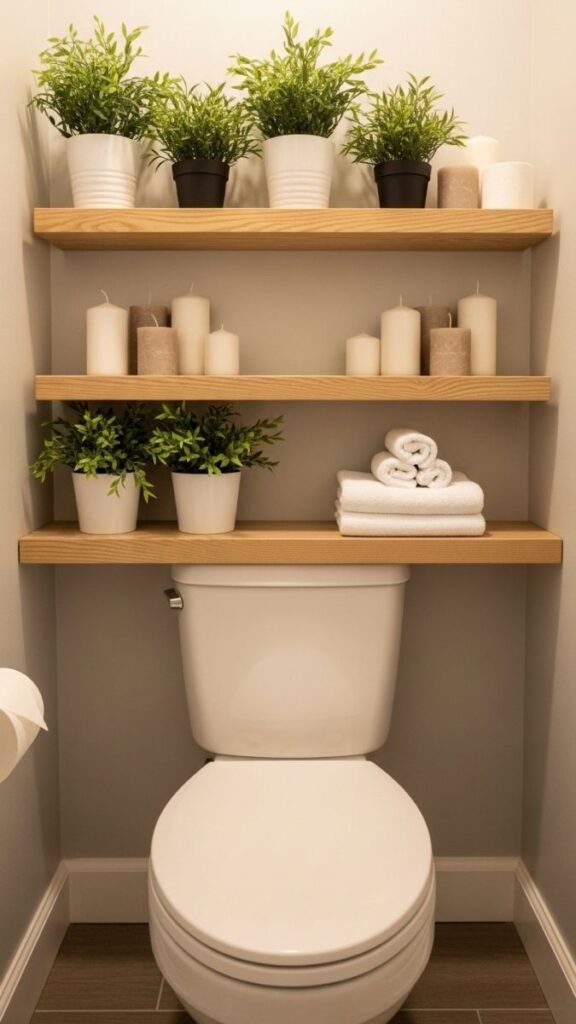
The wall above a toilet is one of the most underused surfaces in a home. A single floating shelf positioned about 12 inches above the tank creates a display and storage zone that’s completely separate from the vanity counter. This keeps everyday items off the sink area and moves visual interest up the wall, drawing the eye away from the toilet itself.
This is also one of the easiest DIY-friendly installations in a bathroom. A solid floating shelf, two wall anchors, and hardware can be installed in under an hour. For renters: freestanding ladder shelves designed to straddle a toilet accomplish a similar visual result without any mounting.
Mixed Metal Finish (Done Intentionally)
Mixed metals in a bathroom work when one finish is dominant and the others are supporting players. A brushed gold faucet paired with matte black towel hardware, for example, creates warmth and contrast without visual chaos as long as both finishes are matte or satin rather than polished. Introducing polished chrome into a matte-finish scheme is where mixed metals typically break down.
The rule I’ve found most useful here: limit to two metal finishes maximum, and let the faucet or the lighting fixture define the dominant choice. Everything else should either match or defer.
Indoor Plants Positioned for Humidity and Light
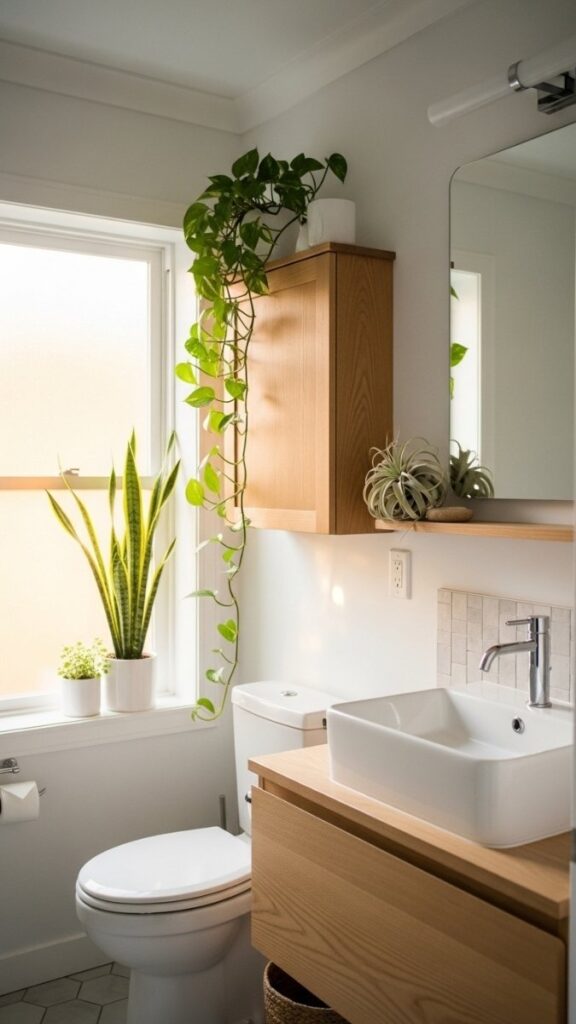
The right plants, pothos, snake plants, air plants, or peace lilies genuinely thrive in bathroom humidity and add an organic texture that no decor item replicates. The challenge is light: a bathroom with a window can support almost any of these; a fully interior bathroom with no natural light limits options to low-light varieties or those near the door.
Plant placement matters spatially. A trailing plant on top of a cabinet or shelf brings life to a vertical surface without occupying counter space. An air plant in a small ceramic holder on the vanity adds texture at eye level. The goal is organic presence, not a greenhouse; two or three plants placed thoughtfully outperform six plants crammed into available surfaces.
Penny Tile or Mosaic Accent Floor in the Shower
A mosaic or penny tile floor inside the shower in a contrasting color or material from the wall tile creates visual differentiation between the wet and dry zones of the bathroom. It defines the shower area without a physical divider and adds a pattern at the one surface that’s rarely the focus: the floor.
Functionally, smaller tiles in a shower floor also increase the number of grout lines, which improves slip resistance, a practical consideration in a wet surface. The visual interest is a bonus. This works at every price point, from ceramic penny tiles under $5/sq ft to handmade terracotta options at a significant premium.
Warm Amber or Dimmer-Controlled Overhead Lighting
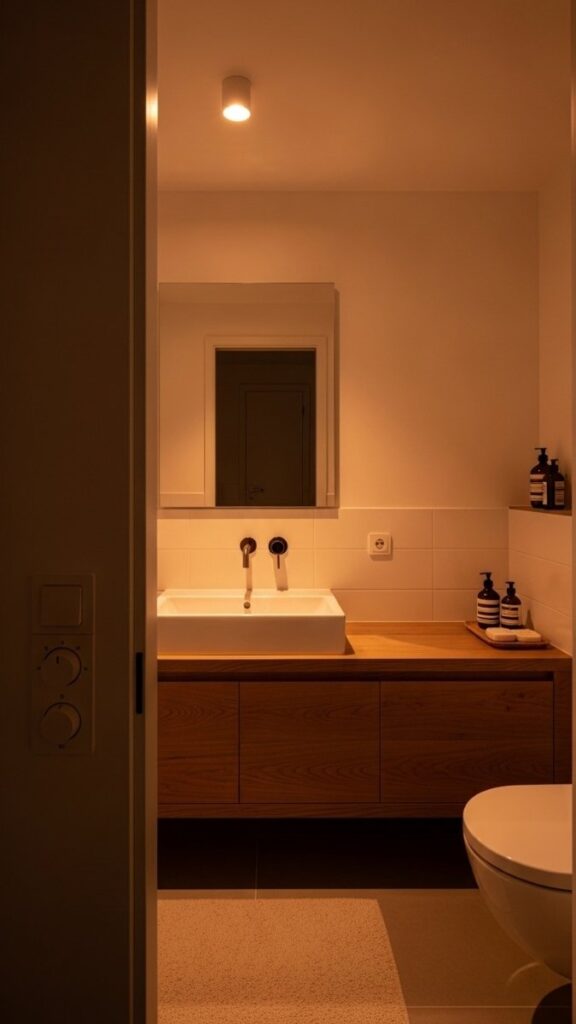
Most bathrooms are lit at 4000K (cool white) or higher, which produces the kind of light that makes every imperfection visible and every surface look slightly clinical. Shifting to 2700K–3000K bulbs warm white, close to incandescent changes the mood of the entire room without touching the layout. Adding a dimmer switch amplifies this further, allowing task lighting at full brightness and ambient lighting at 30–40% when the goal is a bath rather than grooming.
This is one of the lowest-cost, highest-impact changes in this list. Bulb cost plus a dimmer switch runs under $40 in most cases. The spatial effect isn’t about making the room larger or more functional, it’s about how the room feels at different times of day.
Read More About : 27 Small Bathroom Makeover Ideas That Make Every Square Foot Work Harder
Flat-Front Cabinetry with Integrated Pulls
Flat-front cabinetry with no raised panels, no decorative edges is the most common expression of modern bathroom design in 2026. The clean facade reads as contemporary without being stark, especially when paired with warm-toned wood or a matte painted finish. Integrated pulls (routed into the top edge of the door) or minimal bar pulls maintain the clean line without hardware becoming a focal point.
This is primarily relevant for those renovating or replacing vanities. For existing cabinetry, swapping raised-panel doors for flat-front replacements is possible but involves measuring and ordering new door blanks worth considering if the existing case is structurally sound.
Glass Shelf Instead of a Standard Vanity Mirror Cabinet
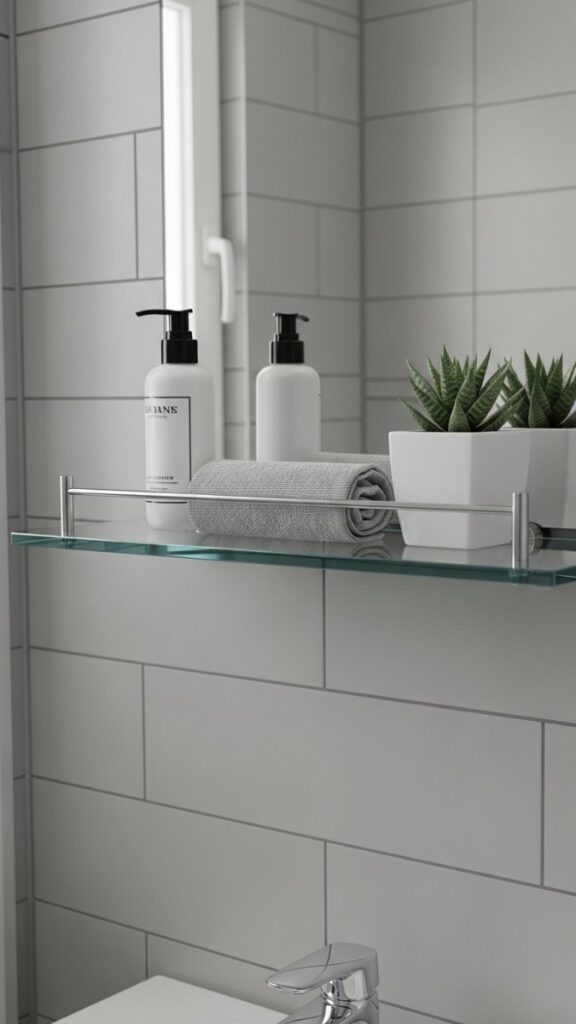
A glass shelf beside or below the main mirror provides open storage without the visual weight of a traditional mirror cabinet. The transparency of the glass means it doesn’t interrupt sight lines across the wall, and the shelf’s depth (typically 4–6 inches) is enough for small toiletry items, a small plant, or a candle without projecting into the room. This is particularly effective in small bathrooms where a medicine cabinet’s door swing would create movement constraints.
For bathrooms where a medicine cabinet is necessary for storage, a recessed model (set into the wall rather than surface-mounted) reduces protrusion and reads more cleanly on the wall plane.
Bath Tray Across the Tub Function Meets Decor
A bath tray that spans the width of the tub transforms what’s often a purely functional surface into an organized zone that signals that the tub is actually meant to be used. The tray keeps surfaces stable, holds items off the tub ledge, and creates a composed vignette that photographs well even when the room is otherwise simple.
This works in any tub, including standard alcove tubs that aren’t freestanding; the tray’s visual effect doesn’t depend on the tub being a statement piece. Wood, bamboo, and matte black metal are the most practical finishes. Avoid chrome in a setup where the rest of the hardware is matte.
Arched Alcove or Niche Behind the Vanity Mirror
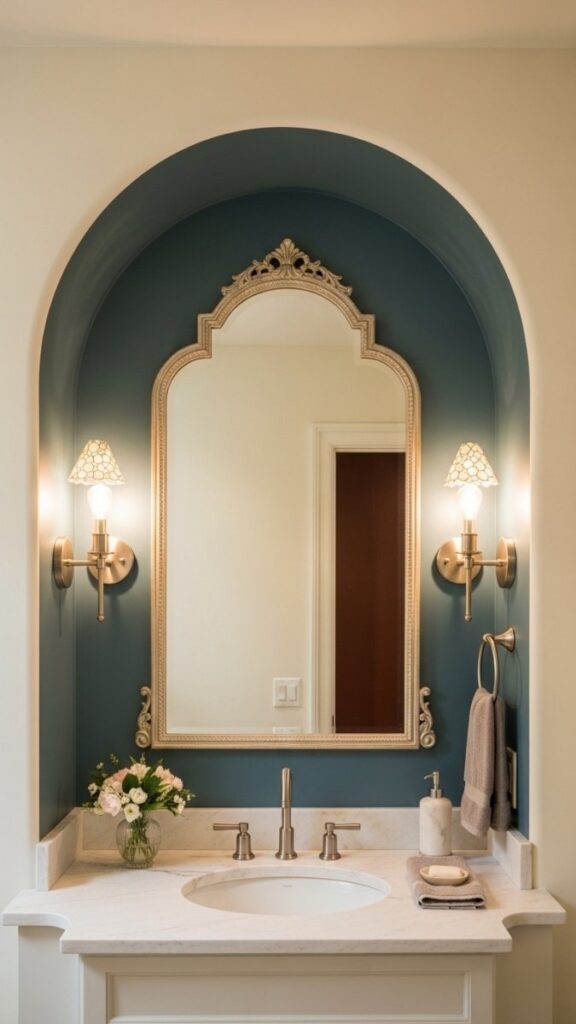
An arched alcove painted a deeper tone than the surrounding wall framing the vanity mirror creates the kind of architectural detail that most bathrooms don’t have. It can be built with standard materials (drywall and paint) without touching the structural wall and adds depth to the mirror zone without requiring additional fixtures or furniture.
This is a renovation or DIY project that requires basic carpentry skills, but it’s more achievable than it looks. The finished result makes the vanity wall read as a designed feature rather than a flat surface with a mirror hung on it.
Dark Grout With Light Tile for Visual Depth
Dark grout with light tile reverses the standard approach and creates a graphic, intentional look that reads as more designed than the typical white-on-white combination. The contrast also means the grout lines don’t disappear visually; they become a deliberate pattern element, emphasizing the tile layout (subway, brick, large format) rather than minimizing it.
From a maintenance perspective, this is the practical choice: dark grout doesn’t show discoloration the way white grout does over time. In high-humidity environments like showers, this is worth accounting for beyond the aesthetic.
A Minimal Artwork Piece One, Framed Properly
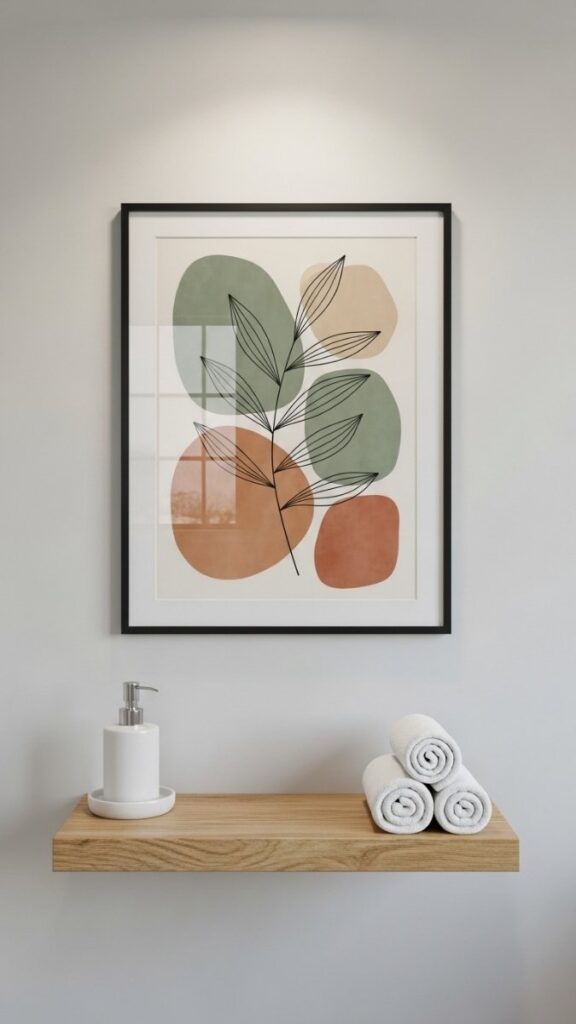
One piece of art, properly framed and intentionally placed, does more for a bathroom’s sense of character than a gallery wall of small prints ever does. In a room this size, more is rarely better. A single piece, a botanical print, a simple abstract, a framed architectural photograph gives the eye somewhere to land without competing with tile, mirrors, or lighting.
Frame selection matters: a simple thin black or natural wood frame at 8×10 or 11×14 is usually the right scale for a standard bathroom wall. Larger prints work above a freestanding tub or on a long wall opposite the vanity. Seal or laminate the piece if humidity is a concern, or use a print without sentimental value so replacement is no issue.
What Actually Makes These Ideas Work
The consistent thread across effective modern bathroom decor is restraint with fewer materials, fewer finishes, fewer competing elements. Modern bathrooms tend to fail not because of what’s missing, but because of what’s been added without a clear visual logic: chrome fixtures with brushed gold accessories with warm wood and cool gray tile and three different paint colors.
The spatial mechanics matter too. Light-colored surfaces, vertical lines, and open floor space all expand the perceived size of a bathroom. Dark colors, heavy furniture, and visual fragmentation (too many small items, too many grout lines, too many patterns) compress it. Understanding which direction you want to move in before making changes saves both money and renovation regret.
Lighting is the most underweighted factor in most bathroom decisions. Tile, fixtures, and hardware choices made under harsh overhead fluorescent lighting will look different under warm, layered, dimmer-controlled lighting and the warm version is almost always better. If you can only change one thing in a bathroom, changing the bulb temperature and adding a dimmer costs the least and delivers the most noticeable result.
Modern Bathroom Decor: Setup Guide by Space Type
| Setup | Best For | Space Type | Key Benefit | Budget Level |
| Floating vanity + sconce lighting | Narrow bathrooms | Small to medium | Floor visibility + functional lighting | Mid |
| Freestanding tub as focal point | Large bathrooms | Large, open | Architectural statement | High |
| Ladder towel rack + open shelving | Renter-friendly setups | Any size | Flexible, no installation needed | Low |
| Limewash accent wall | Character-building on a budget | Small to medium | Texture without renovation | Low–Mid |
| Frameless glass shower panel | Bathrooms with natural light | Small to medium | Open sight lines | Mid–High |
| Large-format tile floor | Renovation contexts | Any size | Fewer grout lines, more spacious read | Mid–High |
| Backlit mirror | Interior or low-light bathrooms | Any size | Task + ambient light in one fixture | Mid |
| Recessed wall niche | Shower tile renovation | Shower-specific | Permanent, clutter-free storage | Mid |
FAQ’s
What’s the most impactful change you can make to a small bathroom without renovating?
Lighting. Replacing cool-white bulbs (4000K+) with warm-white (2700–3000K) and adding a dimmer switch changes how every surface in the room looks and feels. It costs under $40 in most cases and requires no installation beyond swapping a switch plate.
How do you make a bathroom feel more modern without replacing fixtures?
Focus on hardware and finishes rather than fixtures. Replacing towel bars, toilet paper holders, and cabinet pulls with a consistent matte black or brushed gold set, adding a frameless mirror, and introducing one or two warm-toned textiles can shift the visual register significantly, none of which requires fixture replacement.
Is mixing metal finishes in a bathroom a design mistake?
Not necessarily. Two matte or satin finishes (brushed gold faucet + matte black towel hardware, for example) can coexist effectively as long as one finish is dominant. The combination fails when three or more finishes appear, when polished and matte finishes mix, or when no clear hierarchy exists between them.
What tile layout makes a small bathroom feel bigger?
Vertical tile orientation (especially stacked or vertical herringbone in a shower) draws the eye upward, which helps low-ceiling bathrooms read taller. Large-format floor tile with minimal grout lines also reduces visual fragmentation, which makes floors appear more expansive.
How do I add storage to a bathroom without it looking cluttered?
Contain the storage: a floating shelf above the toilet, a vanity with drawers, or a recessed niche in the shower all provide storage without projecting into the room or sitting openly on countertops. The difference between useful storage and clutter is usually whether items are contained in a defined zone or scattered across available surfaces.
Are plants a realistic option for a bathroom with no windows?
Mostly no, with some exceptions. Air plants can survive in low-light bathrooms if they’re moved to a light source a few times a week. Pothos are tolerant of low light but won’t thrive indefinitely without some indirect natural light. A bathroom with a skylight or a translucent window is a more viable plant environment than a fully interior room.
What’s the current trend in modern bathroom design for 2026?
The dominant direction is warmer minimalism neutral palettes with warm undertones (sand, terracotta, warm gray), matte textures over high-gloss surfaces, mixed natural materials (wood + stone + ceramic), and lighting that feels ambient rather than functional. The cold, all-white, high-gloss bathroom aesthetic that peaked around 2018–2020 has largely given way to something that feels more livable.
Conclusion
A well-designed bathroom doesn’t require a full renovation; it requires a clear visual logic applied consistently. Whether that’s a consistent metal finish, a single material contrast, or a deliberate lighting setup, the cumulative effect of a few intentional changes tends to outperform a room full of uncoordinated updates.
Start with one or two ideas that fit your space, your budget, and the fixtures you already have. A warm-toned bulb swap and a new mirror, or a towel ladder and a set of neutral linen towels, are enough to make the room feel different in a meaningful way. Build from there.