

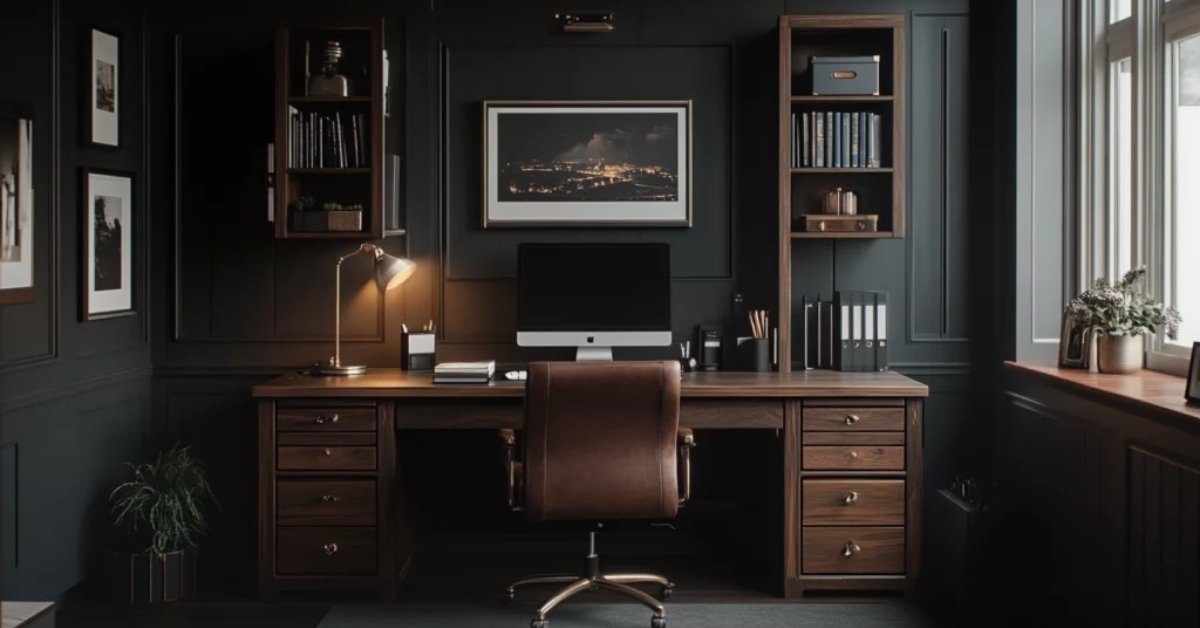
If your current workspace is a corner of the dining table surrounded by charging cables and old mail, you already know the problem, it’s not just ugly, it’s draining. A scattered, visually noisy setup makes it harder to focus, and harder to feel like the work you’re doing matters. Aesthetic Home Office Ideas The good news is that creating a home office that’s both functional and genuinely beautiful doesn’t require a renovation or a big budget. It requires some clarity on layout, lighting, and the few elements that actually shape how a space feels.
This is for anyone working from a spare bedroom, a compact apartment, or an awkward corner of a living room who wants a setup that supports deep work, not one that looks good only in photos. Whether your style leans warm and organic or clean and minimal, these ideas are grounded in how real spaces work, not how staged ones look.
Float a Narrow Desk Against a Window Wall for Natural Front Lighting

A desk placed perpendicular to or directly facing a window gives you something expensive lamps struggle to replicate: natural, diffused front lighting that reduces eye strain and makes your face look good on video calls. Keeping the desk surface narrow60 to 70cm deep is enough for a laptop or monitor setup so the window doesn’t feel blocked when you’re seated. The visual effect of looking out or toward light while you work also naturally reduces the claustrophobic feeling of a small room. This layout works best in spare bedrooms or living rooms where one full wall gets consistent daylight. It solves the twin problems of insufficient task lighting and the psychological heaviness of facing a blank wall all day.
Use a Wall-Mounted Desk to Recover Floor Space in Small Rooms
When the room is small enough that a traditional desk makes it feel like a hallway, a wall-mounted or fold-down desk changes the equation completely. Mounted at the right heighttypically 73 to 76cm from floor level it functions identically to a freestanding desk but folds flat when you close your laptop. The floor stays clear, which visually doubles the apparent size of the room. In a studio apartment or a small guest-bedroom-turned-office, the moveable floor space also lets the room serve double duty. What it solves: the permanent footprint of a desk in a room that needs to be more than one thing.
Layer Warm Lighting With a Desk Lamp, Bias Light, and Overhead Dimmer

One overhead light source is the fastest way to make an office feel like a waiting room. Layering three light sources/ambient (ceiling), task (desk lamp), and accent (bias light behind a monitor or shelf)gives you control over mood and function at different times of day. The bias light specifically reduces the contrast between a bright screen and a dark background, which significantly lowers visual fatigue over long sessions. In the evening, dimming the overhead and relying on warm task lighting makes the space feel more like a study than a corporate cubicle. This setup works in any sized room and is entirely renter-friendly no rewiring needed.
Build a Bookshelf Backdrop That Doubles as Visual Structure
A bookshelf positioned behind your chair isn’t just storage it creates a composed, structured background that anchors the whole room. The key is editing what goes on it: too much visual noise makes the space feel chaotic rather than curated. Aim for a mix of books grouped by spine color or size, one or two small plants, and a few objects with material interest (a ceramic pot, a small framed print). I’ve noticed this kind of backdrop works best in rooms where there’s no natural architectural feature, no fireplace, no interesting wall because the shelf itself becomes the focal point. It also solves the video call problem of having nothing interesting (or worse, something embarrassing) behind you.
Choose a Chair With Visible Legs to Keep the Room Feeling Open

Furniture that sits directly on the floor creates a visual base line that shortens the apparent height of a room. A chair with exposed, tapered legs, whether wood or metallic light passes underneath and keeps the eye moving through the space rather than stopping at a heavy base. This is especially relevant in smaller rooms where every visual trick that creates a sense of openness matters. Functionally, chairs with visible structure (as opposed to upholstered cube chairs) tend to encourage a more active, upright sitting position, which helps with sustained focus. A mid-century style task chair or a Scandinavian-influenced wood chair works well here without looking costume-y.
Paint One Wall a Deep Neutral to Define the Workspace
A single painted accent wall doesn’t have to be dramatic to be effective. In a home office context, a deep warm neutral olive, warm greige, dusty terracotta, or muted navyon the wall behind or beside the desk creates a visual boundary that separates the workspace from the rest of the room. For renters, removable peel-and-stick panels or large-format wallpaper can achieve a nearly identical effect. The psychological function here is real: having a visually distinct zone cues your brain that this is where work happens, which is harder to achieve in open-plan apartments. It also adds depth to a flat, plain room without requiring furniture changes.
Mount Your Monitor at Eye Level to Open Up the Desk Surface

A monitor on a fixed stand takes up 20 to 30cm of desk depth and forces you to either look slightly down or crane upward, depending on the model. A monitor arm mounts the screen at true eye level, reclaims the entire stand footprint, and lets you swing the screen out of the way when you need the desk surface for something else. Aesthetically, it also looks considerably cleanerno chunky stand base competing for space. This is one of those changes that’s both a comfort upgrade and a visual improvement simultaneously. It works in any office setup but is especially useful on smaller desks where surface area is limited.
Use a Pegboard or Slatwall Panel for a Flexible Storage Wall
An unbroken wall above a desk is either wasted space or a spot that collects random stickies and charging cables over time. A pegboard or slatwall panel turns that vertical area into fully customizable, visible storage. The practical advantage is that everything you reach for regularlypens, headphones, a small shelf for a notebook lives within arm’s reach without cluttering the desk surface. The visual advantage is that organized tools on a pegboard look intentional, not messy. For a more refined look, stick to one material finish: all wood, or all black metal, rather than mixing hardware styles. This works especially well in small offices where a storage cabinet would eat too much floor space.
Position a Rug Under (Not Around) the Desk to Anchor the Zone

A rug placed so the front legs of the desk and the chair roll onto it defines the workspace as its own contained zone, especially important in open-plan layouts where the office exists within a larger living space. The rug creates a visual ground plane that says “this area is different from the rest of the room.” For functionality, a low-pile or flatweave rug is easier to roll a chair on than a thick pile. A natural fiber rugite, sisal, or a cotton flat-weave stays neutral enough to work with almost any desk color and adds texture without adding visual noise. The rug should extend roughly 60cm past the sides of the desk to feel proportional.
Add a Tall Narrow Shelf Beside the Desk for Vertical Storage
Most home offices underuse vertical space. A slim bookshelf30 to 35cm deep and as tall as the ceiling will be positioned beside the desk stores significantly more than a wide, low credenza while using far less floor space. The height draws the eye upward, which makes a small room feel taller. Practically, it keeps frequently used items (notebooks, reference books, a small calendar) accessible from the desk chair without requiring you to stand or cross the room. For rooms with lower ceilings, the visual effect works best when the shelf reaches within 30cm of the ceiling, closing off the unused wall space above it.
Use a Linen or Boucle Desk Chair for Warmth Without Bulk

Most ergonomic office chairs are designed for function with little attention to how they look in a home setting. A chair upholstered in linen, boucle, or bouclette fabric brings warmth and texture to a space that can easily feel clinical. The key is to make sure the chair still has adequate lumbar support and seat depth for your workday aesthetics without comfort just creates a different kind of problem. Fabric chairs work best in rooms where spill risk is low and the aesthetic is warm-neutral rather than industrial. For longer work days, pair it with a portable lumbar cushion if needed. This is one I’d actually recommend trying first because it changes the entire feel of the room with one swap.
Keep Cable Management Tight With a Cable Box and Cord Clips
No amount of good furniture or careful lighting compensates for a desk where three chargers, two USB hubs, and a power strip are visible in a tangle. A cable management boxessentially a box with ventilation slots that hides a power strip and excess cord length sits on the floor or mounts under the desk and removes the visual noise entirely. Combine it with adhesive cord clips along the desk’s underside to route cables invisibly from devices to the box. This is genuinely one of the highest-return-per-dollar changes you can make to a desk setup. It solves the single most common reason an otherwise decent workspace still feels chaotic.
Read More About : 24 Aesthetic Home Office Ideas That Actually Work in Real Spaces
Hang One Large Art Print Above the Desk Instead of a Gallery Wall

A gallery wall in a home office often competes with the work itself, too much visual stimulation in your peripheral vision makes focus harder. A single, large-format print (at least 60 x 80cm) centered above the desk has the opposite effect: it reads as a deliberate choice, grounds the wall without fragmenting it, and gives the eye somewhere to rest during thinking pauses. The content matters less than the palette, choose something with tones that complement the rest of the room rather than introduce a new color story. Abstract prints, architectural photography, and botanical illustrations tend to work well in work contexts because they’re visually interesting without being distracting.
Try a Standing Desk Converter Instead of Replacing Your Whole Desk
If you want the flexibility of standing without replacing your desk, a converter platform that sits on top of your existing surface and raises your monitor and keyboard to standing height is a low-commitment way to get there. The better models are counterbalanced, which means they move smoothly with one hand and hold the position wherever you set them. Aesthetically, they’re less sleek than a fully integrated standing desk, but a matte black or white finish blends well with most setups. For renters or people testing whether they’d actually use standing mode before committing to a full desk, this is the practical middle ground.
Use Warm White Walls (Not Bright White) to Keep the Room from Feeling Cold

Bright white walls look correct in design photography but tend to feel stark and cold in actual rooms, especially under artificial lighting. A warm white with slight undertones of cream, ivory, or greige/reads as white but reflects warm light tones rather than blue ones, making the room feel calmer and easier to spend time in. In a home office context, where you might be in the room for five to nine hours a day, the ambient temperature of the wall color has a measurable effect on how the space feels by 4pm. The paint change costs very little relative to its impact on the overall atmosphere.
Put Your Desk in an Alcove or Under a Staircase to Create a Defined Zone
Alcoves, undersides spaces, and built-in recesses are often treated as storage dumping grounds. A desk that fits neatly into an architectural niche solves two problems: it uses otherwise dead space, and it creates a natural sense of enclosure that helps with focus. The three enclosed sides act as a soft visual barrieryou’re not constantly aware of the rest of the room while you work. For lighting, a recessed LED strip along the top of the alcove or a wall-mounted adjustable lamp is usually more practical than a desk lamp in a tight nook. This setup works particularly well in hallways and living rooms where there’s no dedicated room available.
Add a Small Indoor Plant at Eye Level to Introduce Natural Texture

A plant at eye level on a small shelf or a simple wooden stand beside the desk does something that decorative objects don’t: it introduces irregular, organic texture that sits comfortably against the otherwise rectilinear geometry of a desk setup. The visual contrast between soft, varied leaf shapes and the straight lines of a monitor, desk edge, and shelf makes both elements look more intentional. Practically, desk-adjacent plants that tolerate lower light and inconsistent watering (pothos, ZZ plant, snake plant) are the right choice for most home offices. Avoid large trailing plants directly on the desk surface; they compete with your actual work area and get damaged by cables and movement.
Use Black or Matte Metal Accents to Add Visual Weight Without Bulk
A room with only light tones, white desk, natural wood, neutral walls can start to feel undefined, like nothing is anchoring the space. Matte black or dark metal accents (a lamp, a monitor arm, a picture frame, shelf brackets) provide visual weight without physical bulk. The matte finish is important: glossy black picks up reflections and looks brash in most home contexts. This is essentially a contrast principle: your eye needs something darker to understand the lighter elements as light. In 2026, dark matte hardware is still the most versatile accent finish for modern-neutral offices because it works against warm, cool, and natural tones equally.
Use a Tray on Your Desk as a Contained Zone for Small Accessories

Without a dedicated container, small accessories (pens, sticky notes, a stapler, a phone) spread across a desk surface and gradually colonize the entire area. A traywood, marble, or matte ceramic acts as a visual container that limits where accessories live. When everything on the desk that isn’t a computer lives inside one tray, the eye reads the desk as organized regardless of what’s in the tray. It’s a low-cost organizational principle that also photographs well. Keep the tray to one corner or side of the desk so it doesn’t interrupt the working zone. Honestly, this is the simplest version of intentional desk design and the easiest place to start.
Incorporate a Closed Storage Piece to Hide the Mess You Can’t Eliminate
Open shelving looks curated until it doesn’t, and the line between those two states is thinner than most people expect. A closed storage cabinet, a low credenza, a filing cabinet with a lid, or a simple two-door unit gives you somewhere to put everything that needs to be accessible but doesn’t need to be visible. In a home office, this typically includes paper, old files, office supplies, and equipment like a printer. The desk surface and open shelves can then hold only what you actively use, which makes the room feel more controlled without requiring daily tidying. This is especially useful in offices that double as guest rooms, where you need a presentable space quickly.
Create a Reading Corner Adjacent to the Desk for Active Mental Breaks

A home office that contains only a desk and chair limits how you can use the space for thinking work. A small armchair or reading chair positioned in an opposite corner with a good lamp and a side table creates a secondary zone for reading, note-taking, or the kind of unfocused thinking that often precedes good ideas. The physical act of moving from desk to chair also creates a psychological shift that’s useful during long work days. The chair doesn’t need to be large; a compact slipper chair or a vintage armchair works well in offices with limited space but it should be genuinely comfortable, not decorative.
Use Consistent Finishes Across Desk Hardware for a Cohesive Look
Mixed hardware finishes, silver lamp, black monitor arm, gold stapler, chrome headphone stand create low-level visual noise that makes a desk feel unsettled even when everything is technically tidy. Choosing one metal finish across all desk hardware (lamp, arm, pencil cup, shelf brackets) makes the setup read as intentional without any additional cost. The most versatile current choices are matte black (works in any light condition, doesn’t show smudges), warm brushed brass (adds warmth to light or neutral rooms), and satin nickel (works in cooler-toned rooms). The investment is worth making thoughtfully because changing hardware later is more effort than choosing consistently from the start.
Hang a Wall Clock With a Simple Face to Anchor the Room Without Adding Clutter

A clock sounds minor, but a well-chosen one on a bare office wall does two things: it adds a functional element that’s genuinely useful during video calls and focused work sessions (you can check the time without reaching for your phone), and it provides a visual anchor on a wall that might otherwise feel empty. The key is simple design, thin metal hands, minimal or no numbers, a neutral face. A 30 to 40cm diameter is right for most office walls; smaller reads as an afterthought, larger starts to dominate. This is especially useful above a sideboard or floating shelf where the clock can sit visually centered above the furniture below.
Float Shelves at Two Heights to Create Visual Rhythm on a Blank Wall
Two shelves at the same height feel static; shelves at staggered heights create movement and interest on a blank wall. Position one set at roughly shoulder height (when standing) and a second set 40 to 50cm above it. The variation in height allows you to use the lower shelf for frequently accessed items and the upper shelf for display objects or less-used books. In terms of visual weight, the shelves should have some depth (at least 20cm) and be in a warm material, natural wood, whitened oak, or walnut rather than a thin metal bracket system, which looks insubstantial on a larger wall. This layout works best on walls that are at least 150cm wide.
Read More About : 27 Aesthetic Home Office Ideas That Actually Work in Real Spaces
Keep the Floor Around the Desk Completely Clear

Floor clutterbags, boxes, cables, a printer sitting on the floor is the single fastest way to make an office feel cramped. The floor is the largest continuous surface in any room, and visual interruptions on it compress the perceived space significantly. Making a rule that nothing lives on the floor except furniture legs creates immediate breathing room. This usually requires solving storage properly elsewhere (hence the case for cabinets and closed storage above), but the payoff is a room that feels substantially more open without any purchasing. In a small office especially, the clear floor does as much visual work as any piece of furniture you could add.
Introduce Texture Through a Woven Pendant Light or Paper Shade
Most home offices are lit by whatever ceiling fixture came with the apartment, usually a flat disc or a bare bulb. Replacing it with a pendant that has natural material texture (woven grass, rattan, a pleated paper shade) introduces warmth and softness at the ceiling level, which is usually the most neglected surface in a room. The diffused light quality through a woven or paper shade is also significantly more pleasant for sustained work than the direct output of a metal fixture. Renter note: pendant swaps are usually allowed as long as you keep the original fixture to reinstall at move-out.
Use a Narrow Side Table Beside the Chair as a Flexible Overflow Surface

Desk surfaces run out of space faster than expected: coffee, a book, a phone, a second notebook, and suddenly the working area is compromised. A narrow side table (30 to 40cm in diameter or width) positioned beside the chair acts as an overflow surface for things that are in use but don’t need to be on the desk. It’s more elegant than a second monitor stand or an extended desk, and it moves easily. A simple wooden stool, a bistro table, or a minimal plant stand repurposed as a side table works well here. The functional benefit is clear; the design benefit is that it keeps the main desk surface reserved for active work.
What Actually Makes These Ideas Work
Surface-level decor choicesa new lamp, a plant, a printmatter less than the underlying principles of how the space is organized. Three things consistently separate home offices that feel functional and considered from those that don’t:
Defined zones.
In a small room or open-plan apartment, your office needs a visual boundary, even a loose one. A rug, a painted wall, an alcove, or a bookshelf backdrop creates a psychological container for the workspace. Without it, the office bleeds into the surrounding space and neither area functions as well.
Controlled surfaces.
Every horizontal surface in a workspace/desk, shelf, credenza will fill with objects over time unless there’s a system in place. The ideas above that work best long-term are the ones that solve storage, not just add decoration. Trays, closed cabinets, pegboards, and vertical shelves keep the visual field manageable without daily effort.
Layered light.
Single-source lighting is the most common problem in home offices and one of the cheapest to fix. Task lighting, ambient lighting, and a small accent source work together to make a room feel warm and usable at any time of day. Getting this right matters more than the finish of your desk or the color of your chair.
Home Office Setup Comparison Table
| Setup Type | Best For | Space Requirement | Main Benefit | Common Problem Solved |
| Window-facing desk | Focus + video calls | Any size room with natural light | Front lighting, visual openness | Poor lighting, dark atmosphere |
| Wall-mounted fold-down desk | Multi-use rooms, studios | Very small spaces | Recovers floor space | Permanent footprint in limited rooms |
| Alcove or nook desk | Open-plan apartments | Architectural recess or corner | Natural enclosure, focus support | Lack of workspace definition |
| Full desk with closed storage | Busy work-from-home setups | Medium to large rooms | Hidden clutter, organized surface | Visual noise, surface overflow |
| Standing desk or converter | Long workday setups | Standard desk footprint | Posture flexibility | Fatigue, physical stagnation |
| Shared work-reading space | Deep focus + creative work | Room with at least 9 sqm | Multiple work modes in one room | One-function rigidity |
How to Design Your Home Office for Better Flow and Function
The most common layout mistake is placing the desk against a wall in whatever corner has room, without considering how you’ll actually move around it, what you’ll look at while seated, or where the light comes from. Here’s how to think through it more deliberately.
Start with the light source.
Natural light should ideally fall to your left or right not from behind (creates screen glare) and not directly into your face on bright days. Once you’ve identified which direction the best light comes from, that usually determines where the desk can go.
Think about sight lines.
What are you looking at when you look up from the screen? A blank wall three feet from your face will feel oppressive after a few hours. If you can’t face a window, face a bookshelf or a wall with one good print. The sight line when you look up from work is more important than how the room looks from the doorway.
Plan the traffic flow.
The path between the door and your desk should be unobstructed. If you have to navigate around furniture to sit down, or if your chair can’t push back fully without hitting a wall, the room will feel cramped regardless of its actual size. Measure how much space the chair needs to roll back before placing any furniture.
Solve storage before decorating.
Every item that doesn’t have a designated home will eventually live on the desk or floor. Work out where supplies, files, equipment, and everyday-use items will go before choosing art, plants, and accent objects. The decorative layer works only when the functional layer is already solved.
In my experience, the offices that stay looking good after six months are the ones where the storage system was designed first and the aesthetic choices came second not the other way around.
FAQ’s
What makes a home office look aesthetic without spending a lot?
The highest-impact changes are usually free or low-cost: clearing the floor completely, routing cables out of sight, and removing everything from the desk that doesn’t belong there. Once the surface is clear, a single plant, one art print, and consistent hardware finishes do the rest. Good organization makes decoration work; decoration can’t compensate for disorder.
How do I set up a home office in a small room or studio apartment?
Prioritize vertical storage over horizontal, and use a wall-mounted or fold-down desk if floor space is limited. Define the workspace with a rug and a light source that’s separate from the main room lighting. A clearly bounded zone works better psychologically than a desk just floating in a shared space, even if the footprint is small.
What’s the best lighting setup for a home office?
Use three sources: a dimmable overhead for ambient light, a desk lamp on the task surface, and a bias light behind your monitor if you do long screen sessions. The desk lamp should be adjustable and positioned to illuminate your work without creating screen glare. Warm white bulbs (2700–3000K) feel more comfortable than cool daylight bulbs for sustained work.
Minimalist vs. warm aesthetic home office: which is better?
It depends on how you respond to your environment during the day. A minimal setup reduces visual distraction and suits people who find busy environments overwhelming. A warmer setup with more texture, plants, and personal objects suits people who find sterile environments draining. The honest answer is that a few well-chosen warm elements, a textured rug, and a wood surface improves most minimal setups without compromising their function.
How do I make a rented home office look good without permanent changes?
Peel-and-stick wallpaper for accent walls, removable adhesive hooks for cable management, freestanding shelves instead of wall-mounted ones, and a good rug all create a significant transformation without touching the walls. Lighting swaps (replacing fixtures, adding lamps) are also usually allowable and make a large impact.
How much desk space do I actually need for a functional home office?
For a single-monitor laptop setup, 120 x 60cm is comfortable. For a full desktop or dual-monitor setup, 150 x 70cm gives you room to work without the desk surface feeling constantly used up. Depth matters more than width for most peoplea very shallow desk forces everything too close together and limits how you can arrange tools.
Is it worth investing in an ergonomic chair if the office looks good already?
Yesbut it’s not either/or. A fabric-upholstered ergonomic chair (linen, boucle, or a knit mesh) can look appropriate in a home setting and still provide lumbar support, adjustable height, and seat depth. The chairs to avoid are fully plastic task chairs with aggressive aesthetics; they pull the space toward an office-park feel that’s hard to counterbalance with decor.
Conclusion
A home office that works well isn’t the result of one big purchase or a complete overhaul, it’s the result of a few well-considered decisions about light, layout, and storage. The ideas above are deliberately varied in scale and cost because what matters most changes depending on the room. Not every idea will fit every space, but even three or four applied thoughtfully will make a measurable difference in how the room feels and how you feel working in it.
Start with whichever problem is most visible right now: visible chaos, a dark corner, a cluttered desk surface and solve that first. One well-executed change tends to clarify what needs to happen next. The goal isn’t perfection; it’s a space that actively supports the work you’re doing, rather than competing with it.
