

Working from a corner of your bedroom or a cramped dining table has a way of making even simple tasks feel harder than they are. Your environment shapes your focus more than most people realize and a home office that’s both functional and visually calm isn’t just about Pinterest-worthy photos. It’s about building a space that supports how you actually work.
If you’re dealing with a small room, a shared living space, or a rented apartment where you can’t drill a hundred holes in the wall, these aesthetic home office ideas are designed with real constraints in mind. You don’t need a dedicated room or a massive budget. What you need is intentional setup.
In 2026, the shift in home office design is moving away from the maximalist “Instagram shelfie” look toward quieter, more functional spaces, clean desktops, warm lighting, and layered textures that make you want to sit down and actually get things done.
The Floating Desk With a Neutral Gallery Wall

A wall-mounted floating desk does two things at once: it creates a workstation without eating into your floor plan, and it gives your workspace a built-in, considered look. Position it at a standard desk height (about 73–75 cm) and pair it with a simple wall gallery above, think two or three prints in matching frames, evenly spaced. Keep the wall tones warm and neutral. What makes this setup work isn’t the individual pieces, it’s how the desk seems to emerge from the wall, giving the room a sense of visual order even when the space is small.
This layout works especially well in studio apartments or bedrooms where floor space is limited. The floating design keeps the floor visible, which optically enlarges the room.
The Alcove Office With Built-In Shelving on Both Sides
Alcoves are one of the most underused spaces in a home, and they happen to be almost perfectly proportioned for a built-in desk setup. Fitting a desk surface across the width of the alcove and running open shelves up both sides creates a setup that feels custom without necessarily costing custom prices. The enclosed feel of an alcove acts as a natural visual boundary; it tells your brain “this is the work zone,” which matters a lot when your home office shares a room with your sofa.
In my experience, this works best when the back wall of the alcove is painted a slightly deeper tone than the rest of the room, even just a shade or two darker. It creates focus and gives the shelves something to contrast against.
The Warm-Toned Standing Desk Setup With Cork or Plywood Wall

Standing desks have lost their clinical, tech-bro aesthetic. Paired with a natural material wall panel cork, plywood, or even a large linen pinboard they start to feel genuinely warm. The key is keeping everything in the same tonal family: if the wall panel is natural birch, your desk surface should follow suit. The standing desk gives you flexibility throughout your workday, while the textured wall behind adds depth without visual clutter.
This setup is a good call if your space needs to function for both work and relaxation. The warm materials soften the “work mode” feel when you’re done for the day.
The Minimal Black and White Desk With a Single Statement Plant
There’s a reason the black-and-white palette keeps circulating in home office design; it reads as intentional without demanding much from the rest of the room. A matte black desk against a white wall keeps the eye focused on the desktop. The trick to stopping this from looking sterile is introducing one organic element: a large floor plant. A fiddle-leaf fig or an areca palm placed in the corner brings in height, warmth, and movement without competing with the workspace itself.
This approach solves the problem of a home office feeling either too chaotic or too blank. The plant is doing a lot of work; don’t underestimate it.
The Window-Facing Desk for Natural Light Optimization

Positioning your desk to face a window rather than placing the window behind you eliminates screen glare and gives you natural light on your face throughout the day. This is one of those setups that sounds simple but takes some commitment; it might mean rearranging furniture more than once. Sheer curtains are essential here: they soften harsh direct light while keeping the room bright. A wide, low windowsill becomes extra shelf space for plants or a small candle.
For renters working in tight spaces, this is often the single most impactful layout change; you can make better light changes how a room feels entirely.
The Pegboard Organization System Behind the Desk
Pegboards have evolved significantly since the garage-utility look of the early 2000s. In natural pine or painted to match the wall, a pegboard system behind your desk becomes both storage and a visual focal point. The ability to rearrange shelves, hooks, and bins means the setup grows with your work needs. Positioning a few small trailing plants (pothos or string of pearls) on the lower hooks adds softness and breaks up the geometric grid.
This is one I’d actually recommend trying first if you’re dealing with a desktop that constantly accumulates clutter. Moving the frequently used items to the wall keeps the desk surface clear.
The Japandi-Inspired Office With Low Furniture and Warm Wood

Japandi, the cross between Japanese minimalism and Scandinavian warmth, is one of the strongest home office aesthetics in 2026. In practice, it means natural wood grain, low-profile furniture, and near-empty desk surfaces. The desk might be slightly lower than standard (around 68 cm), paired with a streamlined chair that doesn’t overpower the space. Warm pendant lighting positioned low creates a focused pool of light over the work surface. The result feels calm in a way that over-decorated offices rarely do.
This aesthetic works particularly well in smaller rooms; the low furniture keeps the upper half of the room visually open, which makes the ceiling feel higher.
The Corner L-Desk for Dual-Purpose Rooms
An L-shaped desk setup in a corner is one of the most efficient uses of a home office footprint. It creates two distinct work zones, one for screen work, one for writing, sketching, or other analog tasks without needing two separate pieces of furniture. The corner position also means you’re naturally enclosed on two sides, which creates a low-key sense of privacy useful in open-plan living spaces.
Keep one side deliberately clear: an L-desk with both surfaces covered in stuff becomes harder to work at than a single desk. The second surface should have a function, not just collect overflow.
24 aesthetic home office ideas that actually work in small spaces, rented apartments, and open-plan rooms with practical setups for layout, lighting, and storage.
Read More About : 27 Aesthetic Home Office Ideas That Actually Work in Real Spaces
Layered Lighting: Task, Ambient, and Accent Combined

Single overhead lighting creates a flat, office-cafeteria kind of atmosphere that’s hard to focus in. Layered lighting, a warm ambient source, a directional task lamp, and a softer accent light (like an LED strip under a shelf) lets you adjust the room’s mood depending on what you’re doing. Deep focus work benefits from brighter, more direct task lighting. Video calls look significantly better under warm, diffuse ambient light.
The accent layer is often overlooked, but it’s the one that pulls the room together visually in the evening. Even a small LED strip at 2700K color temperature transforms a desk corner into something that doesn’t look like you’re working in a utility closet.
The Bookcase as a Room Divider and Backdrop
In open-plan apartments, defining the office zone without physical walls is a real challenge. A tall open bookcase, think IKEA KALLAX-style or something slightly more substantial positioned perpendicular to the wall creates a visual separation without blocking light or air flow. The back of the bookcase, facing your desk, becomes your backdrop for video calls. Style it deliberately: a mix of books, neutral objects, and one or two small plants reads well on camera.
Honestly, this one solves three problems at once: it creates office privacy, adds storage, and gives you a video call background that doesn’t require a green screen.
The Warm-Toned Palette Office With Terracotta and Beige

Cool-toned home offices (white, gray, blue-gray) have dominated for years, but warm terracotta and beige palettes are taking over in 2026 and they’re surprisingly functional. Warm tones are easier on the eyes during long work sessions and tend to photograph well on video calls. The terracotta doesn’t have to be the wall; even an accent thrown on the chair or a terracotta pot on the desk introduces the tone without full commitment.
This palette works well for anyone whose style leans cozy or earthy, and it pairs naturally with natural wood and linen textures.
The Hidden Home Office Inside a Wardrobe
A wardrobe or large armoire converted into a hidden home office is one of the most practical setups for renters in small apartments. During work hours, the doors are open and you have a fully functional workspace lighting, storage, even a small monitor. When the workday ends, everything closes behind doors and the room goes back to being a bedroom or living room. The psychological separation this creates is significant: closing the wardrobe literally closes the office.
The back wall of a wardrobe is prime pegboard real estate, and built-in LED lighting keeps the space well-lit without needing to run cords across the room.
The Natural Rattan and Linen Maximalist Desk Corner

Maximalist doesn’t have to mean chaotic. A desk corner that layers natural rattan, linen, and wood tones with carefully curated shelf objects creates an environment that feels rich and collected rather than cluttered. The key is sticking to one tonal family: warm neutrals, cream, sand, terracotta, dark olive. Mixing too many textures across different color temperatures is what tips maximalists into being messy.
If your style leans bohemian or earthy, this is the approach that lets you have a personality-filled office without it visually competing with the rest of your home.
The Minimalist Desk With Cable Management Done Right
Cable chaos is one of those small things that makes an otherwise nice setup look unfinished. A desk with properly managed cables routed through grommets or gathered with cable trays below the surface looks noticeably more composed, even with modest equipment. The effort-to-payoff ratio here is very high: an hour of cable management visually improves a desk more than buying a new piece of furniture.
For monitor setups, a monitor arm instead of a stand frees up a significant desk surface and allows you to position the screen at exact eye height, which also helps posture over long sessions.
The Dual Monitor Setup That Doesn’t Look Like a Command Center

Dual monitors make a workspace look heavy by default which is why most dual-monitor setups default to “gaming room” or “control center” aesthetics. The fix is keeping everything else extremely spare: matching monitor arms instead of stands, a single slim desk lamp, no visible cables, and at most two small objects on the desktop. The monitors do the visual weight; everything else should step back.
This setup works best when the desk itself has some warmth; a wood grain surface balances the technology without making it feel cold or clinical.
The Gallery Shelf Arrangement Above the Desk
A single gallery shelf positioned at eye level above your desk when you’re seated becomes a kind of framed backdrop for your workspace. Load it with two or three small prints (vertically oriented) interspersed with objects that have some visual weight: a small plant, a ceramic object, a few books turned spine-inward for texture. This approach takes up almost no floor or desk space while adding a significant amount of visual warmth to the area above the screen.
It also happens to look very good on video calls, which is increasingly relevant for home offices that double as broadcast studios.
The Dark, Moody Office With Dramatic Wall Color

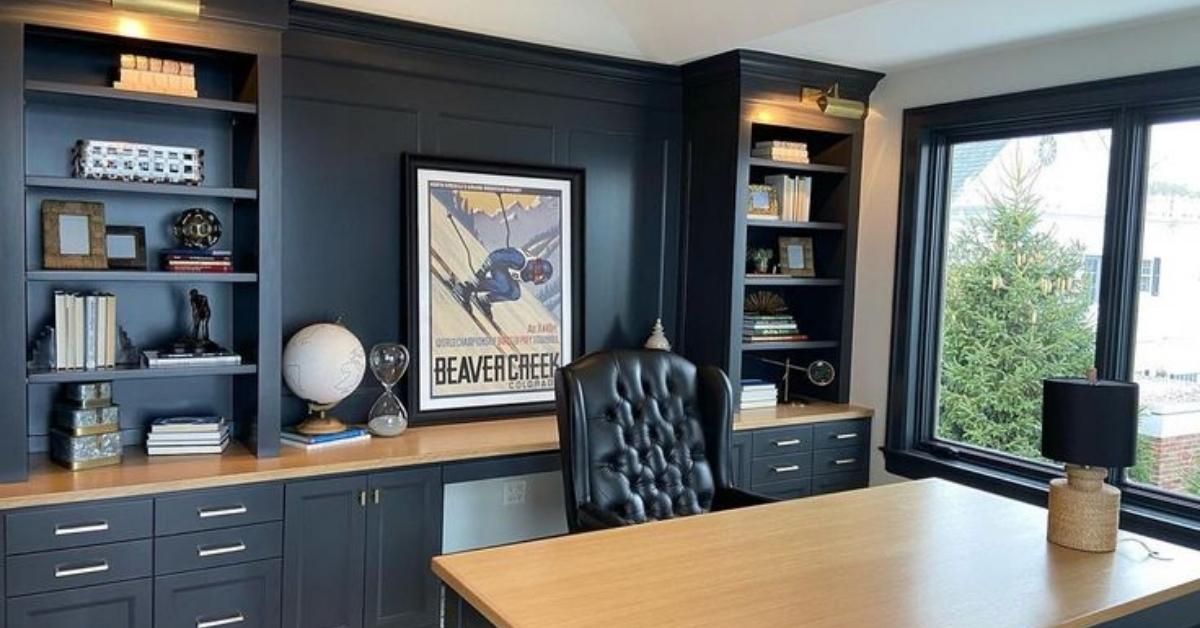
Not every home office needs to be light and airy. A deep wall color forest green, navy, charcoal creates a sense of enclosure that many people find easier to focus in. It also makes warm brass or gold accents pop in a way they simply don’t against white walls. The key to making a dark office feel rich rather than oppressive is the lighting: warm, directional task lighting (around 2700K) and a floor lamp in a corner for ambient fill are essential.
This approach works particularly well in rooms with limited natural light, where a bright white wall only emphasizes the dimness rather than compensating for it.
The Creative’s Studio Office With a Large Drafting Table
A drafting table gives a home office a different energy than a standard desk. It signals something about the kind of work that happens there, which has a subtle effect on how you approach the space. Drafting tables also offer adjustable surfaces, which is useful for both analog creative work and standing for short periods. Keep storage contained to canvas bins or simple metal shelving nearby. The visual message should be “active creative workspace” rather than “organized chaos.”
For anyone whose home office doubles as a studio for writing, design, or art, this is worth the extra footprint.
The Mid-Century Modern Office With Tapered Legs and Vintage Accents

Mid-century modern has proved remarkably resilient as a home office aesthetic partly because the furniture tends to be well-built, and partly because the clean lines and warm wood tones work in almost any room without overpowering it. A walnut desk with tapered legs, a simple leather or boucle chair, and a vintage-style task lamp is the functional core. A botanical print in a thin brass frame above the desk adds the right period note without turning the room into a theme.
This look is especially effective in rooms with parquet or warm-toned hardwood floors, where the desk legs become part of a coherent material story from floor to desktop.
The Built-In Bookcase Wall With Integrated Desk
A floor-to-ceiling bookcase wall with an integrated desk section is the kind of setup that makes a home office feel genuinely architectural. It anchors the room in a way that freestanding furniture rarely achieves. In rental situations, this can be approximated by aligning two tall bookcases on either side of a floating desk. The visual effect is very similar, even if it doesn’t have the precise tailored look of custom joinery.
Keep the shelves styled with intention: books, a few objects, plants at varying heights. Every empty shelf reads as an oversight; every thoughtfully placed object adds to the visual logic.
Read More About : 25 Minimalist Desk Setup Ideas That Are Simple, Clean, and Actually Work
The Biophilic Office With Multiple Plants at Different Heights

Bringing in multiple plants at different heights, a hanging trailing plant, a mid-height potted plant on a stand, and a small succulent on the desk creates a sense of layered greenery that completely changes the feel of a workspace. The biological effect of plants on focus and stress is reasonably well-documented, but the visual effect is just as significant: a room with living plants at three levels feels noticeably more relaxed than one with a single desktop plant.
I’ve noticed this style works particularly well in north-facing rooms that get soft, diffuse light the kind of light that’s bad for productivity but excellent for ferns and pothos.
The Renter-Friendly Removable Wallpaper Accent Wall
Removable wallpaper has reached a quality level where the distinction between it and traditional wallpaper is hard to notice from more than a foot away. For renters, it’s the most impactful wall treatment available. A single accent wall behind the desk in a geometric, architectural, or botanical pattern completely reframes the space. Keep the rest of the office neutral to let the wallpaper do its job.
The setup takes an afternoon and requires zero permanent changes to the apartment. From a design-impact-per-effort standpoint, this is one of the highest-performing moves on this list.
The Japandi Shelf Desk With Wabi-Sabi Accessories

The wabi-sabi aesthetic embracing imperfection and natural materials translates well into a home office context. A simple shelf-style wall-mounted desk with one or two handmade objects (a ceramic cup, a natural stone paperweight, a handwoven textile) introduces texture and character without visual noise. The imperfect quality of these objects contrasts with the clean lines of the desk in a way that feels deliberate rather than mismatched.
This works best when the desk is genuinely spare; the handmade objects are the focal point, not decoration layered on top of a busy surface.
The Multipurpose Office-Library Hybrid
A home office that doubles as a library is one of the most functional dual-purpose room configurations. The books themselves provide acoustic softening, which improves the sound quality of calls and makes the room feel quieter than it actually is. A reading chair in the corner transitions the space from work-mode to rest-mode without any rearranging. The desk should face the bookshelves and not be tucked into a corner with its back to them so the books become a working visual element throughout the day.
This setup requires significant book volume to work, but for anyone with that problem already, it’s a genuine solution.
The Compact Desk Nook With Curtain Privacy Screen

A curtain hung on a ceiling track across a desk corner or alcove is one of the most renter-friendly ways to create a switchable work-life boundary. When the curtain is open, the desk is part of the room. When it’s drawn, the workspace disappears entirely. This is especially effective in studio apartments where you genuinely cannot see the desk from your bed. Floor-length linen in a neutral tone cream, oatmeal, warm white disappears into the room’s palette rather than drawing attention to itself.
The curtain also softens sound slightly, which is noticeable on calls if your apartment has hard floors and bare walls.
The Organized Standing Desk With Side Drawer Unit
A standing desk that incorporates a separate small drawer unit on one side creates a functional workspace without needing a dedicated storage room. The drawer unit should be mobile on casters so it can shift position as needed. What this setup solves specifically is the problem of a standing desk with nowhere to put things: files, notebooks, chargers. Keeping those in the side unit means the desk surface stays clear.
This is especially practical in open-plan homes where the office area needs to stay visually compact and organized during non-work hours.
The Edit-Friendly Desk Setup With Soft Art Deco Accents

Soft Art Deco emerged in 2026 as a counter to the minimalist wave not the heavy Hollywood Regency version, but a lighter interpretation using scalloped shapes, warm ivory tones, and very restrained gold accents. An arched mirror propped against the wall, a scalloped desk lamp, and two or three muted gold accessories bring the reference in without overwhelming the workspace. The effect is editorial in a way that feels distinctly current.
This works best if your space already leans toward warm neutrals; the Art Deco accents land differently against beige and ivory than they do against cool white.
What Actually Makes These Aesthetic Home Office Ideas Work
Aesthetics and function aren’t in conflict in a home office; they’re deeply connected. Here’s what most of these setups have in common at a structural level:
Visual weight is distributed, not concentrated.
The most successful home offices spread visual interest across multiple zones: the desk surface, the wall behind it, and at least one other point in the room. A setup where everything is piled onto the desk looks busy; the same objects spread out across the desk, shelves, and wall look curated.
Lighting is treated as furniture.
Rooms that rely on a single overhead light flatten the depth of any decor. The addition of a warm task lamp and at least one secondary light source (floor lamp, LED strip, sconce) creates the kind of depth that makes a room feel larger and more considered.
Materials have a logic.
The strongest setups aren’t necessarily the most expensive; they’re the ones where all the materials belong to the same tonal family. Mixing warm wood with cold chrome or raw concrete with soft linen creates friction. Choosing a material palette first warm, cool, or neutral-natural and sticking to it makes every individual purchase easier.
The desk surface is protected.
A beautiful home office setup breaks down the moment the desk becomes a dumping ground. Every setup that works long-term has a dedicated place for the things that would otherwise pile up: a drawer, a pegboard hook, a tray. Storage is aesthetic infrastructure.
Aesthetic Home Office Ideas: Quick Comparison Guide
| Setup Style | Best For | Space Type | Key Problem Solved | Difficulty |
| Floating wall desk | Small rooms, renters | Studio, bedroom | Floor space + visual clutter | Easy |
| Alcove built-in | Rooms with alcoves | Any | Layout definition, storage | Moderate |
| Wardrobe office | Studio apartments | Small bedroom | Work-life separation | Moderate |
| Japandi minimal | Stress-prone environments | Any | Overstimulation, clutter | Easy |
| Biophilic plant setup | Diffuse-light rooms | Medium to large | Coldness, lack of texture | Easy |
| Dark moody wall | Rooms with little natural light | Any | Flat, uninspiring atmosphere | Easy |
| Pegboard system | Active, busy workstyles | Any | Desktop clutter | Easy |
| L-desk corner | Dual-use work styles | Medium room | Lack of workspace | Moderate |
| Built-in bookcase wall | Permanent setups | Large room | Anchoring, storage | Hard |
| Curtain privacy screen | Renters, studio apartments | Studio, open plan | Work-life visual separation | Easy |
How to Design Your Home Office for Better Flow and Function
The most common mistake in home office design isn’t buying the wrong furniture, it’s not thinking about movement first. Here’s how to approach layout before you buy anything:
Start with where you’ll actually sit.
The chair position determines everything else. Once you know where the chair goes, you can work out desk orientation, lighting angles, and storage reach. Most people do this backward; they place the desk first, then find the chair position doesn’t work with the light.
Create a clear walk path.
A home office that requires stepping around a chair or squeezing past a shelf every time you enter or exit creates low-grade friction that compounds over months. You should be able to walk from the door to your chair in three steps or fewer without navigating obstacles.
Keep the desk surface to a working footprint.
The entire desk doesn’t need to be accessible at once. Identify the zone where your hands and eyes actually operate during a typical work session, usually about 60 cm wide and 40 cm deep and keep only the essentials within that zone. Everything else earns its place on the desk by being used daily.
Put storage within arm’s reach, not across the room.
If your printer, files, or frequently used supplies require you to stand up every time you need them, you’ll unconsciously avoid getting up and the items will migrate to your desk instead. Keep daily-use items within a seated reach of about 90 cm.
Test the setup before committing.
Sit at the desk position for 30 minutes before you mount, drill, or rearrange permanently. The difference between a good desk orientation and a frustrating one often comes down to where the light hits your screen, or whether you can see small things that are very noticeable after six hours of work.
FAQ’s
What makes a home office look aesthetic without spending much?
The biggest impact comes from three free or low-cost changes: consistent cable management, deliberate lighting (adding a warm lamp), and clearing the desk surface down to essentials. Beyond that, a cohesive color palette even just deciding whether your space is warm or cool makes everything feel more intentional.
How do I make a small home office feel bigger?
Position the desk to face a window if possible, use a floating or wall-mounted desk to keep the floor visible, and choose light wall tones. Mirror placement of a round or arch mirror on the wall adjacent to the desk also reflects light and adds perceived depth without taking up floor space.
Is a standing desk worth it for a home office?
For most people who sit for six or more hours a day, yes but only if the desk can genuinely be adjusted between seated and standing positions. A desk that stays in one position defeats the purpose. Pair it with an anti-fatigue mat and set reminders to alternate positions every 45–60 minutes.
Minimalist vs. maximalist home office: which is better for productivity?
Neither is objectively better; it depends on the type of work. Maximalist, layered spaces with books and objects tend to suit creative or writing work. Minimalist, visually clear setups suit focused, analytical work. The mistake is setting up a visually stimulating space for deep analytical work, or a sterile space for creative work.
How do I set up a home office in a shared or open-plan space?
The most effective approaches are visual: a tall bookcase used as a room divider, a curtain on a ceiling track, or an area rug beneath the desk to define the zone. The goal is a visual boundary, not a physical one. These cues work surprisingly well at signaling “work zone” to both your own brain and other people in the space.
What lighting is best for a home office?
For general work: a warm-white ambient light (2700–3000K) paired with a directional task lamp on the desk. For video calls: front-facing warm light (not overhead it creates harsh shadows). Avoid cool fluorescent lighting for long sessions; it tends to create eye fatigue faster than warm LED alternatives.
What’s the best home office setup for renters?
Focus on changes that don’t require drilling: removable wallpaper for accent walls, freestanding shelving, clip-on desk lamps, and cable management via adhesive clips. A large area rug defines the zone without altering the floor. These changes are fully reversible and collectively make a significant visual difference.
Conclusion
A home office that works well practically and aesthetically doesn’t happen by accident, but it also doesn’t require a renovation budget or a dedicated room. The ideas in this list span studios, shared spaces, small budgets, and large rooms precisely because the principles behind them thoughtful lighting, material consistency, clear surfaces, and defined zones apply almost everywhere.
The key is finding what works for your specific space, not replicating a setup that looks good in someone else’s apartment. Start with one or two ideas that address your actual frustrations whether that’s desktop clutter, poor lighting, or the inability to mentally leave the office at the end of the day and build from there. Even one deliberate change to your workspace tends to motivate the next.
