

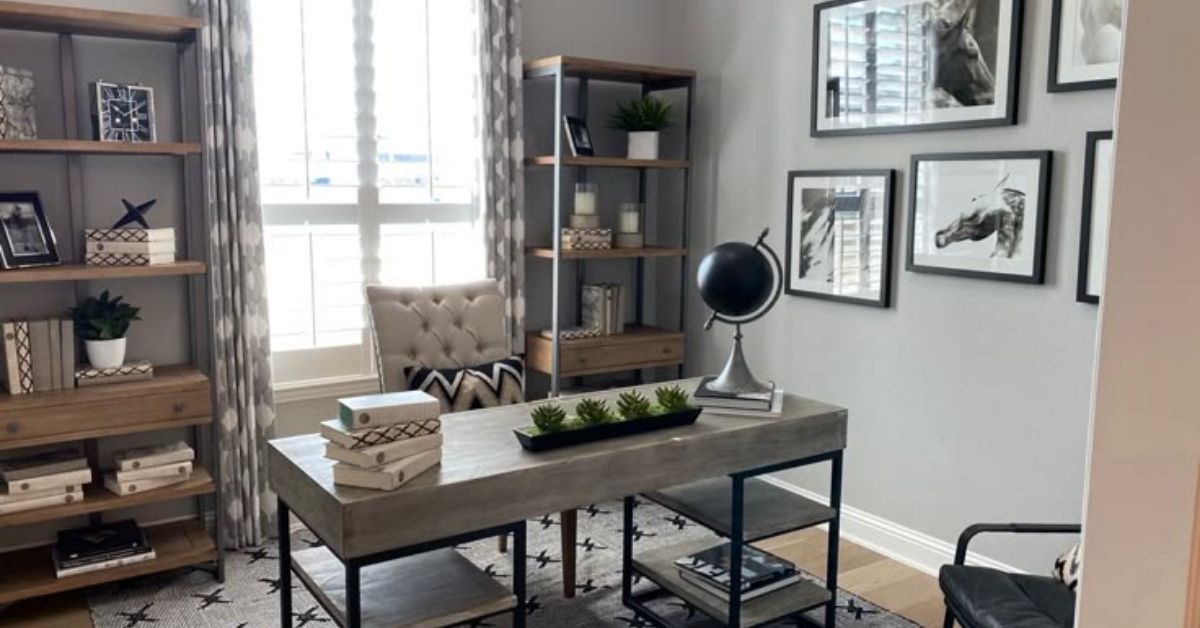
There’s a version of working from home that actually feels good where the space around you isn’t just functional, but genuinely settled. Not a corner of the bedroom with a laptop on the bed, and not a Cozy Home Office Decor Ideas sterile desk pushed against a white wall. Something in between: warm, organized, and designed around how you actually work.
If your home office still feels makeshift or just “fine,” you’re not alone. Most people furnish it as an afterthought, picking up whatever chair or shelf was available at the time. But the layout, lighting, and materials in your workspace affect focus, energy, and how long you can comfortably sit there more than most decor decisions in any other room.
For anyone trying to make their home office feel intentional without a complete renovation budget, this list covers 27 real, workable ideas from small lighting swaps to full layout strategies organized around what actually creates warmth and function in a home workspace.
Layer Your Lighting With Three Sources, Not One

Single overhead lighting is one of the most common reasons a home office feels clinical and draining by mid-afternoon. The fix isn’t necessarily expensive, it’s about layering. A warm-toned desk lamp for task work, a floor lamp in the corner for ambient fill, and a pendant or sconce on the wall to break up the flat ceiling light creates the kind of depth you’d find in a well-designed living room. This works especially well in offices that double as guest rooms or sitting areas, because layered lighting makes the space feel multi-use rather than single-purpose. The movement flow of the room stays clear; you’re not adding furniture, just adjusting where light lives.
Use a Bookcase as a Room Divider in Open-Plan Spaces
In studio apartments or living-room-office combos, the biggest challenge is visual separation, making your brain understand that the desk area is “work” and the sofa area is “not work.” A tall open bookcase placed perpendicular to the wall does this without closing off natural light or making a small space feel boxed in. Style the shelves with a mix of books, small plants, and a few objects rather than filling every inch the visual breathing room is part of what makes it feel designed rather than cluttered. In my experience, this layout works best when the bookcase is positioned so your desk chair faces away from the living area entirely, which makes the psychological separation more effective.
Anchor the Desk With a Wool or Jute Rug

Desks pushed against walls often feel like they exist independently of the room like furniture that arrived and never got introduced to anything else. Placing a rug under and in front of the desk grounds the setup and makes it read as an intentional zone rather than an afterthought. Wool and jute rugs work particularly well because they add texture without visual noise, and they’re durable enough for a chair with casters (look for low-pile options if you’re using a rolling chair). This idea solves an awkward problem in rooms where the desk is the only piece of furniture suddenly there’s a zone, not just a desk.
Mount Floating Shelves Above the Desk Instead of a Hutch
A bulky hutch cuts into your visual field and makes a small desk feel even more enclosed. Floating shelves give you vertical storage without the weight. The key is placement: shelves mounted about 18–22 inches above the desk surface give you room to work comfortably without reaching up constantly. Style them asymmetrically, stagger heights if your wall allows it, and mix functional items (books, small storage bins) with a few decorative ones (a trailing plant, a small ceramic). This setup is especially useful for renters because it uses wall anchors minimally and keeps the desk surface clear.
Bring In One Statement Chair in a Warm Neutral

Most home offices have exactly one chair, the desk chair and nothing else to sit in. Adding a single accent chair in the corner, near a window or a floor lamp, changes how the space functions entirely. You have a place to read, take calls without being at a desk, or shift position during the day. A boucle, linen, or velvet chair in warm sand, terracotta, or dusty sage adds enough texture and color to make the room feel considered. This doesn’t require a large room even in a 10×10 office, a compact armless chair takes up less than 4 square feet and significantly softens the space.
Warm Up White Walls With Limewash or Textured Paint
Flat white walls in a home office reflect harsh light and give the room a temporary, unfinished feeling. Limewash paint creates a layered, slightly matte texture that absorbs light instead of bouncing it; the effect shifts subtly throughout the day depending on where the sun hits. It works in almost any color, but warm whites, clay tones, and dusty sage read particularly well in home offices because they balance warmth with enough neutrality to stay calm during long work sessions. This is a weekend DIY project for most rooms, and one of the more impactful changes you can make to how a space feels without changing any furniture.
Build a Gallery Wall That Frames the Monitor, Not Just the Room

Gallery walls in offices often end up competing with the screen you’re looking at art and a monitor simultaneously and neither gets proper attention. Instead, treat the monitor as the center of the composition and build the wall art arrangement around it: two to three framed prints or one large piece on either side, mounted at eye level when seated. This creates a symmetrical visual frame that actually makes the screen easier to focus on, because the surrounding wall becomes cohesive instead of fragmented. Mix frames finish a few in natural wood, one or two in thin black rather than matching everything perfectly.
Use Curtains Floor-to-Ceiling, Even With Small Windows
Hanging curtains at ceiling height instead of just above the window frame is one of the simplest ways to make any room feel taller and more intentional. In a home office, this also helps control the quality of light; sheer linen curtains diffuse harsh afternoon sun into something softer, which reduces screen glare without blocking the view. For small windows especially, this trick expands their perceived scale significantly. Choose a neutral linen, cotton, or textured weave in a tone close to the wall color so the curtain blends rather than competes.
Add a Pegboard or Grid Panel for Functional Wall Storage

In a home office without drawers or built-in storage, surfaces fill up fast. A pegboard or metal grid panel mounted above the desk turns vertical wall space into active storage: hooks for headphones, small shelves for a pen cup or sticky notes, clips for papers. The organizational benefit is practical, but honestly the visual effect is also significant when the desk surface is clear and everything has a designated spot, the whole room feels calmer. Paint the pegboard the same color as the wall (or a tone slightly warmer or deeper) and it reads as intentional rather than utilitarian.
Style Your Desk With a Cohesive Material Palette
The most cluttered-looking desks usually aren’t actually cluttered; they’re just visually inconsistent. A collection of plastic, metal, fabric, and ceramic in five different colors reads as chaotic even when organized. Choosing two or three materials (wood, brass, and ceramic, for example) and keeping accessories within a limited color range earthy, neutral, or tonal creates the kind of desk that looks considered without requiring anything to be hidden. A linen desk pad is one of the most effective single additions because it unifies all the objects sitting on top of it.
Read More About : 28 Modern Home Office Decor Ideas That Make Working From Home Actually Feel Good
Place the Desk at an Angle for Better Light and Flow

Most desks go flush against a wall because it’s the obvious choice in a small room but it’s rarely the best one. Placing a desk at an angle in a corner lets natural light come from the side rather than directly behind or in front of the screen, which reduces glare and eye strain during long sessions. It also frees up floor space in front of the desk, making the room feel less blocked. This works particularly well in corner offices or rooms where two walls have windows, because you can position the desk to take advantage of cross-light.
Introduce a Live Plant at a Scale That Matches the Room
A 4-inch succulent on a desk doesn’t change how a room feels. A large plant, a fiddle leaf fig, a monster, or a tall snake plant placed in the corner of a room does. The scale shift is what matters: when a plant is large enough to occupy vertical space the way furniture does, it reads as part of the room’s structure rather than just an accessory. For offices with limited natural light, snake plants, ZZ plants, and pothos are reliably low-maintenance. In spaces with a good window, a fiddle leaf or monster will reward the light. Go for one large plant rather than several small ones. It’s more spatially effective.
Use a Warm-Toned Desk Lamp With a Wide, Diffused Shade

Most desk lamps throw light in a tight circle, leaving the surrounding desk surface in shadow and creating a contrast that’s harder on the eyes during extended screen time. A lamp with a wider shade and a warm-toned bulb (2700K–3000K range) distributes light more evenly and reduces the harsh pool effect. Ceramic or stone bases in warm tones, sand, cream, rust add material weight to the desk without taking up much surface space. This is one of the more impactful small swaps in a home office, and one I’d actually recommend trying before changing anything else in the room.
Treat the Bookshelf as a Display, Not a Storage Dump
A bookshelf full of books spine-out in no particular order reads visually as chaos, even if everything is technically organized. Treating some shelves as display space objects, small plants, a framed print and organizing others by color grouping or height variation changes the bookshelf from storage infrastructure to a designed element of the room. Use linen or leather-look boxes for items you want accessible but hidden. The goal is a shelf that draws the eye and holds it comfortably, not one that needs to be scanned for whatever you’re looking for.
Pin a Large Linen or Cork Board for Visual Thinking Space

For people who do creative work writing, design, and planning having a large surface to pin and rearrange ideas is functionally different from a digital notes app. A linen-covered pinboard (or framed cork wrapped in fabric) mounted above the desk serves both a practical and aesthetic purpose: it gives you a place to externalize thinking, and when curated deliberately, it also functions as a visual anchor for the room. The size matters; a board that’s too small becomes a cluttered notice board; one that spans most of the wall width becomes an intentional mood board.
Choose a Desk With Storage Built Into the Base
In small offices, storage is almost always the limiting factor. A desk with drawers built into the base (rather than a separate filing cabinet placed next to it) keeps the footprint compact and keeps the room from looking like two separate pieces of furniture sharing a space awkwardly. Look for desks where the drawers run the full depth of the desk shallow drawers fill up fast. This setup works best in rooms that don’t have a separate closet or shelving unit, because it centralizes what you need within reach without requiring additional floor space.
Hang a Mirror to Reflect Light and Open the Room

Home offices often end up in rooms with only one window which means one side of the room is always significantly darker than the other. Hanging a mirror on the wall opposite or adjacent to the window reflects available light into the darker half of the room, improving overall brightness without adding any electrical fixture. An arched or oval mirror in a wood or brass frame also adds shape contrast to a room full of rectangular furniture, which makes the space feel more visually complete. This is one of the more reliable tools for small offices where adding more windows isn’t an option.
Add Texture Through a Chunky Knit Throw or Woven Blanket
The tactile quality of a space, what it feels like to be in it, not just look at it, is often what separates a room that feels genuinely cozy from one that’s merely tidy. A chunky knit throw or woven wool blanket draped over the back of the desk or accent chair adds warmth without doing anything structural to the room. It also makes practical sense in offices where the temperature tends to run cool, which is common in north-facing or basement rooms. Choose a texture that contrasts with the dominant material on the desk if the desk is smooth wood or glass, a rough-weave throw reads well beside it.
Install a Narrow Floating Ledge for Rotating Displays

Picture ledges, narrow floating shelves about 3–4 inches deep are typically seen in living rooms, but they’re underused in home offices. Mounted at eye level when seated, a ledge gives you a place to lean prints, swap in seasonal objects, or keep a few rotating items without committing to wall holes for each one. The depth is the advantage: because it protrudes barely anything from the wall, it doesn’t visually encroach on the room. For renters or anyone who changes their mind about wall art frequently, this is a more flexible alternative to permanent hooks or gallery nails.
Create a Coffee Station on a Small Sideboard or Bar Cart
This sounds indulgent, but having a coffee or tea setup within the office serves a real purpose: it reduces the number of times you leave the room mid-work-session, which is one of the quieter focus killers in a home setup. A narrow bar cart or small sideboard in the corner takes up minimal floor space and can double as extra storage on the lower shelf. Style the top with a small tray, your coffee equipment, and one or two objects: a plant, a candle and it becomes a functional vignette rather than just a beverage station.
Choose Artwork That Has Depth and Stillness, Not Busyness

The art in a workspace affects concentration in a way that’s easy to underestimate. Highly detailed or visually complex prints, pattern-heavy designs, photorealistic imagery, lots of color variation can pull attention even in peripheral vision. For a home office, artwork that has a clear focal point and a lot of visual quiet around it (abstract prints, landscape photography, minimal line drawings) gives the eye somewhere to rest without engaging the same cognitive attention that your work needs. One large piece tends to work better than three or four smaller ones in this context, because there’s only one thing competing for your peripheral awareness.
Read More About : 24 Work From Home Setup Ideas That Actually Make You More Productive (Without Buying a Desk)
Use a Warm Paint Color on Just One Wall
Painting a single wall behind the desk in a warm tone terracotta, soft rust, deep cream, or warm sage is one of the more effective ways to make a home office feel designed without committing to a fully colored room. It creates a natural visual anchor for the desk area and makes the desk setup feel intentional and framed. In photographs and video calls, it also reads significantly better than a plain white wall. This works best in rooms with good natural light, because warm paint tones can deepen significantly in low-light conditions.
Position Seating So You’re Not Facing the Door Directly

Sitting directly in line with a door either facing it head-on or with your back to it is one of the more subtle layout issues in home offices, and both positions affect how settled you feel in the space. Facing the door creates an anticipatory attention response every time someone moves in the hallway. Back to the door means any movement behind you registers as a disruption. Positioning the desk at a slight angle so you have peripheral awareness of the door without facing it directly tends to produce the most comfortable, focused setup. This isn’t always possible in very small rooms, but even a 30-degree shift can make a difference.
Layer a Desk Pad Over the Desk Surface for Both Function and Feel
A desk pad particularly in leather, linen, or cork serves several practical purposes at once: it protects the desk surface, reduces wrist fatigue from hard surfaces, and visually centers the workspace by giving the monitor, keyboard, and accessories a unified base. In terms of the overall look, it’s one of the simpler things that makes a desk feel designed and ready for use rather than improvised. Going as large as the desk will allow an undersized pad creates an awkward composition where items are constantly falling off its edges.
Use Built-In or Recessed Shelving if Your Layout Allows

If your home office has an alcove, chimney breast, or any natural wall recess, fitting it with custom or semi-custom shelving is the highest-return investment you can make in the space. Recessed shelving doesn’t encroach on floor space the way freestanding units do, and it makes the room feel like it was designed for exactly this purpose which in older homes with original architectural features, it probably was. IKEA Billy bookcases fitted into alcoves with trim pieces around them are a common budget approach that reads as built-in from across the room.
Diffuse a Scent That Supports Focus, Not Just Ambiance
This is a more unusual addition to a home office, but it’s genuinely functional. Scents like cedar, eucalyptus, rosemary, and sandalwood have well-documented associations with alertness and calm focus not in a pseudoscientific way, but in the simpler sense that a pleasant, consistent background scent signals “this room is for work” to the brain over time. A small ceramic diffuser or reed diffuser takes up minimal space on the desk or a nearby shelf. Keeping its subtle heavy fragrance in a small workspace quickly becomes distracting rather than supportive.
Frame the Window View as an Intentional Part of the Setup

If your office has a window with any kind of view, trees, a garden, even a rooftop or sky, position the desk so you can see it while working rather than having the window at your back or to the side. Natural visual depth (looking at something 20–30+ feet away) is physically restful for the eyes during screen-heavy work, and having a natural view reduces the need for decorative elements to make the room feel alive. Frame the window with sheer curtains and a plant on the sill to turn it into a deliberately composed backdrop rather than just a light source.
What Actually Makes a Cozy Home Office Work
Coziness in a workspace isn’t just about comfort, it’s about a space that feels complete, so your brain can settle into work instead of registering things that feel unfinished or wrong. Most home offices feel uncomfortable for specific, fixable reasons: lighting that’s too flat, surfaces that are too hard, no visual separation from the rest of the home, or a layout that puts your back to the door.
The ideas above work across different room sizes and budgets, but they share one underlying logic: they reduce cognitive friction. A warm, organized, well-lit space doesn’t improve your work directly, it reduces the small distractions and discomforts that chip away at focus throughout the day.
The most impactful starting points, for most rooms: lighting layers, a rug under the desk, and wall art that frames the space rather than cluttering it. Get those three right and most other decisions become easier.
Cozy Home Office Ideas: Setup Guide by Space Type
| Idea | Best for | Space type | Problem it solves | Effort level |
| Layered lighting | All offices | Any size | Harsh, flat lighting | Low |
| Bookcase divider | Open-plan homes | Studio/open layout | No visual separation | Medium |
| Angled desk placement | Renters, small rooms | Compact/corner | Poor light + blocked flow | Low |
| Floor-to-ceiling curtains | Small window rooms | Any size | Low natural light feel | Low |
| Large statement plant | Rooms needing warmth | Medium–large | Empty corners, sterile feel | Low |
| Built-in recessed shelving | Homeowners | Alcove/chimney rooms | Storage without floor space | High |
| Accent chair corner | Multi-use offices | Medium–large | Only one seating option | Medium |
| Single warm accent wall | Any office | Any size | Blank, clinical backdrop | Low–Medium |
| Desk with built-in storage | Small, single-room offices | Compact | No storage, cluttered desk | Medium |
| Gallery wall around monitor | Creative workers | Any size | Dead wall behind screen | Medium |
Common Home Office Mistakes That Make the Space Feel Uncomfortable
Overhead lighting only.
A single overhead bulb, especially a cool-white one, is the most reliable way to make a home office feel like a waiting room. The fix is adding warmth and directionality, not necessarily brightness.
Chair that doesn’t fit the desk height.
A mismatch between desk and chair height puts you in a position where you’re either hunching or reaching, and you’ll register it as general discomfort in the room without identifying it as a furniture calibration issue. Desk height should sit at elbow height when seated.
The desk pushed into the corner facing the wall.
This setup closes off the forward view entirely. Even a 45-degree angle opens up the sightline and changes how the space feels to work in.
Art hung at standing height in a seated workspace.
Most wall art in home offices ends up hung at “living room height” comfortably when you’re standing or walking through but when you’re seated all day, it’s above your sightline. Art in a home office should be hung so the center of the piece is at approximately seated eye level.
Too many materials and colors on the desk.
A desk with plastic accessories, metal items, colorful stationery, and fabric in five different tones looks disorganized regardless of tidiness. Material consistency is the single most effective desk organization tool that doesn’t involve storage.
FAQ’s
What makes a home office feel cozy rather than just functional?
Coziness in a workspace comes from layered warmth meaning more than one light source, soft materials (a rug, a throw, a linen desk pad), and a layout that feels settled rather than makeshift. A desk against a blank wall with overhead lighting checks the functional boxes but misses the sensory ones. Adding texture, warm light, and at least one plant-scale organic element changes how the room registers emotionally without changing how it works.
How do I make a small home office feel less cramped?
Two changes have the most impact: raise the curtains to ceiling height (makes the room feel taller) and add a mirror opposite or adjacent to the window (distributes light to darker areas). Beyond that, keeping the desk surface clear and using vertical wall storage instead of desktop clutter helps the room feel larger than it is.
What’s the best color for a cozy home office?
Warm neutrals clay, warm white, soft terracotta, dusty sage, or warm sand tend to work better in home offices than cool grays or stark whites. They hold warmth through the day as natural light shifts, and they read well on video calls. If committing to a full room color feels like too much, a single accent wall behind the desk is an effective lower-commitment option.
Is it worth investing in a proper desk chair for a home office?
Yes, especially if you’re working 4+ hours a day from space. Discomfort accumulates poor lumbar support, incorrect desk height, or an unsuitable seat depth all affect how long you can concentrate and how the room feels to be in. A good chair doesn’t need to be expensive, but it does need to fit your desk height and support your lower back in a neutral position.
How do I separate my home office from the rest of a small apartment?
A bookcase used as a partial divider is the most effective option in small spaces; it creates visual and psychological separation without blocking light or requiring a dedicated room. Rugs are equally useful: a rug under the desk zones it as “work space” in a way that’s subtle but effective. Consistent lighting that stays on only during work hours also trains the brain to associate the zone with focus.
What plants work best in a home office with low light?
Snake plants, ZZ plants, pothos, and peace lilies all tolerate low natural light reliably. For spaces with a bit more indirect light, a monstera or philodendron will do well. The key in a home office is choosing something that requires minimal maintenance. Plants that need frequent watering or misting become another task on the desk rather than a calming presence.
Do home office rugs need to be chair-friendly?
If you use a rolling desk chair, yes. Low-pile or flatweave rugs allow the chair to roll without resistance. High-pile or shaggy rugs can be uncomfortable and wear unevenly under a chair. If your rug is thick and you want to keep it, a clear plastic chair mat placed under the desk area is a practical solution that protects the rug and keeps the chair mobile.
Conclusion
A cozy home office isn’t about perfection, it’s about a space that supports how you actually work. Even a few targeted changes, like adding a second light source, introducing a rug, or repositioning the desk to improve your sightline, can noticeably shift how the room feels to spend time in. The key is addressing what’s actually making the space feel uncomfortable or incomplete, rather than adding more things to it.
Start with one or two ideas from this list that match your room size, budget, or immediate frustration point. Adjust the lighting first if it’s flat, the layout first if the space feels blocked, and the materials first if the desk surface looks chaotic. Build from there small, deliberate changes compound into a workspace that genuinely functions and feels like somewhere worth being.
