

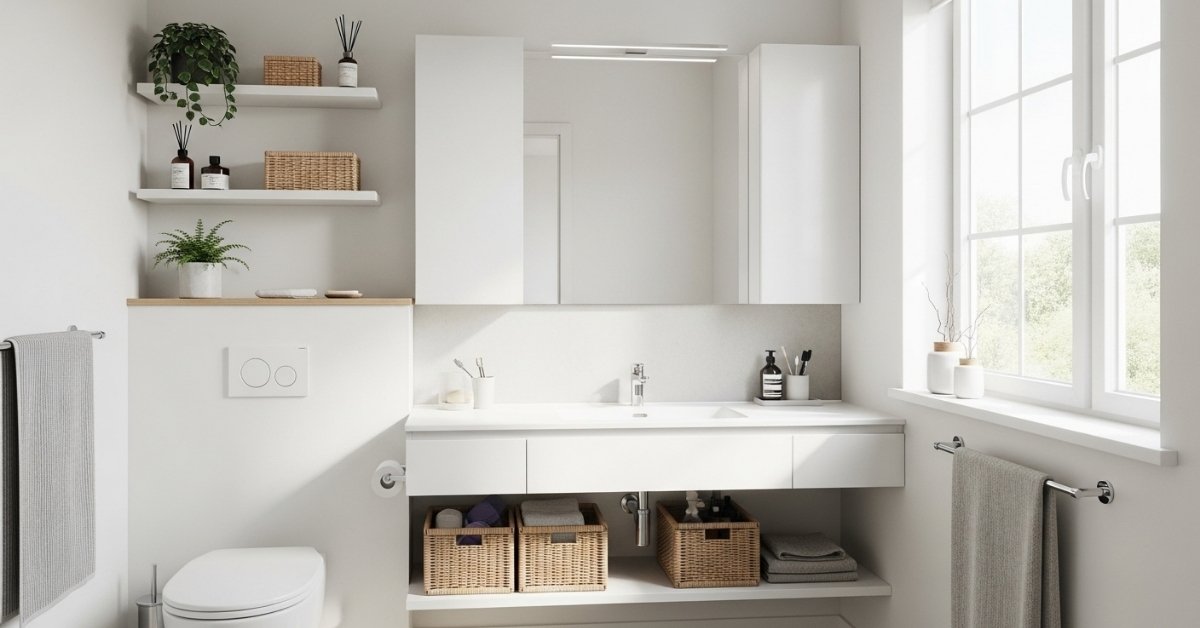
Small bathrooms are genuinely one of the harder rooms to organize not because there’s nothing to work with, but because every inch counts and most conventional advice assumes you have more room than you do. Bathroom Storage Ideas for Small Spaces If your bathroom feels perpetually cluttered despite your best efforts, the problem is usually layout, not quantity.
Whether you’re renting a compact apartment, working with a bathroom under 50 square feet, or just trying to reduce daily chaos, these ideas are built around real constraints: limited wall space, no permanent drilling, awkward corners, and the need for things to actually stay organized.
Slim Rolling Cart Between the Toilet and Wall

That gap between the toilet and the wall is almost always dead space. A slim rolling cart typically 6 to 9 inches wide slides in cleanly and gives you three to four shelves of usable storage. In my experience, this works best when you keep the top shelf for daily items (lotion, Q-tips, a candle) and lower shelves for backup supplies. It keeps the visual line low and tucked, so the cart reads as part of the room rather than an intrusion. Especially useful in rental bathrooms where wall installation isn’t an option.
Floating Shelves Above the Toilet
The wall above the toilet is one of the most underused surfaces in a small bathroom. Two or three floating shelves staggered or evenly spaced turn it into a vertical storage column without touching the floor plan. Keep the lower shelf practical (backup rolls, a small bin, folded hand towels) and the upper shelf lighter and more decorative. The visual effect is upward movement, which makes low-ceilinged bathrooms feel taller. This setup works in most bathrooms and requires minimal wall work.
Over-the-Door Organizer for Everyday Essentials

The back of the bathroom door is essentially a free wall that most people ignore. An over-the-door organizer with clear pockets or wire shelves gives you a place to store hair tools, small bottles, and toiletries without taking up counter or cabinet space. This is especially useful in bathrooms shared by two people, where the countertop becomes a battleground. Go for a version with loops or hooks at the top rather than tension rods; they stay more stable on hollow core doors and don’t slide down over time.
Tension Rod Storage Under the Sink
Most under-sink cabinets waste at least half their vertical space. A simple tension rod installed horizontally across the inside of the cabinet creates an instant hanging bar for spray bottles which frees up the floor of the cabinet for bins, baskets, or a second tension rod at a lower level. Renters love this setup because it requires zero drilling and costs almost nothing. The result is a cabinet that holds two to three times more than it did before, with everything visible and reachable.
Corner Shower Caddy That Mounts Without Suction Cups

Suction cup caddies fall. It’s a universal experience. A tension pole caddy one that extends floor to ceiling between two surfaces stays in place reliably and gives you multiple shelf tiers in the corner of the shower. The corner placement keeps the main shower walls clear, which makes the space feel less enclosed. Look for caddies with drainage holes on each shelf and at least one hook bar for loofahs or razors. This is one I’d actually recommend trying first if you’ve given up on wall-mounted options.
Magnetic Strip for Metal Beauty Tools
Bobby pins, tweezers, nail clippers, and metal nail files tend to disappear into drawers and never resurface. A small magnetic strip, the same concept as a kitchen knife strip mounted inside a cabinet door or on a narrow wall section keeps these tools visible and reachable. The strip only needs to be six to eight inches wide to handle most small metal tools. It’s particularly useful in compact bathrooms where drawer space is minimal. You can also use it for small metal hair clips and barrettes that typically pile up on the counter.
Stackable Clear Bins in Deep Drawers

Deep bathroom drawers are notoriously bad at organization; everything slides around, small items get buried, and the drawer becomes a mixed pile within a week. Clear stackable bins, sized to match your drawer depth, divide the space into fixed zones and make it easy to see everything at once. Assign each bin a category: cotton products, lip products, skin care, hair accessories. The transparency matters more than the aesthetic. When you can see it, you use it. This setup is particularly useful for shared bathrooms with multiple users.
Wicker or Rattan Basket Under the Vanity
Pedestal sinks are stylish but offer zero storage; everything ends up on the floor or the counter. A large wicker or rattan basket placed underneath holds rolled towels, a backup toilet paper roll, or a small bin of supplies without looking out of place. The organic texture softens the often stark, hard-surface feel of small bathrooms and adds visual warmth without adding visual weight. This works especially well in neutral or earthy-toned bathrooms where natural materials feel intentional rather than improvised.
Read More About : 27 Minimalist Bathroom Decor Ideas That Make Small Spaces Feel Intentional and Calm
Wall-Mounted Medicine Cabinet With Mirror

If you’re working with a bathroom that has zero cabinet storage, a recessed medicine cabinet might be the single highest-impact change you can make. It sits flush with the wall, so it doesn’t project into the room, and the mirror front doubles as functional decor. Even a surface-mounted version (no drywall cutting required) adds 3 to 4 inches of depth enough to hold multiple rows of skincare products, medications, and toiletries that would otherwise crowd the counter. The key is keeping the contents organized by frequency of use so the cabinet stays functional rather than becoming a second junk drawer.
Narrow Freestanding Tower Shelf
A freestanding tower shelf typically 10 to 12 inches wide is one of the most flexible storage pieces for small bathrooms because it requires no installation and moves easily. Place it next to the sink, next to the toilet, or in a corner. Use the shelves for baskets rather than loose items baskets contain the visual clutter even when the contents aren’t perfectly organized. The vertical form keeps the footprint small while maximizing storage height. This is a particularly good option for bathrooms where the wall material makes drilling difficult or uncertain.
Suction Cup Shelf in the Shower Corner

For bathrooms where a tension pole caddy isn’t viable, a heavy-duty suction cup corner shelf specifically designed for corners with dual contact points can actually hold reliably, the key word being “heavy-duty.” These are a different category from standard suction mounts. They use multiple suction points and a locking mechanism that significantly improves staying power on glazed tile. Limit them to lighter items (soap, a razor, a small bottle) and they’ll perform much better than typical suction caddies. Best for tiled showers with smooth, glazed surfaces.
Pegboard Painted to Match the Wall
Pegboard is genuinely useful in small bathrooms because it adapts so you can rearrange hooks and baskets as your needs change. When painted the same color as the wall, it reads as part of the surface rather than an added element, which keeps the room from feeling busier. Mount it on a section of wall that’s typically underused: beside the sink, opposite the shower, or on a narrow wall between fixtures. Add hooks for towels, small shelves for bottles, and baskets for grouped items. Honestly, this is one of the more underrated bathroom storage solutions because it offers true flexibility without sacrificing the feel of the room.
Countertop Organizer With Tiered Levels

Not every bathroom has room for a countertop organizer, but if you have even 8 to 10 inches of clear counter space, a tiered riser dramatically improves how much fits in that footprint. Items on the lower level are easy to reach; items on the upper level stay visible without crowding the front row. This reduces the “digging through a pile” problem that most vanity counters develop. Keep daily-use items on the lower tier and occasionally-used products on the upper. The vertical stacking reduces the lateral spread of products, which makes the counter appear more open.
Shower Curtain With Built-In Pockets
Shower curtains with built-in fabric side pockets are a surprisingly functional solution for bathrooms where wall installation is completely off the table apartments, rentals, or bathrooms with difficult tile. The pockets hang inside the shower and hold shampoo, conditioner, body wash, and razors at a comfortable height without anything on the shower floor or ledge. Choose a curtain with reinforced pocket stitching and enough weight to hang straight lightweight versions that tend to billow and tip things over. This works best in showers up to about 60 inches wide.
Drawer Dividers in Bathroom Vanity

Bathroom vanity drawers are frequently wider than they need to be for any single category of product, which means they quickly become disorganized. Adjustable drawer dividers create fixed sections that prevent items from migrating into each other’s spaces. Unlike bins, dividers use the full depth of the drawer; nothing is stacked or hidden below something else. Assign sections by product type: face care on the left, eye products in the center, tools on the right. The organization stays intact because there’s physically nowhere for items to go except their designated section.
Hooks on the Inside of Cabinet Doors
The inside of cabinet doors is almost always empty. Small adhesive hooks or stick-on holders placed on the inside of your vanity cabinet door create storage for hair dryers, flat irons, and styling tools that would otherwise take up drawer or counter space. This keeps frequently used tools accessible without permanently cluttering the visible surfaces. Use heat-resistant hooks or a small fabric loop for styling tools that retain warmth after use. This is one of those solutions that’s invisible when the cabinet is closed but makes a meaningful difference in daily use.
Wall-Mounted Toothbrush and Cup Holder

The countertop beside the sink tends to accumulate toothbrushes, toothpaste, cups, and skincare products until the surface is entirely covered. A wall-mounted toothbrush holder and cup bracket moves the most-used items off the counter and onto the wall directly above the sink where they’re just as reachable but no longer taking up counter real estate. In 2026, this type of minimalist wall-mounted sink area has become standard in compact bathroom designs precisely because it visually opens up the counter. Available in adhesive-mount versions for renters. The counter suddenly has room to breathe again.
Read More About : 29 Small Bathroom Decor Ideas That Make Every Inch Work Harder
What Actually Makes These Bathroom Storage Ideas Work
The difference between bathroom storage that holds up and bathroom storage that reverts to chaos within two weeks usually comes down to three things: accessibility, visibility, and category logic.
Accessibility means the things you use every day are the easiest to reach, not buried behind backup supplies or tucked into the back of a drawer. Visibility means being able to see what you have without moving other things. Clear bins, open shelves, and transparent organizers all serve this purpose. Category logic means grouping by use, not by size or appearance, face care together, hair tools together, first aid together.
In my experience, the biggest mistake in small bathroom storage is trying to store everything in the same type of container. Different product types need different solutions: liquids need drainage, small tools need compartmentalized space, bulky towels need open shelving or baskets. Mixing these without distinction creates systems that look organized when you set them up and fall apart quickly in practice.
Bathroom Storage Ideas for Small Spaces: Setup Comparison
| Storage Idea | Best For | Space Type | Problem Solved | Renter-Friendly |
| Slim rolling cart | Daily + backup supplies | Under 50 sq ft | No wall space | Yes |
| Floating shelves above toilet | Vertical storage | Most bathrooms | Dead wall space | Partial |
| Over-the-door organizer | Daily essentials, tools | Any size | Counter clutter | Yes |
| Tension rod under sink | Cleaning products | Vanity cabinets | Wasted vertical space | Yes |
| Tension pole shower caddy | Shampoos, body care | Any shower | Falling suction caddies | Yes |
| Magnetic strip | Small metal tools | Any wall/cabinet | Lost small items | Yes |
| Freestanding tower shelf | Towels, baskets | Corners, narrow walls | No installation option | Yes |
| Wall-mounted medicine cabinet | Skincare, medications | Tile/drywall walls | Zero cabinet storage | No |
| Countertop tiered organizer | Skincare products | Limited counter | Counter sprawl | Yes |
| Drawer dividers | Makeup, tools | Vanity drawers | Drawer chaos | Yes |
How to Organize a Small Bathroom Without Adding More Furniture
Before adding new storage, the highest-leverage move is almost always to reduce what’s being stored. Most small bathrooms are disorganized not because storage is lacking but because there’s more stuff than the space was designed to hold.
Start with an audit: check under the sink, in the medicine cabinet, and in drawers for duplicates, expired products, and items that don’t belong in the bathroom. This typically frees up 20 to 30 percent of existing storage before anything else changes.
Next, prioritize floor clearance. Even in small bathrooms, keeping the floor as clear as possible, no baskets sitting directly on the floor, no trailing cords, no product bottles at the base of the tub makes the room feel measurably larger. The eye reads floor space as open room, and even a few inches of visible floor makes a difference.
Then work vertically. Small bathrooms rarely use their wall height effectively. The space from counter height to ceiling is often completely empty, while the surfaces at eye level are overcrowded. Floating shelves, tower units, and wall-mounted organizers all move storage upward and off the floor plane.
Finally, consider the workflow of your bathroom use. Items you use every morning should be the most accessible. Items you use occasionally should be stored in deeper or higher locations. Items you rarely use should be stored outside the bathroom if possible a linen closet, a bedroom cabinet, or an under-bed storage solution. When the bathroom only stores what belongs in it, even a very small space becomes workable.
FAQ’s
What’s the best storage solution for a bathroom with no cabinet space?
A combination of over-the-toilet floating shelves, an over-the-door organizer, and a freestanding tower shelf covers most storage needs without requiring built-in cabinetry. Start with vertical wall space above the toilet; it’s the most unused area in most bathrooms.
How do you organize a small bathroom if you’re renting and can’t drill?
Adhesive hooks, tension rod shelves, over-the-door organizers, rolling carts, and freestanding shelving units all work without drilling. Command strips also hold surprising amounts of weight on tile if the surface is clean and the product is applied per instructions.
Is it worth installing a recessed medicine cabinet in a small bathroom?
If your bathroom has drywall between the studs at the right width (typically 14 to 16 inches on center), a recessed medicine cabinet is one of the best storage upgrades available; it adds storage depth without projecting into the room. Surface-mounted versions are easier to install and still offer significant storage if recessing isn’t an option.
How do you keep a small bathroom organized long-term?
The key is assigning every category of product a fixed location and keeping only what you regularly use in the bathroom. Storage systems fail when there’s more product than space, not when the containers aren’t the right shape.
What are the most common small bathroom storage mistakes?
Storing too much product, ignoring vertical space, and using disorganized single containers instead of categorized sections are the most common issues. Also using suction cup products on textured tile they won’t hold reliably and the resulting falls break things.
How do you make a small bathroom look less cluttered?
Reduce visible product on counters, use closed storage where possible, and keep the floor clear. A bathroom with clutter moved behind cabinet doors or into organized bins reads as significantly more spacious than the same room with products on every surface.
What’s the best way to store towels in a tiny bathroom?
Rolled towels in a wicker basket under a pedestal sink, towel hooks on the back of the door, or a small wall-mounted towel bar above the toilet are all space-efficient. Avoid bulky towel racks that project into walking space.
Conclusion
Small bathrooms don’t need to feel cramped or disorganized; they need storage that matches the actual constraints of the space. The key is using what’s already available: wall height, door backs, cabinet interiors, and corner spaces that most setups ignore. Even implementing two or three ideas from this list tends to make a noticeable difference in how the room functions day to day.
Start with whatever solves your most immediate problem whether that’s a cluttered counter, an unusable under-sink cabinet, or a shower with nowhere to put anything. Small, intentional changes work better than a full overhaul, and they’re easier to maintain. Pick one setup, give it a week, and adjust from there.
