

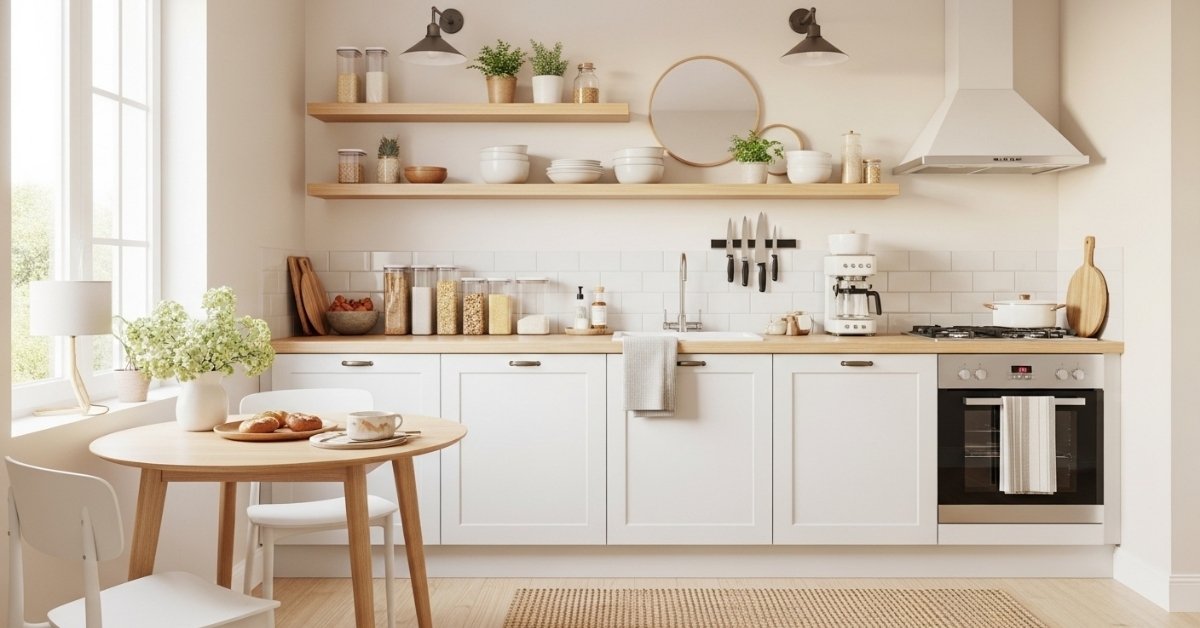
Small kitchens have a way of feeling chaotic fast. Limited counter space, cramped storage, lighting that barely reaches the corners it all adds up to a room that functions but never quite feels put-together. The good news is that most small kitchen problems aren’t about size. They’re about organization, light, Small Kitchen Decor Ideas on a Budget and how the eye moves through space.
If you’re working with a galley layout, a studio kitchenette, or a rental kitchen where you can’t touch the walls, this list is built for exactly that. Every idea here either frees up space, adds visual breathing room, or pulls the room together without requiring a renovation.
These aren’t dramatic overhauls. They’re the kind of changes that cost under $50, take an afternoon, and make you actually enjoy being in the kitchen.
Open Shelving on One Wall Instead of Upper Cabinets

Swapping one set of upper cabinets for open shelves (or simply removing cabinet doors and painting the interior) does two things at once: it creates the illusion of more wall space and gives you a reason to keep things organized. The key is treating those shelves like a display, stacking your most-used items at eye level, group things by function, and leave some breathing room between objects. This works especially well in kitchens with a single wall of cabinetry or narrow galley layouts where every visual plane feels heavy. It also works for renters who can install floating shelves without permanent damage. The visual problem it solves is that enclosed cabinetry in a small kitchen tends to feel like walls closing in. Open shelves push that feeling back.
A Peel-and-Stick Backsplash Behind the Stove
The area behind the stove is one of the most visually prominent surfaces in a kitchen, and in small spaces it reads as a focal point whether you style it that way or not. A peel-and-stick backsplash tile (available in subway, penny round, and herringbone patterns) adds texture and color contrast without any installation beyond a clean dry surface. In my experience, this is one of the first things I’d recommend trying because it changes the room’s visual character more than almost anything else at this price point. It works best in rental kitchens or spaces where a full tile backsplash isn’t in the budget. It solves the problem of flat, unfinished walls that make a kitchen look like a placeholder rather than a real room.
A Rolling Cart That Doubles as Counter Space and Storage

Counter space is the single most limiting factor in small kitchens, and a rolling cart solves it without committing to anything permanent. A simple butcher block cart or metal utility cart adds both prep surface and storage underneath and rolls out of the way when it’s not needed. Position it parallel to the longest counter for a prep island feel, or tuck it against a side wall when you need movement space. The problem it solves is purely functional: more surface area without any construction. This setup is especially useful in L-shaped or single-wall kitchens where the layout only gives you 18–24 inches of counter to work with. For a more elevated version, add a small herb planter or a cookbook propped on top to make it feel intentional rather than improvised.
Under-Cabinet Lighting with Plug-In LED Strips
Overhead lighting in small kitchens almost always creates shadows directly on the counter where you need to see most. Under-cabinet LED strips the plug-in kind, no wiring required to fix that in about twenty minutes. Warm-toned LEDs (2700K–3000K) are the right choice here: they make the space feel cozy rather than clinical, and they make natural wood tones and stone-look surfaces look significantly better. This is one of those upgrades that changes how the kitchen feels more than how it looks. It solves a functional lighting problem but the visual effect of a warm glow across the workspace is what makes the room feel layered and considered. Works in any kitchen, but especially noticeable in darker spaces or kitchens with small or no windows.
Read More About : 31 Cute Amazon Finds for Bedroom Decor That Actually Make Your Space Feel Put Together
A Statement Rug Under the Kitchen Sink or Work Zone

Kitchens feel unfinished when every surface is hard tile floor, laminate counter, painted cabinets. Adding a low-pile washable rug in front of the sink or main prep area introduces warmth and visual softness that the room is usually missing. It’s also one of the fastest and cheapest ways to add pattern or color to a small kitchen without painting anything. Stick to patterns with at least two tones that already exist in your kitchen (even something as simple as matching one color from the rug to your dish towel or a plant on the counter makes the room feel cohesive). Washable cotton or polypropylene rugs work best in kitchen environments. The problem it solves is visual monotony when every surface in a small kitchen is the same material family, the space reads as flat.
Magnetic Knife Strip Instead of a Knife Block
A knife block on the counter in a small kitchen takes up real estate you genuinely can’t afford to give. A magnetic strip mounted on the wall ideally near the stove or prep area keeps knives accessible, visible, and completely off the counter. At $15–30, it’s one of the cheapest space reclamations possible. The functional benefit is obvious, but the visual benefit is worth noting too: a clean row of knives on the wall reads as an intentional design choice rather than a utilitarian workaround. This works best mounted on a stretch of wall that doesn’t have upper cabinets, a side wall, the space between a window and the range, or directly above the counter. It solves the clutter problem without hiding anything; everything stays visible and easy to grab.
Decanting Dry Goods into Clear Matching Jars

Honestly, this one requires zero design skill and does a lot of heavy lifting visually. Flour in a bag, pasta in a box, oats in a cardboard container these are functional but visually noisy. Moving them into matching clear glass or acrylic canisters creates an organized, cohesive look that makes even a small counter corner or open shelf feel styled. The glass also makes inventory obvious (you’ll see when you’re running low), which is a small but genuinely useful bonus. This works best on open shelves or counters where items are visible. The problem it solves is visual clutter caused by mismatched packaging colors, shapes, and fonts all of which compete with each other in a small space.
A Small Herb Garden on the Windowsill
A windowsill herb garden is one of the few decorating ideas that’s genuinely functional. Fresh herbs on the windowsill add color, texture, and life to a part of the kitchen that’s otherwise just a view. The key is keeping it simple: three pots maximum, all the same size, all the same type of container. Mismatched pots of varying sizes look cluttered; matching ones look curated. Terra cotta and white ceramic both work well against most kitchen tile or paint colors. This setup works best in kitchens with south or east-facing windows where herbs actually get enough light to thrive. The problem it solves is the emptiness of a windowsill that’s either completely bare or used as a dumping ground for random items.
Painting the Inside of Cabinets or Shelves an Accent Color

This is the kind of detail that costs about $10 worth of paint and reads like intentional interior design. When you open a cabinet or look at an open shelf, a contrasting color on the back wall or interior surface adds depth that a plain white interior doesn’t have. Warm terracotta, dusty sage, or a deep navy all work. The key is choosing something that either complements the countertop or the dish color rather than fighting them. I’ve noticed this tends to work best when the rest of the kitchen stays neutral; the painted interior becomes a quiet focal point rather than competing with other colors in the room. It solves the visual problem of open shelving looking flat and incomplete.
A Slim Pegboard Panel for Tool and Utensil Storage
Wall space in small kitchens is underused more often than counter space. A pegboard panel, even one that’s 18 by 24 inches, can hold spatulas, ladles, measuring cups, pot lids, and a few small hooks for towels or a small plant. It’s the most flexible wall storage system for kitchens because you can rearrange it without drilling new holes. Paint it the same color as your wall if you want it to recede, or a contrasting color if you want it to read as a feature. This works especially well in rentals where you can mount a single panel with minimal hardware. The problem it solves is tool clutter on the counter which in small kitchens is the primary source of visual noise.
Adding a Simple Curtain Under an Open Sink

If your kitchen has a freestanding or apron-front sink without base cabinets, the area underneath is usually exposed and messy cleaning supplies, extra bottles, plastic bags. A simple tension rod and a gathered curtain panel fixes this completely. It hides the storage while adding a soft textile element to a room that’s usually all hard surfaces. Linen, cotton canvas, or ticking stripe all work well. This setup is especially practical for older rental kitchens or vintage homes where base cabinetry is minimal or nonexistent. The problem it solves is exposed under-sink storage that reads as clutter even when it’s technically organized.
A Single Pendant Light Over the Counter or Island
Most small kitchens rely entirely on a single overhead fixture that does everything and does none of it particularly well. Adding one pendant light, even a plug-in version that hangs from a ceiling hook rather than a hardwired junction box, changes the lighting hierarchy of the room. It creates a focal point and brings light closer to the surface where it’s most needed. A brushed brass or matte black shade in a simple dome or cylinder shape works in almost every kitchen aesthetic from modern to farmhouse. This works best over a counter overhang, a small island, or a dining table tucked into the kitchen. The problem it solves is flat, shadowless lighting that makes everything look the same and the room feel smaller than it is.
Swapping Cabinet Hardware for a Consistent Finish

Mismatched hardware is one of those things that registers as “off” without being immediately obvious. Old rentals, builder-grade kitchens, and vintage homes often have knobs and pulls in different eras of finish: some chrome, some brushed nickel, some aged brass. Replacing everything with one consistent handle style and finish unifies the cabinetry without changing a single cabinet. Bar pulls in black matte or brushed brass read the most current in 2026 and work across a wide range of cabinet colors. This is a pure aesthetic upgrade; the problem it solves is visual inconsistency that fragments the room rather than letting the eye move through it smoothly.
A Small Chalkboard or Framed Print Near the Fridge

Empty wall space near the refrigerator is one of the most commonly wasted spots in a small kitchen. A single framed print or a small chalkboard adds something intentional without taking up any counter or shelf space. Keep it simple: a botanical line drawing, a single food word in a script font, or a small abstract print in two tones. The frame itself matters black or warm wood reads best in most kitchen aesthetics. This is a low-commitment change that solves the problem of empty vertical space that makes small kitchens feel unfinished rather than minimal.
Using a Tension Rod Inside Cabinets to Double Storage
A tension rod installed vertically inside a cabinet like the ones under the sink creates a second hanging zone for spray bottles, foil boxes, or cutting boards without adding any new hardware. Horizontal tension rods across a cabinet shelf can hold lids upright between them rather than stacked flat. These are the kinds of solutions that make a small kitchen feel genuinely organized rather than just visually tidy. They cost about $5 and take 30 seconds to install. The problem they solve is poor vertical space use inside cabinets, which wastes a surprising amount of storage in small kitchens.
Read More About : 27 Cozy Bedroom Ceiling Lighting Ideas That Make Your Room Feel Warm and Intentional
A Matching Set of Dish Towels as a Color Anchor
In small kitchens, soft goods do a lot of decorative work precisely because there’s so little space for anything else. A set of two or three matching dish towels in the same color or pattern introduces a cohesive color note without adding any objects. The trick is treating them like you’d treat a throw pillow, choose a color that appears somewhere else in the kitchen (even something as small as the inside of your cabinet or the herb pot on the sill) and let them bridge the palette together. Waffle weave, linen, and striped cotton all look good. This is one of the most genuinely underused ideas in small kitchen styling.
Painting or Wallpapering the Ceiling in a Pattern or Color

The ceiling in a small kitchen is almost always ignored. Adding a subtle pattern via removable wallpaper or a single paint color draws the eye upward, which creates the perception of height and makes the room feel taller. This works best with quiet patterns, a small geometric repeat, a thin stripe, or a faint botanical motif rather than anything bold. Pale sage, dusty rose, or warm ivory are all current ceiling color options for 2026 that feel fresh rather than busy. This solves the visual problem of low ceilings feeling claustrophobic in a small kitchen and because it’s overhead, it adds interest without crowding any surfaces or walls.
A Tiered Fruit or Produce Stand on the Counter
Getting produce off the counter and into a tiered stand frees up flat surface area while adding a natural, textured element to the kitchen. A two-tier wire or woven wicker stand can hold fruit, vegetables, bread, or even eggs whatever you use frequently and want to access. The visual benefit is height variation: instead of everything on one flat surface, you get a small sculptural moment that draws the eye without crowding it. This works especially well in kitchens where the counter is the main visual surface and where there’s little room for purely decorative items. The problem it solves is both functional (freeing counter space) and visual (breaking the flatness of a bare counter).
Installing a Simple Floating Shelf for a Coffee or Tea Station

Grouping everything related to your morning routine in one defined area: a shelf, the appliance underneath, mugs on hooks below the shelf makes a small kitchen feel more intentional. It turns a functional area into something that reads like a designed station rather than a cluster of appliances. The shelf itself can be a simple pine board with brackets for under $20. This works best on an empty wall section or the wall beside a window. It solves the problem of kitchen appliances looking scattered and random, which is one of the most common reasons small kitchens feel cluttered even when they’re not.
Replacing a Bare Bulb Overhead with a Simple Drum Shade
A bare bulb overhead fixture is functional and deeply unflattering. Replacing it with a simple drum shade fabric, linen, or rattan costs $20–40 and changes the quality of light in the room entirely. The shade diffuses the light instead of directing it as a harsh point source, which evens out shadows on the walls and makes the room feel warmer and softer. This is one of the few upgrades that changes both the look and the feel of a small kitchen at the same time. It solves the problem of harsh overhead lighting that flattens the room and makes it look utilitarian rather than livable.
A Small Folding Dining Shelf That Mounts to the Wall

In studio apartments or galley kitchens where there’s no room for a table, a fold-down wall shelf provides a surface for eating, working, or prepping that completely disappears when not in use. Mounted at counter height, it functions as extra counter space. Mounted a few inches lower, it works as a breakfast table for one or two. These are available as kits for under $60 or can be built with a hinged board and two wall brackets. The problem it solves is the lack of a usable surface for anything other than cooking which in a small kitchen means the counter does triple duty and always looks busy.
What Actually Makes These Ideas Work
The through-line across all these ideas is constraint management. Small kitchens don’t suffer from a lack of style; they suffer from too many competing surfaces, too little light differentiation, and storage systems that weren’t designed for the space. The ideas that make the most consistent difference are the ones that address all three at once: open shelving clears visual weight and improves storage logic; under-cabinet lighting separates the work surface from the rest of the room; rolling carts and fold-down shelves add functional area without taking permanent floor space.
The other factor that’s easy to miss is visual continuity. In a small kitchen, mismatched hardware, varied storage containers, and uncoordinated textiles don’t just look cluttered; they break the eye’s movement through the space. When you unify even two or three elements (all your cabinet pulls in the same finish, your canisters in matching material, your dish towels in the same color family), the room starts to feel considered rather than assembled by accident.
Small Kitchen Decor Setup Comparison
| Idea | Best For | Space Type | Problem Solved | Budget |
| Open shelving | Renters, display storage | Galley, single-wall | Visual heaviness | Low ($0–$30) |
| Peel-and-stick backsplash | Renters, quick upgrades | Any kitchen | Bare unfinished walls | Low ($25–$60) |
| Rolling cart | Studio kitchens, no island | Narrow layouts | Counter space shortage | Low–Mid ($40–$120) |
| Under-cabinet LED strips | Dark kitchens, renters | Any kitchen | Poor task lighting | Low ($15–$40) |
| Pendant light | Any kitchen with height | Over counter/island | Flat, uniform lighting | Mid ($30–$80) |
| Fold-down shelf | Studio apartments | Zero dining space | No eating surface | Low–Mid ($40–$80) |
| Magnetic knife strip | Tight counter spaces | Any kitchen | Knife block clutter | Low ($15–$30) |
| Pegboard panel | Renters, flexible storage | Single-wall, galley | Wall space waste | Low ($20–$50) |
How to Avoid the Most Common Small Kitchen Decorating Mistakes
Buying storage that’s the wrong scale.
Wide basket organizers or large countertop canisters look fine in a standard kitchen and overwhelming in a small one. Before buying anything, measure the available surface or shelf depth. Small kitchens tend to have 10–12 inch deep shelves rather than the standard 12–14. Items that stick out past the shelf edge create the exact visual clutter you’re trying to eliminate.
Adding too many “accent” items.
A plant, a fruit bowl, a cookbook stand, a decorative cutting board, and a small framed print on a small counter, that’s five things competing for attention. Pick one or two items that earn their place visually and functionally, and clear everything else off. The restraint is the style.
Ignoring the vertical dimension.
Most small kitchen organizations stops at counter height. Wall space above the backsplash, the narrow vertical strip between upper cabinets, and the ceiling itself are almost always left bare even though they’re the surfaces that most affect how tall and open the room feels. Floating shelves, pegboards, under-cabinet hooks, and a ceiling treatment all use vertical space without crowding the floor or counter.
Choosing the wrong lighting color temperature.
Cool-white LEDs (4000K and above) make small kitchens feel sterile and make wood tones and warm surfaces look flat. Warm white (2700K–3000K) is almost always the better choice for residential kitchens. It makes the space feel warmer and makes food look better, which is ultimately the whole point of the room.
FAQ’s
What’s the easiest small kitchen decor change with the biggest visual impact?
Under-cabinet LED lighting. It adds task illumination where it’s actually needed, introduces warm light layering that overhead fixtures can’t provide, and takes about 20 minutes to install without any wiring. The visual shift is noticeable enough that it changes how the whole room feels rather than just one corner.
How do I make a small kitchen feel bigger without renovating?
Use open shelving instead of upper cabinet doors on at least one wall, keep countertops as clear as possible, and add a light source at a lower level (under-cabinet strips or a pendant rather than just overhead). The combination of visual openness and tiered lighting creates the perception of depth that a single flush fixture and closed cabinetry removes.
Can I decorate a rental kitchen without damaging anything?
Yes. Command strips and hooks hold lightweight shelves and pegboards. Tension rods work inside cabinets and under the sink. Peel-and-stick backsplash removes cleanly. Plug-in pendant lights hang from ceiling hooks. Most of the ideas in this list don’t require any drilling or paint.
Open shelves vs. closed cabinets: which is better for a small kitchen?
It depends on how organized you are in practice, not in theory. Open shelves make a small kitchen feel more open and larger, but they require consistent organization, mismatched items, random placement, and visible clutter look much worse on open shelving than behind doors. If your kitchen items are reasonably cohesive in color and shape, open shelves are the better visual choice for small spaces. If they’re not, closed cabinets will serve you better.
How do I add color to a small kitchen without making it feel smaller?
Introduce color through soft goods (dish towels, rugs, curtains) and on vertical or receding surfaces (the inside of cabinet shelves, the backsplash, the ceiling) rather than on large horizontal surfaces like the counter or floor. Color on overhead or recessed surfaces reads as a backdrop rather than an object, which adds interest without reducing perceived space.
Is a rolling kitchen cart worth it in a very small kitchen?
Generally yes as long as it’s on wheels and you’re actually willing to move it. A stationary cart in a narrow kitchen creates a permanent obstacle. A rolling one adapts to the situation: out when you need prep space, against the wall or in a corner when you need to move around. Aim for one that’s no wider than 18 inches so it can slot into standard kitchen gaps.
What color works best on small kitchen walls in 2026?
Warm whites and off-whites still perform the best in small kitchens because they reflect light without adding visual noise. What’s shifting in 2026 is the undertone creamy, slightly yellow-toned whites are replacing cooler blue-toned whites. For something with more personality, warm sage and greige are both showing up in small kitchens as cabinet and wall colors without making spaces feel heavier or darker.
Conclusion
A small kitchen that functions well and feels good to be in isn’t about having more space, it’s about using what you have with more intention. Better lighting, consistent storage, and a couple of well-placed design choices can shift a kitchen from frustrating to genuinely pleasant without touching the layout or the budget in any serious way.
Start with one or two ideas that address your biggest frustration first if it’s counter clutter, try the rolling cart or knife strip; if the room just feels dim and flat, begin with under-cabinet lighting. Build from there rather than trying to do everything at once. Small kitchens reward incremental, specific improvements far more than sweeping redecoration.
