

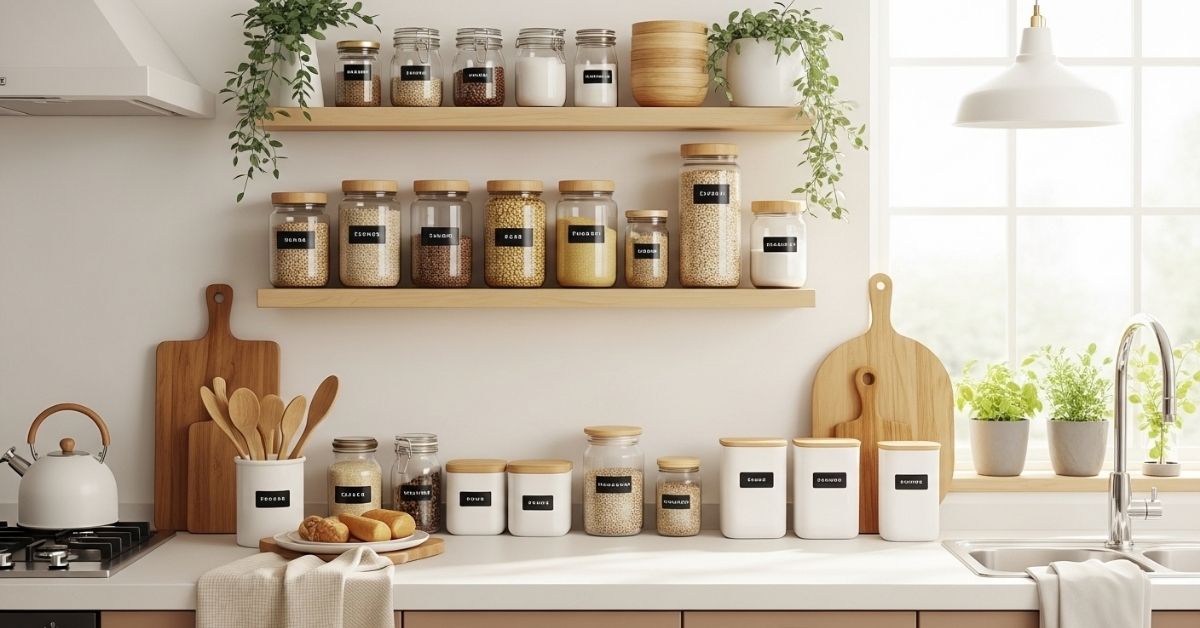
There’s a specific kind of frustration that comes with a kitchen that functions fine but never quite looks right. Counters that accumulate stuff the moment you clear them. Cabinet interiors you’d rather not think about. That one drawer. If your kitchen feels like it’s working against you visually and practically, you’re not dealing with a decor problem, you’re dealing with a systems problem dressed up as one.
Kitchen organization aesthetics aren’t about making everything look like a staged photo. They’re about creating a space where the way things are stored actually matches the way you move, cook, and live. Done well, the organization becomes the aesthetic open shelves that display what’s worth displaying, drawer inserts that make cooking faster, countertops clear enough that the materials underneath (tile, stone, wood) finally get to do their job.
If you’re working with a small kitchen, a rented apartment, or just a layout that never felt quite right, these ideas are built for real spaces not showrooms.
Open Shelf Styling With a Strict Edit

Most open shelving fails not because of the shelves but because of what goes on them. The setup that actually works: two to three shelves max, styled in thirds (practical items, a plant or two, a few decorative pieces), with consistent dishware that reads as a collection rather than a mix. Warm wood shelves against a white or light-tiled wall create enough contrast that the display feels intentional. This works especially well above a countertop run in narrow galley kitchens, where upper cabinets can feel heavy and low. The visual benefit is removing closed cabinets from one wall makes a compact kitchen feel several feet wider than it is.
Decanted Pantry Staples in Clear Uniform Containers
Decanting isn’t just aesthetic, it’s a genuinely useful system once you set it up properly. When dry goods (flour, oats, pasta, lentils, coffee) move into same-size clear canisters with clean labels, two things happen: you see what you have at a glance, and the visual noise of competing packaging disappears entirely. Tall, straight-sided glass or acrylic containers stacked or lined on a pantry shelf or counter create a rhythm that reads as organized even mid-cook. This is one I’d actually recommend trying first because the payoff-to-effort ratio is unusually how it takes an afternoon to set up and then maintain itself.
Drawer Inserts That Match Your Actual Cooking Habits

Generic drawer organizers fail most kitchens because they’re designed for an average cook, not your specific cooking. A better approach: map out what you actually reach for daily (spatulas, peeler, tongs, one good knife) and build your insert system around those items first. Bamboo or light wood inserts in a deep drawer keep tools visible without stacking. Separate cutlery inserts in a shallower drawer, positioned closest to the table or dishwasher, cut seconds off every meal. This matters most in kitchens where counter space is limited and drawers are doing double duty.
A Utensil Crock That Earns Its Counter Space
If a utensil crock is going to live on your counter, it needs to justify the square footage. That means editing down to the 6–8 tools you use weekly, choosing a vessel with enough weight and visual presence (matte ceramic, stoneware, or a simple linen-finished pot) that it reads as intentional decor rather than overflow storage. Position it near your cooktop, not your prep zone, so it’s functional where it matters. Honestly, the version most people have of an overstuffed container full of things they never use is doing more harm than a clear counter would.
Read More About : 27 Modern Kitchen Counter Decor Ideas That Actually Work in Real Homes
Under-Cabinet Lighting as an Organizational Tool

Lighting changes what you see which directly affects how organized a space feels. Under-cabinet LED strips (warm white, 2700–3000K) illuminate your prep surface and simultaneously draw the eye to the counter rather than to upper cabinet clutter. The result is a kitchen that feels intentional after dark without adding anything to the space. This setup works especially well in rentals where overhead lighting is fixed and unflattering. A plug-in LED strip, mounted with adhesive clips under the cabinet edge, costs very little and requires no rewiring.
A Designated Dry Goods Station on the Counter
Countertop clutter usually happens because frequently used items don’t have a clear home. A cooking station fixes that: a small wooden tray or marble slab in the corner nearest to your stove, holding only what you reach for every time you cook oil, salt, maybe a spice or two. Containing these items on a tray gives the grouping a visual boundary, making it look curated rather than left out. It also makes cleaning the counter faster because the tray lifts as a unit. In small kitchens, this approach reduces the visual weight of the counter without requiring you to hide anything away.
Vertical Spice Storage on an Inside Cabinet Door

The inside of cabinet doors is some of the most underused storage in a kitchen. A door-mounted spice rack narrow enough to clear the shelf inside when the door closestakes spices off the counter or out of a crowded cabinet and organizes them vertically in a way that’s both visible and easy to update. Tiered versions let you see labels at a glance. This is especially useful in apartments and galley kitchens where counter space is at a premium and spice sprawl is constant. Bonus: it keeps frequently used spices near the stove without occupying any surface area.
A Pegboard Wall Panel for Cookware and Tools
Pegboard works in kitchens for the same reason it works in workshops it makes everything visible, reachable, and rearrangeable. Mounted on a blank kitchen wall (or the side of a cabinet run), a white or natural wood pegboard panel can hold pans, lids, utensils, a small shelf for oils, even a rail for paper towels. The layout is fully adjustable as your storage needs shift. In kitchens where cabinet depth is shallow or drawer count is low, this kind of wall storage can absorb a significant amount of what would otherwise be counter clutter. It works best in kitchens with at least one clear wall that isn’t interrupted by appliances.
Matching Bins in the Pantry or Lower Cabinets

Mismatched containers inside cabinets create visual noise even when the items inside are organized. Switching to a system of same-size bins, pull-out baskets, lidded boxes, or simple open containers in one color lets the eye scan quickly and makes the cabinet feel like a system rather than a holding space. Label the fronts with a label maker or simple chalk tags. Group by category (baking, snacks, canned goods) rather than by frequency. This setup is especially effective in deep lower cabinets where things tend to disappear toward the back. It’s also renter-friendly, nothing requires installation.
A Knife Block Alternative: Magnetic Wall Strip
Knife blocks take up more counter space than they earn, and in-drawer knife inserts require a dedicated deep drawer. A magnetic wall strip solves both problems: knives mount vertically on the wall near the prep area, visible, accessible, and completely off the surface. Stainless steel or matte black strips pair well with most kitchen hardware. Mounting them at eye level between the counter and upper cabinets uses a zone that’s otherwise empty. This is one of those changes that improves the kitchen both visually and functionally; the prep area clears up, and the knives are actually easier to grab.
Floating Shelves in the Corner Dead Zone

Kitchen corners both upper and lower are consistently the worst-used storage zones in most homes. Upper corner dead zones (too far to reach, awkward depth) work better as display than storage: one or two floating shelves at different heights, holding a cookbook, a trailing plant, and a few ceramic pieces. It turns an unusable corner into a visual anchor point without requiring any functional storage to move. In open-plan kitchens where the corner faces the dining or living area, this setup does a lot of work as a visual bridge between the two spaces.
Tray Organization Inside Deep Drawers
Deep drawers are excellent storage until everything migrates to the bottom and nothing is findable. A simple fix: lay flat trays or shallow risers inside the drawer to create two visible layers. Items used daily sit on top (spatulas, measuring spoons, a vegetable peeler); items used weekly sit beneath. The tray acts as a visual separator and keeps the top layer from shifting. This is most useful in kitchens where one deep drawer is doing the work of three shallow ones which is common in European-style kitchen layouts and most modern apartment renovations.
A Floating Shelf Bar Cart Alternative for a Kitchen Nook

If your kitchen has a nook, alcove, or small stretch of unused wall near the dining area, a floating shelf styled as a drinks or coffee station pulls that zone into the room’s aesthetic rather than letting it read as dead space. Two shelves, one for glasses, one for bottles or a small plant creates a setup that’s functional for entertaining and visually connected to the kitchen without requiring a bar cart or additional furniture. This works especially well in apartment kitchens with a pass-through to a dining area, where the transition between spaces tends to feel abrupt.
Consistent Hardware as a Visual Unifier
In kitchens where cabinets are older or mismatched, consistent hardware does more unifying work than almost any other single change. Swapping out all pulls and knobs to the same finish, brushed brass, matte black, satin nickel creates a visual rhythm across the whole cabinet run. In 2026, brushed gold and warm bronze are the hardware tones showing up most in renovated kitchens, especially paired with white or sage green cabinets. This is a renter-friendly upgrade if the original hardware can be saved and replaced on move-out, and it costs significantly less than new cabinet fronts.
Labeled Zones in the Refrigerator

Refrigerator organization is usually treated as purely functional, but it has a direct effect on how the whole kitchen feels mostly because an organized fridge is one that gets used correctly, reducing the counter pile-up of items that were forgotten and moved out. Clear pull-out bins divided by category (dairy, produce, leftovers, drinks) with simple labels mean every person in the household puts things back correctly. Designate one clear container as a “use first” bin for items close to expiring. In my experience, this single system reduces food waste and the resulting kitchen disorder more than most visible organizational changes.
A Simple Pot Lid Organizer Inside a Cabinet
Pot lids are the item most likely to create a cabinet avalanche. A vertical organizer either a wire rack that holds lids upright or a tension rod system keeps lids separated, visible, and removable with one hand. Mount it inside the cabinet nearest your stove. This one change frees up a surprising amount of lower cabinet space because lids no longer need to stack on top of pots. It works in nearly every kitchen size and requires no installation in most configurations.
Read More About : 21 Small Kitchen Decor Ideas on a Budget That Actually Make the Space Work
A Tiered Stand for Fruit and Produce on the Counter

Produce that lives on the counter tends to spread out and take over. A two-tier standwire, wood, or ceramic stacks it vertically and contains it to one footprint. The visual effect is cleaner than a bowl (which tends to overflow), and the airflow of an open stand keeps fruit in better condition than a closed container. Choose a material that works with your counterwarm wood for natural kitchens, matte black wire for more industrial or modern spaces. This is a simple, inexpensive change that works in almost any kitchen size.
Spice Jars Decanted Into a Matching Set
Commercially packaged spices in mismatched containers are one of the fastest ways to make a counter or shelf feel disorganized even when the spices themselves are arranged neatly. Decanting into a matching set of small glass jarsamber, clear, or matte white and applying clean printed labels brings the whole zone together visually. Store them on a narrow wall shelf beside the stove or in a pull-out drawer rack. This setup works especially well in open kitchens where the spice area is visible from the dining or living room.
A Paper Towel Holder That Mounts Under the Cabinet

Paper towel rolls are constant counter clutter that nobody thinks to move until they see the counter without one. An under-cabinet-mounted holder takes a few minutes to install and frees up a full roll’s footprint on the counter. Position it near the sink or prep zone for maximum usability. This is a small change that matters more in narrow countertop kitchens where every inch of prep space is functional rather than decorative.
A Chalkboard or Memo Wall Panel as Functional Decor
A chalkboard section on the wall near the pantry or refrigerator functions as a visual anchor and a practical systemgrocery lists, meal plans, or notes written directly on the wall rather than scattered on paper. Painted with chalkboard paint or installed as a framed panel, it keeps planning visible and off the counter. This works particularly well in family kitchens or shared apartments where multiple people are managing the same food supply. The aesthetic effect is deliberately analog in a way that contrasts nicely with the more modern organizational systems elsewhere in the kitchen.
A Dish Drying Mat Instead of a Rack

A standard dish rack is one of the bigger visual disruptors on a kitchen counter because it’s always in use and hard to tuck away. A flat drying matabsorbent microfiber or siliconetakes up less counter space, lies completely flat when not in use, and rolls or folds for storage under the sink. It doesn’t hold as many dishes as a rack, but for one-to-two-person households or anyone with a dishwasher, it handles the hand-wash overflow without the bulk. A neutral stone-gray or sage mat blends with almost any counter surface.
A Cookbook Stand or Recipe Tablet Holder as a Counter Anchor
A single cookbook stand near the stove does two things: it gives one of your most-used items a permanent home (so it stops moving around), and it creates a deliberate focal point on the counter that reads as curated rather than functional. Choose a stand that’s slightly decorative wooden with simple joinery, or a sleek metal easel rather than a purely utilitarian clip design. A cookbook or tablet at cooking height is also genuinely more useful than one lying flat on a counter, which means this is one of those cases where the aesthetic improvement comes directly from the functional one.
Grouped Appliances on One Counter Zone

Appliances scattered across the full length of a counter create visual noise even when individually neat. Grouping them on one endcoffee maker, kettle, toaster, blender and anchoring the group on a wooden board or large tray creates a defined “appliance zone” that contains the visual weight to one section of the counter. The rest of the surface reads as clear prep space rather than storage. This works especially well in L-shaped kitchens where one arm of the counter can serve as the appliance zone, leaving the other for prep.
A Narrow Rolling Cart Between Appliances or Cabinets
The gap between a refrigerator and a cabinet run is usually wasted space anywhere from 4 to 12 inches depending on the kitchen. A slim rolling cart (sometimes called a “slim pantry cart”) fits into this space and pulls out as needed. It can hold spices, oils, canned goods, cleaning supplies, or baking tools whatever doesn’t have a natural home in the existing cabinet system. In small apartments, this can effectively add a full pantry’s worth of storage in dead space. Look for carts with full-extension pull-out capability so items at the back are actually accessible.
Woven Baskets for Lower Open Shelves or Pantry Bottoms

Woven seagrass or rattan baskets on lower shelves or pantry floors are one of the more practical storage formats for items that don’t need to be airtight potatoes, onions, extra produce, cloth bags, or kitchen linens. The texture reads warmly against painted shelves or light wood, and the basket contains the visual randomness of irregular-shaped items into one cohesive form. Label the front if multiple baskets are in use. This setup works particularly well in open-bottom kitchen islands or in farmhouse-style kitchens where the lower shelf is exposed.
A Minimalist Cleaning Supply Station Under the Sink
Under-sink storage is typically chaotic items shoved in without a system, often on top of each other or around pipes. A pull-out caddy for cleaning products (with the sprays hanging by their triggers from the caddy rail) and a simple two-tier shelf for smaller items brings the same organizational logic as the rest of the kitchen into the one zone most people ignore. This matters because under-sink chaos tends to overflow onto the counter or into adjacent drawers. Keeping it systematized keeps the whole sink area cleaner by default.
A Consistent Color Story Across Storage Containers

One of the more significant visual upgrades a kitchen can get without any structural change is moving toward a consistent container color palette. This doesn’t mean everything has to match exactly but choosing a two-to-three-tone range (cream, natural wood, matte black / white, warm gray, terracotta) and applying it across canisters, bins, baskets, and drawer inserts pulls the kitchen together visually in a way that reads as designed rather than assembled. This is the kind of detail that makes the organization feel like an aesthetic choice, which is the whole point of treating kitchen organization as decor.
What Actually Makes Kitchen Organization Aesthetics Work
The most common reason kitchen organization fails visually even when it’s technically functional is a mismatch between the scale of the system and the scale of the space. A large pantry organized with small jars looks chaotic. A narrow galley kitchen with oversized appliance blocks looks cramped regardless of how tidy each item is.
What works is organizing at the right visual weight for your specific kitchen. In small kitchens, the priority is reducing visual texture, fewer visible items, more consistent containers, more wall-mounted storage to clear surfaces. In larger kitchens, the priority is creating definition zones that give different parts of the kitchen a clear purpose so the space doesn’t feel like a warehouse of stuff.
Lighting reinforces both. Under-cabinet lighting in a small kitchen emphasizes the counter surface (usually the cleanest horizontal plane) over the clutter of upper cabinets. Pendant lighting in a larger kitchen creates zones by drawing the eye to specific areas rather than letting the whole room read as one continuous space.
The other thing that matters is maintenance design/setting up systems that return to order without effort. Clear containers make you more likely to refill than replace. Labeled zones make it easier for anyone to put things back correctly. Pull-out storage means you can actually access the back of a cabinet, which means things don’t pile up at the front. Organization aesthetics that last are ones where the visual order is the natural result of the system, not something you have to impose on top of it.
Kitchen Organization Aesthetics: Setup Guide by Space Type
| Kitchen Type | Best Organization Priority | Visual Strategy | Key Storage Fix |
| Galley / Narrow | Vertical storage, clear counters | Remove upper cabinet visual weight with open shelves | Magnetic knife strip, wall pegboard |
| Small Apartment | Multi-use systems, hidden storage | Consistent container palette | Rolling slim cart, under-cabinet mounts |
| Open-Plan Kitchen | Zone definition, aesthetic coherence | Color-consistent containers, tray groupings | Appliance zone + floating shelves |
| Large Kitchen | Preventing over-spread, maintaining zones | Anchor visual weight with large elements | Pull-out bins, pantry decant system |
| Rented Kitchen | No-install solutions, reversible changes | Baskets, freestanding carts, removable rails | Door-mounted spice racks, drying mats |
| Farmhouse Style | Texture + function balance | Natural materials (wood, woven, ceramic) | Open shelves, woven baskets, crocks |
Common Kitchen Organization Mistakes That Make Your Space Feel Messier
Organizing everything visibly.
Open shelves and visible storage only work when the items on display are worth displaying. Most people overload open storage with the full contents of a closed cabinet, which produces a look that’s actually more visually chaotic than a closed door would be. The rule: open storage for 20–30% of your items, closed storage for the rest.
Using too many container styles.
Mixing wire baskets, plastic bins, woven boxes, and lidded containers across the same shelf or pantry creates visual noise even when everything is technically sorted. A cohesive system needs at most two or three container formats in the same color family.
Ignoring the backsplash zone.
The wall between the counter and the upper cabinets is one of the most underused organizational surfaces in a kitchen. A magnetic strip for knives, a narrow rail for small baskets, or a row of hooks for mugs moves items off the counter without requiring any cabinet space.
Organizing the wrong things first.
Most people start with their most cluttered zone (the “junk drawer,” the spice cabinet) when the more effective approach is to start with whatever is most visible from the room’s entry point. Visual order at the sight line creates the impression of an organized kitchen even if the inside of every cabinet is still in progress.
Buying organizational products before auditing what you have.
New bins and containers frequently duplicate storage for things that should simply be removed. Before purchasing any organizational product, remove everything from the target area, discard or donate anything unused in the last year, and then see what storage you actually need. In most kitchens, the answer is less than expected.
FAQ’s
What is kitchen organization aesthetics?
Kitchen organization aesthetics refers to the practice of designing storage and organizational systems so they are both functional and visually cohesive where the way items are arranged, contained, and displayed contributes to the overall look of the kitchen rather than just managing clutter. The goal is a kitchen where order is visible and intentional.
How do I make my kitchen look organized without doing a full renovation?
Start with the most visible surfaces, countertops and open shelves. Move to consistent containers for pantry staples, add a few wall-mounted storage solutions (magnetic knife strip, door-mounted spice rack), and standardize your container color palette. These changes require no structural work and create significant visual improvement in most kitchens.
What’s the most impactful single kitchen organization change?
Clearing countertops down to only what you use daily tends to have the biggest immediate visual impact because counters are the first thing you see when entering the kitchen. Everything else contains matching, labeled pantry zones/builds on top of that foundation.
Open shelves vs. closed cabinets: which is better for small kitchens?
Closed cabinets keep visual noise contained and work better for most small kitchens because they hide organizational imperfection. Open shelves work well in small kitchens only when the items on display are edited down to a curated selection. A hybrid approach of one or two open shelves for display, closed cabinets for everything else tends to give the best result in compact spaces.
How do I maintain kitchen organization long-term?
Systems maintain themselves when every item has a clear, easy-to-return-to home. The key is designing for the path of least resistance if putting something away takes more effort than leaving it out, it will always end up out. Pull-out bins, labeled zones, and containers that are easy to open and close make maintenance the natural behavior rather than an extra step.
Is decanting pantry items actually worth it?
For frequently used dry goods (flour, oats, pasta, coffee, sugar), yes the visibility alone reduces overbuying and waste, and the visual consistency across a shelf or pantry is significant. For items used infrequently or in small quantities, the benefit is mostly visual rather than functional, and it may not justify the setup time.
What’s a good kitchen organization starting point for renters?
Begin with no-install solutions: a slim rolling cart for extra storage, door-mounted spice racks, under-cabinet magnetic strips, and a drying mat in place of a dish rack. These systems require no drilling, no permanent changes, and most move with you to the next place.
Conclusion
A kitchen that feels organized and visually coherent doesn’t require a renovation or a large budget; it requires a system. When the way you store things reflects the way you actually use the space, the kitchen starts to look intentional on its own. The organization becomes the aesthetic, rather than something layered on top of it.
Start with one or two ideas that fit your specific kitchen, your counter space, your storage constraints, your daily routine. Clear the countertop and add one wall-mounted solution. Decant your most-used staples. Standardize one shelf. Small, specific changes in a kitchen compound faster than in most other rooms, because you’re in that space every day.
