

There’s a specific kind of discomfort that comes from lying in bed under a harsh overhead light. The room looks bright but feels cold, and no amount of throw pillows seems to fix it. Cozy Bedroom Ceiling Lighting Ideas Ceiling lighting is one of the most overlooked elements in bedroom design, yet it’s often the single thing that determines whether a room feels restful or just… functional. The fixture you choose and how you layer it with other light sources changes the entire mood of the space.
If your bedroom feels unfinished despite having the right furniture and colors, the ceiling is usually where the disconnect lives. A flush-mount with the wrong bulb temperature, a fan-light combo that belongs in a 1990s rental, or simply one overhead source doing all the heavy lifting these are common setups that quietly make rooms feel less than they could be.
For anyone trying to build a bedroom that genuinely feels like a retreat, not just a room with a bed in it, this list covers ceiling lighting approaches that work across room sizes, ceiling heights, budgets, and aesthetics.
A Linen Drum Pendant Over the Bed for Soft, Downward Light

When a ceiling fixture is chosen for looks alone, it usually disappoints in practice. A linen drum shade pendant solves both problems; it’s visually calm and filters light into something genuinely warm. The fabric diffuses the bulb so there’s no harsh point of light, just an even, amber-toned glow that spreads downward across the bed. This works especially well in rooms with 8–9 foot ceilings where a chandelier would hang too low but a flush-mount feels too flat. In my experience, this is one I’d actually recommend trying first because it requires zero rewiring most drum pendants swap directly onto an existing ceiling medallion or junction box.
Recessed Lighting on a Dimmer Switch Around the Room Perimeter
Recessed lighting has a reputation for feeling clinical, which is fair when it’s installed straight down the center of the room at full brightness. The fix is placement and control. Positioning recessed cans near the walls rather than the ceiling center creates wash lighting. The beam hits the wall and bounces back softly, removing the spotlight effect entirely. Pair this with a dimmer (not optional), and you go from office lighting to something that actually supports winding down at night. This setup is most useful in larger bedrooms where a single pendant doesn’t provide enough reach, or in rooms with low furniture where wall-washing adds vertical interest.
A Chandelier with Fabric Shades Instead of Open Bulbs

Open-bulb chandeliers look beautiful in product photos and create glare in real bedrooms. The version that actually works day-to-day swaps those exposed bulbs for small fabric or frosted-glass shades on each arm. The light output is nearly the same, but the visual effect is dramatically softer. You can look up without squinting, which matters when you’re lying in bed. This style works best in rooms with ceilings above 9 feet, where the fixture needs some visual weight to hold the space. It also reads as intentionally designed rather than a default, which changes the feel of the whole room.
4. String Lights Anchored to the Ceiling in a Canopy Pattern
This isn’t a dorm-room idea if executed with restraint. Anchoring warm-toned (2200–2700K) string lights from a center ceiling hook down to the four corners of the room or just above the headboard creates a canopy effect that’s surprisingly effective at making a room feel enclosed and cozy. The key is bulb temperature and density: too cool or too many, and it looks like a patio. Done right, it adds a layer of ambient light that no overhead fixture can replicate. This is a strong option for renters who can’t modify existing wiring and want something that goes beyond a floor lamp.
A Rattan or Wicker Pendant for Patterned Shadow Work
The functional difference between a solid shade and an open-weave one is the secondary effect: shadow. A rattan or wicker pendant casts geometric light patterns across the ceiling and upper walls when lit, which adds dimension to a plain room without adding any physical objects. During the day it reads as a textural decor piece. At night, with a warm Edison or globe bulb, it becomes the most interesting thing in the room. This works especially well in rooms that feel flat or monotonous not because it’s decorative, but because it activates the vertical surfaces of the space in a way that furniture can’t.
Flush-Mount with a Frosted Glass Diffuser and Warm Bulb

Low ceilings don’t leave many options, which is why so many small bedrooms end up with whatever flush-mount came with the apartment. The upgrade isn’t expensive; a frosted glass or opal diffuser flush-mount with a 2700K bulb (not daylight, never daylight in a bedroom) produces a gentle, even light that reads as intentional rather than default. The frosted glass eliminates the visible filament, so there’s no focal point of brightness, just soft light. This is the most practical choice for rooms under 8 feet and for renters who need a single fixture to do quiet, unfussy work.
Read More About : 27 DIY Apartment Decor Ideas for Renters Bedroom That Actually Work in Real Life
A Semi-Flush Globe Pendant in Smoked or Seeded Glass

Seeded or smoked glass pendants are having a genuine moment in 2026 and they work for a reason that goes beyond trend. The texture of the glass (tiny bubbles or irregular thickness) scatters light in multiple directions rather than throwing it straight down, which creates a fuller ambient glow. A semi-flush version hangs just slightly below the ceiling (4–8 inches) and works in spaces where a full pendant would feel too low. The bronze or brass hardware ages well and adds warmth even when the light is off, a detail that matters in a room you spend a lot of time in.
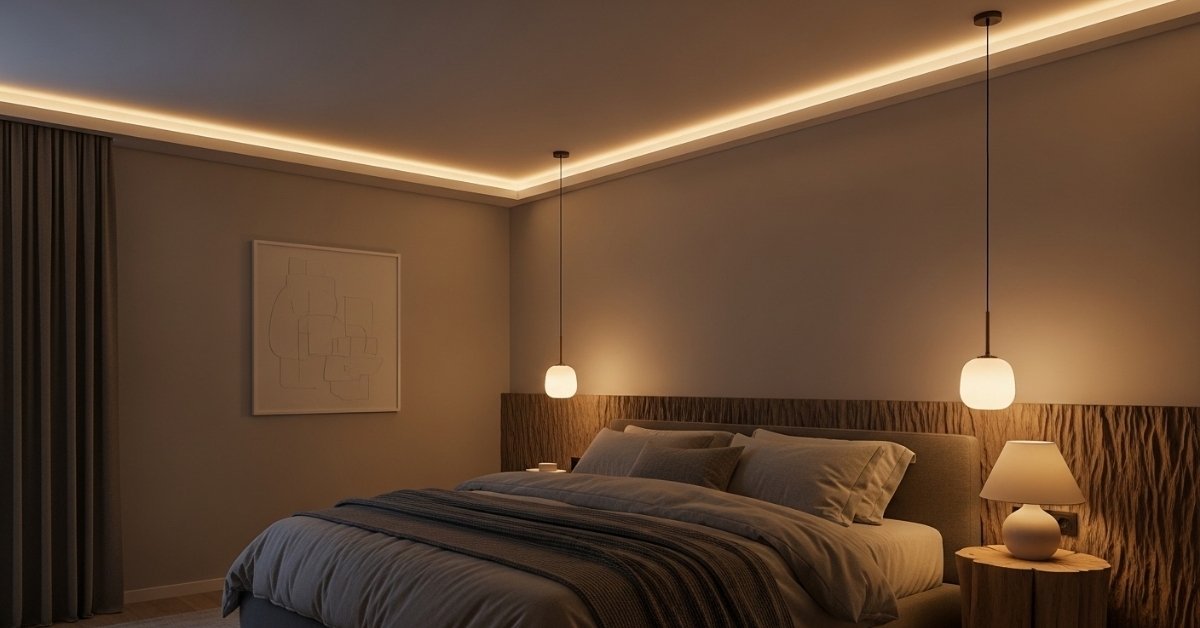
Two Matching Pendants Flanking the Bed Instead of One Centered Light
Centering every light source on the ceiling creates a symmetry that technically works but doesn’t serve the room functionally. Two smaller pendants positioned above each nightstand hung from ceiling canopies or on plug-in swag setups direct light exactly where it’s needed for reading and eliminate the bedside table lamp entirely. This frees up surface space and changes the visual balance of the room: instead of one source flooding everything from above, you get two pools of warm light on either side of the bed that feel personal and intentional. Works best in rooms where nightstand space is limited.
Cove Lighting Built Into a Tray Ceiling

Tray ceilings are underused. The recessed ledge around the perimeter is designed for exactly this: running a warm LED strip inside the cove so the light bounces upward against the ceiling rather than downward into the room. The effect is indirect: there’s no visible light source, just a warm halo that makes the ceiling look higher and the room feel more enveloped. Honestly, this is one of the most effective lighting moves you can make in a bedroom if your ceiling architecture supports it. The LED strip itself is inexpensive; the impact is disproportionate.
A Lantern-Style Pendant in Black Metal for Contrast
Black fixtures read differently than chrome or nickel they don’t reflect, they anchor. A lantern-style pendant in matte black with a visible warm bulb works as a visual contrast point in neutral rooms that feel too soft or undefined. The lantern shape has enough visual interest to function as decor while the open frame keeps the light from being blocked. In white or light-walled rooms, the fixture grounds the ceiling without competing with anything else in the space. This setup is most useful in rooms that feel “nice but forgettable” the kind of room that needs one point of definition to pull together.
A Paper or Washi Lantern Pendant for Soft, Diffused Coverage

There’s a reason the Noguchi-style paper lantern has remained relevant for decades: it does one thing extremely well. The rice paper diffuses light in every direction simultaneously, with no hotspots and no harsh shadows, producing an effect closer to natural light than almost any other fixture type. Hung at the right height (bottom of shade at approximately 7 feet), a large paper lantern lights a full room evenly while keeping the ceiling feeling open. This is a budget-forward option that doesn’t read as cheap when sized correctly the key is going larger than feels intuitive.
LED Strip Lighting Behind a Crown Molding or Ceiling Beam
This is the hidden light approach and it changes how the whole room reads at night. A warm LED strip tucked behind crown molding or a false ceiling beam throws light upward against the ceiling and along the wall junction, creating a glow that has no visible source. The room feels lit without feeling like a lit room, which is the exact quality that makes bedrooms feel restful. I’ve noticed this style tends to make ceilings look significantly higher than they are, which is a meaningful bonus in rooms that already feel tight. Setup requires some DIY comfort but no electrician.
A Coastal or Woven Seagrass Pendant for Earthy Warmth

Natural fiber pendants seagrass, jute, abaca absorb and filter light rather than reflecting it, which means the light that comes through is already softened before it reaches the room. This works well in bedrooms that lean into organic textures (linen, wood, stone) because the fixture doesn’t fight any of the other materials it extends them. The weave pattern also creates subtle shadow play on nearby surfaces without the dramatic effect of open-weave rattan. A practical note: these are generally lighter in weight, which makes installation easier and allows them to work with standard ceiling hooks.
A Vintage Milk Glass Flush-Mount for Nostalgic Warmth
Milk glass pendants and flush-mounts have a specific quality of light that modern frosted fixtures don’t quite replicate. The opal glass is thicker and denser, which means the light source is completely invisible and the glow is even across the entire surface of the shade. Vintage or vintage-style milk glass fixtures (widely available at architectural salvage or reproduced by smaller lighting brands) add a quiet, nostalgic quality to bedroom lighting that works in traditional, farmhouse, and transitional spaces. The fixture itself is unassuming enough that it doesn’t demand attention, it just makes the room feel considered.
Read More About : 27 Bedroom Wall Decor Ideas Above Bed That Make the Whole Room Feel More Intentional
A Cluster of Micro-Pendants at Varying Heights

A single pendant centered on the ceiling is the default. A cluster of three or five smaller pendants hung at slightly different heights from a canopy plate adds movement and visual depth without requiring a chandelier. The irregular drop heights create a composition that looks designed rather than installed, and the multiple light sources (even if small) fill the room more evenly than a single point of light. This approach works well in rooms with high ceilings where a single fixture leaves too much empty space, and in spaces with a modern or eclectic aesthetic where pattern matters.
Plug-In Swag Pendant for Renters Who Want Real Lighting
The ceiling light you can’t hardwire is still solvable. A plug-in pendant where the cord runs from a ceiling-mounted hook down the wall to a standard outlet gives renters access to overhead-style lighting without touching the electrical. The cord can be surface-mounted along the wall with adhesive clips or left to drape naturally, which reads as intentional in more relaxed aesthetics. The fixture selection is the same as any hardwired pendant, so there’s no visual compromise. This setup is especially effective in rooms where the existing ceiling fixture is a builder-grade eyesore that can’t be replaced.
A Large Sputnik-Style Chandelier in a High-Ceiling Bedroom

High ceilings are an asset that most bedrooms underuse. A sputnik or starburst chandelier with arms radiating outward from a center canopy fills vertical space in a way that grounds the room without lowering the visual ceiling. The multiple exposed bulbs mean the light spreads in all directions, reducing the need for supplemental sources, and the sculptural form of the fixture does work as a focal point even in daylight. This is not a subtle choice, and that’s exactly the point: rooms with high ceilings need something with enough presence to hold the proportion.
Warm LED Recessed Trim Lights Paired with a Central Statement Piece
Layered lighting is about giving yourself options, not filling every square foot of ceiling with fixtures. A statement pendant at the center doing the ambient work paired with two recessed trims near the reading or dressing area of the room creates a practical, flexible system. Each layer can be dimmed independently, so the room can shift from fully lit to softly glowing depending on time of day and activity. This setup works in mid-size to larger bedrooms where one light source leaves corners underlit, and it’s especially effective in rooms that function for both sleeping and working.
A Copper or Brass Flush-Mount with Visible Bulb as a Design Object

Brass and copper fixtures shifted from dated to considered somewhere around 2020 and the warm metal tones remain relevant because they do something useful: they add warmth to the room even when the light is off. A dome-style flush-mount in brushed brass with an exposed amber bulb functions as a design object during the day and a warm light source at night. The key is choosing brushed or satin finishes over polished polished brass reads formal, brushed reads relaxed. This is a strong choice for transitional or modern-traditional rooms that want warmth without going full rustic.
Coffered Ceiling with LED Strips Inside Each Panel
If the room has a coffered ceiling, the panels are frames waiting to be lit. Running a warm LED strip inside the recessed edge of each coffer so the light faces inward and upward activates the architecture of the room in a way that furniture alone can’t. The effect is dramatic without being theatrical: each panel has its own defined glow, creating a grid of warm light across the ceiling that reads as intentional and sophisticated. This is a permanent modification that adds the most value in master bedrooms where the design investment makes sense long-term.
A Bell-Shaped Pendant in Matte Ceramic or Plaster

Matte surfaces don’t reflect what they absorb. A bell-shaped pendant in raw plaster, matte ceramic, or painted plaster finish creates a fixture that becomes part of the room’s texture rather than a separate shiny object. The downward-focused beam works well over a reading chair, desk corner, or centered above a bed where you want directional warmth without scatter. This style is most at home in Scandinavian-minimal or quiet luxury bedrooms where material quality matters more than visual complexity. The fixture itself doesn’t demand attention, which is often exactly the right choice.
A Schoolhouse Globe Pendant for Timeless, Even Light
The schoolhouse globe pendant is one of those designs that hasn’t changed in 80 years because it works. The enclosed globe diffuses light in every direction, the neck prevents glare from underneath, and the overall shape is simple enough to work in almost any room style traditional, transitional, modern farmhouse, minimal. Semi-flush and pendant versions are both widely available. It’s not an exciting choice, but in a room that already has personality through furniture and textiles, a quiet fixture that does its job without competing is often the right call.
A Macramé or Textile Pendant for a Bohemian Soft-Light Effect

Open-weave textile pendants macramé, knotted cotton, or handwoven fiber function like woven rattan but with softer edges. The light that comes through the gaps is diffused by the surrounding fiber, so the effect is warm and uneven in an organic way rather than a geometric one. These work best in bedrooms that lean into natural materials and relaxed aesthetics, and they’re one of the few fixtures that look better handmade than machine-produced. An important sizing note: go bigger than seems necessary. A small macramé pendant reads as an accessory; a large one reads as a fixture.
A Black-and-Brass Cage Pendant for Industrial-Warm Contrast
The cage pendant works when the room has enough other soft elements to balance the hard lines of the metal. Black exterior with a brass or gold interior finishes, a common combination, creates a fixture that reads warm from below (brass reflects the bulb’s light back down) and graphics from above. An Edison or globe bulb with a visible amber filament is the right pairing: the filament becomes part of the composition rather than just a light source. This setup works in rooms with dark accents, mid-century furniture, or industrial-modern leanings not in rooms that are already very heavy on metal or dark tones.
A Low-Profile Disc Light in Concrete or Stone Finish

Disc lights thin, wide flush-mounts in a circular form solve the low-ceiling problem without sacrificing design. A concrete or stone-look finish adds texture at eye level (or slightly above it) without the visual heaviness of a box fixture. The low profile keeps the ceiling line intact, and the matte material prevents any of the clinical brightness that comes from white or chrome flush-mounts. This is most useful in modern, minimal, or industrial-leaning bedrooms where the fixture is meant to be understated but not invisible, a quiet piece that holds its own.
A Shaded Fan Light in a Muted Tone for Function and Warmth
Ceiling fans with light kits are almost always an aesthetic compromise and they don’t have to be. The version that works chooses the fan and light kit as a unit rather than adding a kit as an afterthought. A fan in warm oak, dark walnut, or matte black with a fabric-shaded light kit (not exposed bulbs, not a glass bowl) produces warm downward light and moves air, two functions that bedrooms actually need. This is a strong practical choice for warm climates or rooms that heat up, where a floor fan would add clutter and a window AC unit is too loud.
A Sculptural Plaster or Organic-Form Pendant as a Focal Point

The ceiling is the one surface in a bedroom that nothing else competes with no furniture, no art, no windows. A sculptural pendant that reads as a form rather than just a fixture turns the ceiling into a deliberate design moment. Organic plaster shapes, irregular hand-formed designs, and sculptural pendants in stone-look materials have been gaining traction since 2024 and are moving into mainstream availability in 2026. The light quality from these fixtures is secondary to the visual effect; most use frosted bulbs for soft diffusion but in a room that’s otherwise well-lit by supplemental sources, a sculptural focal piece at the ceiling completes the composition.
What Actually Makes Bedroom Ceiling Lighting Work
The most common lighting mistake in bedrooms isn’t choosing the wrong fixture, it’s expecting one fixture to do everything. A bedroom ceiling light that tries to provide task lighting, ambient lighting, and mood lighting simultaneously usually fails at all three. The setups that genuinely work divide those functions intentionally.
Bulb temperature is non-negotiable.
Anything above 3000K in a bedroom fixture will read as white or cool light, which activates rather than relaxes the nervous system. Stick to 2700K for warm-neutral and 2200K for amber-warm. This is the single change that makes the biggest difference without touching the fixture itself.
Dimmer switches transform fixed-output lights.
A $15–30 dimmer compatible with your bulb type (check for LED-compatible dimmers) gives a single fixture the range of an entire lighting system. A flush-mount on full brightness for getting dressed, at 40% for reading, and at 15% for winding down is three different rooms from one source.
Fixture height relative to ceiling height determines whether a pendant works.
The general rule: bottom of pendant shade should hang at approximately 7 feet from floor for pendants positioned in traffic areas, slightly lower over the bed where there’s no clearance concern. In rooms under 8 feet, any pendant risks feeling intrusive flush or semi-flush is the more comfortable choice.
Multiple light sources at different heights create depth.
A ceiling fixture + bedside lamp + optional floor lamp covers three vertical zones: high (ambient), mid (task), and low (accent). Even two of the three creates more visual interest and practical flexibility than one ceiling source doing all the work.
Bedroom Ceiling Lighting: Setup Comparison Guide
| Setup | Best Room Size | Ceiling Height | Problem It Solves | Budget Level |
| Drum pendant | Small–Medium | 8–10 ft | Harsh overhead light | Low–Mid |
| Recessed + dimmer | Medium–Large | Any | Uneven or clinical lighting | Mid–High |
| String lights (canopy) | Any | 8–12 ft | Lack of warmth, renter-friendly | Low |
| Rattan/woven pendant | Small–Medium | 8–10 ft | Flat, textureless space | Low–Mid |
| Cove LED strip | Medium–Large | Tray/coffered | Low ceiling feel, harsh light | Mid |
| Sputnik chandelier | Large | 10+ ft | Empty vertical space, scale | Mid–High |
| Sculptural plaster pendant | Medium–Large | 9+ ft | Missing focal point | High |
| Schoolhouse globe | Any | 8–10 ft | Lighting that works across styles | Low–Mid |
| Plug-in swag | Any | 8–10 ft | Renter with bad existing fixture | Low |
| Two pendant flanking | Medium–Large | 8–10 ft | Nightstand clutter, reading light | Mid |
How to Avoid the Most Common Bedroom Ceiling Lighting Mistakes
Sizing fixtures too small.
A pendant that looks proportional in a product photo often disappears in an actual room. For bedrooms, pendant shades under 10 inches in diameter rarely read as intentional above a bed; they look like an afterthought. The safe starting point for a centered pendant in an average bedroom is 14–18 inches in diameter.
Using daylight bulbs.
5000K or 6500K bulbs belong in offices, kitchens, and bathrooms not bedrooms. This is the most common reason a bedroom fixture “doesn’t work.” The fixture is usually fine; the bulb temperature is the problem. Replace first before replacing the fixture.
Centering everything.
A single centered ceiling light in a long or asymmetrical room creates an imbalance: one end of the room is lit, the other is in shadow. Two recessed lights, or a pendant offset toward the bed with a supplemental source elsewhere, serves the actual layout of the space better than strict geometric centering.
Ignoring layering.
A ceiling fixture as the only light source means one switch controls the entire mood of the room. There’s no flexibility. Even one additional bedside or floor lamp gives the room range and ceiling fixtures can be left off entirely once the room is otherwise lit, which is often the right call.
Choosing fixtures for looks in bright showroom light.
The way a fixture photographs or looks in a well-lit showroom is not how it looks at 10pm in your bedroom. Ask about light output (lumens), check the bulb compatibility, and prioritize diffusion how well the shade conceals the bulb over visual style alone.
FAQ’s
What type of ceiling light makes a bedroom feel the most cozy?
Fixtures that diffuse light rather than project it tend to produce the warmest, most comfortable bedroom atmosphere. Drum shades, frosted glass globes, paper lanterns, and woven pendants all filter the bulb so there’s no visible point of brightness. Pair any of these with a 2700K bulb on a dimmer for maximum effect.
What’s the best bulb temperature for bedroom ceiling lights?
2700K is the sweet spot for most bedrooms warm enough to feel relaxed without veering into orange. For an even more amber feel closer to candlelight, 2200K works well for secondary or accent fixtures. Avoid anything above 3000K in a bedroom; it reads as white or cool light, which disrupts the sense of calm the room should have.
Can I add cozy ceiling lighting without rewiring or calling an electrician?
Yes. Plug-in swag pendants attach to a standard ceiling hook and run to a wall outlet with no wiring required. String light canopies work the same way. For renters who can replace fixtures (with landlord permission), most pendants and flush-mounts screw into standard junction boxes in under 20 minutes with a screwdriver and voltage tester.
How do I choose the right size pendant for my bedroom ceiling?
A general rule: the pendant shade diameter (in inches) should be roughly half the width of the surface below it. For a queen bed that’s 60 inches wide, a 14–18 inch shade is appropriate. For very large or open rooms, sizing up always works better than sizing down small fixtures in big rooms read as accidental, not designed.
Is a ceiling fan with a light kit a good option for bedrooms?
It depends entirely on the execution. A fan with an exposed-bulb light kit or a basic glass bowl fixture is almost always an aesthetic compromise. A fan chosen as a unit with a fabric-shaded or frosted-globe light kit in a finish that matches the room’s hardware can work well, especially in warm climates. The fan function is worth the aesthetic limitation when the room genuinely heats up at night.
How many ceiling lights does a bedroom actually need?
Most bedrooms function well with one ceiling source plus one or two supplemental sources at lower heights. Bedrooms that need two ceiling fixtures are usually larger master suites with defined zones: a sleep area and a sitting or dressing area where a single fixture doesn’t reach both. For standard-size bedrooms, one well-chosen ceiling fixture on a dimmer plus bedside lighting covers everything.
What’s the difference between ambient and accent ceiling lighting in a bedroom?
Ambient ceiling lighting provides general illumination and fills the room. Accent ceiling lighting highlights something specific: a cove, a beam, an architectural feature. In a bedroom, ambient is the primary ceiling fixture; accent is LED strips in a tray ceiling or cove that create mood without replacing functional light. Most bedrooms benefit from both, not just one.
Conclusion
Bedroom ceiling lighting doesn’t need to be complicated to work well, it needs to be deliberate. The right fixture at the right height, with the right bulb temperature and a dimmer to control output, changes how a room feels morning and night. Most of the issues that make bedrooms feel unfinished or uncomfortable trace back to this one element.
Start with the fix that addresses the most obvious gap in your current setup whether that’s a bulb swap, a dimmer installation, or replacing a builder-grade fixture with something that actually suits the room. You don’t need all 27 ideas. You need two or three that fit your ceiling height, your room size, and how you actually use the space. Pick those and build from there.
