

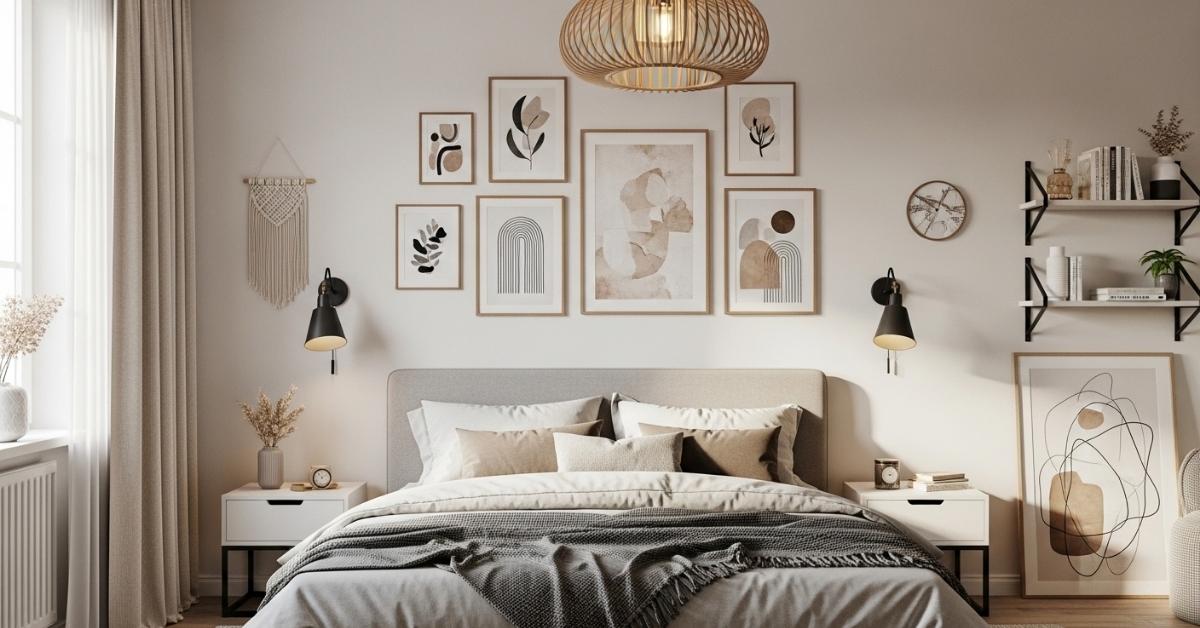
The wall above your bed is one of the most loaded spots in any bedroom. It’s what you see when you lie down, what guests notice when they walk in, and honestly what makes the difference between a room that feels pulled together and one that just… doesn’t. Bedroom Wall Decor Ideas Above Bed Yet it’s also one of the most overthought spaces in home design. Too often it ends up either completely bare or overwhelmed with a gallery wall that competes with everything else in the room.
If your bedroom feels like it’s missing something but you can’t place what, it’s probably this wall. Whether you’re working with a small apartment bedroom, a rental you can’t drill into, or a large primary suite that needs a real focal point, the ideas below cover real setups with actual placement logic, material guidance, and spatial reasoning, not just pretty pictures.
For anyone trying to make their bedroom feel more cohesive without adding more furniture, this is the place to start.
A Single Large-Scale Art Print Centered Above the Headboard

When a room lacks a clear focal point, one well-sized print can do more than a dozen smaller pieces. The key is scale the art should span roughly two-thirds the width of your bed. A 60–80cm wide bed calls for something in the 90–120cm range. Hanging it 15–20cm above the headboard keeps the composition tight and grounded rather than floating. This setup works best in neutral rooms where you want one strong visual anchor. It solves the problem of walls that feel empty without creating visual clutter.
A Woven Rattan or Macramé Wall Hanging for Texture-Forward Warmth
Textile wall hangings do something flat art can’t they add physical depth and warmth to a surface. In rooms with smooth walls, light-colored furniture, and minimal decor, a large woven piece introduces texture that the eye naturally rests on. Hung from a simple wooden dowel, it works without any drilling in many cases (a command strip or tension rod adapter can handle pieces up to a few kilograms). This setup is especially useful in rental bedrooms where permanent fixtures aren’t an option, and in rooms that already have plenty of color but feel flat in terms of material variety.
A Floating Shelf With Curated Objects Instead of Artwork

A shelf above the bed isn’t new but the way most people use it is what makes or breaks it. The setup that actually works is one long shelf (at least 100cm) rather than two smaller ones, positioned about 30–40cm above the headboard. Keep objects to an odd number with clear visual weight variations: something tall, something low, something with texture. This works particularly well in rooms without much visual depth, because it creates a layered horizontal line that draws the eye across rather than upward into empty wall space. If the shelf is positioned too high, the room feels like a hotel. At the right height, it reads as an intentional design decision.
A Diptych or Triptych That Functions Like a Window
Two or three coordinated frames hung at the same height with consistent spacing (7–10cm gaps between them) create a horizontal composition that mimics the visual logic of a window, something the eye moves along rather than stops at. This is different from a full gallery wall in that it has clear edges and doesn’t compete with the rest of the room. In a smaller bedroom, a diptych is almost always more effective than multiple mismatched frames because it keeps the visual weight contained. Black and white photography tends to work well here because it doesn’t fight the room’s color story.
Read More About : 27 Aesthetic Boho Bedroom Decor Ideas That Actually Work in Real Homes
Architectural Molding or a DIY Panel Frame for Depth Without Art

In rooms where the budget doesn’t stretch to large artwork, or where the aesthetic leans more architectural than decorative, a painted molding frame (or modern slat panel) above the bed creates the visual impression of depth and intention without any actual decor hung inside it. The molding or panel is attached to the wall and painted the same color or a tone slightly deeper to create a subtle inset effect. I’ve noticed this style works especially well in bedrooms that already have white or cream walls because the tonal variation is enough to create definition. It’s also one of the few above-bed setups that actually improves in photographs, which matters more than it should.
A Brass or Black Metal Sconce Pair as Both Lighting and Decor
Wall sconces positioned on either side of the headboard solve two problems at once: they replace bedside table lamps (freeing up nightstand space) and fill the vertical wall area in a way that feels functional rather than purely decorative. The ideal placement is at reading height when seated roughly 140–150cm from the floor, slightly above pillow level. Articulating arms are worth the extra cost because they can adjust between ambient lighting and task lighting depending on the moment. This setup works best in rooms with small nightstands or no nightstands at all. Brushed brass and matte black both read as intentional; shiny chrome tends to look more dated.
A Botanical Print Collection With a Consistent Frame Style

The reason most gallery walls above beds fail isn’t the art, it’s inconsistent framing. When every frame is a different style or finish, the collection reads as accumulation rather than curation. The fix is simple: pick one frame profile (thin, natural wood or thin matte black are the most versatile) and use it for everything. A grid of six botanical prints in a 2×3 arrangement gives the wall structure. The total composition should be roughly the width of the bed, centered. This approach works especially well in rooms where the rest of the decor is neutral and simple, because the botanical imagery adds enough warmth without dominating.
An Oversized Round Mirror for Light Reflection and Visual Expansion
A round mirror above the bed works differently than rectangular ones; the curved edge softens the room’s straight lines and avoids competing with the horizontal logic of the bed. The practical function (bouncing natural light around the room) makes it especially useful in bedrooms with a single window or north-facing light. Diameter should be at least 60cm to read as intentional; smaller round mirrors in this position tend to look like a decision that wasn’t quite committed to. Rattan, wood, and unlacquered brass frames work better than ornate gilded ones, which can age the room’s feel quickly.
A Canvas or Framed Piece Leaning Against the Wall on a Ledge

For renters or anyone reluctant to commit to permanent holes in the wall, a picture ledge above the bed creates flexibility without sacrificing visual impact. The ledge itself should be installed at around 30–40cm above the headboard, and the art can be rotated seasonally or replaced whenever the mood changes. The best part of this setup is layering a large canvas at the back with a smaller framed print or two leaning in front creates depth that flat-mounted art can’t achieve. Low-profile platform beds suit this look best because the proportions allow for a taller piece without the whole arrangement feeling top-heavy.
A Word or Quote in a Refined Typography Print
Typography above the bed works when the execution is restrained. One print, one phrase, clean font, white or off-white background, minimal frame. The mistake most people make is choosing text that’s too literal or motivational in a way that reads as more coffee-mug than bedroom. Typeface matters: a well-set italic serif feels considered; a bold sans-serif motivational phrase feels transient. In my experience, this works best in bedrooms that are otherwise very minimal. The typography gives the room a quiet personality without introducing color or pattern.
A Canopy or Draped Fabric Panel That Softens the Whole Wall

Fabric above the bed doesn’t have to mean a full four-poster frame. A single wide panel of linen, muslin, or cotton voile hung from a ceiling-mounted rod or curtain track and draped loosely creates a canopy effect that’s both functional (it softens acoustics slightly) and visual (it adds height and coziness to the room). This is one of the few above-bed treatments that works better in rooms with high ceilings at standard 240cm ceiling heights, the fabric tends to crowd the space unless it’s kept very light and simple. Natural undyed linen is the most adaptable choice because it works across almost any color palette.
Read More About : 21 Luxury Bedroom Ideas on a Budget That Actually Look High-End
A Pegboard Panel Customized for Bedroom Use
Pegboards aren’t just for home offices. A pegboard panel above the bed painted to match the wall or in a contrasting tone creates a modular display surface that can hold small plants, a tiny mirror, hooks, or lightweight framed art. The advantage over fixed shelves is that the arrangement can be changed without any new drilling. This setup is particularly practical in small bedrooms where the above-bed wall has to do more than just look good; it can contribute to storage and functionality. The aesthetic reads as modern and considered when the pegboard is styled with restraint (five or six items maximum).
A Neon or LED Sign for Atmosphere in a Modern or Eclectic Bedroom

In rooms that already lean eclectic, maximalist, or modern-dark, a neon sign above the bed works as both light source and design statement. The sign itself should be meaningful but short one or two words and the color should be warm rather than cool to avoid a clinical or commercial feel. Pink, amber, and warm white are the most livable options for a bedroom context. This isn’t a setup for every room, but in the right space it fills the above-bed area in a way that nothing else quite does. It also solves the problem of overhead lighting in rooms that lack ceiling fixtures. The glow is directional but warm.
A Collection of Framed Mirrors in Mixed Sizes for a Glam Effect
Multiple mirrors above the bed create more visual complexity than a single large one, and they bounce light from different angles. The key to making this look intentional rather than chaotic is a consistent frame finish across all pieces of gold, brass, or chrome and an arrangement that has clear visual balance even if it’s not symmetrical. The arrangement should be planned on the floor before drilling. This setup works best in rooms with at least one strong light source (natural or artificial) because the mirrors need something to reflect in order to deliver their spatial effect. In very dark rooms, this approach flatters less.
A Living Plant Wall Section With Mounted Planters

Mounted planters above the bed require some practical thought irrigation, light, and weight but they solve a specific aesthetic problem well: they bring organic, living texture into the most static part of the room. Trailing plants like pothos or string-of-pearls work better than upright plants in this position because the downward growth creates movement. Three planters in a triangular arrangement (two at the top, one centered lower) gives the composition better proportions than a straight horizontal line. This works best in bedrooms with natural light nearby and is more practical than it sounds small wall-mounted planters are lightweight and most plants above a bed get adequate indirect light.
Architectural Floating Ledges in a Staggered Pattern
Rather than one long shelf, staggered ledges at different heights create a more dynamic composition while maintaining the flexibility of a display surface. Three ledges one centered higher, two flanking at a slightly lower position create an asymmetrical arrangement that draws the eye diagonally rather than straight across. The ledges should be narrow (8–10cm depth) so they don’t project too far from the wall. This is one of the setups I’d actually recommend trying first if you want flexibility without the permanence of fixed art, because you can restyle the displays as often as you want without touching the walls again.
A Simple Wooden Branch or Driftwood With Hanging Elements

A wide piece of driftwood or a cleaned, dried branch mounted horizontally above the bed creates a natural, freeform sculptural element that works without any art at all. Small hangings, tiny macramé pieces, dried botanical bunches, or simple string lights can be suspended from the branch at varying heights. The organic irregularity of the wood shape means no two installations look exactly alike, which gives this setup an authenticity that bought decor sometimes lacks. It works best in bedrooms with natural materials elsewhere: wood floors, linen bedding, ceramic accents. The overall weight of a branch like this tends to be light, so mounting is simpler than it looks.
Layered Framed Art With Varying Depths on Multiple Ledges
Two picture ledges at different heights above the bed, one lower, one about 40cm above it create a gallery-style layered look without committing to a fixed gallery wall arrangement. Art can be stacked, leaned, and repositioned without additional holes in the wall. The layering gives pieces three-dimensionality that flat-mounted art doesn’t have. This is especially effective in rooms where the art collection is evolving, because the whole display can be refreshed quickly. Consistency in frame color (even if sizes vary) keeps the arrangement from looking like a storage solution rather than a deliberate design.
A Curtain Panel Behind the Bed as a Soft Accent Wall Effect

Floor-to-ceiling curtains behind the bed (not at the window) create the visual effect of a soft accent wall without the commitment of painting or wallpaper. The fabric absorbs light and sound, making the room feel quieter and more enveloping. For best results, the curtain rod should be installed close to the ceiling and the fabric should pool slightly on the floor. Half-length curtains in this position look incomplete. This works best in bedrooms with neutral or white walls because it introduces color and texture simultaneously. Linen, velvet, and heavyweight cotton all work well; sheer fabrics lose the depth effect.
A Vintage Map or Blueprint as an Oversized Statement Piece
A vintage-style map or architectural blueprint print is one of the few above-bed choices that feels personal and specific rather than generic. At large scale (90cm or wider), a well-framed map reads as a genuine statement piece rather than filler. The subject can be a city, a country, a coastline, or an abstract topographic print. What matters more is that the print has enough detail to reward looking at it closely. Dark frames and aged, sepia-toned palettes tend to suit bedrooms with warmer, more traditional furnishings. Modern bedrooms may find cleaner-lined reprint maps or astronomical charts work better with the overall aesthetic.
A Gridded Set of Polaroids or Small Prints on Clips or Washi Tape

For renters or those who want to avoid any drilling at all, a string-mounted grid of small prints or polaroids above the bed creates an intentional display without permanent fixtures. The key to making this look curated rather than dormitory-style is a consistent print format (all polaroids, or all square prints in the same size), a fixed grid layout rather than a random arrangement, and neutral or matching clip hardware. Black binder clips on dark string, or small wooden clips on natural twine, both work. The display should fill at least 80% of the bed width to read as a design decision rather than an afterthought.
A Painted Mural Section in a Single Color or Motif
A painted element above the bed, a simple arch, a loose botanical motif, or a shaped color block treats the wall itself as the decor rather than something to hang things on. This requires some confidence in execution, but even a simple painted arch (just a semicircle of color behind the headboard) creates an effect that no hung piece can quite replicate. In 2026, soft arched shapes in warm terracotta, sage, or warm plaster tones are emerging as a quieter alternative to full accent walls. For renters, removable wall paint or peel-and-paint panels make this more achievable than it sounds. The effect is especially striking in rooms with otherwise plain white walls.
A Shadow Box Collection With Meaningful Objects

Shadow boxes allow three-dimensional objects to be displayed on the wall in a way flat frames don’t. Small collections of pressed leaves, found stones, delicate objects from travel become intentional when given their own framed context. Three shadow boxes in a horizontal arrangement, using the same frame finish, work well above a bed. The depth of the box (typically 3–7cm) means items appear to float within the frame, which creates a more interesting visual effect than a photograph or print would. This setup works particularly well in rooms where the decor already incorporates organic or natural materials, because it extends that logic to the wall.
A Full-Width Headboard Alternative Made From Wall-Mounted Slats
Wall-mounted wood slats installed vertically from behind the mattress line upward to roughly 160cm function simultaneously as a headboard and a wall treatment. The visual effect is more architectural than decorative, and it suits rooms leaning toward Scandinavian, Japandi, or minimal-modern aesthetics. Natural oak or walnut-stained slats with 2–3cm gaps between them create a rhythm that makes the wall feel designed rather than furnished. This is a more involved project than hanging a picture, but it solves the above-bed problem permanently and eliminates the need for a separate headboard. Renter-friendly versions using adhesive mounting strips for individual slats are now available in most home stores.
A Cluster of Pendant Lights as Sculptural Hanging Decor

Pendant lights above the bed hung in a cluster of three at varying heights rather than as functional over-bed lighting function as sculptural objects as much as light sources. The key is choosing pendants with interesting shapes (geometric, woven, or handblown glass) and controlling their height so the lowest doesn’t hang below shoulder height when sitting up in bed. This approach works best in rooms with dimmer switches, where the intensity can be lowered to make the pendants atmospheric rather than harsh. It also works best in rooms with few other decorative elements; the pendants do the visual work so everything else can stay minimal.
A Tapestry With an Abstract Pattern for Color Without Commitment
A tapestry in the right colorway can be the easiest way to introduce a pattern into a bedroom without wallpaper, art budget, or permanent changes. The difference between a tapestry that elevates a room and one that pulls it toward a college-dorm aesthetic is primarily scale and material quality; a large, hand-woven tapestry in natural fibers reads very differently from a small digitally printed one. Hung from a wooden dowel visible at the top, the hardware becomes part of the look. This works best in rooms where the bedding and furniture are fairly neutral, allowing the tapestry to carry the room’s color story.
A Statement Wallpaper Panel Applied Only Above the Bed

Instead of papering an entire wall, applying a single wallpaper panel centered above the bed and stopping at the edges of the headboard width creates a targeted accent that’s both easier to execute and easier to live with than a full feature wall. The panel should be roughly 10–15cm wider than the bed on each side and extend from just above the headboard to roughly 50–60cm above it, or all the way to the ceiling depending on the room’s proportions. This approach suits bold patterns especially well, because the contained area limits how much of the pattern the eye has to process. Peel-and-stick wallpaper has improved substantially in recent years and makes this a realistic option for renters.
What Actually Makes These Ideas Work
The ideas above cover different budgets, aesthetics, and room sizes but the ones that work best share a few consistent underlying principles.
Scale is the most common failure point. An above-bed treatment that’s too small for the space looks incidental, not intentional. A general guideline: whatever you hang or place should occupy roughly 60–75% of the bed’s width. A queen bed is about 150cm wide, which means the above-bed visual element should span roughly 90–115cm. This applies to single art pieces, gallery walls, and shelf arrangements equally.
Vertical height matters as much as width. Most people hang things too high. The base of whatever you’re putting above the bed should be 15–20cm above the top of the headboard (or where a headboard would be), not 40–50cm. When pieces are hung too high, the space between the bed and the decor creates a visual gap that makes the room feel disconnected.
Material contrast helps more than matching. If your bedding is smooth and flat, add texture above (woven, macramé, wood). If your headboard is already heavily textured (velvet, tufted), keep the above-bed element flat (art, mirror). The contrast is what creates visual interest identical materials in the same zone flatten out.
Lighting direction is often overlooked. The above-bed wall exists in a zone that’s often under-lit, especially in rooms that rely on overhead fixtures. Adding a wall sconce, bedside lamp, or directed picture light not only improves the bedroom’s functionality it also makes whatever you hang on that wall look significantly better. Art in particular changes completely depending on whether it’s lit from the side or from below.
Bedroom Wall Decor Above Bed: Idea Comparison Guide
| Setup | Best Room Size | Renter-Friendly | Budget Level | Problem It Solves |
| Large single art print | Any | Yes (large command strips) | Low–Mid | Empty, unfocused wall |
| Woven/macramé hanging | Small–Medium | Yes (lightweight) | Low | Flat, textureless wall |
| Floating shelf + objects | Any | No (drilling required) | Low | Storage + visual layering |
| Diptych/triptych frames | Small–Medium | Yes | Low–Mid | Bare wall, limited budget |
| Sconce pair | Any | No | Mid–High | Lighting + decor combined |
| Botanical print grid | Any | Yes | Low | Cohesion, neutral palette |
| Round mirror | Small–Medium | Yes | Mid | Dark rooms, limited light |
| Ledge with layered art | Any | Semi (one ledge) | Low | Flexibility, no commitment |
| Wood slat panel | Medium–Large | Semi | Mid–High | No headboard, architectural feel |
| Wallpaper panel | Any | Yes (peel-and-stick) | Mid | Bold pattern, low commitment |
| Pendant lights | Medium–Large | No | Mid–High | Sculptural impact, mood lighting |
| Canopy/fabric panel | Large | Yes | Low | Empty vertical space, height |
Common Mistakes That Make Above-Bed Decor Feel Off
Hanging too high.
This is the most frequent issue. When there’s more than 20–25cm between the headboard and the bottom of the artwork or decor, the room reads as disconnected. The bed and the wall treatment should feel like they belong to the same composition.
Going too small.
A single A3 print centered above a king bed looks like a placeholder. If the right-sized piece isn’t in the budget yet, it’s often better to leave the wall bare until it is a small piece in the wrong place that draws attention to the wrong things.
Too many competing elements.
A gallery wall, a shelf, a sconce pair, and a large print all in the same zone creates visual noise. The above-bed wall works best when one element is clearly dominant and others (if present at all) are secondary.
Ignoring the headboard’s visual weight.
A tall, bulky upholstered headboard already occupies a lot of visual space adding another large element directly above it doubles the weight at the top of the room and can make the space feel heavy. In this case, lighter treatments (a single linear piece, a sconce pair, a minimal shelf) work better than large art.
Choosing decor without considering the room’s light.
The above-bed wall is usually one of the darker areas of a bedroom, particularly in rooms with curtains closed. Whatever goes there needs to work at that light level. Highly saturated prints can look muddy in low light, while light-toned pieces can disappear.
FAQ’s
What size art should go above a bed?
A general rule: the artwork or arrangement should span 60–75% of the bed’s width. For a queen bed (roughly 150cm wide), that means the piece or grouping should be 90–115cm across. Going narrower than that tends to look like the piece was placed there rather than chosen for the space.
How high above the headboard should you hang wall decor?
Aim for 15–20cm above the top of the headboard. This keeps the composition visually connected to the bed. If there’s no headboard, treat the top of the mattress plus pillows as the upper boundary and work from there.
What’s the best wall decor for a small bedroom above the bed?
A single large-scale piece (art print, mirror, or textile) works better in small bedrooms than multiple smaller pieces. The visual simplicity keeps the room from feeling crowded. A round mirror is a particularly strong choice because it expands the perception of space by reflecting light.
Can you put a mirror directly above a bed?
Yes, and it can be very effective but size and weight are important. A mirror should be properly anchored into wall studs or with appropriate fixings. A round mirror with a lightweight frame (rattan, thin metal) in the 60–80cm diameter range is both safe and visually effective above most bed types.
Gallery wall vs. single large print above the bed which works better?
It depends on the room. A single large print is almost always easier to execute well and looks more considered in smaller or more minimal spaces. A gallery wall can work beautifully but requires much more planning consistent framing, careful spacing, and a clear overall shape to the grouping. If in doubt, start with one large piece.
What’s the easiest above-bed decor for renters?
Picture ledges (one or two screws per shelf), command-strip mounted lightweight prints, or textile hangings on friction-mount rods are the most renter-friendly options. Peel-and-stick wallpaper panels have also improved enough that they’re now a realistic option for temporary treatments.
Does the decor above the bed have to match the headboard?
It doesn’t need to match, but it should relate. A heavily textured, dark upholstered headboard pairs better with lighter, simpler decor above (a single line drawing, a minimal print). A minimal or low-profile headboard gives you more freedom to go bold above it without the room feeling top-heavy.
Conclusion
The wall above the bed has more design impact per square centimeter than almost anywhere else in the bedroom but only when the treatment feels proportional, intentional, and well-lit. Small changes in scale, height, or material choice make the difference between a space that looks finished and one that still feels like something’s missing.
Start with one idea that fits your current space, budget, and aesthetic whether that’s a single oversized print you’ve been putting off buying, a picture ledge that gives you flexibility, or a round mirror that makes a small room feel larger. You don’t need to solve the entire room at once. One well-chosen treatment above the bed tends to make everything else in the room look more deliberate too.
