

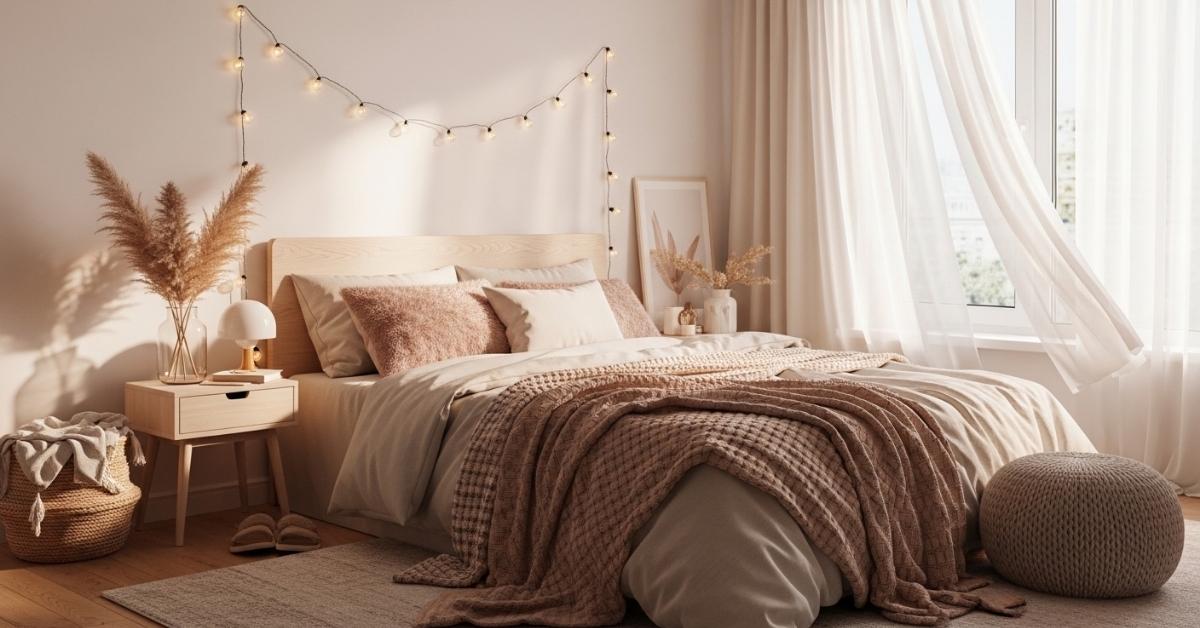
There’s a specific feeling a bedroom can have where the light is soft, the layers feel intentional, and you actually want to spend time there. If your bedroom currently feels more like a place you sleep in than a place you rest in, you’re not alone. Most bedrooms Cozy Bedroom Ideas Aesthetic look fine on the surface but miss the details that make them feel genuinely warm and lived-in.
The good news: creating a cozy aesthetic doesn’t mean a full renovation or a designer budget. It usually comes down to a few specific choices: how you layer textiles, where your light sources sit, how much visual breathing room you leave on the walls. If your style leans neutral, warm, or minimal-but-soft, these ideas will land well in your space.
For anyone working with a small bedroom, a rented apartment, or a layout that’s always felt slightly off, this list is built for real rooms, not magazine shoots.
Layer Your Bedding With at Least Three Textures

Cozy bedrooms almost always have one thing in common: the bed looks like it’s been thoughtfully built up, not just made. That means going beyond a duvet and two pillows. The real trick is combining materials that contrast something smooth (linen or cotton duvet), something tactile (a waffle-knit or chunky throw draped across the foot of the bed), and something with a bit of sheen or weight (velvet cushions or a quilted sham).
This layered approach works because different textures catch light differently, which makes the entire bed look richer and more dimensional without adding visual clutter. It works especially well in bedrooms that lack architectural detail, because the bedding becomes the focal point. If your room is on the smaller side, keep the palette tonal (varying shades of one color) so the layers read as intentional rather than busy.
Add a Pendant or Wall Sconce Instead of an Overhead Light

Overhead lighting is one of the biggest obstacles to a cozy bedroom aesthetic. It’s flat, harsh, and casts the kind of light that makes a room feel clinical rather than restful. Swapping in layered, lower-positioned light sources, even just plug-in wall sconces on either side of the bed changes the entire mood of the space.
The reason this works spatially is simple: lower light sources create a warm pool of light at eye level, which draws attention downward and makes ceilings feel less prominent. For renters, plug-in sconces are a genuinely practical solution no electrician needed, they mount with a single screw or even adhesive, and the cord can be tucked behind the headboard. Pair them with warm-toned bulbs (2700K or lower) for the most noticeable shift.
Read More About : 27 Amazon Finds Living Room Decor Ideas That Actually Work in Real Homes
Use a Low-Profile Bed Frame to Make the Room Feel Bigger

A bed frame that sits lower to the ground does something counterintuitive: it makes the ceiling feel higher and the room feel more open. This is especially useful in bedrooms with standard 8-foot ceilings that can feel slightly compressed once furniture is in. Platform beds or simple wooden low-frames remove the heavy visual weight of tall headboards and footboards, which lets the eye travel across the room rather than stopping at the bed.
In my experience, this setup works best in smaller bedrooms where every inch of visual floor space matters. The lower the bed, the more floor you can see and visible floor equals perceived space. This idea is also a good budget move; low-platform frames tend to be more affordable than upholstered beds with tall headboards.
Hang Curtains from Ceiling to Floor

The way curtains are hung matters more than the curtains themselves. Hanging rods at ceiling height rather than just above the window and allowing fabric to pool slightly on the floor creates a sense of height and architectural drama that most bedrooms completely lack. Even inexpensive linen or sheer curtains look elevated when they’re installed this way.
This setup solves the common problem of windows that feel stubby or walls that feel low. Vertically proportioned fabric essentially tricks the eye into reading the room as taller than it is. For small bedrooms, sheers in a warm white or natural linen tone keep the space light while still adding softness and texture. If you’re renting and can’t put holes in the ceiling, tension rods mounted as high as possible have a similar effect.
Build a Reading Nook Corner With a Chair and Floor Lamp

One chair in a bedroom corner transforms the entire function of the space. Instead of a room that’s only for sleeping, it becomes somewhere you actually want to be reading, journaling, or just sitting with coffee before starting the day. The setup doesn’t require much: a compact armchair (a round barrel chair or boucle accent chair works well), an arching floor lamp positioned behind and above it, and a small table or tray for a drink.
What makes this feel intentional rather than random is placement. Tuck the chair into the corner at a slight angle rather than flush against both walls this creates a sense of shelter without closing the space off. This idea is especially effective in bedrooms that are larger than average and feel sparse or echoey without additional furniture.
Use Warm White or Greige Paint Instead of Bright White

True white walls in a bedroom often read colder than expected especially in rooms that face north or don’t get much direct sunlight. Shifting to a warm white (with yellow or pink undertone) or a greige (gray-beige) creates a significantly more cocoon-like feeling without making the room feel dark.
The practical effect: warm-toned walls reflect light differently than cool whites, adding a softness that shows up most during evening hours when the lighting is lower. This is one of the easiest changes to make with a visible return. Good options to look at in 2026 include warm off-whites leaning toward cream or bisque shades that are photographed as neutral but read as genuinely warm in person. If you’re renting, even a single warm-toned accent wall behind the bed has a similar effect on the overall atmosphere.
Add a Woven or Jute Rug Under the Bed
Hard floors in a bedroom feel cold literally and visually. A rug anchors the bed and creates a defined, soft zone that makes the whole room feel more intentional. The key detail most people miss: the rug should be large enough to extend at least 18–24 inches on each side of the bed, so you step onto it when you get up. A rug that only partially tucks under the bed tends to look awkward.
Jute and woven rugs specifically add a layer of natural texture that works well in warm or neutral bedrooms; they bring organic material into a space that’s often dominated by soft fabrics and smooth surfaces. For rooms where the aesthetic leans minimal or Scandinavian, a simple flat-weave rug in natural tones grounds the space without adding visual noise.
Incorporate Wood Tones With a Floating Nightstand or Shelf

Wood is one of the most reliable materials for creating warmth in a bedroom. Even one or two wood-toned pieces, a floating nightstand shelf, a small stool used as a side table, or a wooden tray on a dresser shift the room toward warmer, more organic territory. The floating shelf approach is particularly useful in small bedrooms where floor space is limited: it keeps the visual floor clear while still providing the functionality of a nightstand.
This works best when the wood tone is warm rather than cold, think medium walnut, honey oak, or natural ash rather than whitewashed or gray-stained wood. These tones reflect amber light well, which becomes especially apparent in the evening when you’re using warm-toned lamps.
Style a Small Gallery Wall With Vintage-Style Prints
An empty wall in a bedroom can make the room feel unfinished but covering it with too much art creates visual noise. The sweet spot for a cozy aesthetic is a small, curated grouping of 3–4 prints in a similar color palette. Botanical prints, abstract warm-toned art, or simple line drawings in natural or cream frames are all strong choices.
Position the grouping above a dresser or at eye level on a wall that doesn’t compete with the bed for attention. Keep the frames in the same finish (all wood, all black, or all natural) and vary the size slightly, one larger anchor piece with two or three smaller ones around it. This is one I’d actually recommend trying first because the impact-to-effort ratio is high; you’re adding warmth and personality without touching furniture placement.
Read More About : 21 Cozy Living Room Lighting Ideas That Actually Change How Your Space Feels
Use Linen Bedding as Your Baseline

Linen has a specific quality that most bedding fabrics don’t: it looks better and slightly rumpled. That “just woke up” texture is actually the aesthetic and it makes beds look cozy and inviting without requiring any particular styling effort. From a practical standpoint, washed linen breathes well, softens over time, and holds up through repeated washing better than cheaper cotton alternatives.
For a cozy bedroom aesthetic, oatmeal, warm white, sage, or dusty rose linen are all worth considering. They photograph warmly and read as elevated without being precious. Honestly, if you only change one thing about your bedding, switching to linen has the most visible return.
Create a Soft-Lit Vanity Corner With a Round Mirror
A vanity corner adds function to a bedroom without taking up significant space and when styled with a round mirror and warm lighting, it becomes one of the coziest spots in the room. The circular mirror specifically softens the corner and avoids the boxy feeling that rectangular mirrors can create in tight spaces.
The lighting around the vanity matters a lot here. A small table lamp with a warm-toned bulb is more effective than a backlit mirror for creating atmosphere. If you do use a lighted mirror, choose one with an adjustable color temperature so you’re not stuck with cool LED light in a room designed to feel warm.
Add a Canopy or Draped Fabric Above the Bed

A canopy doesn’t have to mean four-poster or overly formal. Sheer fabric draped from a ceiling hook gathered to each side of the headboard creates a shelter-like quality over the bed that immediately makes the space feel more private and intentional. It’s one of the more dramatic changes you can make without moving furniture or repainting.
This works especially well in bedrooms with high ceilings that feel slightly cavernous. The draped fabric brings the visual ceiling down to a more human scale, creating what designers often call a “room within a room” effect. For renters, a simple command hook or tension rod mounted on the ceiling can support lightweight sheer fabric without damage.
Use Closed Storage to Eliminate Visual Clutter
Clutter is the single biggest obstacle to a cozy bedroom aesthetic not because minimalism is required, but because visual noise competes with the restful feeling the space is supposed to create. Closed storage (dressers with drawers, baskets with lids, wardrobes with solid doors) keeps everyday items out of sight without requiring you to actually own less stuff.
This is especially important in small bedrooms where open shelving tends to read as chaotic rather than curated. The practical rule: leave only one or two intentional items visible on any surface (a lamp, a single plant, a book) and store everything else. The resulting visual quiet makes even a busy, lived-in room feel significantly calmer.
Incorporate a Trailing Plant or Dried Botanical for Organic Warmth

Plants bring a quality to a room that no textile or paint color can replicate the suggestion of living, growing things. In a bedroom, a trailing pothos on a shelf, a fiddle leaf in a corner, or even a bunch of dried pampas grass in a ceramic vase creates an organic quality that makes the space feel less interior-designed and more genuinely inhabited.
For low-light bedrooms, pothos, snake plants, and ZZ plants are all reliable options that don’t need direct sun. Dried botanicals, pampas grass, cotton stems, eucalyptus are even lower maintenance and work well for renters who travel frequently or forget to water plants.
Style the Space With a Cohesive Neutral Palette (With One Warm Accent)
A neutral bedroom palette doesn’t mean boring, it means visually restful. The key to avoiding a flat or cold result is building the neutrals around warm undertones (cream, oatmeal, warm gray) rather than cool ones (cool white, blue-gray), and introducing one slightly warmer accent color that creates contrast without visual noise.
Terracotta, dusty rose, sage, or warm amber all work well as a single accent in an otherwise neutral room. The accent can be as simple as one throw pillow, a vase, or a candle holder. This one detail prevents the room from reading as sterile and adds just enough visual interest to feel curated.
Hang a Large Piece of Art at Headboard Height

In bedrooms without a headboard or with a low-profile one a single large piece of art hung at headboard height acts as the visual anchor for the entire room. The bed essentially becomes a frame for the artwork, and the wall above it becomes the focal point rather than dead space.
The practical sizing guideline: the art should be roughly two-thirds the width of the bed (so for a queen bed, about 40–50 inches wide). Too small and it floats awkwardly; too large and it overwhelms the space. Warm-toned abstracts, vintage landscapes, or large-format botanical prints all work well in a cozy bedroom aesthetic.
Use a Nightstand Lamp With a Fabric Shade for Diffused Light
The shade material on a bedside lamp matters more than most people expect. A fabric or linen shade diffuses light outward and creates a warm, even glow; a glass or metal shade directs light more sharply and can feel harsh in a nighttime bedroom setting. A ceramic base with a linen shade is the combination that shows up most in cozy bedroom setups and for good reason: it’s warm, textural, and casts light in a way that’s genuinely flattering.
Position the lamp so the bottom of the shade is roughly at eye level when you’re sitting up in bed. Too high and the bulb shines directly into your eyes; too low and the light doesn’t spread across the room. This one placement detail makes a significant difference in how the lamp performs.
Add a Full-Length Mirror to Reflect Light and Add Depth

A floor-length mirror leaned against a wall does two things simultaneously: it makes a small room feel larger by creating a visual depth that doesn’t exist, and it reflects natural light from windows into darker corners of the room. In bedrooms where natural light is limited, this is one of the most practical single-object improvements you can make.
The leaning position (rather than wall-mounted) keeps the room feeling relaxed rather than formal, and it’s a renter-friendly option that doesn’t require drilling. A warm wood frame keeps it cohesive with a cozy, neutral aesthetic; black metal frames work better in rooms leaning more minimal or modern.
Incorporate Soft Storage Baskets for Texture and Function
Baskets are one of the few storage solutions that actually look better out in the open than hidden away. A seagrass or woven cotton basket on the floor near the bed holding extra blankets or pillows adds texture and warmth while solving the very real problem of where to put linens that don’t fit in the closet.
They work best when the weave is tight enough to look intentional rather than haphazard. Round baskets with handles tend to read as more deliberate than large, shapeless laundry-style bins. Two baskets of slightly different sizes, stacked or side by side, create more visual interest than a single one.
Layer the Window Treatment With Sheer and Blackout

A single curtain panel is often not enough to achieve both the soft, diffused daytime light a cozy bedroom needs and the actual darkness required for good sleep. Layering a sheer panel with a separate blackout panel both on the same rod with a double bracket solves both problems simultaneously.
During the day, you draw the blackout back and let the sheers filter the light into a soft glow. At night, both close for full darkness. This is the setup that works in almost every bedroom context from apartments with street-facing windows to bedrooms that get early morning sun. It’s a slightly higher investment than a single curtain, but the function-to-aesthetics ratio makes it worth it.
Style the Dresser Top Like a Vignette, Not a Flat Surface
The top of a dresser is often either completely bare (which reads as unfinished) or piled with clutter (which reads as chaotic). The cozy middle ground is styled as a small vignette, a curated collection of 3–5 objects at varying heights that makes the surface look intentional.
A reliable formula: one lamp, one tray holding small items (so they feel collected rather than scattered), one plant or dried botanical, and one or two personal objects. The varying heights create visual rhythm, and the tray prevents the surface from reading as messy. Keep everything in a similar material or color palette, all wood, all warm neutral tones for the most cohesive result.
Introduce Candlelight for Evening Atmosphere

Candlelight in a bedroom does something that no artificial light source fully replicates; it flickers, which creates subtle movement and warmth that the room otherwise lacks. Even a few candles placed on the dresser or nightstand create an evening ritual quality that makes the bedroom feel genuinely restorative.
From a practical standpoint, pillar candles on a wooden tray (so wax doesn’t damage surfaces) and smaller votives in glass holders are the most functional options. Unscented or lightly scented options in warm, neutral tones (ivory, oatmeal, sage) keep the aesthetic cohesive without overpowering the room. Battery-operated candles are a good alternative for spaces where an open flame isn’t practical.
Use a Headboard-to-Ceiling Upholstered Panel for Warmth and Softness
A floor-to-ceiling upholstered panel behind the bed is one of the more dramatic cozy bedroom ideas that doesn’t require a complete renovation. It functions like a headboard but fills the entire wall section, which creates a padded, softened backdrop that makes the bed area feel sheltered and intentional.
This is especially effective in bedrooms where the wall behind the bed is plain or large. The upholstered fabric absorbs sound slightly (which adds to the restful quality), and in a warm linen or boucle fabric, it adds significant texture to the room. DIY versions using panel battens wrapped in fabric are a realistic option for those who want the look without paying for a custom piece.
Add a Small Bookshelf or Nightstand With Built-In Storage

A small bookshelf used as a nightstand is one of the more practical ideas for bedrooms where reading before sleep is part of the routine. It keeps books accessible, prevents the pile-of-books-on-the-floor situation, and adds a warm, personal quality that a standard nightstand doesn’t. A slim 3–4 shelf unit in a warm wood tone works well in most bedroom scales.
This setup works particularly well in bedrooms with limited floor space, because the vertical storage footprint is the same as a regular nightstand while providing significantly more capacity. Style the top shelf with a lamp and one or two non-book objects to keep the functional look intentional rather than purely utilitarian.
Choose a Bed in Natural or Textured Material Over Upholstered White
Rattan, woven grass, or raw wood bed frames bring an organic quality to a bedroom that upholstered beds (especially in white or gray) tend to lack. The natural material has visible texture, which adds warmth without requiring additional layers of soft furnishings. In a bedroom leaning toward a cozy, earthy, or organic aesthetic, a rattan or cane bed frame reads as a confident design choice rather than a default.
These frames also tend to be lighter visually than solid upholstered or wooden bed frames, which makes them particularly well-suited to smaller bedrooms. They’re widely available at accessible price points and don’t require the same care as fully upholstered alternatives spills and dust both clean more easily on woven or solid wood surfaces.
Use a Bench at the Foot of the Bed for Layering and Function

A bench at the foot of the bed is one of those pieces that looks purposeful and adds real-world function: it’s somewhere to sit while dressing, a place to drape a throw, and a visual anchor that gives the bed a finished, composed quality. Bedrooms without foot-of-bed furniture often feel like something is missing even if you can’t immediately identify what.
For small bedrooms, a slim bench (18–20 inches deep) keeps the clearance walkway open while still providing the visual layering effect. An upholstered bench in a fabric that echoes the bedding color keeps the palette cohesive; a wooden slatted bench adds a natural contrast to softer materials.
Finish With a Signature Scent for a Full Sensory Experience

A bedroom that looks cozy is one thing. A bedroom that also smells like a specific, subtle scent you associate with rest is something else entirely. Scent is one of the most underused tools in bedroom design and in 2026, the move away from heavy, synthetic fragrances toward lighter, more natural options (cedarwood, eucalyptus, sandalwood, clean linen) means there’s more room to experiment without the room feeling like a candle shop.
A reed diffuser or a small ceramic essential oil diffuser is the most consistent option; both release scent slowly and evenly without requiring attention. A scent that you use only in the bedroom creates a sensory cue that tells your nervous system the space is for rest which, over time, actually improves how quickly you settle down at night.
What Actually Makes These Cozy Bedroom Ideas Work
Most cozy bedroom aesthetics fail not because the individual pieces are wrong, but because the room lacks coherence. Everything is chosen in isolation rather than in relation to everything else. The bedding, the lighting, the furniture, and the accessories should all feel like they belong to the same palette and material world.
A useful way to check this: stand in the doorway of your bedroom and squint. If one element immediately jumps out as a different color temperature or texture family, that’s usually the piece disrupting the cohesion. It might be a cool-white light bulb in an otherwise warm room, a shiny surface among matte textures, or a piece of furniture that doesn’t match the general wood tone of the rest of the space.
The other thing that reliably makes or breaks a cozy bedroom aesthetic is lighting. Rooms with a single overhead light source almost never feel cozy regardless of what else is in them. A minimum of three light sources, a bedside lamp on each side of the bed and a third ambient source (floor lamp, sconces, or even candles) is the baseline for a bedroom that actually feels warm in the evening.
Cozy Bedroom Aesthetic Ideas at a Glance
| Idea | Space Type | Primary Benefit | Investment Level |
| Layered bedding textures | Any size | Visual warmth and depth | Low |
| Ceiling-height curtains | Small or average rooms | Makes room feel taller | Low–Medium |
| Plug-in wall sconces | Rentals, small rooms | Warm ambient lighting | Low |
| Low-profile bed frame | Small bedrooms | More perceived floor space | Medium |
| Woven/jute rug | Any size | Anchors bed, adds texture | Medium |
| Canopy or draped fabric | High-ceiling rooms | Adds intimacy over the bed | Low |
| Upholstered ceiling panel | Average to large rooms | Dramatic softness and warmth | High |
| Layered curtain treatment | Any size | Function + cozy light quality | Medium |
| Rattan/wood bed frame | Small to medium rooms | Organic warmth, lighter visual weight | Medium |
| Signature scent | Any size | Full sensory coziness | Low |
How to Make Your Bedroom Feel More Open and Organized Without Adding More Furniture
One of the most common mistakes in bedroom design is treating “cozy” as a license to fill every surface and corner. The result is a room that feels heavy and cluttered rather than warm and restful. A true cozy aesthetic is selective; it’s about the quality of what’s there, not the quantity.
Start with the floor.
Visible floor creates a sense of openness that makes even a small bedroom feel manageable. Avoid placing too many pieces of furniture against every wall; leaving one wall or corner completely clear gives the eye somewhere to rest.
Think vertically.
In rooms where floor space is limited, vertical storage (floating shelves, tall bookshelves, wall-mounted sconces) adds function without occupying the space you walk through. This is especially useful for bedrooms under 150 square feet.
Control the color temperature of your lighting.
Before buying any new furniture, swap all your light bulbs to 2700K or lower. This single change which costs almost nothing shifts the entire atmosphere of the room toward warmth. Many bedrooms that feel cold or flat are simply using the wrong light temperature.
Edit what’s on your surfaces.
Every dresser top, nightstand, and shelf should be evaluated for visual weight. If a surface holds more than five items, it probably needs editing. The items that stay should be intentional: a lamp, a plant, a single decorative object. Everything else should have a drawer or basket home.
Leave the area around the bed clear.
Walking space on either side of the bed should be at least 24 inches, ideally 30. When this clearance is compromised by furniture, the room immediately feels more cramped and less restful, regardless of how beautiful the individual pieces are.
Frequently Asked Questions
What is a cozy bedroom aesthetic?
A cozy bedroom aesthetic refers to a design approach that prioritizes warmth, softness, and sensory comfort over strict formality or trendiness. It typically involves layered textiles, warm lighting, natural materials like wood and linen, a neutral or warm color palette, and minimal visual clutter. The goal is a space that feels genuinely restful rather than just visually polished.
How do I make my bedroom look cozy on a budget?
Starting with lighting swapping in warm-toned bulbs and adding a plug-in sconce or two makes the biggest visible difference at the lowest cost. From there, layering your existing bedding with a textured throw, adding a few plants, and decluttering surfaces will do more than most furniture purchases. New curtains hung at ceiling height are also a high-impact, relatively low-cost change.
What colors make a bedroom feel cozy?
Warm whites, oatmeal, greige, soft terracotta, dusty sage, and warm camel tones consistently create cozy atmospheres. The key is that the undertones are warm rather than cool. A blue-gray paint or a stark cool white will work against a cozy aesthetic regardless of how expensive the other pieces are.
Cozy minimalist vs. cozy maximalist bedroom: which is better for small spaces?
For small spaces, a cozy minimalist is almost always the better approach. The goal is warmth through material and light quality rather than through volume of objects. Too many layers in a small room compound visual clutter which creates anxiety rather than rest. Focus on fewer, better-chosen pieces with strong texture and warm tones.
How many light sources does a cozy bedroom need?
At minimum, three: one on each side of the bed for reading and task light, and one ambient source elsewhere in the room (a floor lamp, sconce, or even candles). A single overhead light creates flat, harsh illumination that works against any cozy aesthetic regardless of the decor.
Do I need a headboard for a cozy bedroom aesthetic?
No but the wall above your bed needs some kind of visual anchor. That could be a headboard, a large piece of art, an upholstered wall panel, or even a simple arrangement of smaller framed prints. Leaving the wall above the bed completely blank tends to make the room feel unresolved.
What bedding fabric is best for a cozy bedroom aesthetic?
Washed linen is the most consistently recommended option because it has a natural texture, gets softer over time, and looks good slightly rumpled, which suits the relaxed quality of a cozy aesthetic. Cotton percale is crisper and better for hot sleepers. Velvet or flannel work well as accent layers (throws, shams) but can feel heavy as primary bedding.
Conclusion
A cozy bedroom aesthetic isn’t something you achieve all at once; it builds gradually as you make better-aligned choices about lighting, materials, and what you actually keep in the room. The good news is that most of the changes with the highest visual return are also among the least expensive: light bulbs, curtain height, textural layering, and surface editing are all low-cost moves that outperform most furniture upgrades.
Start with one or two ideas that match your current space, budget, or the specific problem you’re trying to solve. If the room feels cold, address the lighting first. If it feels unfinished, focus on the bed styling or the wall above it. Small, specific changes built over time create a room that genuinely feels like yours which is what a cozy bedroom aesthetic is actually about.
