

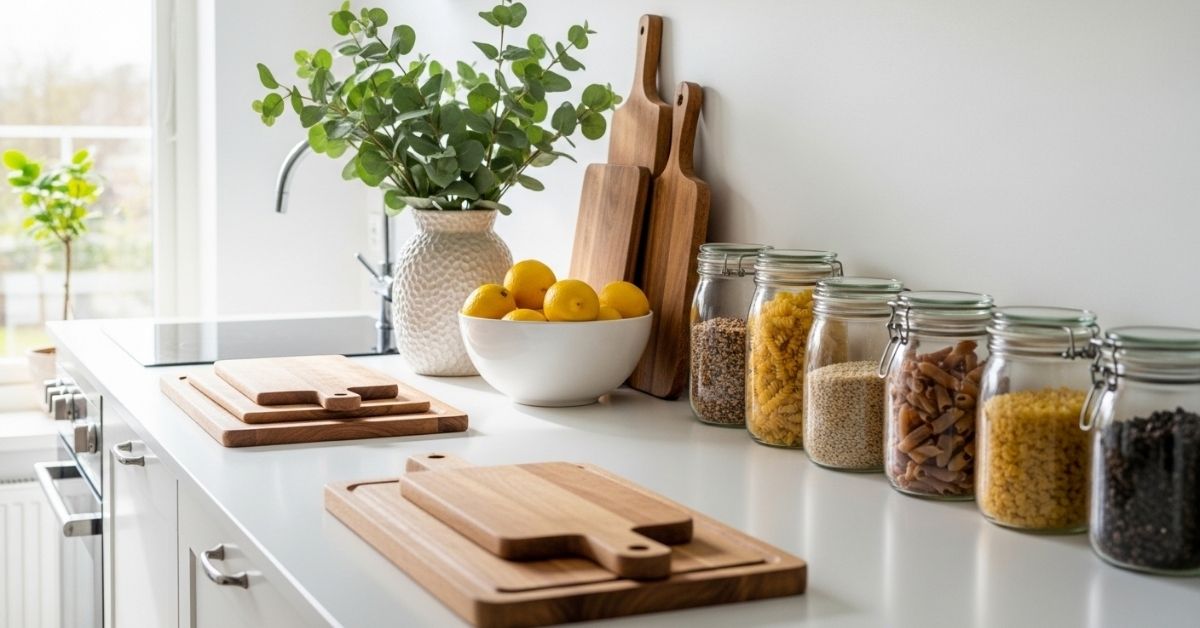
Most kitchen counters end up as catch-all surfaces a pile of mail here, a forgotten appliance there, and somehow a random candle that migrated from the living room. The counters are one of the most visible parts of your kitchen, yet they’re also the easiest to let go. Getting them right isn’t about perfect staging. Kitchen Counter Styling Ideas It’s about finding a balance between what you actually use every day and what makes the space feel intentional.
If you’re working with a smaller kitchen or limited surface area, the ideas here are built with that in mind. You don’t need a sprawling open-plan space or a quartz waterfall island to pull off a well-styled counter most of these setups work just as well in compact apartments and rental kitchens.
The goal: counters that feel curated, not cluttered.
Group Everyday Essentials Into a Styled Station

One of the most practical things you can do is stop treating your daily-use items as clutter and start treating them as a display. A wooden cutting board leaned against the backsplash, a set of matching canisters for coffee and tea, and a small olive oil bottle can form a cohesive “cooking station” that looks intentional. The vertical element the leaning board draws the eye upward and prevents the setup from reading as flat. This works especially well in narrow kitchens where counter depth is limited. Instead of spreading items out horizontally, you stack visual interest vertically, which keeps the counter from feeling cramped.
Use a Tray to Define the Styling Zone
A tray is one of the simplest tools for making a counter look styled instead of crowded. When you place a candle, a small vase, and maybe a ceramic dish inside a tray, it signals that these items belong together. It creates a contained “moment” on the counter rather than things just sitting loosely across the surface. In my experience, this works best when you use a material contrast a dark tray on a light counter, or a light rattan tray on darker stone. The boundary gives the eye somewhere to land, which makes even a basic setup look considered. Trays also make it easy to move the whole arrangement when you need the workspace.
Lean Into One Natural Material for Warmth

Wood is consistently the easiest material to style with because it adds warmth without competing with your existing kitchen aesthetic. A wooden spoon holder next to a small wood bowl with a couple of apples or lemons brings in an organic texture that softens the hardness of countertops and backsplash tile. You don’t need to match every piece in fact, varied tones in the same wood family (light beech next to a darker walnut board, for example) look more natural than a perfectly matched set. This setup works especially well in kitchens that lean white or grey, where the counters need visual warmth but you don’t want to introduce color.
Read More About : 27 Neutral Aesthetic Living Room Wall Decor Ideas That Actually Work in Real Homes
Style Around Your Coffee Maker Instead of Hiding It
Most people either push the coffee maker to the back of the counter or try to tuck it away somewhere, but honestly it makes more sense to lean into it. If you’re using it daily, styling around it transforms a functional appliance into an anchor piece. A small wooden riser or shelf beside the machine to hold stacked mugs, a little dish for spoons, and maybe a small trailing plant like pothos creates what feels like a considered coffee corner. Under-cabinet lighting (even a simple plug-in strip light) turns this corner into the warmest spot in the kitchen at night. Best for kitchens where the counter runs along a wall with upper cabinet access.
Use Height Variation to Prevent a Flat Look

When everything on your counter sits at roughly the same height, the eye skims across it without landing on anything. Introducing varied heights a tall potted herb like rosemary or basil, a medium-height oil bottle, and a small salt cellar or pinch pot creates a visual rhythm that feels more alive. The principle is similar to how a bookshelf works: variation creates interest. Herbs have the added advantage of being functional, so they earn their counter space. This approach works in almost any kitchen size, but it’s particularly useful in open-plan spaces where the counter is visible from across the room.
Edit Down to Three Items Per Zone
There’s a version of counter styling that involves adding things, and then there’s the version that involves taking things away. If your counters feel busy even after styling, the issue is almost always too many items per zone. A good rule: treat each counter zone (roughly 18–24 inches of surface) as space for three items maximum. One functional, one decorative, one that bridges both like a cookbook stand that holds a recipe but also looks good. This constraint forces you to prioritize what actually earns its place on the counter. I’ve noticed this style tends to feel most satisfying in kitchens with busier backsplash patterns or bold tile work, where the counter itself needs to stay quiet.
Bring in a Small Potted Plant or Fresh Herbs

A single potted plant does something that no candle or decorative object fully replicates it signals that the kitchen is actively lived in. A small basil plant near a window, or a compact succulent on the far end of a counter, introduces organic color and life without requiring much maintenance or space. If your kitchen gets decent natural light near the sink or window, fresh herbs are especially practical: they double as styling and as ingredients. For kitchens with no natural light on the counter, a low-maintenance plant like a ZZ plant in a small ceramic pot works well as a stationary decorative element that won’t need much care.
Use a Cookbook or Open Book as a Styling Element
A cookbook stand that holds an open recipe isn’t just functional it adds the feeling that the kitchen is actually used for cooking, not just storage. Oversized cookbooks in particular have a visual weight that grounds a counter zone, especially near the stove. Paired with one or two simple elements a small herb or a wooden utensil holder it creates a setup that looks curated but still practical. This is especially effective in kitchens styled with a light, airy palette where you need an anchor piece with visual substance. Go for this if you want your kitchen to feel like a real cooking space rather than a showroom.
Create a Fruit Display That Doubles as Decor

A bowl of fruit is one of the oldest counter styling tricks, but it still works when done intentionally. The key is the bowl itself. A wide, shallow ceramic dish or a simple wood bowl with a few lemons, limes, or green apples creates a clean, colorful display without looking like a grocery store arrangement. Citrus especially photographs well and stays looking good for a couple of weeks. The color contrast between fruit and a neutral bowl (white, terracotta, matte black) is what makes it feel styled rather than practical. Works in nearly any kitchen, but especially good for white or grey countertops that need a pop of natural color.
Keep One End of the Counter Completely Clear
This is the counterpoint (literally) to adding styling elements: deliberately leaving a section of counter empty. When one zone is styled and another is intentionally clear, it creates visual breathing room that makes the whole kitchen feel more controlled. The open space doesn’t read as unfinished it reads as intentional, especially when the counter material itself is attractive (stone, butcher block, or even a well-maintained laminate). This is particularly useful in longer kitchen runs where styling every inch would make the space feel cluttered rather than curated. The rule: if the counter is longer than six feet, leave at least one third of it clear.
Add a Small Mirror or Reflective Object for Light

A small mirror leaned against a backsplash tile might feel unconventional in a kitchen, but it works the same way it does in any other room it bounces light around and creates the impression of more space. In a galley kitchen or any layout with limited natural light, even a small circular mirror (20cm or so) on the counter can visibly brighten the area. The key is keeping the surrounding styling minimal so the mirror doesn’t compete with too many objects. This is one of those ideas that sounds odd before you try it and looks genuinely good after.
Layer Textures Without Adding Color
If you prefer a palette that stays calm and cohesive all whites, creams, and natural tones the way to add visual interest is through texture contrast rather than color. A matte ceramic bowl next to a smooth stone pestle, a linen dish towel folded flat on the counter nearby, and a raw-edge wood board creates a layered look that feels rich without introducing any competing hues. The variety of surface finishes (matte, smooth, woven, rough) catches the light differently and keeps the setup interesting. This works best in kitchens with a neutral or monochrome palette where color contrast would feel jarring.
Style the Space Beside the Sink Thoughtfully

The counter next to the sink is often the least styled and most cluttered spot in the kitchen. A ceramic soap dispenser (rather than a plastic pump bottle), a small plant or succulent, and a neatly folded dish towel turn this functional zone into something considered. Matching the soap dispenser material to other ceramic elements in the kitchen helps it feel connected rather than random. The dish towel in a coordinating linen or cotton adds texture without taking up significant space. This is a quick swap that costs very little but changes how the most-used part of your counter reads.
Use Vertical Stacking With Risers or Small Shelves
A two-tier wooden riser or a small counter shelf is one of the most practical styling upgrades for a kitchen counter that needs to hold a lot without looking disorganized. Oils, small spice jars, and a compact plant can be arranged across two levels, creating a organized display that keeps everything accessible without taking up a large footprint. It compresses the visual “footprint” of your counter items by using vertical space. This is especially useful for renters who can’t add wall shelving and need to make the counter itself work harder.
Read More About : 23 Modern Living Room Decor Ideas That Actually Work in Real Homes
Introduce a Single Candle or Taper for Ambience

A candle on a kitchen counter doesn’t have to feel out of place. A single pillar candle in a matte ceramic holder, or a slim taper in a simple candlestick, adds warmth in the evening that overhead kitchen lighting never achieves. Position it away from the cooking zone typically at one end of the counter or on an island and keep the surrounding setup simple. One candle reads as intentional. Four candles reads like a dinner table. The material of the holder matters: unglazed ceramic, dark metal, or simple glass all work better in kitchen contexts than ornate or overly decorative holders.
Style Your Knife Block or Magnetic Strip as a Feature
A good knife block or magnetic wall strip is already a design object the problem is that most people treat it as purely functional and park it wherever it fits. Moving the knife block to a visible position and treating the area around it as a deliberate styling zone (a cutting board leaning beside it, a small plant nearby) turns one of your most practical counter items into a focal point. If you’ve already invested in a wooden block or a quality magnetic strip, let it be seen. This works best in kitchens where the cooking zone is a visual feature open layouts, kitchen-facing island counters, or spaces with good task lighting overhead.
Cluster Items in Odd Numbers for Visual Balance

There’s a simple design principle that translates directly to counter styling: odd numbers of items look more natural than even numbers. Three items grouped together a tall vase, a medium bowl, a small candle has a visual looseness that two or four items don’t. Even numbers tend to read as symmetrical and formal, which usually isn’t what you want on a kitchen counter. The grouping doesn’t have to be geometric in fact, a slight offset or gap between one of the pieces looks more organic than items placed equidistant from each other. This is one of the easier principles to apply without buying anything new; it’s mostly just rearranging what you have.
Use a Bowl of Lemons for Instant Freshness
A bowl of lemons is such a reliable counter styling move that it borders on cliché and it still works. The reason is practical: yellow lemons against almost any counter material create a natural focal point, and citrus stays looking fresh for two to three weeks with minimal effort. A wide, low bowl in a contrasting material (dark matte ceramic, pale stone, or natural wood) lets the color do the work. This isn’t the most original idea on this list, but it’s consistently one of the most effective for kitchens that need a quick refresh without rearranging anything.
Keep Appliances Corralled in One Zone

If you use multiple small appliances, the most impactful thing you can do for your counter’s visual clarity is group them into a single dedicated zone. Toaster, blender, and stand mixer in one corner positioned as close to the wall as possible frees up the rest of the surface for cleaner styling. When appliances are scattered across the counter, no matter how attractive they individually are, the whole surface reads as disorganized. This approach also makes it easier to add a styling vignette (a plant, a tray, a cookbook) somewhere else on the counter without it competing visually with the appliances.
Try a Marble or Stone Pastry Board as Decor
A marble pastry board is one of those items that’s genuinely useful and genuinely beautiful, which makes it easy to justify leaving on the counter. Propped slightly against the backsplash or laid flat, it introduces material contrast and a coolness of tone that works particularly well in kitchens with warm wood elements. Even a smaller board (around 30–40cm wide) adds a considered quality to the counter. If you don’t bake often, it still earns its place as a textural element that elevates the overall counter setup.
Style With Intention Around the Stovetop

The counter directly beside the stove is typically the messiest and the most ignored from a styling perspective. A ceramic spoon rest, a slim utensil holder with just the essentials, and a small heat-tolerant herb (like thyme or chives) in a clay pot can turn this working zone into something that looks considered even mid-cook. The key is editing: only items that earn their place next to the stove stay there. Everything else moves. This is one I’d recommend trying first because the return is immediate the stovetop zone is where your eye goes first in a kitchen, and a small amount of styling here has a disproportionate visual impact.
Use a Rattan or Woven Tray for Texture Contrast
Rattan and woven elements have been trending steadily through 2025–2026 in kitchen interiors precisely because they add organic texture that ceramic and stone don’t offer. A rattan tray on a smooth quartz or marble counter creates a deliberate surface contrast that makes both materials look more interesting. Keep the items inside the tray simple a candle, a small vase, or a single decorative object. The woven texture does the heavy lifting visually, so the styling inside the tray can be minimal. Works especially well in kitchens with a neutral palette or a Mediterranean-leaning aesthetic.
Coordinate Container Labels for a Cohesive Look

Canister sets are a counter styling staple, but the coordination detail that most people skip is the labels. Matching labels even simple typed paper labels or a consistent handwritten style transform a set of canisters from functional storage into a cohesive counter display. This doesn’t require expensive label makers or designer stationery: a consistent font printed on basic card stock and taped to the front of each canister achieves the same effect. In a kitchen that already has a lot going on visually (busy tile, patterned wallpaper), coordinated canisters provide a calm, organized anchor point on the counter.
Style With a Seasonal or Color-Coordinated Fruit Bowl
Swapping your fruit bowl with the season is a low-effort way to keep your counter styling feeling current. A bowl of pomegranates and deep-toned pears in autumn, citrus in winter, stone fruit in summer each brings in natural color that shifts with the time of year. This keeps the kitchen from feeling static or staged. The choice of bowl matters here: a wide, shallow ceramic dish or a simple wire basket works better than a deep bowl where only the top layer of fruit is visible. For open-plan homes where the kitchen counter is visible from the living area, seasonal styling here does double duty as ambient decor.
Add a Small Framed Print or Handwritten Recipe Card

A small framed print on a kitchen counter sounds unusual, but leaned casually against a backsplash tile (rather than hung on a wall), it works as a grounding object that adds personality to a styled zone. A botanical print, a food illustration, or even a handwritten family recipe in a simple frame introduces warmth and character. Keep the frame material consistent with other counter elements wood, simple black metal, or natural stone so it reads as part of the setup rather than something that wandered in from another room. Best for kitchens with longer runs of counter where there’s space for a more decorative moment.
Keep One Drawer or Caddy for Counter Overflow
This one is less about styling and more about maintenance: the counter will only stay well-styled if there’s a designated place for the items that don’t belong there. A small basket, caddy, or drawer near the kitchen that can hold mail, keys, chargers, and other non-kitchen items prevents the counter from reverting to a dumping ground. Once the overflow has somewhere to go, the styled elements on the counter stay visible and intentional. This is a systems idea as much as a styling idea and in practice, it’s one of the most useful things you can do for long-term counter maintenance.
Use Under-Cabinet Lighting to Frame Your Counter Styling

Under-cabinet lighting changes how your entire counter reads after dark. Warm LED strip lights installed beneath upper cabinets wash down across the counter, highlighting whatever you’ve styled there and adding a warmth that transforms the kitchen in the evening. Even a simple plug-in LED strip (no hardwiring required) makes a noticeable difference to how a counter feels at night it softens the overhead light and draws attention to the surface rather than the ceiling. For rental kitchens where you can’t make permanent changes, peel-and-stick LED strips are an easy, removable option that still delivers the same warm ambient effect.
What Actually Makes These Ideas Work
The ideas above aren’t hard to apply the harder part is editing. Most counter styling problems come from too much on the surface, not too little. Here’s what separates counters that look good from ones that just look busy:
Material contrast matters more than coordination. Trying to match every item in the same material ends up feeling flat. The more interesting setups pair two or three different materials wood, ceramic, metal, or stone that complement without matching.
Functionality should anchor the setup.
Items that have no practical reason to be on the counter (purely decorative with no relationship to the kitchen) tend to look out of place. The best counter setups include things you actually use, styled with intention.
The space around objects is as important as the objects.
Negative space sections of clear counter is not wasted space. It frames what’s there and makes styled zones feel deliberate. In 2026, the direction in kitchen interiors is noticeably toward restraint: fewer things, better chosen.
Kitchen Counter Styling Quick Setup Guide
| Idea | Best For | Space Type | Problem It Solves |
| Grouped essentials station | Daily functionality | Any kitchen | Scattered clutter, disorganized workflow |
| Tray styling zone | Cohesive look | Small to medium | Items looking unrelated or random |
| Height variation setup | Visual interest | Narrow counters | Flat, one-dimensional counter surfaces |
| Coffee corner | Appliance styling | Any kitchen | Appliances looking like clutter |
| Minimal 3-item zone | Clean, simple look | Small kitchens, studios | Overcrowded surfaces |
| Under-cabinet lighting | Ambience + display | Any kitchen with upper cabinets | Poor evening lighting, flat counter feel |
| Seasonal fruit bowl | Fresh, rotating decor | Open-plan kitchens | Static, staged-looking counters |
| Appliance corralling | Reducing visual noise | Larger kitchens | Multiple appliances scattered across surfaces |
| Rattan tray contrast | Textural warmth | Neutral kitchens | Surfaces feeling cold or flat |
| Sink zone styling | Functional zone upgrade | Any layout | Neglected, cluttered sink area |
Common Kitchen Counter Styling Mistakes That Make Your Space Feel More Cluttered
Styling without editing first.
Adding decorative items on top of an already busy counter doesn’t improve anything it just adds more. The first step should always be clearing the surface entirely and only returning what earns its place.
Mixing too many materials at once.
Four different textures and five different finishes in one counter zone reads as chaos regardless of how good each individual item is. Limit your material palette to two or three per zone.
Ignoring the scale of objects relative to the counter.
Tiny objects on a large counter disappear. Oversized pieces on a small counter overwhelm. The height and width of your items should be roughly proportionate to the counter depth and the space around them.
Placing purely decorative items too close to cooking zones.
Candles, paper items, and light ceramic pieces near a stove create safety concerns and also get greasy or dusty quickly. Keep decorative styling to counter zones away from active cooking areas.
Letting appliances sit where they land.
The toaster next to the coffee maker next to the blender scattered across the counter is the single biggest culprit for a kitchen that feels cluttered even when it’s technically clean. Corralling appliances changes everything.
FAQs
What’s the easiest way to make kitchen counters look more styled?
Start with a tray. Grouping two or three existing objects inside a tray creates visual containment that makes even basic items look intentional. It requires no new purchases and takes under five minutes to set up.
How many items should be on a kitchen counter?
A good baseline is three to five items per visible counter zone (roughly 18–24 inches of surface). One functional item, one organic element (plant, fruit, herbs), and one textural piece (tray, board, ceramic) is a reliable combination. More than five items per zone usually starts to feel cluttered.
How do I style kitchen counters in a small kitchen?
Focus on vertical interest rather than spreading items across the surface. Lean a cutting board against the backsplash, use a small riser for oils and spices, and keep one end of the counter completely clear. In small kitchens, negative space is more valuable than decoration.
Minimal counter styling vs. maximalist: which works better for most kitchens?
For most kitchens especially smaller ones and open-plan spaces where the kitchen is visible from the living area minimal styling works better. It’s easier to maintain, looks cleaner on an everyday basis, and photographs better. Maximalist counter styling can work in larger kitchens with dedicated display zones, but it requires more curation and upkeep.
Do kitchen counters need to match aesthetically throughout?
Not exactly, but they benefit from a consistent material palette. If wood is your main material, repeating it in two or three elements across different counter zones creates cohesion without requiring everything to be identical. Mixing completely unrelated materials or color palettes across zones reads as unplanned.
Is it worth buying a countertop stand or riser just for styling?
A small wooden riser (typically under $20) is one of the highest-return purchases for counter styling. It adds height variation, creates defined zones for oils and small items, and makes a collection of practical objects look organized rather than random. Worth it, especially for kitchens where wall shelving isn’t possible.
What plants work best on kitchen counters?
Fresh herbs basil, rosemary, thyme are ideal near windows because they’re functional and look good. For counters with limited natural light, a small pothos, ZZ plant, or succulent in a ceramic pot adds organic life without needing direct sun.
Conclusion
Well-styled kitchen counters don’t require a full renovation or a budget for new appliances. The biggest shifts usually come from subtraction editing what’s on the surface paired with a few intentional additions that combine function with form. Even small changes like switching to a ceramic soap dispenser, corralling appliances into a single zone, or adding a tray to a loose grouping of items can noticeably change how the kitchen feels day to day.
Start with one or two ideas that fit your actual kitchen: your counter size, your light, and how you use the space. Adjust from there. The key is finding what works for your specific setup rather than replicating someone else’s kitchen styling is one area where real life should take priority over the perfectly staged photo.
