

There’s a particular kind of frustration that comes from sitting down to work and feeling distracted before you’ve even opened a tab. The desk is technically a functional laptop, charger, a mug but the surface feels scattered, the cords are a mess, and there’s no sense that this space was designed for focus.
That’s exactly the problem minimalist desk setups solve, and it’s why they’ve gone from niche aesthetic to a genuine productivity strategy. The principle isn’t about having less for the sake of having less. Minimalist Desk Setup Ideas It’s about eliminating visual noise so your attention doesn’t fragment the moment you sit down. In 2026, more people are designing dual-purpose desks in studios and spare bedrooms workspaces that need to function cleanly without dominating the room.
If your style leans neutral, calm, or purposefully simple, these setups are worth the closer look. Each one is built around practical decisions, not just aesthetics.
The Single-Monitor Floating Desk With Bare Wall Space

Most desks compete with the wall behind them gallery walls, shelves, frames and the result is visual static every time you look up. This setup inverts that. A slim floating desk (no legs, no bulk below) paired with a clean wall creates a workspace that reads as intentional rather than improvised. The monitor sits on an arm, freeing up the surface completely. There’s one small tray for essentials and nothing else.
It works because the human eye naturally rests on blank space. When the wall behind your desk is empty, the monitor becomes the focal point which is exactly what you want during work hours. This setup is especially practical in small bedrooms or studio apartments where the desk occupies a corner and needs to visually “disappear” when you step away from it.
The Warm Wood Desk With a Single Lamp and Neutral Everything
Wood is one of the best materials for a minimalist desk setup because it introduces warmth without adding clutter. A single desk lamp with a warm bulb (2700K range) casts focused light and creates a visual anchor on the surface. Everything else the notebook, the pen, the small tray stays in the same tonal range: cream, tan, off-white.
What this solves is the “cold and sterile” trap that minimalism sometimes falls into. A lot of all-white setups feel clinical rather than calm. Warm wood grain pulls the setup into livable territory. In my experience, this works best when the rest of the room uses similar natural materials: wicker, linen, matte ceramics so the desk doesn’t feel like it was styled for a photo.
The Hidden Cable Setup That Makes Minimalism Actually Possible

Here’s the uncomfortable truth about most “minimalist” desk photos: the cables are cropped out. Real minimalism at a desk requires dealing with cord management before anything else. A wireless keyboard and mouse remove two common offenders. A cable box mounted under the desk (or a cable raceway along the wall) handles power strips and laptop chargers.
This matters spatially even one visible cable draws the eye and interrupts the sense of order. The payoff is significant: once the cords disappear, you need very little else to make the desk feel clean. A matte desk pad, a monitor, and one small object (a plant, a single candle) are genuinely enough.
A Corner Desk Setup With Negative Space as the Design Decision
Corner desks are usually filled to capacity with two monitors, speakers, a ring light, and peripherals. But the smarter move is to treat the corner as a generous L-shape where only one side is active. The work zone lives on one arm; the other stays empty. That empty arm isn’t wasted. It’s where your coffee goes during a long session, where a notebook opens during a call, where your eyes rest between tasks.
This is particularly useful for people who oscillate between computer work and handwritten planning. The physical separation of zones (digital on the left, analog on the right, or whatever fits) adds clarity without adding furniture.
The All-White Desk Setup With a Single Textural Contrast

White-on-white setups only work when there’s one deliberate textural break otherwise the whole thing reads as empty rather than minimal. A terracotta plant pot, a linen notebook cover, or a warm wood pen holder is enough. The contrast doesn’t need to be dramatic. It just needs to be there, or the setup starts to feel like an unphotographed room rather than a considered one.
The functional benefit of an all-white desk: it reflects natural light. Placed near a window, a white surface functions like a secondary light source. For people working on tasks that require accurate color (design, photography, writing with concentration) this added ambient light reduces eye strain without adding a bulky light panel.
A Minimalist Desk Nook Built Into a Bookshelf Alcove
Not every desk needs its own room or wall. Tucking a slim desk surface into an existing bookshelf opening or between two tall shelves creates a dedicated workspace in a compact footprint. The surrounding shelves provide structure without crowding the desk surface itself. Books, plants, and minimal decor on the shelves frame the workspace rather than cluttering it.
This setup solves the “desk in the living room” problem many apartment dwellers face. Instead of a desk sitting awkwardly in open space, the alcove gives it architectural definition. It reads as a built-in feature rather than a temporary arrangement.
The Low-Profile Laptop-Only Desk With One Peripheral

Honestly, most single-monitor setups would benefit from questioning whether they need the monitor at all. A good laptop stand (or monitor arm that positions the screen at eye level) combined with a single external keyboard is often enough and the result is a desk that packs down or clears off in under sixty seconds.
This is one I’d actually recommend trying first if you’re setting up a desk in a shared space. The visual footprint is minimal, the setup is portable, and it keeps the desk surface from becoming a permanent fixture when you need the space for something else.
A Japandi-Inspired Desk With Low Furniture and Dark Wood
Japandi, the blend of Japanese and Scandinavian design principles, translates particularly well to desk setups. The key elements: low furniture with clean lines, dark natural wood, warm lighting that sits low rather than overhead, and a strong preference for quality over quantity of objects. One well-made desk, one lamp, one chair, nothing superfluous.
The spatial effect is grounding rather than expansive. Where white setups feel open, Japandi setups feel settled and deliberate. For people who find bright, airy spaces distracting rather than calming, this is the better direction.
The Standing Desk Setup With Minimal Surface Coverage

Standing desks are useful but most people over-clutter them with accessories designed for sitting desks. The cleaner approach: treat the standing desk surface like a kitchen counter. Only what’s in active use stays on the surface. Everything else lives in a drawer, a shelf, or a bag.
At standing height, a desk is easier to clear and reset between tasks. The physical act of switching from sitting to standing also creates natural checkpoints for clearing the surface, a behavioral feature, not just an aesthetic one.
Read More About : 29 Home Office Ideas That Actually Work in Real Spaces (Not Just Pretty Ones)
A Floating Shelf Desk for Renters Who Can’t Drill
Renters often avoid desk setups that require wall mounts or permanent installation. Two floating shelves installed with removable adhesive hardware, one positioned at desk height, one at keyboard height, create a functional workspace without a conventional desk at all. The footprint is near-zero, the setup costs under $80, and it patches out cleanly when you leave.
This works especially well in tight bedrooms where a standard desk would block the door or crowd the bed. The narrow shelf depth forces minimalism by default; there’s only room for what you actually need.
The Dual-Monitor Setup That Still Reads as Minimal

Two monitors don’t automatically mean visual chaos; the problem is usually inconsistent heights, mismatched stands, and cables running across the surface. A dual monitor arm that holds both screens at identical height, with cables routed through the arm itself, creates a symmetrical setup that reads as cohesive rather than cluttered.
A single wide desk pad that spans the full setup ties the surface together. Without it, dual monitors feel like two separate stations pushed together. With it, the whole surface reads as one intentional zone.
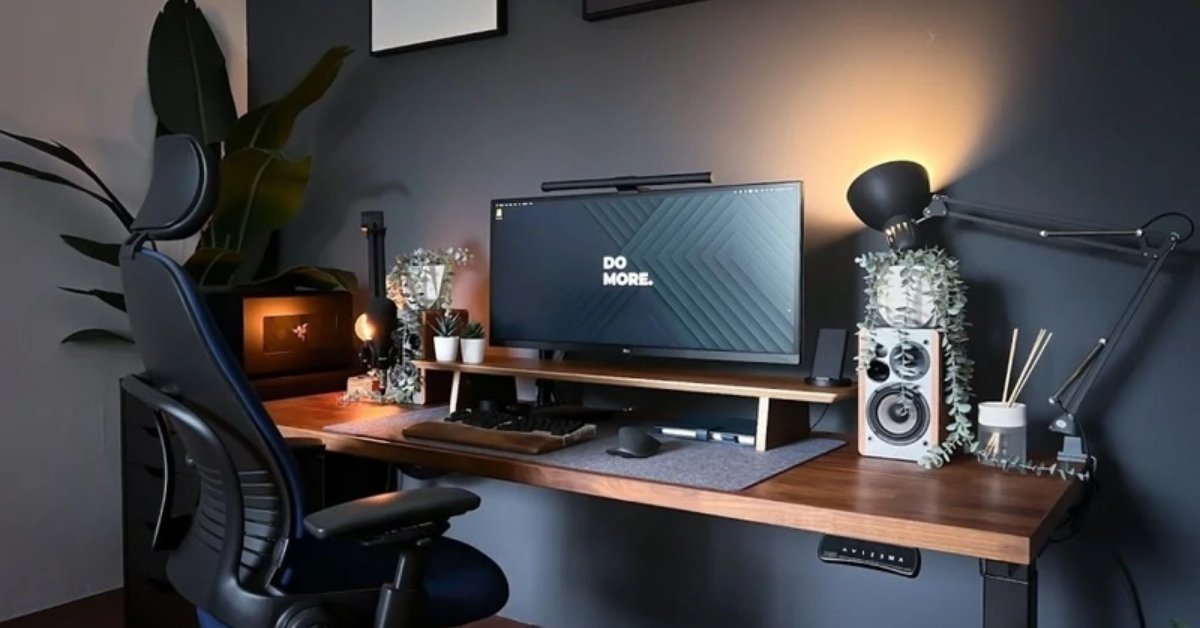
A Dark Desk Setup With Moody Lighting and One Point of Warmth
Dark desk setups are underused. There’s an assumption that minimalism requires white or light neutrals, but a dark-toned desk charcoal, deep walnut, matte black simplifies the visual field differently. Where white setups rely on openness, dark setups rely on contrast and depth.
One warm light source (an amber desk lamp at low level) is essential. Without it, a dark desk setup flattens. With it, the lamp becomes the focal point, the desk surface recedes, and the overall effect is focused and calm, particularly useful for evening work sessions.
The Pegboard Desk Setup That Hides Storage in Plain Sight

Pegboards solve the minimalist desk’s fundamental contradiction: you need some things accessible, but things on the desk surface create visual noise. Moving accessories to a pegboard (headphones, a small plant, a notebook) removes them from the surface without hiding them from reach.
The pegboard must stay sparse, one hook per item, deliberate gaps between objects or it becomes a wall full of clutter rather than a storage solution. The rule of thumb: if it takes effort to find something on the pegboard, there’s too much on it.
A Boho-Minimalist Desk With Rattan, Plants, and Natural Materials
Minimalism doesn’t have to be austere. A boho-minimalist desk setup uses natural materials rattan, bamboo, wicker, unfinished wood to add warmth and texture without adding visual clutter. The organizing principle is the same: one surface, one lamp, one or two objects. The materials do the visual work.
Plants are the most effective boho addition because they’re three-dimensional and organic. A single plant in the right spot corner of the desk, or on a low shelf nearby adds life to a setup without introducing the visual weight of more furniture or decor.
The Narrow Desk Setup for Tight Bedrooms and Small Apartments

A desk that’s 60cm (about 24 inches) deep fits against almost any bedroom wall without dominating the room. The constraint forces discipline: there’s not enough surface for excess, so only the essentials stay. A laptop, a lamp, and one small object is typically the maximum at this depth.
This is genuinely the best starting configuration for anyone setting up a desk for the first time in a small space. It’s easier to add than to subtract, and a narrow desk with nothing extra on it looks more intentional than a wide desk half-covered in things.
A Scandi Desk Setup With White, Birch, and One Black Accent
Scandinavian desk setups work on a simple formula: white, wood, one dark accent. The dark accent a black monitor arm, a charcoal tray, and a matte black lamp base prevents the setup from reading as blank. It gives the eye something to land on without introducing color or pattern.
Birch is the best wood for this approach because its grain is fine and subtle. It reads as clean from across the room, which is the effect Scandi design consistently achieves: organized enough to feel calm, warm enough to feel livable.
The Work-From-Home Setup That Hides When You’re Off the Clock

For people who don’t have a dedicated home office, the best desk setup is one that stops being a desk when you’re not working. A fold-down cabinet desk (also called a secretary desk or murphy desk) closes flat against the wall. From across the room, it reads as a cabinet or credenza. Open, it’s a fully functional workspace with internal storage.
This is especially relevant in 2026, as more people work from studio apartments or single-bedroom flats without a spare room. The mental separation that comes with physically closing a desk at the end of the workday is an underrated benefit: the living space stops feeling like an office extension.
Read More About : 27 Amazon Dining Decor Finds That Make Your Table Look Intentional (Not Just Decorated)
A Minimalist Desk With Smart Storage Entirely Below the Surface
Drawers under the desk not on it are the most efficient minimalist storage system. A two-drawer pedestal fits under most standard desks and holds chargers, notebooks, stationery, and small items without touching the surface. The desk surface stays clear; everything else is one pull away.
The key is to actually use the drawers as active storage rather than overflow. If the top drawer becomes a catch-all, the surface will follow. One category per drawer (cables and tech in one, paper and stationery in another) keeps both the surface and the storage working.
The Micro Desk Setup on a Windowsill or Ledge

Deep windowsills typically 12 to 18 inches are underused as desk surfaces. A laptop fits comfortably with the screen facing inward, the view outside adds natural light and a visual break from the screen, and no additional furniture is needed.
This is a zero-cost setup change that works particularly well in older apartments with wide masonry windowsills. The limitation is obvious: no monitor, limited surface space. But for one to two hours of focused work in the morning, it’s a better environment than a dark corner desk.
An L-Shaped Minimalist Desk with One Active Zone
L-desks are designed for two zones: keep one active, one deliberately empty. The empty side isn’t waiting to be filled. It serves as a breathing room: a place to spread out during working, a visual reset at the end of the day.
The setup avoids the cluttered corner office effect that L-desks often create because people fill every surface they’re given. Treating the second arm as intentionally empty, not temporarily empty, is the design decision that makes the whole thing work.
A Bedroom Desk Integrated Into the Wardrobe Nook

Built-in wardrobes with a central alcove are a natural place for a desk; the nook already provides visual containment, the wardrobe doors on either side enclose the workspace, and the setup disappears completely when the wardrobe is closed.
Adding a wall-mounted pendant or swing-arm lamp to this configuration provides task lighting without taking up surface space. The desk surface stays completely clear because the surrounding cabinetry provides all the necessary storage. It’s one of the most spatially efficient home office configurations available in a bedroom setting.
The Monochromatic Desk Setup in All Beige and Sand Tones
Monochromatic setups where every element stays in the same tonal range look curated without requiring much design skill. A beige or sand palette keeps the setup visually quiet even when there are a few more objects on the desk than usual. The sameness of tone creates cohesion.
This also ages well. Unlike trend-driven setups that rely on specific colors or products, a sand-and-beige desk looks equally at home in 2024, 2026, or 2030. I’ve noticed this style tends to appear in spaces where the person is going for longevity over novelty; they want it to look good without constant updating.
A Floating Desk With a Vertical Wall Grid for Visual Structure

A wall grid panel (like a pegboard but with a more architectural feel) gives the wall behind the desk structure without filling it with shelves. Small hooks, a narrow shelf, and a couple of hanging objects create the sense of a considered workspace without busy decoration.
The difference from a regular pegboard is visual: grid panels have a more intentional, finished look that fits better in a home setting than the utilitarian pegboard vibe. They’re also easier to rearrange, which matters when you’re still figuring out what the desk actually needs.
The Minimalist Gaming Desk That Doesn’t Look Like a Gaming Desk
Gaming setups are often the opposite of minimal RGB lighting, multiple screens, cables everywhere, accessories stacked on every corner. But a gaming desk doesn’t need to announce itself. A single large monitor (32″ is enough for most games), a slim keyboard without visible backlighting, a wide desk pad in a neutral color, and nothing else on the surface looks indistinguishable from a clean work desk.
The trade-off is real: fewer accessories means fewer options. But for people who game in the evenings and work at the same desk during the day, a setup that transitions smoothly between uses is worth the constraint.
A Natural Light Desk Setup Positioned for Morning Sun

Light direction matters as much as light quantity. Placing a desk perpendicular to a window rather than facing it directly gives you natural light across the surface without glare on the screen. Morning east-facing light is the most useful for work: bright but not harsh, and it typically fades by midday so you’re not fighting glare during afternoon sessions.
This is a positioning fix, not a purchase. If your desk is currently facing the window or turned away from it entirely, rotating 90 degrees is worth trying before adding any lamps or light panels.
A Minimalist Standing Desk Mat and Foot Balance Board Setup
Standing desks without support accessories often lead to people sitting down anyway. An anti-fatigue mat and a balance board (a simple curved wood board you shift your weight on while standing) make standing sustainable for longer stretches and neither item touches the desk surface.
The visual effect is clean: the desk surface stays empty, the floor around it has intentional items rather than random rugs or chairs, and the whole setup communicates that the person working there has thought about how they use the space, not just how it looks.
A Minimalist Desk Corner That Doubles as a Reading Nook

A desk corner and a reading chair don’t need to be in different rooms. Positioning a small desk beside a low armchair with a shared floor lamp between them creates a dual-purpose corner that serves focused work and quiet reading without doubling the furniture.
The floor lamp is the key: it covers both zones with one light source, reducing the number of items and cords in the corner. The two activities screen work and reading feel distinct because the furniture distinguishes them, even if they occupy the same 6-foot section of wall.
What Actually Makes These Minimalist Desk Setups Work
The ideas above span different sizes, budgets, and room types but they share a few underlying principles that explain why they function.
Surface tension is real.
The desk surface is the one place where objects accumulate fastest. Every minimalist desk setup that works has a clear rule for what’s allowed on the surface and that rule is almost always “only what’s in active use right now.”
Lighting does more than illuminate.
A well-placed lamp reduces perceived clutter by creating a visual hierarchy: the lit zone is the active zone, everything outside it recedes. This is why a desk can have three or four items on it and still feel calm if the lamp is placed deliberately.
Cable control is foundational, not optional.
It’s worth spending money and time on cable management before spending anything on decor. Wireless peripherals, under-desk cable trays, and good power strip placement reduce visual noise more than any aesthetic choice.
Empty space requires maintenance.
A cleared desk doesn’t stay cleared without a system. That system could be as simple as a single rule: everything goes in a drawer at the end of the day but without it, entropy wins. The setups that photograph well and actually stay that way both rely on a reset habit, not just initial arrangement.
Minimalist Desk Setup Ideas: Quick Decision Guide
| Setup Type | Best For | Space Constraint | Core Problem Solved | Difficulty |
| Floating wall desk | Renters, small rooms | Very small | Floor space and visual bulk | Low |
| Warm wood + single lamp | Home offices, shared spaces | Medium | Sterile feel in minimalist setup | Low |
| Corner desk, one active zone | L-shaped rooms, multi-use spaces | Medium-large | Over-cluttered corner desks | Low |
| Fold-down cabinet desk | Studio apartments, living rooms | Any | No visual separation from living space | Medium |
| Japandi dark wood setup | Dedicated office or bedroom nook | Any | Too-bright or too-clinical setups | Medium |
| Pegboard wall storage | Small desks, active workspaces | Small-medium | Surface clutter from daily accessories | Low |
| Narrow 60cm desk | Bedrooms, tight apartments | Very small | Large desk dominating small room | Low |
| Windowsill desk | Any room with deep sill | Near zero | No space for extra furniture | Very low |
Common Minimalist Desk Mistakes That Undermine the Setup
Buying more before clearing.
The most common mistake is adding new items: a lamp, a plant, a tray before removing what’s already there. Most desks benefit from a complete surface clear before any decision about what goes back.
Mismatched heights.
A monitor at the wrong height, a keyboard at the wrong angle, a chair too high or too low these don’t just cause ergonomic issues, they create visual imbalance that no amount of styling fixes. Get the heights right before worrying about what goes on the surface.
One light source that’s wrong.
An overhead ceiling light pointed directly down on a monitor creates glare and harsh shadows on the desk surface. A dedicated desk lamp positioned to the side (the non-dominant hand side for most people) makes the setup look better and work better simultaneously.
Treating the under-desk area as invisible.
Cords bundled on the floor, a power strip lying sideways, shoes kicked under the desk none of this is truly invisible when you’re sitting at the desk. Under-desk management is part of the setup.
Seasonal drift.
A minimal desk in January becomes a cluttered desk by March without a reset system. The cleanest setups belong to people who clear the surface regularly, not people who styled it once.
FAQ’s
What is a minimalist desk setup?
A minimalist desk setup is a workspace deliberately reduced to only what’s needed for active work. It prioritizes a clear surface, controlled lighting, hidden storage, and visual calm over a maximum number of features or accessories.
How do I start a minimalist desk setup on a budget?
Start by clearing your current desk entirely, then only put back what you actually need. Cable management (a simple Velcro tie, a small tray) and one good lamp often make more difference than any new purchase. You can build from there without replacing what you already have.
Do minimalist desks work for people who need a lot of things accessible?
Yes the key is moving storage off the surface rather than eliminating it. A pegboard, under-desk drawers, or a small shelf nearby keeps everything within arm’s reach without cluttering the work surface itself.
Standing desk vs. sitting desk: which is better for a minimalist setup?
Both work well. Standing desks tend to force better surface discipline because the height makes it awkward to pile things up. Sitting desks allow more flexible storage options underneath. The minimalist outcome depends more on your reset habits than on which type you choose.
What’s the single most effective change for a cleaner-looking desk?
Cable management. Removing visible cords from the desk surface through wireless peripherals, cable clips, or an under-desk tray has more visual impact than rearranging any of the other items.
Is a minimalist desk setup practical for creative work?
Generally yes, with one adjustment: creative work often requires spreading out materials temporarily. The setup works best when there’s a nearby surface (a low shelf, a small table) for in-progress work, so the desk itself can return to a cleared state when you’re done.
How do I keep a minimalist desk looking clean long-term?
One end-of-day habit putting everything back in its designated spot before you leave the desk is more effective than any organizing system. The physical reset takes under two minutes and prevents the gradual accumulation that undoes most minimalist setups.
Conclusion
A minimalist desk doesn’t require starting over or buying a new setup. Most of the ideas above work with what you already have repositioned, cleared, or organized differently. The goal isn’t a desk that looks good in photos. It’s a desk you can sit down at without the setup itself competing for your attention.
Start with one or two ideas that fit your actual space and working style. Clear the surface first, address the lighting next, then decide what comes back. The desk that functions best is usually the one with the least on it and you build toward that gradually, not all at once.
