

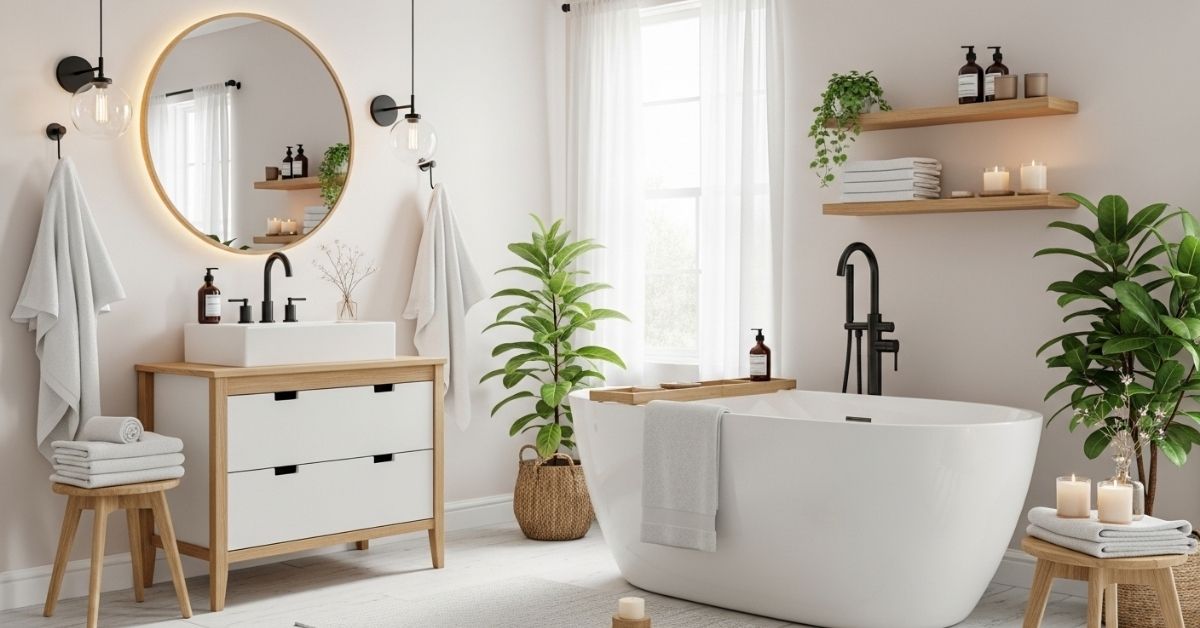
Small bathrooms tend to get treated like afterthoughts: a few towels, some soap, and whatever storage fits under the sink. But even a compact bathroom can feel considered and calm when the layout, materials, and lighting are working together. This isn’t about spending more; it’s about choosing better.
If you’re dealing with a space that feels cramped, overly bright, or just visually cluttered, Bathroom Decor Ideas these bathroom decor ideas are built around real constraints/rentals, small square footage, limited budgets and real solutions that hold up past the initial excitement of a refresh.
Mount a Narrow Wooden Shelf Above the Toilet for Functional Wall Space

The wall above the toilet is almost always wasted. A slim wooden shelf around 8 to 10 inches deep turns it into the most functional square footage in the room. Stack rolled hand towels in a basket, add a trailing plant for visual softness, and store a few glass jars for cotton rounds or Q-tips. The wood introduces warmth against tile or painted walls, and the shelf itself doesn’t project far enough to interfere with the space when you’re standing.
This setup works best in bathrooms under 50 square feet where floor space is non-negotiable. The shelf solves two problems at once: it clears the countertop and gives the eye a resting point on an otherwise flat wall. Go for unlacquered oak or pine if you want something that develops character over time; painted MDF works fine if you prefer something seamless.
Swap Harsh Overhead Lighting for a Sconce on Each Side of the Mirror
Overhead lighting in bathrooms is almost always unflattering and harsh. A pair of wall sconces positioned at eye level on either side of the mirror solves this immediately, light falls across the face evenly, eliminates the downward shadow cast by ceiling fixtures, and changes the entire mood of the space. In my experience, this single swap does more for a bathroom’s atmosphere than any surface-level styling.
Warm-toned bulbs (2700K to 3000K) work best here. Brushed brass or matte black sconces are both doing well in 2026 and feel modern without being trendy. This is especially useful for renters who can swap sconces back when leaving or add a plug-in version that requires no wiring at all.
Use a Round Mirror Instead of a Rectangular One to Soften Tile-Heavy Walls

Most bathrooms default to rectangular mirrors because they’re easy to find. But a circular or arch-shaped mirror breaks the grid of tile and cabinetry with a softer line, making the wall feel more balanced rather than just more covered. The visual effect is subtler than it sounds; the room reads as less boxy, especially in narrow bathrooms where every horizontal line emphasizes how tight the space is.
A round mirror also pairs better with off-center placement, which is useful when your vanity isn’t centered under the light source. Go large at least 24 inches in diameter, so it actually anchors the wall rather than floating awkwardly above the sink.
Layer a Woven Rug Over Tile for Warmth Without a Renovation
Bare tile makes a bathroom feel clinical, and in small spaces that lack natural light, it amplifies the coldness of the room. A textured cotton weave, jute-blend, or a washable flatweave laid in front of the vanity or the shower creates a visual anchor that also adds physical warmth underfoot. It’s a small addition that changes the sensory experience of the space significantly.
For small bathrooms, keep the rug to 20 by 30 inches or 24 by 36 inches at most. Anything larger reads as too busy and crowds the floor plan visually. Stick with natural tones, sand, cream, warm gray to maintain a cohesive feel regardless of your tile color.
Add a Teak or Bamboo Bath Mat for a Spa-Style Floor Element

A wooden bath mat is one of the easiest ways to shift a bathroom from functional to considered. Teak and bamboo slat mats add a tactile element that no fabric rug replicates; they feel intentional in the same way a hotel wet room does. They also drain well and resist moisture, which makes them practical for shower exits, not just decorative.
This works particularly well in all-white or neutral bathrooms where the warmth of natural wood stands out. The contrast between cool tile and warm wood grain does a lot of the visual work without requiring any other styling additions.
Style the Counter With Three Items Maximum for a Cleaner Spatial Read
Counter clutter is one of the fastest ways to make a bathroom feel smaller than it is. Limiting what lives on the surface to three intentional itemsa soap dispenser, a small tray, and one object with some visual interest frees up visual breathing room and makes the space easier to clean. The constraint forces better decisions about what actually belongs out.
Honestly, most things that end up on bathroom counters don’t need to be there. A small tray helps because it groups items into a defined zone, which the eye reads as “styled” rather than “scattered.” This approach works regardless of counter sizeit’s more about the decision-making than the square footage.
Hang Eucalyptus or Dried Botanicals From the Showerhead for a Low-Cost Spa Feel

A bundle of fresh eucalyptus hung from the shower arm costs almost nothing and changes the entire experience of the shower. The steam activates the oils and fills the space with a clean, herbal scent. Visually, it introduces organic texture against hard tile and metal fixtures without requiring any shelves, hooks, or installation.
Eucalyptus lasts about three to four weeks in a humid environment before needing to be replaced. Dried lavender, pampas, or preserved cotton stems are good alternatives that last longer but without the scent component. This is one I’d actually recommend trying first because the impact-to-effort ratio is genuinely hard to beat.
Read More About : 25 Kitchen Decor Ideas That Actually Work in Real Homes (Not Just Pinterest Boards)
Replace Builder-Grade Cabinet Hardware With Brushed Metal Pulls
Standard bathroom vanity hardware is almost always the weakest design element in the roomchrome knobs that match nothing and add no character. Swapping them for brushed brass, matte black, or antique bronze bar pulls is a 20-minute project that changes how the entire vanity reads. The updated hardware gives the cabinets a more intentional, furniture-like quality.
Bar pulls in a 4- to 5-inch center-to-center measurement work best on most standard bathroom vanities. This works in rentals to keep the original hardware and reinstall it before you leave. The difference in the room’s overall feel is disproportionate to the cost and effort involved.
Introduce a Trailing Plant on a High Shelf to Add Vertical Life

Bathrooms with good humidity and some natural or ambient light are actually ideal for trailing plants. A pothos, heartleaf philodendron, or string of pearls on a high shelf adds vertical movement to a space that usually only has horizontal lines to work with tile rows, countertops, cabinet edges. The cascading foliage softens those horizontal elements and gives the room a lived-in quality that no amount of styling quite replicates.
High placement keeps the floor clear and draws the eye upward, which is a useful spatial trick in low-ceiling bathrooms. If your bathroom has no natural light, pothos and heartleaf philodendron tolerate artificial light better than most plants.
Use Matching Storage Containers to Unify an Open Shelf Setup
Open shelving in bathrooms creates storage but also exposure everything becomes a display whether you intend it to or not. Matching containers (ceramic jars in one tone, woven baskets in one texture, glass canisters in one size) prevent the shelf from reading as chaotic. The uniformity creates a visual system the eye can quickly process, which reads as calm rather than cluttered.
The practical version of this doesn’t require buying anything new. Decant existing products into consistent containers and use one style of basket for anything you want to conceal. It takes about an afternoon to set up and the visual payoff is significant for a small, inexpensive change.
Install a Floating Vanity to Visually Extend the Floor Area

A floating vanity mounted to the wall rather than sitting on the floor reveals the floor plane beneath it, which makes the room read as larger than it is. The uninterrupted tile view from wall to wall creates a spatial continuity that floor-standing cabinets interrupt. In bathrooms under 35 square feet, this matters more than almost any other single design choice.
The practical benefit is also real: cleaning under a floating vanity is significantly easier than navigating around cabinet legs and bases. This is more of a renovation decision than a quick styling swap, but for anyone building or doing a refresh, it’s worth prioritizing over countertop upgrades.
Try Dark Paint on One Accent Wall to Create Depth in a Neutral Bathroom
A bathroom doesn’t have to be all-light to feel open. A single deeply saturated wallcharcoal, navy, or dark green behind the vanity creates depth and makes the lighter surfaces in the room pop by contrast. The effect is more dimensional than an all-white space, and it can make a bathroom that’s just “fine” feel more considered.
Moisture-resistant eggshell or satin finish is the right call for any bathroom wall. Keep the accent to one wall only, usually the one the mirror sits against and let the other three stay neutral. This balances the drama without making the room feel cave-like.
Use Towels as a Color Layer Instead of Buying New Accessories

Towels are the most underused color tool in most bathrooms. Most people default to white or whatever was cheapest, which is fine but one or two sets in a considered color (sage, warm taupe, deep terracotta, dusty blue) can establish an entire palette without requiring any other purchases. The towels become the intentional element that makes everything else feel placed rather than random.
Layer them on a towel ladder or a hook rack where they’re visible, rather than folded inside a cabinet. The texture and color do real visual work when they’re on display. This is a budget-first move that has more impact than most paid styling options.
Read More About : 23 Bedroom Decor Ideas That Actually Make Your Space Feel Calm, Cozy, and Put-Together
Add a Small Tray to Organize the Countertop Into a Defined Zone
A tray is one of the simplest organizational tools in a bathroom because it converts a scattered collection of items into a contained grouping. The brain reads “tray of things” as one visual unit rather than five separate objects, which immediately reduces the perceived clutter on a surface. It’s a small distinction, but in a tight space it changes the way the countertop reads.
Rattan, marble, ceramic, and resin all work depending on the overall aesthetic. Keep the tray smallsix to eight inches across its groups without dominating. The items inside should be things you actually use daily; a tray full of decorative items that never get touched quickly reads as fussy.
Lean a Full-Length Mirror Against the Wall in Larger Bathrooms for Depth

In bathrooms with enough floor space, a leaned mirror adds depth without requiring any installation. It reflects light back into the room, makes the space feel wider, and functions as both a practical and decorative object. An arched or rectangular style with a thin wooden or metal frame keeps it feeling minimal.
This works best in bathrooms where the vanity mirror is small or the room has a dead wall with nothing on it. Placing the mirror beside natural light (if there’s a window) maximizes the light-bouncing effect. For anyone who rents and can’t mount fixtures, it’s a particularly useful solution.
Switch to Liquid Soap With a Ceramic Dispenser for a Cohesive Counter Look
Plastic soap packaging is one of the most visually noisy elements in most bathrooms. A ceramic or glass pump dispenser eliminates the label and the visual noise in one move. It’s a straightforward swap that makes the counter look intentional without changing anything else. Refill with any liquid soap from a large bottle, it’s also more economical over time.
Matte white, sage green, and warm terracotta ceramic dispensers are all widely available and work across most neutral bathroom palettes. If you have two sinks, matching dispensers at both ties the counter together without requiring any additional coordination.
Use a Wall-Mounted Hook Rail Instead of Towel Bars for Flexible Daily Use

Towel bars are functional but inflexibleyou can only hang as many towels as bars, and the placement has to be deliberate. A row of hooks on a rail gives you more flexibility: hang towels, robes, bags, or whatever needs to be accessible that day. The Shaker-style hook rail, in particular, has been gaining traction in 2026 because it bridges the gap between utilitarian and designed without trying too hard.
Mount the rail at shoulder height around 60 to 65 inches from the floor and space hooks at least 4 inches apart so hanging items don’t overlap. In a small bathroom, one rail replaces the need for a towel bar, a robe hook, and possibly a small over-door organizer.
Introduce a Ceramic or Stone Catch-All Dish Near the Sink
A small dish near the sink solves the problem of rings, hair clips, and small items that end up scattered on the counter or lost entirely. It’s a functional choice that also reads as intentional styling defined place for small objects immediately makes the surrounding surface look more organized.
Matte ceramic, alabaster, and raw stone all work well, and the options at this size point (three to five inches across) are inexpensive. The key is to use just one dish and keep it genuinely smallnot a staging tool for more items, but a purposeful holder for the two or three things you actually set down daily.
Use Matching Frames for Bathroom Art to Make It Read as Intentional

Art in bathrooms tends to look accidental unless the framing creates a visual system. A small grouping of three to five prints in matching frames (same finish, same width border) reads as a cohesive installation rather than random additions. Botanical prints, abstract line drawings, and minimal photography all work well in humid spaces when framed behind glass.
The toilet wall is the most underused vertical space for art in most bathrooms. A row of prints or a simple two-by-two grid at eye level when seated gives the space a finished quality that’s difficult to achieve with a single piece. Keep frames small four by six to five by seven to avoid overwhelming the wall.
Add a Ladder Rack for Towels and Display in One Object
A wooden or metal ladder rack is one of the most practical dual-function objects in bathroom decor. It stores towels on every rung, keeps them visible and accessible, and adds a vertical design element that doesn’t require mounting. Lean it against any wall and it’s immediately functionalno hardware, no commitment.
Lean it against the wall beside the shower for the most logical towel placement. A natural wood ladder works in warm, neutral spaces; matte black metal reads as more modern and pairs well with white tile. In my experience, this works best in bathrooms where the towel bar situation is awkward or insufficient ladder rack is almost always a more practical replacement.
Keep One Natural ElementStone, Wood, or PlantGrounded in the Space

The bathrooms that feel most calm and cohesive usually have one recurring natural material that grounds the whole spacea teak mat, a stone soap dish, a live plant on the windowsill. It doesn’t need to be expensive or elaborate; the key is that it breaks the uniformity of manufactured materials and gives the room a tactile quality that tile and laminate can’t replicate.
Pick one material and repeat it in two or three small ways rather than introducing five different natural elements at once. The consistency creates cohesion. A bathroom with teak accessories throughout, a mat, a small tray, a toothbrush holder reads as more deliberate than one with a teak mat, a jute rug, a linen shower curtain, and a rattan basket all competing.
What Actually Makes These Bathroom Decor Ideas Work
Most bathroom decor advice focuses on individual products. What it often misses is that the underlying logic, how elements relate to each other, how light moves through space, and how much visual information is competing for attention matters more than any single item.
Scale
The biggest mistake in small bathrooms is choosing accessories that are too small. A tiny rug, a tiny mirror, a tiny shelf all make the room feel fussier and smaller. When in doubt, size up.
Material consistency
Mixing too many finishes (chrome, brass, matte black, brushed nickel) in a small bathroom creates visual noise. Commit to one or two and let that be the connective thread.
Light first, styling second
No amount of good styling compensates for bad lighting. If the room is harsh or dim, fix the lighting before investing in any decor. Warm, diffused light makes everything else look better by default.
Empty space is part of the design
Bathrooms where every surface is used feel cramped. Leaving space on the counter, on shelves, on walls is an active design decision, not a sign that something is missing.
Bathroom Decor Ideas by Space Type, Function, and Budget
| Idea | Best Space Type | Primary Function | Budget Level | Difficulty |
| Wooden shelf above toilet | Small bathroom, any layout | Storage + styling | Low | Easy |
| Side-mounted sconces | Any size, low natural light | Lighting quality | Low–Medium | Easy (plug-in) or Moderate (hardwired) |
| Round mirror | Narrow or tile-heavy bathrooms | Visual balance | Low–Medium | Easy |
| Woven floor rug | Any size, cold-feeling space | Warmth + texture | Low | Easy |
| Teak bath mat | Modern, spa-style bathrooms | Tactile + visual | Low | Easy |
| Counter styling (3 items max) | Any size, cluttered counters | Organization | Free | Easy |
| Floating vanity | Small bathroom, renovation | Space illusion | High | Complex |
| Dark accent wall | Medium–large bathroom | Depth + mood | Low | Moderate |
| Ladder towel rack | Any size, insufficient storage | Storage + display | Low | Easy |
| Hook rail | Any size, active household | Flexible storage | Low | Easy |
| Matching storage containers | Open shelving, any size | Visual cohesion | Low–Medium | Easy |
How to Make the Most of a Small Bathroom Without Adding More Furniture
Think vertically before horizontally.
Most bathroom floor plans are fixed, but vertical space almost always goes unused. Shelves above the toilet, hooks near the ceiling, tall ladder racksthese options don’t reduce walking space and they address the core problem of inadequate storage.
Define zones even in a single-room layout.
Even in a tiny bathroom, the counter area, the shower wall, and the toilet wall each have a different function. Treating each zone with its own intentional approach rather than spreading the same type of decor everywhere creates more organization without requiring more objects.
Use light to manipulate perceived size.
A large mirror reflects the room back at itself and doubles the visual width. Warm lighting at eye level makes the room feel more intimate and less clinical. Neither requires structural changes, and both meaningfully affect how spacious the bathroom feels.
Reduce before you add.
In most cases, the problem isn’t that something is missing, it’s that there’s too much visual noise. Editing down to fewer, better items does more for the space than bringing in anything new.
FAQ’s
What is the most impactful single change you can make to bathroom decor?
The single highest-impact change in most bathrooms is swapping overhead lighting for side-mounted sconces at mirror level. It improves the quality of light immediately, eliminates unflattering shadows, and changes the entire mood of the space without structural renovation.
How do I make a small bathroom look bigger without renovating?
Three things together do the most work: a large round mirror to reflect the space, warm light at eye level rather than harsh overhead fixtures, and a floating vanity (or clear floor space) to extend the visual line of the floor. You don’t need all three, but each one independently improves the perceived size.
What bathroom decor style is trending in 2026?
Quiet material-forward design is the dominant direction in 2026natural stone, unpainted wood, ceramic, and linen replacing glossy or heavily branded accessories. The aesthetic is less about adding decorative pieces and more about choosing functional objects with considered material and finish.
Is it worth decorating a rental bathroom?
Yes, and it doesn’t require any permanent changes. Plug-in sconces, removable hooks, leaned mirrors, wooden mats, and container styling on existing shelves all improve the space without risking a security deposit. Focus on objects that move with you rather than fixtures.
What are common bathroom decor mistakes that make the space feel smaller?
The most common are: too many competing finishes (chrome mixed with brass mixed with matte black), accessories that are too small for the space (a 16-inch rug in a 40-square-foot bathroom), keeping too many items on the counter, and using cool-toned overhead lighting that flattens the room and removes any sense of warmth.
How many towels should be displayed in a small bathroom?
Two to four is the practical range for display. More than that and the visible stack or rack starts to dominate the visual space. Keep additional towels in a cabinet or basket. A consistent color for displayed towelsrather than a mixmakes the amount feel more considered.
What plants work in a bathroom with no natural light?
Pothos, heartleaf philodendron, ZZ plants, and cast iron plants all tolerate low-light environments and high humidity. Avoid succulents and most flowering plants in no-natural-light bathrooms. They need direct sun to thrive and will decline quickly without it.
Conclusion
A bathroom doesn’t need a full renovation to feel significantly better. In most cases, the difference between a space that feels unfinished and one that feels considered comes down to a handful of decisions: better lighting, fewer things on the counter, one material that repeats throughout the room, and enough open space to let what’s there breathe.
Start with whatever feels most immediately solvable for your spacethe lighting, the counter clutter, the towel situation. Make that one change well before adding anything else. The rooms that feel most put-together are usually the result of a few well-made decisions, not a complete overhaul.
