

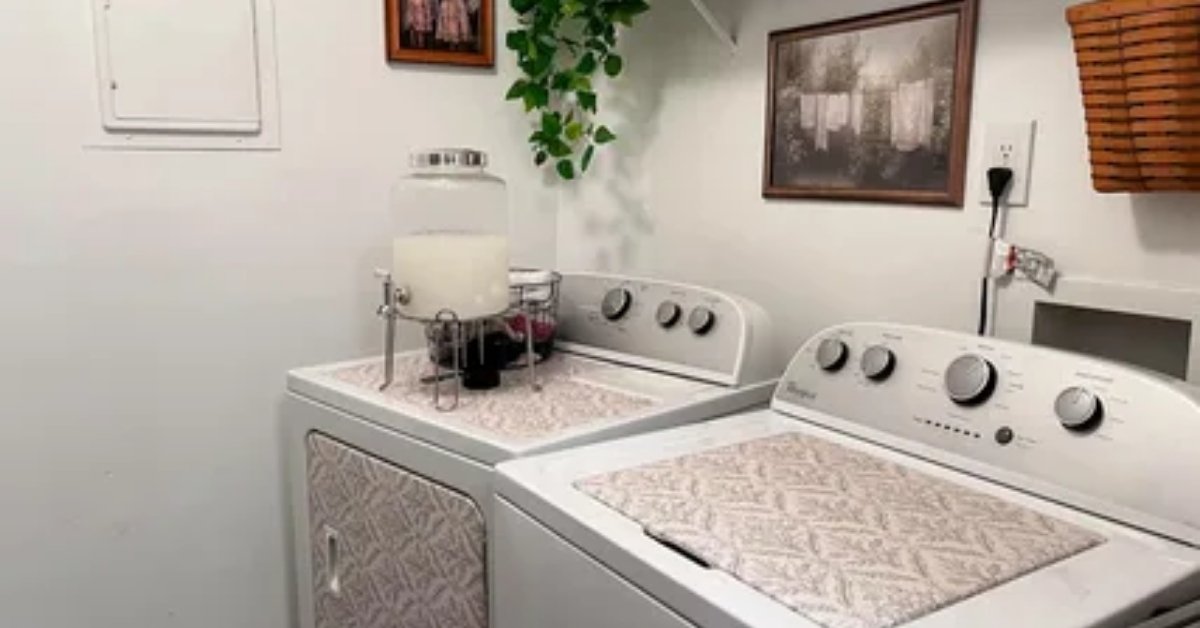
Your laundry room doesn’t have to feel like an afterthought. Most of these spaces suffer the same issues: exposed shelving that collects dust, harsh overhead lighting, no counter space, and zero visual appeal. Laundry Room Makeover Ideas The result is a room you rush through instead of actually using well. If you’re working with a tight budget and a small or awkward laundry space, there’s actually a lot you can do without touching the walls or replacing appliances.
This is for anyone who wants a laundry room that functions better and looks put-together without spending on a full renovation. Small apartments, rental units, narrow utility closets these ideas are designed with real constraints in mind.
Add Open Floating Shelves Above the Washer and Dryer

The most underused real estate in a laundry room is the vertical space directly above the machines. Two simple floating shelves installed about 18 inches apart give you a place for detergent, dryer sheets, fabric softener, and a couple of baskets for items waiting to be folded. Go for raw wood or white-painted MDF if you want to keep it budget-friendly; either reads clean against a white appliance finish. The key is keeping the shelves uncluttered three or four items per shelf max, so the whole wall reads organized rather than stuffed.
Switch Out the Lighting Fixture for a Warmer Bulb Temperature
Harsh fluorescent lighting makes every room feel like a gas station restroom and laundry rooms are especially prone to it. Swapping a dated fixture for a flush-mount or semi-flush light (under $30 at most hardware stores) and switching to a 2700K–3000K bulb does two things: it makes the space feel noticeably less clinical, and it improves visibility without the flat glare that flattens everything. This works even in windowless laundry closets. It’s one of the least talked-about changes and one of the most effective ones I’d recommend trying first.
Use a Rolling Utility Cart for Extra Storage and Counter Space

Laundry rooms rarely have counter space, which means you end up using the top of the washer for everything including folded clothes that sit there for three days. A slim rolling utility cart (look for ones around 6–9 inches wide) slides into the gap between the machine and the wall or cabinet. The shelves hold product bottles, the top acts as a folding surface extension, and the whole thing rolls out when you need it. This setup is especially useful in rental spaces where you can’t add built-ins.
Install a Rod Between Cabinets or Walls for Hang-Drying
Most hang-dry items end up draped over a dining chair or shower rod, neither of which is ideal. A simple wall-mounted or tension rod installed in the laundry room either between walls in a closet layout or mounted to studs above a countertop creates a proper hang-dry zone that keeps clothes from wrinkling while they air dry. Pair it with matching wood or slim-line hangers so it stays visually clean. This is one of those additions that immediately improves daily use, not just aesthetics.
Replace Cabinet Hardware to Refresh Built-Ins Without Replacing Them

If you’ve got older laundry room cabinets with dated or mismatched handles, the hardware is the fastest thing to change. Swapping flat silver pulls for matte black bar handles or brushed brass knobs shifts the whole tone of the space without any painting or demolition. A set of matching hardware runs $20–$50 depending on quantity. The shaker-door cabinet with black hardware combination is especially dominant in 2026 laundry room renovations; it bridges the gap between utilitarian and intentional.
Use Labeled Glass or Clear Canisters for Detergent and Supplies
Bulky cardboard detergent boxes and half-open plastic bags are visual noise and they make even a tidy room look cluttered. Transferring your laundry products into matching clear canisters with simple labels solves both the storage and the look simultaneously. Round glass jars with matte black lids work especially well because they read as intentional design rather than just organization. The clear sides let you track when you’re running low, which is a practical bonus that gets overlooked.
Lay Peel-and-Stick Floor Tiles to Upgrade Dated Vinyl

Laundry room floors take a beating and most renters are stuck with whatever faded vinyl came with the unit. Peel-and-stick floor tiles, specifically the thicker luxury vinyl options have improved significantly and hold up well in low-traffic utility areas. A black-and-white checkered or herringbone pattern adds enough visual interest that the floor becomes an asset rather than something you’re trying to ignore. This is a weekend project that costs under $50 for a small laundry room.
Mount a Folding Wall Table to Create a Surface on Demand
In small laundry rooms where a permanent counter isn’t possible, a folding wall-mounted table gives you a flat surface when you’re folding clothes and disappears when you’re not. These are common in European utility designs and increasingly popular in American apartment renovations. A solid wood or MDF panel with folding brackets costs around $40–$80 total to DIY. When the table is folded up against the wall, it takes up about 3–4 inches of depth and becomes nearly invisible.
Add a Pegboard Panel for Hanging Supplies and Tools

A pegboard section, even just a 2-by-3-foot panel, creates a functional wall system for all the miscellaneous items that usually pile up on top of surfaces. Spray bottles, scrub brushes, lint rollers, small scissors: they all have hooks. Painted white, a pegboard reads more like an organized wall panel than a garage aesthetic. It’s particularly useful in laundry closets where floor space is limited and every square inch of wall matters.
Paint the Walls a Warm White or Soft Greige Instead of Bright White
Most laundry rooms default to stark white, which tends to make the space feel cold and expose every scuff and stain. A warm white (like Benjamin Moore’s White Dove) or a soft greige creates a more settled, finished atmosphere without adding visual heaviness. In a room this small, even a subtle color shift reads clearly. Pair it with warm-toned wood accents on shelving and your laundry room stops feeling like a utility closet.
Add a Small Framed Print or Two to Treat the Space Like a Room

The decision to put no art in a laundry room is what keeps it feeling like a utility space permanently. Two small framed prints, botanical illustrations, a simple typographic quote, an abstract hang above the shelving and immediately signal that this is a finished room. The frames don’t need to be expensive; black or white frames from a dollar store or thrift store work fine when the print inside is good. Placement matters: hang them at eye level, slightly centered over whatever’s on the shelf below.
Read More About : 21 Kids Room Decor Themes That Are Actually Fun to Live With (Not Just Look At)
Use Baskets to Corral Loose Items on Shelves
Open shelving looks good in photos and chaotic in real life unless you’re using baskets. Matching woven baskets or fabric bins on the shelves group loose items (socks waiting for their pair, cleaning cloths, dryer sheets) into contained units that read as organized even when they’re not perfectly arranged. Natural rattan and cotton rope baskets are consistently available at low price points and hold up in humid laundry environments. The trick is matching sizes mixing three different basket heights on one shelf reads messy.
Install a Tension Shelf Above a Stacked Washer-Dryer Unit

Stacked laundry units are practical but tend to leave an awkward blank wall above them. A tension shelf, the type that uses adjustable poles rather than wall anchors, fits between the floor and ceiling and creates a full shelving column alongside the machines. This works in closet-style laundry spaces where wall mounting isn’t possible or where you want flexibility to adjust shelf heights later. The full-height column of storage makes the space feel more designed than it actually is.
Swap a Plain Laundry Hamper for a Woven or Fabric One
The laundry hamper lives in the room full-time, so it earns a design decision. Plastic hampers tend to look cheap regardless of how tidy the surrounding space is. A seagrass round basket, a large cotton rope hamper, or a linen-covered bin occupies the same floor footprint but reads as an intentional choice. This is especially noticeable in smaller laundry rooms where the hamper takes up a meaningful portion of the visible space.
Apply Removable Wallpaper to an Accent Wall or Backsplash Area

One peel-and-stick wallpaper panel, even just the wall behind your shelving or above the backsplash, adds enough personality to differentiate the space without a major commitment. Small-scale patterns (thin stripes, subtle geometric tile, small botanicals) work better here than large prints because the wall space is limited. Removable wallpaper is renter-friendly and repositionable if you make an error during installation. In my experience, the area directly behind open shelving is the ideal placement because the product and baskets in front of it soften the wallpaper’s scale and prevent it from feeling overwhelming.
Add a Countertop Over a Front-Loading Pair for Folding Space
If your front-loading washer and dryer sit side by side without any surface above them, a simple countertop changes the function of the whole room. A cut-to-size piece of butcher block, MDF, or laminate board supported by the machine tops and attached to the wall at the back creates a legitimate folding station without any cabinetry required. This is one of the most used upgrades in the space because it directly solves the most common laundry room problem: nowhere to put anything you’ve just folded.
Use a Painted Accent Color on the Door or Trim to Add Depth

If the whole room is neutral, the door or trim is an easy place to add a deliberate color choice without committing to painting every wall. A deep navy, forest green, or terracotta on the door frame or window trim creates a focal point that makes the room feel considered. This works particularly well in laundry rooms that open off a hallway, because the color creates a visual boundary between the utility space and the rest of the home.
Hang a Small Plant or Two for a Softening Effect
Laundry rooms are one of the few spaces where trailing plants genuinely work well; the humidity from the machines benefits moisture-loving varieties like pothos or heartleaf philodendrons. A single hanging planter near the top of the shelving or mounted from a ceiling hook adds a softening element that breaks up the hard surfaces. The greenery contrast against white walls and white machines is simple but effective in making the space feel inhabited rather than purely functional.
Use a Curtain to Conceal Open Shelving or Clutter

Open shelving is practical but unforgiving everything needs to look organized all the time. A tension rod with a simple linen or cotton curtain can conceal the lower portion of an open shelving unit or hide clutter beneath a countertop. The top shelf or the countertop surface stays open and visible; the curtain closes off whatever’s below it. Neutral linen in white or warm beige disappears into the background rather than drawing attention to itself.
Label Everything with a Consistent System
Label makers and adhesive label holders aren’t just for type-A personalities they do genuine organizational work in a laundry room. When every basket, canister, and section has a clear label, the room stays usable over time rather than reverting to a catch-all. A consistent font and label material (all white, all matte black text, all the same size) ties the whole thing together visually. I’ve noticed this style tends to work best when the labels are placed at the same height on every container; the alignment is what makes it read as a system.
Add a Small Rug for Warmth and Sound Absorption

Tile or vinyl floors in laundry rooms are practical but acoustically harsh the machines amplify against hard floors and bare walls. A washable cotton rug placed in front of the machines absorbs some of that sound and adds a grounding visual element. Look for flat-weave options (Moroccan-style stripes, solid neutrals) that won’t bunch or curl under foot traffic and can be thrown in the wash when they get dusty. Sizing tip: the rug should span the full width of the machine pair rather than stopping short underneath one of them.
Install a Stainless Steel or Utility Sink If Space Allows
A utility sink opens up the laundry room to hand-washing, stain pre-treating, and soaking tasks that otherwise happen in the bathroom or kitchen. Compact utility sinks in stainless steel or white composite are available at big box stores starting around $100, and they connect to existing plumbing if you’re replacing an older or smaller sink already in the space. Honestly, this is a bigger quality-of-life improvement than most visual changes because it changes how you use the room entirely.
Bring in a Wooden Drying Rack That Doubles as a Design Element

Most drying racks are chrome or plastic functional but visually neutral in the worst way. A natural solid wood folding drying rack (they’re widely available now in teak and rubberwood) does the same job but reads as a considered furniture piece rather than a utility item. When not in use, fold it flat and lean it against the wall it looks intentional even stored. This works especially well in laundry rooms with a warm-toned wood and white palette.
Use Command Hooks Strategically for Bags, Ironing Boards, and Accessories
Command hooks are one of the most underused tools in small laundry room organization. A row of three or four hooks along one wall at consistent heights and evenly spaced holds laundry bags, reusable tote bags, the ironing board, and accessories that otherwise end up on the floor. Black command hooks on white walls disappear just enough while still being visible. This is a fully renter-safe option because the hooks are removed cleanly.
Paint or Refinish the Cabinets Instead of Replacing Them

If your laundry room has existing cabinetry that’s dated or discolored, painting is the most cost-effective upgrade you can make. A proper prep-and-prime process followed by a semi-gloss latex paint in white or cream gives cabinets a surface that’s durable enough to handle a humid room. New hardware alongside the paint dramatically changes how finished the cabinetry looks. The total project usually runs $30–$70 in materials depending on cabinet size significantly less than any replacement option.
Read More About : 24 Kids Room Storage Ideas That Actually Keep the Chaos Under Control
Create a Lost Socks Wall or Station with a Fun Corkboard
This is a functional, slightly personality-driven addition that solves a real problem. A small corkboard mounted on the wall with individual socks pinned to it until their match shows up removes the pile of orphaned socks that accumulates on top of machines or in a random basket. It takes up minimal space, costs almost nothing, and adds a bit of character without committing to any particular aesthetic. Works especially well in family laundry rooms where solo socks are a daily reality.
Mirror a Wall to Make a Narrow Space Feel Wider

In laundry closets or very narrow utility rooms, a large frameless mirror or a leaner mirror along one wall creates the visual effect of the space doubling in width. The reflection of the window or overhead light makes the room feel considerably brighter as well. An unframed mirror panel (available in various sizes at home improvement stores) is the most affordable route; a simple thin-frame option adds a bit of structure. This is one of the rare additions that improves both how the room looks and how it feels to stand in.
What Actually Makes These Laundry Room Makeover Ideas Work
Most people approach a budget laundry room makeover by buying decorative items, a cute sign, a new rug, a plant and then wondering why it still feels like a utility space. The difference between a makeover that reads finished and one that doesn’t comes down to three underlying principles:
Cohesion over variety.
The strongest laundry room makeovers on any budget use two or three materials at most typically one metal finish (black or brass), one natural texture (wood, rattan, or linen), and white or neutral surfaces. When everything is from the same family, even a few items read as a designed space.
Function before aesthetics.
If your laundry room doesn’t solve the practical problems first, no folding space, no storage, nowhere to hang things, decorative additions just float on top of the dysfunction. Start with what actually improves how you use the room, then layer the visual elements.
Scale and proportion.
A single large basket looks better than four small mismatched ones. A shelf that spans the full width of the wall looks more intentional than a short shelf off-center. Working with the proportions of the space rather than against them makes every dollar spent look like more.
Laundry Room Makeover: Idea vs. Space Type vs. Benefit vs. Difficulty
| Idea | Best Space Type | Main Benefit | Difficulty | Approx. Cost |
| Floating shelves above machines | All layouts | Vertical storage | Low–Medium | $20–$60 |
| Peel-and-stick floor tiles | Small rooms, rentals | Visual refresh | Low | $30–$60 |
| Countertop over front-loaders | Side-by-side machines | Folding surface | Low–Medium | $40–$100 |
| Folding wall table | Narrow or closet layouts | Surface on demand | Medium | $40–$80 |
| Rolling utility cart | Any layout | Gap storage, portability | Low | $25–$60 |
| Removable wallpaper accent | Rental spaces | Personality | Low | $20–$50 |
| Cabinet repainting | Rooms with existing cabinets | Full refresh | Medium | $30–$70 |
| Tension rod hang-dry bar | Closet or narrow rooms | Air-drying function | Low | $10–$25 |
| Wall mirror | Narrow rooms | Visual expansion | Low | $20–$60 |
| Matching baskets + labeling | Open shelving | Organization | Low | $20–$40 |
How to Design Your Laundry Room for Better Flow and Function
The biggest layout mistake in laundry rooms is treating the machines as the design constraint and building around them reactively. A better approach is to plan the room as a workflow: dirty laundry arrives, gets sorted, washed, dried, hung or folded, and exits. Each of those stages needs a place.
Sorting happens at the entry of a divided hamper or two separate baskets near the door. Washing supplies need to be within arm’s reach of the machine, ideally at shoulder height on a shelf directly above. Hang-drying needs a dedicated rod, not a borrowed shower bar. Folding needs a real surface, not the top of the dryer. If your layout doesn’t support this flow, start by identifying the one stage that causes the most friction and solve that first.
For small or closet-size laundry rooms, vertical organization is the single most impactful principle. Floor space is limited but wall height is almost always underused. A full-height shelving column beside the machines, a tension rod at the top, baskets on the upper shelves, and a folding surface at waist height covers most of what you need in 12–18 square feet.
For renters specifically: prioritize reversible changes (command hooks, tension rods, peel-and-stick materials, removable wallpaper) and free-standing pieces (rolling carts, standing shelving units, leaner mirrors) over any wall-mounted or permanent installations. You can build a very functional, well-designed laundry room entirely within rental-safe constraints.
FAQ’s
What’s the cheapest way to update a laundry room?
Start with lighting and storage: a new bulb and a couple of matching baskets cost under $20 total and change how the room feels and functions. Peel-and-stick floor tiles, removable wallpaper, and new cabinet hardware are the next tier, each running $30–$60 and delivering a visible visual shift.
How do I make a small laundry room look bigger?
Use light wall colors, keep surfaces clear of clutter, and add a mirror on the narrowest wall. Vertical shelving draws the eye upward, which makes a tight space feel taller. Avoid dark-colored baskets or accessories on lower shelves; they ground the space visually and compress it.
Can I do a laundry room makeover in a rental apartment?
Yes the key is sticking to reversible methods: command hooks, tension rods, peel-and-stick tiles and wallpaper, freestanding shelving, and rolling carts. None of these require wall damage and most can be removed in under an hour.
What type of shelving works best above a washer and dryer?
Floating shelves are the most common choice because they’re adjustable, inexpensive, and keep the floor open. If wall mounting isn’t an option (rentals), a tension floor-to-ceiling shelving unit beside the machines achieves the same result without anchors. Either way, leave at least 18 inches between the top of the machine and the bottom shelf so loading and unloading isn’t blocked.
What’s the difference between a laundry room refresh and a full renovation?
A refresh works within the existing layout, same plumbing, same appliance positions, same cabinet boxes (if any). New paint, hardware, lighting, storage, and accessories fall here. A renovation involves moving plumbing, replacing cabinets, or changing the room’s footprint. For budget makeovers, a refresh can achieve 80% of the visual and functional result of a renovation at 10–15% of the cost.
Is it worth adding a utility sink to a laundry room?
If the plumbing is already in place or nearby, yes it’s one of the highest-function additions you can make. Hand-washing, soaking, stain treatment, and cleaning all move out of the bathroom or kitchen and into the space that makes more sense for them. If it requires new plumbing runs, weigh the cost against how often you’d actually use it.
How do I keep a laundry room organized long-term?
The key is building a home for everything before items accumulate. One basket per category (darks, lights, delicates), one shelf for products (with a label so things go back where they came from), and one hook or rack for hang-dry items. Organization systems in laundry rooms fail when there are too many categories or not enough dedicated spaces, not because people aren’t trying.
Conclusion
The most effective laundry room makeovers on a budget aren’t about buying more, they’re about making the space function better and removing the visual noise that makes it feel chaotic. Better lighting, cohesive storage, and one or two design choices (a warm rug, a framed print, matching baskets) are enough to shift the room from purely utilitarian to somewhere you don’t dread walking into.
Start with whichever two ideas address your biggest current frustrations whether that’s no folding space, nowhere to hang things, or shelving that always looks like a disaster. Make those changes first and build from there. A small, focused set of improvements will always do more than a scattered collection of decorative additions.
