

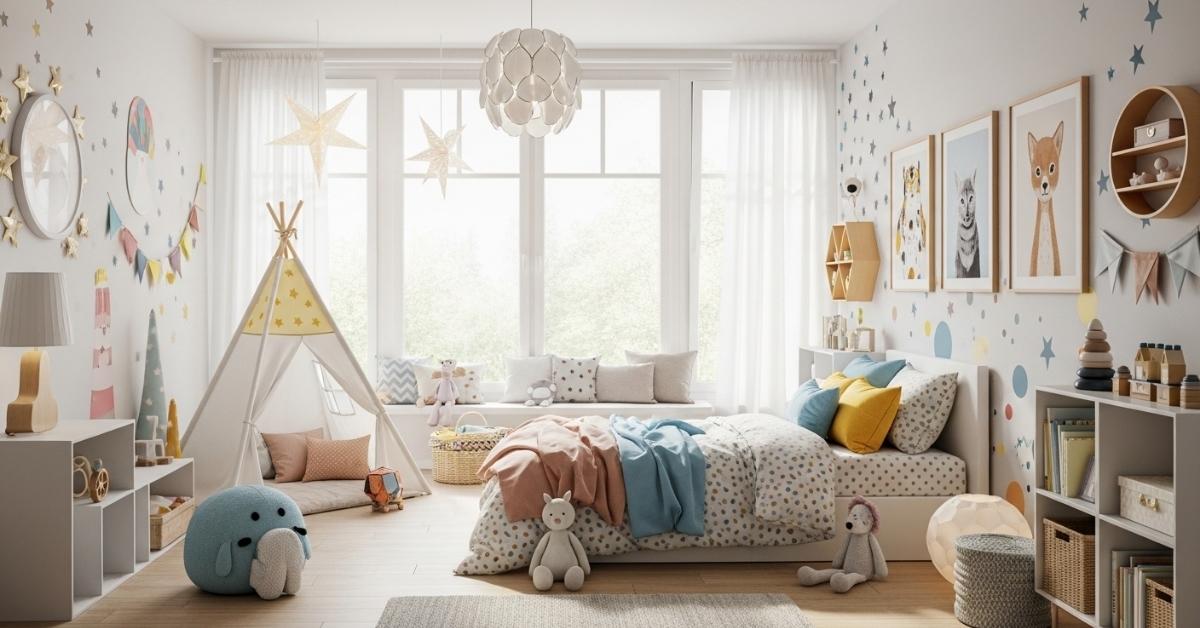
Most kids’ rooms end up looking like a storage unit had a craft fair inside it. The toys multiply, the floor disappears, and the “fun” aesthetic somehow makes the space feel smaller and more stressful for everyone. If you’re working with a shared room, a small bedroom, or just a layout that never quite comes together, these ideas are for you.
The goal here isn’t a picture-perfect showroom. It’s a room that works one where your kid can sleep, play, and grow without the space constantly feeling like it’s fighting you. These 27 kids room ideas are grounded in real spatial logic: how furniture placement affects movement, how storage can be built into the design instead of added on top, and how to create a room that ages well without a full overhaul every two years.
Floor Bed Frame with Low Storage Drawers Underneath

A floor-level platform bed completely changes how a kids’ room feels. Instead of a tall bed frame dominating the room, the low profile keeps the visual weight down; the ceiling feels higher, the room feels wider. Pair it with built-in drawers underneath and you’ve eliminated the need for a separate dresser, which in a small room is a significant space gain. This setup works especially well in rooms under 10×10 feet, where every square foot of floor space matters. It also removes the “under-the-bed” junk zone problem entirely; those drawers have a purpose and a lid.
Corner Reading Nook with Built-In Cushioned Bench
Dead corners are one of the most underused spots in a kids’ room. A built-in bench with cushion on top and storage below converts that awkward angle into the most used spot in the room. Add a small wall-mounted shelf at arm’s reach height for books and a warm-toned lamp nearby, and you’ve created a dedicated reading zone that naturally separates from the play area. The physical definition of a “quiet corner” also helps with wind-down routines; kids respond well to spaces that feel intentionally different from the rest of the room.
Loft Bed with Play Zone Underneath

In a single-child bedroom where you need to make the floor work twice as hard, a loft bed is one of the most efficient setups available. The sleeping area moves up, and the zone underneath becomes whatever the room needs: a play area, a small study desk, or a reading teepee. In my experience, this layout works best when the ceiling is at least 8 feet high; anything lower starts to feel cramped at the top. Hang curtains from the loft frame to define the lower zone and give it a sense of enclosure; kids tend to love the “hideout” effect, and it contains the play mess within clear visual boundaries.
Gallery Wall at Kid Height with Rotating Art Frames
Standard gallery walls are hung at adult eye level, which means kids rarely connect with them. Dropping the arrangement down to around 36–48 inches from the floor changes how a child interacts with their own space. Use a mix of clip-based frames and small shelves so artwork can actually rotate your kid’s drawings, seasonal prints, or photos cycle through without requiring new holes in the wall every month. This is a particularly good solution for renters who want flexibility, and it gives kids a sense of ownership over their room’s look without making permanent decisions.
Neutral Base with Bold Accent Wall Behind the Bed

The common mistake in kids’ rooms is going all-in on a theme on every surface, every object matching one color scheme. The problem is that kids’ tastes shift, and repainting a fully themed room is a project. A better approach: keep three walls neutral and use one bold accent wall behind the bed. It anchors the room visually without overwhelming it, and when your kid wants to switch from dinosaurs to space, you only repaint one wall. The furniture stays the same. The investment stays protected.
Open Shelving at Reachable Height for Toy Rotation
Toy storage that kids can’t reach themselves creates dependency and clutter you end up managing alone. Low open shelving at around 18–30 inches from the floor puts the responsibility (and the access) where it belongs. Use fabric bins for categories blocks in one, figures in another and rotate what’s displayed every few weeks. Fewer toys out at once actually increases engagement; it’s a well-documented effect called “toy rotation,” and the shelving design makes it easy to implement. This setup works in almost any room size and doesn’t require a large investment to execute well.
Double-Duty Desk with Pegboard Above

A desk without organization built into it becomes a flat surface for piling things. Mounting a pegboard directly above the desk at around 12 inches above the surface gives you hooks for scissors, baskets for crayons, and small shelves for books without using any desk space. The pegboard is also reconfigurable as needs change, which matters in a room where the user’s requirements shift from coloring books at age 5 to homework and projects at age 10. Paint it in a muted tone to keep the visual effect calm rather than busy.
Bunk Bed with Trundle for a Shared Room
Shared rooms are where smart furniture choices pay off most. A bunk bed with an integrated trundle gives you three sleeping surfaces in the footprint of a standard full-size bed. During the day, the trundle tucks away and the floor opens up. The vertical stacking also creates a natural division in the room where each child gets their own level, which helps with the territorial dynamics that come with sibling room-sharing. Go for a solid frame with a full-length safety rail on top; it’s worth the investment for longevity and safety.
Read More About : 29 Dining Room Ideas That Make Every Meal Feel Like an Occasion
Canopy Over the Bed for Definition Without Walls

In a room where you can’t add walls or change the layout, a canopy over the bed creates a “room within a room” effect without construction. A simple hoop or rod-based canopy hung from the ceiling with sheer or linen fabric adds warmth and clearly defines the sleep zone. It also tends to help with sleep; the slight enclosure creates a sense of calm that open rooms sometimes lack. This is one I’d actually recommend trying first for younger kids especially, because the effect is significant and the setup costs almost nothing.
Built-In Window Seat Doubling as Toy Storage
If your room has a window on a wall with wall-to-wall space, a built-in window seat is one of the best investments you can make. The bench lid opens to reveal a large storage cavity ideal for bulky items like building sets, dress-up bins, or sports gear that are too large for regular shelving. The seat itself becomes a reading spot, an extra perch for friends, or a morning getting-dressed zone. Flanking it with simple floating shelves on either side creates a built-in alcove effect that makes even a basic room feel architecturally intentional.
Chalkboard or Whiteboard Wall Panel for Creative Play

Rather than covering an entire wall in chalkboard paint (which is hard to remove and limits flexibility), use a large framed chalkboard panel mounted at child height. A 24×36-inch panel gives enough surface for drawing, lists, and creative play without committing the whole wall. It channels the “draw on the walls” impulse that almost every young child has, and contains it to one designated zone. Honestly, this is a much easier version of the full chalkboard wall and works in rentals without any negotiation with the landlord.
Warm Lighting Layers: Overhead + Bedside + Task
Most kids’ rooms rely on a single overhead light which creates flat, harsh lighting for all activities. Layering three types of light changes the functional flexibility of the room significantly. A dimmable overhead for general use, a warm bedside lamp for wind-down reading, and a focused task light above the desk. Each zone gets what it needs. The warm-toned bedside lamp in particular helps with the transition from play to sleep, because it signals a shift in the environment that cool overhead lighting doesn’t.
Modular Cube Storage as a Room Divider

In a shared room without a physical wall, a cube storage unit positioned perpendicular to the wall creates a soft divide between two zones. Each side gets its own visual territory. The cubes serve as storage for both kids’ bins on each facing side belonging to that child’s space. It’s not a soundproof wall, but it creates enough visual separation to reduce conflict over space. This works best when the unit is around 40–48 inches tall, high enough to define zones without blocking natural light from windows.
Neutral-Colored Rugs to Define the Play Zone
A rug does more than add softness; it defines zones without furniture or walls. In a kids’ room, placing a large neutral rug in the center of the room creates a clear “play area” that’s distinct from the sleep and study zones. Kids naturally gravitate to it. The neutrality of the color matters: a bold patterned rug in a room full of toys and colorful objects adds visual noise. A simple solid or subtle texture keeps the room feeling organized even when the toys are out.
Floating Shelves Above the Dresser for Display and Storage

The wall above a dresser is almost always underused. Adding two or three floating shelves in that vertical space creates a cohesive furniture cluster: the dresser handles clothing, the shelves handle books, display items, and smaller storage baskets. It also visually raises the room’s eye line, which makes the ceiling feel higher. Keep the shelf depth modest (around 8–10 inches) so they don’t project far into the room or clash with the dresser below.
Teepee or Play Tent as a Defined Imaginary Space
Young children use imaginative spaces differently than adults use furniture. A teepee or simple canvas tent in the corner of a room becomes whatever the child needs it to be a spaceship, a reading cave, a quiet retreat. Functionally, it defines a separate zone within the room without using any additional wall space or furniture. Add a small pillow and a low-voltage string light inside, and the corner becomes the most-used spot in the room. This is a particularly effective solution for kids who share a room and need a sense of personal space.
Read More About : 21 Bathroom Decor Ideas That Make Even the Smallest Spaces Feel Intentional
Two-Tone Wall Paint at Dado Rail Height

Splitting the wall color at around 36 inches creates a horizontal line that makes the room feel grounded and purposeful without the commitment of a full accent wall. The lower color can absorb the visual impact of scuffs and marks (which happen in any room where children live), and the upper white keeps the room bright and light. It’s a design move that’s common in 2026 kids’ room trends specifically because it solves a practical problem while looking intentional. Use an eggshell finish on the lower portion for cleanability.
Bookshelf with Picture-Book Display (Face-Out) at Kid Height
Standard bookshelves show only the spine of each book, which makes selection harder for young readers. A dedicated face-out display shelf, even just one or two rows shows the cover, making books feel more accessible and inviting. Mount it at around 24–30 inches from the floor and limit it to current favorites. I’ve noticed this style tends to dramatically increase how often younger kids independently choose to read, compared to shelves where books are spine-out and harder to identify at a glance.
Pegboard Feature Wall for Craft and Maker Spaces

For a child who draws, builds, or creates, a full-width pegboard section of wall is one of the most useful investments a kids’ room can have. It keeps supplies visible and reachable, reduces the “I can’t find the scissors” friction that slows creative play, and the configuration can evolve as the child’s interests shift. This isn’t a craft corner, it’s a functional wall that treats the room as a creative studio. Keep the pegboard color muted (sage, terracotta, or white) to prevent it from competing visually with everything that hangs on it.
Gender-Neutral Color Palette for Longevity
Rooms designed in stereotyped color palettes tend to need full repaints by age 7 or 8. A warm neutral palette terracotta, warm cream, soft sage, or dusty clay creates a room that adapts across developmental stages without a full overhaul. These tones also work better with most furniture finishes (natural wood, white, matte black) than primary-color schemes, which means you’re not locked into matching everything perfectly. Pops of color can come through bedding, rugs, and accessories all of which are easy to swap.
Under-Stair Kids Room or Nook (Where Layout Allows)

If your home has stairs with accessible space underneath, converting it into a dedicated kids’ zone is one of the most space-efficient moves available. A simple cushion, a few built-in shelves, and a warm light create a nook that children use constantly partly because the low ceiling and enclosed feeling mimics the “fort” experience that kids naturally seek. It removes the play space from the main bedroom and gives the child a territory that feels genuinely theirs.
Murphy Bed for Multi-Use Kids Rooms
If the kids’ room also functions as a play space or creative studio, a wall-mounted Murphy bed frees up the entire floor during the day. Folded up, the room becomes a usable studio. At night, the bed folds down and the space becomes a bedroom. This setup requires upfront investment and wall planning, but for a room that needs to function for both work and play, it eliminates the compromise entirely. It works especially well in rooms where square footage is limited and floor space has the most value.
Color-Coded Storage System by Category

When toy storage has no visible logic, putting things away feels like a puzzle for kids and adults. A color-coded bin system solves this with a simple visual cue: red bin = cars, blue bin = Lego, green bin = art supplies. Kids as young as three can follow color cues, which means cleanup becomes a matching game rather than a decision-making exercise. This doesn’t require expensive bins, basic fabric cubes from any home goods store work well. The key is consistency and limiting each bin to one category.
Study Zone with Pinboard for School Work Display
A dedicated study area functions better when there’s a display surface directly above the desk for current school work, projects, and reference materials. A simple pinboard (cork or fabric-wrapped) at eye level keeps the desk surface clear because materials that would otherwise pile up have a designated vertical home. It also gives children a sense of pride in their work seeing assignments and projects displayed creates a studio-like atmosphere that supports focus. For kids in primary school and up, this setup makes a noticeable difference in how the study zone is used.
Natural Wood Furniture with White Walls for a Timeless Base

The strongest base for a kids’ room is one that doesn’t require updating every few years. White walls with natural wood furniture creates a backdrop that absorbs color change through accessories, a new rug, different bedding, swapped wall art without ever looking dated. This approach also photographs well if you ever want to document the room, and it works across age ranges from toddler through early teen. In 2026, the move away from highly themed kids’ rooms toward this more lasting neutral base is one of the more notable shifts in how parents are approaching room design.
Macramé or Fabric Wall Hanging for Texture Without Clutter
Visual texture matters in a kids’ room because it adds warmth without adding physical clutter. A large macramé or woven wall hanging above the bed fills wall space with dimensional interest that doesn’t need dusting, repositioning, or updating seasonally. It works particularly well above the headboard in place of framed art, it softens the wall without the formality of frames, and its natural fiber tones sit comfortably with almost any furniture finish.
Grow-With-Me Furniture: Convertible Crib to Toddler Bed

For younger children, the most practical investment is furniture that converts across developmental stages. A crib that converts to a toddler bed, then to a full-size bed, reduces the number of furniture purchases by at least two. These typically cost more upfront than a standard crib, but the total cost over five years is significantly lower. The design of convertible pieces has also improved; many current options look like standard adult furniture at their final stage, meaning they don’t visually announce themselves as a “kids” piece in a way that quickly feels babyish.
What Actually Makes These Kids Room Ideas Work
The ideas above cover a wide range of storage, layout, lighting, furniture but they all follow the same underlying logic.
The floor is the most valuable surface.
In a kids’ room, floor space is where play happens. Every furniture decision should be evaluated against how much floor it takes up and whether what it offers is worth the trade. Vertical storage (shelving, loft beds, pegboards) consistently gives better return per square foot than horizontal layouts.
Zones create usable structure.
Kids don’t naturally separate activities they play where they sleep, sleep where they study, and leave everything where they stopped. Creating defined zones (sleep, play, study) with rugs, lighting, or furniture arrangement gives the room spatial logic that makes cleanup, routine, and focus easier.
Flexibility beats themes.
A room built around a theme (jungle, princess, superhero) has a short lifespan. A room with a neutral base that accepts changing accessories lasts years without requiring a significant investment to update. This is especially true for children between ages 3 and 10, where interests shift rapidly.
Storage should be where the activity is.
Art supplies near the desk. Books near the reading nook. Toys near the play zone. When storage is centralized but activity is distributed, things don’t get put away because it’s inconvenient. Proximity is the simplest organization strategy.
Kids Room Setup Quick Comparison
| Idea | Best For | Space Type | Primary Problem Solved | Budget Level |
| Loft Bed with Play Zone | Single child, active room | Small rooms | Floor space | Medium |
| Bunk Bed + Trundle | Sibling sharing | Shared rooms | Sleeping capacity | Medium–High |
| Murphy Bed | Multi-use room | Compact rooms | Day/night flexibility | High |
| Cube Storage Divider | Siblings sharing | Shared rooms | Territorial division | Low–Medium |
| Corner Reading Nook | Any age | Small or large | Dead corner + quiet zone | Low |
| Floor Bed + Drawers | Toddler to primary age | Small rooms | Storage + safety | Low–Medium |
| Convertible Crib | 0–5 years | Nursery to kids room | Long-term investment | Medium |
| Pegboard Wall | Creative/maker kids | Any | Craft supply access | Low |
Common Kids Room Mistakes That Make the Space Feel Smaller or More Chaotic
Furniture that’s too large for the room.
A full-size bed in a 9×10 room leaves almost no walkable floor space. The instinct to provide a “real” bed is understandable, but a twin or loft setup preserves the floor and makes the room feel significantly more livable.
Open toy storage without categories.
A bin full of mixed toys looks like chaos and becomes chaos. Kids don’t put things away in an unstructured bin they dump and leave. Categorical storage with visual cues (color, label, photo) reduces the resistance to tidying.
Single overhead lighting.
A bare overhead fixture in the center of the ceiling is the least useful light for a kids’ room. It doesn’t support the study zone, the reading nook, or the wind-down routine. Adding even one warm lamp near the bed changes the evening atmosphere significantly.
Hanging artwork at adult height.
A gallery wall or framed print at 60 inches from the floor means nothing to a 4-year-old. Artwork, clocks, and interactive elements at child height 36–48 inches make the room feel like it belongs to them.
No transition zone.
Rooms without a defined “between” space, a rug by the door, a low bench for backpacks, a hook for school bags end up with entry clutter that spreads into the rest of the room. A small entry zone right inside the door, even just a hook and a basket, prevents the daily pile-up.
FAQ’s
What are the best kids room ideas for small spaces?
The most effective small-room strategies are vertical: loft beds, floor-to-ceiling shelving, and wall-mounted pegboards free up floor space where play actually happens. A cube storage unit used as a room divider also doubles as storage without adding to the room’s footprint. Prioritize furniture that serves at least two functions: a storage ottoman, a bed with drawers underneath, or a window seat with a storage cavity below.
How do I design a kids room that will last as they grow?
Start with a neutral base white or warm cream walls, natural wood furniture and use accessories for personality. Bedding, rugs, wall art, and bins are low-cost and easy to swap as your child’s interests change. Avoid built-in themes that require repainting or replacing furniture every few years. Convertible furniture (crib-to-bed, adjustable desks) reduces the number of purchases across developmental stages.
How can I organize a shared kids room without it feeling cramped?
Use a cube storage unit or bookshelf as a soft room divider to create individual zones. Give each child a defined area with their own color-coded storage, their own light source, and their own display space (a pinboard or shelf for their things). A bunk bed with a trundle adds sleeping flexibility without dominating the floor.
What’s the best lighting setup for a kids room?
Layer three types: a dimmable overhead for general use, a warm bedside lamp for sleep routines, and a focused task light above the study desk. The bedside lamp is the most important; a warm, low-light source near the bed helps signal the transition from play to sleep, which makes wind-down routines significantly easier.
Floor bed vs. standard bed frame in a kids room which works better?
For toddlers and primary-age children, a floor bed is safer and often more space-efficient especially with built-in drawer storage underneath. A standard frame with more height can waste vertical space that could otherwise be captured with a loft setup. Go with a floor or loft option if floor space is the primary concern; use a standard frame only in larger rooms where the tradeoff isn’t as significant.
Is toy rotation actually effective for keeping a kids room organized?
Yes, and it’s worth building the storage for it. Limiting visible toys to what fits on one or two low shelves, then rotating what’s displayed every few weeks, reduces visual overwhelm and consistently increases engagement with the toys that are out. The key is having enough covered storage (bins, drawers, baskets) to keep the rest accessible but out of sight.
How do I make a kids room feel calm without making it boring?
Use a warm neutral palette as the base (terracotta, sage, cream) and limit the number of patterns in the room to one or two. A single bold accent wall, a textured rug, and a few purposeful display items create visual interest without visual noise. Warm lighting in the evening transforms the atmosphere more than any paint color; it’s the most underrated element in a calm kids’ room.
Conclusion
A well-designed kids’ room doesn’t have to be a Pinterest fantasy or a budget project, it just needs to work for the child who lives in it. The ideas in this list address real spatial problems: not enough floor space, too much clutter, poor lighting, storage that doesn’t get used. Even small adjustments relocating artwork to kid height, adding a warm bedside lamp, or switching to categorical storage bins change how the room functions on a daily basis.
Start with one or two changes that fit your current space and budget. If the room feels chaotic, the floor and storage are the first priorities. If it feels impersonal or doesn’t quite land, lighting and one defined zone (a reading nook, a canopy over the bed) will make the biggest difference. There’s no need to redesign everything at once; the key is finding what your specific room actually needs.
