

If your kid’s room looks tidy for exactly 11 minutes after cleanup, you’re not alone. The real issue isn’t your child, it’s usually a storage system that doesn’t match how kids actually use their space. Toys end up on the floor because the bins are too deep, shelves collect random piles because nothing has a clear “home,” and the room feels cluttered before bedtime even hits.
These kids room storage ideas are built around real rooms, small ones, shared ones, rental-friendly ones. Whether you’re dealing with a toddler’s toy explosion or a tween’s growing collection of stuff, there’s a setup here worth trying.
Open Cube Shelving Along a Low Wall

Low cube shelves, the kind that sit at a child’s eye level, work so well because kids can actually see and reach what’s inside. Place a 4×2 or 4×4 grid unit along one full wall and mix open cubes (for books, displayed toys) with fabric bins or baskets (for the things that don’t look good out in the open). The visual rhythm of same-sized squares keeps the room from looking chaotic even when the bins are stuffed. This works best in rooms under 120 square feet where every inch of wall needs to pull double duty, and it’s a setup I’d actually recommend trying first because it requires zero wall mounting if you use a freestanding unit.
Under-Bed Storage With Roll-Out Bins
The floor under the bed is prime real estate that most kids’ rooms waste completely. Low-profile roll-out bins of the kind with smooth casters and lids are far more functional than flat under-bed bags because a child can actually retrieve something without pulling everything out. Use one bin per category: building blocks, dress-up accessories, spare linens. If the bed sits too low, bed risers add 3–5 inches of clearance and cost almost nothing. Especially useful in smaller rooms where floor space limits how many additional furniture pieces you can add.
Wall-Mounted Rail System With Interchangeable Hooks and Baskets

A horizontal wall rail system think pegboard’s cleaner cousin lets you rearrange hooks, shallow shelves, and baskets without putting new holes in the wall every six months. Mount it at the child’s shoulder height and use it for the things that need daily access: backpack, headphones, art supplies, water bottle. As your kid grows, the configuration changes rather than the whole setup. Good for renters when installed into studs and removed carefully, and especially functional in rooms that double as homework and play spaces.
Tall Bookshelf With the Lower Half Reserved for Toys
A standard tall bookshelf becomes more useful when you intentionally zone it: upper shelves for books, display items, and things that don’t need constant access lower cubbies for the daily-use toys. This prevents the usual problem where everything gets shoved onto every shelf randomly. Add a label or a small photo card on each lower bin so younger kids know exactly where things go. The visual weight of a tall unit anchors the room, and when the lower half is organized with matching bins, even a full shelf doesn’t feel overwhelming.
Pegboard Above a Small Desk

A pegboard mounted above a small desk solves the perpetual problem of art supplies, pencils, scissors, and craft materials spreading across every flat surface. Use a mix of small ledge shelves for jars, hooks for rulers and scissors, and a couple of small wire bins for loose supplies. The whole setup keeps the desktop clear while putting everything within arm’s reach. This is one of the better storage ideas for kids who do a lot of drawing or crafting. The visual access means they’re more likely to actually put things back in the right spot.
Toy Rotation System With Labeled Lidded Bins in a Closet
This is less about furniture and more about strategy but it’s one of the most effective. Store 70% of toys in labeled lidded bins inside the closet, and only keep the current week’s selection out in the room. Rotate every week or two. Kids play more deeply with fewer toys out at once, and the room stays manageable between cleanups. Clear bins mean you can see what’s inside without pulling everything down. Lidded containers stack cleanly and keep the closet from looking like a toy avalanche waiting to happen.
Window Seat With Hidden Storage Compartment

If the room has a wall under a window, a simple bench-style window seat with a hinged lid turns dead floor space into a large storage compartment perfect for bulkier items like stuffed animals, dress-up clothes, or building sets. The bench surface becomes a reading or play space. In terms of spatial efficiency, a window seat that’s 48 inches wide and 18 inches deep can hold a surprising amount while adding a cozy architectural detail to the room. Best for rooms where floor space is tight and wall-mounted options are limited.
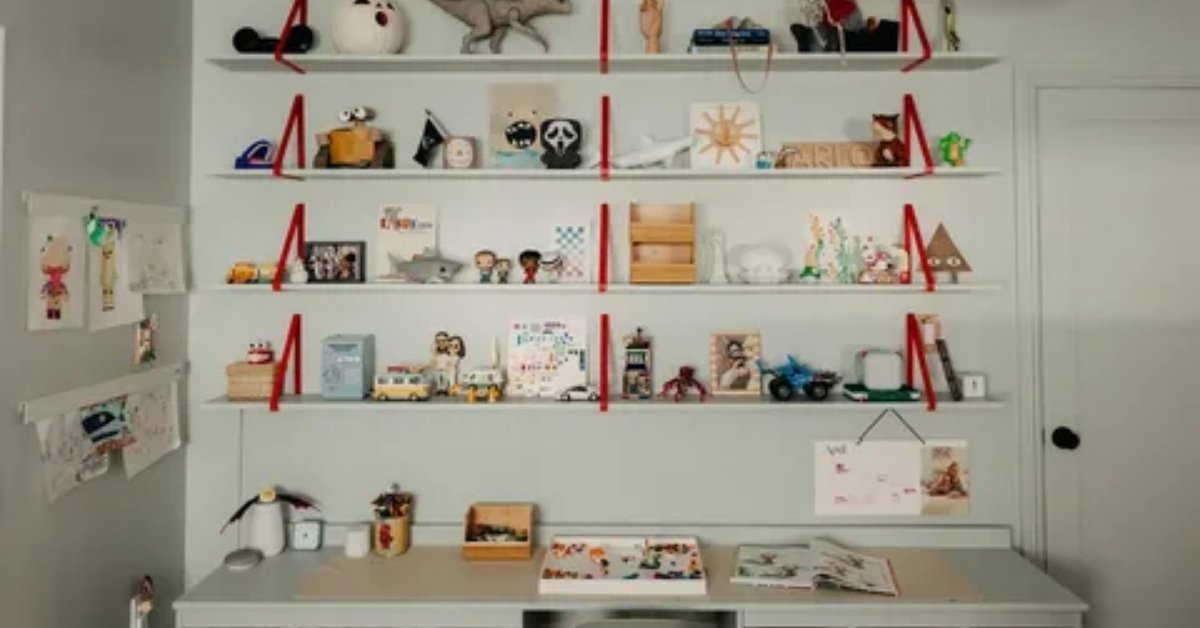
Floating Shelves at Multiple Heights for Books and Small Figures
A series of floating shelves at two or three different heights creates natural visual zones: taller shelves for books and less-accessed items, lower ones for the action figures, small toys, or art objects a child wants to see and reach daily. The staggered arrangement adds visual interest without requiring a full shelving unit. Keep shelf depth to 8–10 inches to prevent piling: when a shelf is shallow, kids naturally keep it neat because there’s only room for one layer of items. Best in rooms where floor space needs to stay open for play.
Read More About : 27 Shared Kids Room Ideas for Boy and Girl That Actually Work in Real Homes
Hanging Fabric Organizer Over the Back of the Door

The back of the bedroom door is consistently underused in kids rooms. A hanging pocket organizer with 12–24 pockets handles the small stuff that usually ends up scattered: crayons, small figurines, hair accessories, game pieces, socks. Choose one where the pockets are transparent or open so kids can see what’s inside. For younger children, a lower placement means independence; they can put things away without asking for help. Zero floor space required, and it removes easily without damage for renters.
Stackable Drawers for Art and Craft Supplies
Clear or labeled stackable drawer units of the kind with 6–10 small drawers are ideal for the fine-grained stuff: markers, stickers, washi tape, stamps, clay, foam pieces. One drawer per category means a child (and parent) can find the dried-out markers or the glitter glue in seconds rather than digging through a bin. Rolling versions add flexibility; the unit can move from desk to floor to a corner as needed. In my experience, this works best when you keep it at child height so kids can access it without lifting anything heavy.
Corner Shelving Unit to Use Awkward Room Angles

Most rectangular kids rooms have corners that end up as dead zones. An L-shaped corner shelf unit or a triangular corner bookshelf turns that awkward space into usable storage without eating into the open floor area. Corner units work well for a curated display, a few beloved toys, a small plant, a stack of picture books rather than for high-volume storage. In smaller rooms, this is often the only place to add shelving without making the space feel smaller or blocking movement paths.
Bed With Built-In Drawers Underneath
A bed frame with built-in drawers is the most space-efficient single furniture choice in a small kids room. Two to four deep drawers below the mattress eliminate the need for a separate dresser entirely, freeing up a full wall for shelves or a desk. Assign one drawer for seasonal clothing, one for pajamas and undergarments, and one for toys and you’ve consolidated three separate storage pieces into the bed itself. Most functional in rooms under 100 square feet or for shared rooms where two beds leave very little floor space for furniture.
Open Toy Bins With Casters Near the Play Area

Large, open-top bins on casters are the least fussy storage option for the toys kids use every single day, building blocks, balls, cars, and larger stuffed animals. They’re easy enough for a 3-year-old to use independently: roll out, grab, roll back. No lids to open, no drawers to close. The casters mean the whole cluster can move against the wall when the floor needs to be clear for active play. Avoid overfilling: once a bin is too heavy to roll or too full to see into, the system breaks down. One type of toy per bin, and resist adding a fourth bin when three start to overflow.
Magnetic Strips for Metal Toy Parts and Loose Accessories
A heavy-duty magnetic strip mounted at child height handles the small metal pieces that go missing the fastest magnetic building tiles, metal toy pieces, game components, small collectible figures with metal bases. It’s a visual display and a storage solution at the same time. Pieces are immediately visible and accessible, and the strip itself takes up almost no space. Best installed in a play-focused room rather than a sleep room, since it encourages a “look at this collection” display that keeps some energy in the space.
Hanging Hammock Net for Stuffed Animals

Stuffed animals are one of the bigger volume problems in kids’ rooms; they’re large, numerous, and don’t stack neatly in bins. A hanging corner hammock net solves this by lifting the collection off the floor and into a space (the upper corner) that’s otherwise unused. A full hammock can hold 20–30 stuffed animals, takes about 10 minutes to install with two hooks, and costs almost nothing. It also adds a visual softness to the upper half of the room. One thing to watch: avoid overstuffing it to the point where nothing can be retrieved without an avalanche.
Transparent Storage Bins With Consistent Sizing
Mixed bin sizes create visual noise and make stacking nearly impossible. Committing to one bin size even if it means some space goes unused results in a system that stays neater over time because everything is interchangeable. Transparent bins mean kids and parents see exactly what’s inside without pulling anything down. For shelves inside closets, matching bin sizes make the most of vertical space. Label each bin with a picture (for pre-readers) or a word, and keep one bin visibly empty as a catch-all for things that don’t have a home yet.
Wall-Mounted Art Display Rail for Rotating Kids’ Artwork

Artwork inevitably accumulates on every flat surface and the refrigerator. A dedicated art display rail, a simple wooden dowel or wire with clips gives artwork a defined home and makes the whole display feel intentional rather than chaotic. Clip 5–8 pieces at a time and rotate when new pieces come in. Old pieces go into a flat storage box under the bed rather than being tossed. This one actually solves two problems: it displays the work in a way that feels respectful of the effort, and it prevents paper piles from spreading across the desk or windowsill.
Tiered Rolling Cart for Art Supplies or LEGO Organization
A three-tier rolling cart is the most flexible storage option for kids who switch between activities frequently. Art day: top tier holds markers and brushes, middle holds paper, bottom holds dried paint and tools. LEGO day: reorganize by brick size. The cart rolls to wherever the child is working, and pushes back into a corner when not in use. It takes up minimal floor space and adapts as interests change which they do, constantly. In 2025–2026, we’re seeing a strong shift toward multi-use furniture in kids rooms precisely because dedicated single-purpose storage becomes obsolete too quickly.
Closet Divider System With Labeled Zones

Most standard closets in kids rooms are used as one big space where everything competes for the same square footage. A simple closet divider system, a combination of upper shelf bins, a lower hanging rod at kid height, and door-mounted pockets turns a single closet into a multi-zone storage system. Label each zone clearly. The result is a room that can stay much tidier because the closet does far more work. For renters, this requires no modifications beyond basic hooks and freestanding organizers that come in and out cleanly.
Read More About : 26 Small Kids Room Ideas That Actually Work in Tight Spaces
Book Ledges With a Forward-Facing Display
Standard upright bookshelves hide book covers behind spines, which makes it harder for young children to find the book they want. Narrow picture ledges are the kind where books lean slightly forward and display the cover, make books more visually accessible and, honestly, make kids more likely to actually pick them up and read. Three or four ledges stacked vertically hold 20–30 books while taking up less wall depth than a standard bookshelf. Mount the lowest one at the child’s eye height. Works especially well for picture book collections in rooms where reading before bed is part of the routine.
Labeling System With Picture Labels for Pre-Readers

Storage systems fail when kids can’t identify where things go. For children who aren’t reading yet, picture labels, a printed photo or hand-drawn image of the bin’s contents taped to the front make independence possible. A child who can identify that the bin with the car picture is for cars doesn’t need to ask for help every time cleanup happens. This applies to bins, shelves, and closet zones equally. Simple to implement, costs nothing beyond a few prints, and it’s the single change most likely to make a storage system self-sustaining.
Modular Toy Kitchen With Built-In Storage Drawers
If a play kitchen is already part of the room, choosing one with built-in drawer or cabinet storage underneath means it does double duty. The lower drawers hold the kitchen accessories, play food, dishes, pretend appliances exactly where they’re used. This eliminates the need for a separate bin or shelf for kitchen accessories and keeps related items spatially logical. Play kitchens with lower storage are also more proportional to a child’s height, with the working surface at the right level and storage below where kids naturally look.
Bedside Caddy or Pocket Organizer for Nighttime Essentials

A bedside surface usually ends up cluttered with books, water bottles, stuffed animals, and whatever else a child can’t part with at bedtime. A hanging caddy that attaches to the side of the mattress or bedframe eliminates the need for a nightstand entirely in smaller rooms. Three to four pockets handle the nighttime essentials: current book, small flashlight, a stuffed animal or two. It keeps the floor beside the bed clear and prevents the pile of “I need this to sleep” items from spreading across the carpet.
Overhead Loft Shelf for Seasonal or Less-Used Toy Storage
High shelves near the ceiling are ideal for storage that doesn’t need daily access, seasonal toys, backup art supplies, games for older children, items waiting to be rotated in. This keeps the lower portions of the room clear for active storage and play. It also visually draws the eye upward, which makes the room feel taller. The one practical note: make sure whatever goes up there comes down safely. Large bins with lids work better than open bins at height, and labeling from the front means you can identify the contents without climbing.
S-Hook Rail Inside Wardrobe for Bags and Accessories

The inside of a wardrobe door or an existing rod is perfect for an S-hook rail that handles bags, sports accessories, dress-up pieces, and anything with a strap or handle. Bags are notoriously hard to store too floppy for shelves, too large for bins. Hanging them on S-hooks keeps them visible, organized, and immediately accessible. For active kids with a rotation of sports bags, dance bags, or school backpacks, this removes the pile-behind-the-door problem entirely. Requires zero installation beyond adding S-hooks to an existing rod.
Reading Nook With Built-In Side Storage
A reading nook built into a corner or alcove, even a simple one made from two bookshelves and a cushioned bench gains extra function when the sides hold books at arm’s reach. Small shelves on either side of the seat mean a child can reach any book in the current rotation without standing up. The enclosed feeling of the nook naturally contains the books and keeps them from spreading to other parts of the room. For rooms with low, awkward ceiling areas (common in attic conversions or sloped-ceiling rooms), this turns a spatial constraint into a feature.
Entryway-Style Drop Zone at the Bedroom Door

Setting up a small drop zone at the bedroom entrance, a few hooks at child height, a small shelf or tray for shoes, and a hook for backpacks prevents the room’s interior storage from being overwhelmed by the daily in-and-out items. When a child walks in, the backpack goes on the hook, shoes go on the tray, and the rest of the room stays organized. It’s the same logic as an adult entryway, scaled down. Works best for school-age children who bring more in and out of their rooms than younger kids do.
What Actually Makes These Storage Ideas Work Long-Term
Storage systems in kids’ rooms fail for one of three reasons: the child can’t access it independently, the system requires too many steps to use, or it doesn’t account for how much the volume of stuff changes.
The most durable setups share a few things in common. First, they’re visible bins, shelves, and hooks where the child can see everything without opening something or moving something else. Second, they’re consistent with the same bins, same spots, so the routine of putting things away is automatic. Third, they leave room to grow. A bin that’s completely full the day you organize it will overflow in two months.
For younger children (under 6), simplicity matters most: fewer categories, larger bins, and picture labels. For older children, a more detailed system with more categories usually works because they have more types of items and more of a stake in keeping things organized. The transition typically happens around ages 6–8, and it’s worth revisiting the whole setup at that point rather than patching the original system.
Kids Room Storage Setup Comparison
| Storage Idea | Best For | Space Type | Problem Solved | Difficulty |
| Cube shelving unit | Ages 2–8 | Small to mid-size rooms | Toy overflow + visual clutter | Easy |
| Bed with drawers | Any age | Rooms under 100 sq ft | No floor space for dresser | Medium (furniture choice) |
| Rolling cart | Crafters, LEGO fans | Any | Supplies scattered on surfaces | Easy |
| Window seat bench | Any age | Rooms with window wall | Bulky item storage | Medium–Hard |
| Loft shelf | Ages 6+ | Rooms with high ceilings | Seasonal/overflow storage | Medium |
| Hanging hammock net | Ages 2–7 | Any | Stuffed animal volume | Easy |
| Pegboard above desk | Ages 5+ | Desk corner areas | Craft supply sprawl | Easy |
| Under-bed roll-out bins | Any age | Low-clearance rooms | Wasted floor space | Easy |
| Closet divider system | School age | Any with a standard closet | Disorganized closet | Medium |
| Book ledges | Pre-readers to age 8 | Any | Book access + display | Easy |
Common Kids Room Storage Mistakes That Make the Space Feel Messier
Using bins that are too deep.
Deep bins become black holes. A child pulls everything out to find what they’re looking for, and nothing gets put back properly. Shallow bins and open shelving outperform deep storage for daily-use items. Save deep bins for seasonal or less-accessed storage.
No clear category boundaries.
When “toys” is one category and they all share one bin, the system can’t survive. Breaking toys into types of building sets, art, small figures, outdoor toys and giving each type its own dedicated space creates a structure a child can actually maintain.
Mounting storage too high.
This sounds obvious but it’s consistently the reason storage systems fail in kids rooms. If a child needs help to access or return something, they simply won’t do it. The entire system needs to be operable by the child independently at least for the most-used storage.
Overorganizing.
A storage system with 25 categories and matching labels works beautifully on day one. By week three, everything ends up in the wrong bin because the categories are too granular. Start with 8–10 broad categories and subdivide only if the volume genuinely requires it.
Forgetting to edit.
Storage systems need quarterly reviews. Toys the child has outgrown take up space that should serve current interests. Rotating out what’s no longer used to donate, store elsewhere, or sell is what keeps the system functional between major reorganizations.
FAQ’s
What’s the best storage system for a small kids room?
The best approach for a small room combines vertical storage (wall shelves, tall cube units) with furniture that doubles as storage (bed with drawers, window seat bench). The goal is to keep the floor as clear as possible, which makes the room feel larger and gives children more space to actually play.
How do I get my kids to actually put things away?
The system needs to be simpler than the mess. If putting something away requires more steps than leaving it on the floor, the floor wins. Use open bins (no lids for everyday items), picture labels for younger children, and keep storage at child height throughout.
Are open shelves or closed storage better for a kids room?
Both work, but for different items. Open shelving is better for things used frequently, books, current toys, art supplies because visibility and access are easy. Closed storage (drawers, lidded bins, baskets) is better for items that create visual noise when out in the open, or for things used less often.
What’s the difference between toy rotation and regular storage?
Regular storage keeps everything accessible all the time. Toy rotation keeps the majority of toys stored away (in a closet or separate area), rotating a small selection into the room every week or two. Rotation tends to result in more focused play, fewer messes, and a room that’s genuinely easier to keep tidy.
How do I store art supplies so my kids can access them independently?
A low rolling cart with labeled drawers, or a pegboard with hooks and small bins above a desk, works well. The key is that supplies are visible (so kids know what they have) and accessible without adult help. Avoid storing supplies in a high cabinet out of sight usually means out of mind, and out of reach means a request for help every single time.
Is it worth buying a bed with built-in storage?
For small rooms, yes it’s one of the highest-impact single furniture changes you can make. A bed with two to four drawers eliminates the need for a dresser, freeing up significant floor space. The main limitation is that the drawers require the bed to have clearance on the sides, so placement against a wall only works on one side.
At what age should kids have their own organized storage system?
Toddlers (ages 2–3) can use simple systems with open bins and picture labels. Around ages 4–5, they can manage a slightly more detailed system with a few more categories. By ages 7–8, many children can be involved in setting up their own storage system, which makes them more invested in maintaining it.
Conclusion
A well-organized kids room isn’t about achieving showroom perfection, it’s about building a system your child can actually use and maintain. The right storage makes the space function better daily, reduces the cleanup battle, and gives kids more room (literally) to do what they’re supposed to do in there.
Start with one or two of these ideas that fit your space constraints and your child’s age. You don’t need to overhaul everything at once in fact, starting small makes it easier to see what’s working before committing to a full reorganization. Pick the biggest pain point (the toy overflow, the art supply chaos, the stuffed animal situation) and solve that one first.
