

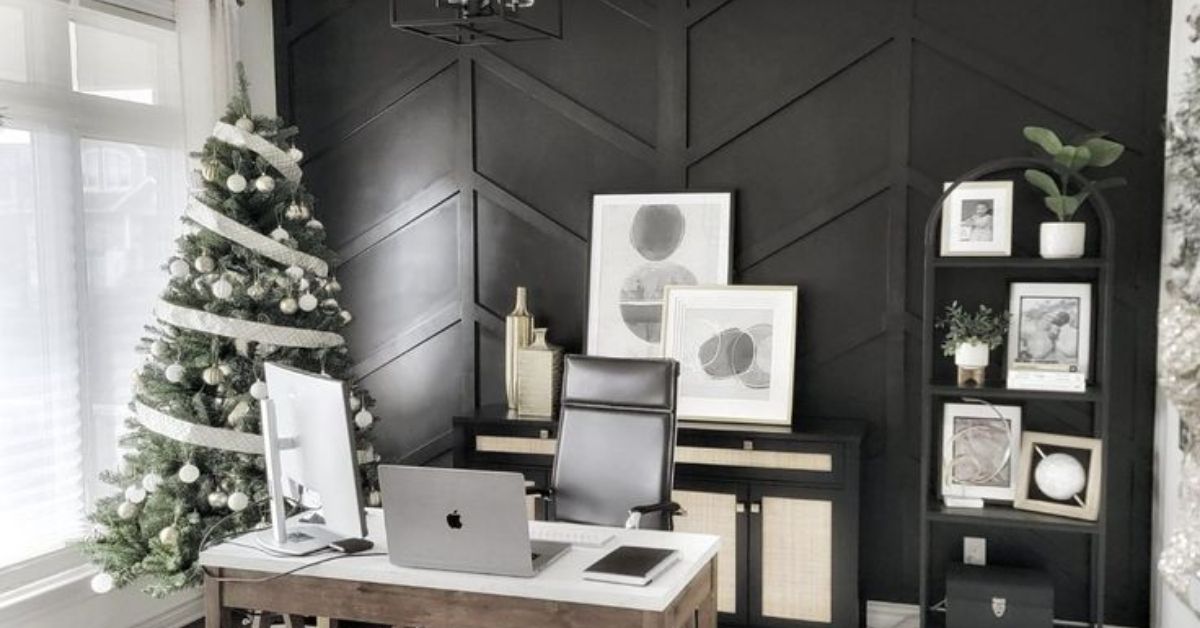
Your home office walls are doing more work than you think. A bare wall behind your desk creates a flat, uninspiring backdrop both for your own focus and for every video call you’re on. But overcrowded walls? They add visual noise that makes it harder to think clearly.
If you’re working from a spare bedroom, a living room corner, or a dedicated studio, the way you treat your walls directly affects how productiveand how comfortableyou feel in that space. This isn’t about decorating for aesthetics alone. It’s about building a wall setup that supports the way you actually work.
For anyone trying to balance a functional workspace with a home that still feels like a home, these home office wall decor ideas are built around real constraints: limited space, rental restrictions, awkward layouts, and varying budgets.
A Single Large-Scale Art Print Behind the Desk

One oversized printthink 24×36 inches or larger does what a gallery wall can’t in a small room: it anchors the space without cluttering it. Position it centered behind your monitor so it reads clearly on video calls without distracting. Abstract prints in neutral tones (charcoal, warm beige, muted sage) work particularly well because they add depth without pulling focus. This setup works best when your desk faces a wall directly and you want a finished, professional look without a lot of installation effort. One nail, one statement.
A Floating Shelf Row at Eye Level
A single row of floating shelvesor two staggered rowsadds storage, texture, and visual interest simultaneously. The key is restraint: fill about 70% of the shelf space and leave breathing room. Use a mix of functional items (a small speaker, a notebook stack) and organic elements (a trailing pothos, a small ceramic). This works especially well in offices that lack built-in storage, since the shelves pull double duty. Renters can use damage-free brackets rated for moderate weight. The horizontal line the shelves create also makes the wall feel wider.
A Corkboard or Pegboard Styled as a Feature Wall

A well-styled corkboard is one of the most underrated home office wall decor ideas not because it’s pretty, but because it’s genuinely useful. Frame it in thin wood or paint a border around it to make it feel intentional rather than dashed together. Pegboards work similarly: mount one in black or white, add metal hooks and shelves, and suddenly your most-used tools are visible and reachable without taking up desk space. This is particularly practical in compact offices where the desk surface gets overwhelmed quickly. Honest opinion this is one I’d recommend trying first, especially if your work involves physical materials or frequent reference notes.
A Gallery Wall with an Intentional Grid Format
Gallery walls earn their bad reputation when they’re randomly assembled. The fix is simple: commit to one frame color, one frame size (or two complementary sizes), and a tight grid layout. Measure and mark your grid before you hammer anything. For home offices, a 2×3 or 3×2 arrangement of 8×10 frames creates a focal point that feels curated without being loud. Mix black-and-white photography with one or two typography prints, motivational if that’s your thing, abstract if you prefer a cleaner feel. The uniformity of the grid keeps the wall organized, which mirrors the kind of mental environment most people need for focused work.
A Painted Accent Wall in a Muted, Saturated Tone

In 2026, single-color accent walls are back but the palette has shifted away from bold primaries toward muted, complex tones. Think dusty sage, warm terracotta, deep slate, or muted clay. Paint just the wall your desk faces, and leave the remaining three walls white or off-white. The contrast creates depth and makes your desk setup read as a distinct zone within a larger room. This is especially effective in open-plan apartments where the office area needs visual definition without physical separation. One gallon of paint, one afternoon, meaningful spatial impact.
Read More About : 21 Desk Lighting Ideas That Actually Improve Your Productivity (Without Wrecking the Vibe)
A Wall-Mounted Monitor Arm That Clears the Desk
This one crosses into furniture territory, but the wall treatment it enables is worth including. When your monitor is arm-mounted rather than stand-based, your desk surface clears completely and the wall behind it becomes a genuine decor opportunity. You can hang a single piece of art centered at eye level, or use the space for a small floating shelf cluster. The mount itself also reads as intentional and clean on video calls. Works best in permanent home offices where drilling is an option. In my experience, this change makes the space feel more like a proper office and less like a temporary setup.
Vertical Shiplap or Wood Panel Strip on One Wall

Vertical panelingwhether real shiplap, MDF strips, or peel-and-stick alternativescreates texture and height on a wall that would otherwise feel flat. Running the panels vertically draws the eye upward, which is useful in rooms with lower ceilings. Paint them the same color as the wall for a subtle tonal effect, or keep them white against a slightly warmer wall for contrast. A wall sconce mounted directly on the panel pulls the look together without extra furniture. This works well in dedicated office rooms where you want the space to feel like a real room, not just a desk shoved against a wall.
A Chalkboard or Whiteboard Wall Panel
A whiteboard panelframed in thin metal or wood gives you a genuinely functional wall element that doesn’t look clinical when done right. Position it beside your desk rather than directly behind it so it doesn’t dominate your video call background. Use it for weekly priorities, project mapping, or client timelines. The difference between a whiteboard that looks like office supply overflow and one that looks intentional is entirely in the frame and placement. For roles that involve visual planning, design, content, consulting this might be the most useful wall addition in this entire list.
A Woven Wall Hanging for Texture Without Weight

Woven or macramé wall hangings work in home offices because they add softness to what is often a hard-surface-heavy room (monitors, desks, keyboards). Choose a piece in natural tonesoff-white, warm tan, muted camel and hang it at a height where the bottom sits just above desk level. This keeps it visible above the monitor without interfering with your sightline. The texture reads well on camera because it adds depth without pattern confusion. Best suited for styles leaning minimal, Scandinavian, or organic modern. Renters love these because they require only one hook.
Built-In Bookshelf Wall (Floor to Ceiling)
Floor-to-ceiling shelving turns an entire wall into a functional focal point. The trick that makes this look designed rather than accumulated: paint the shelves and wall the same color. Everything reads as one cohesive unit. Organize books by color or category, and intersperse a few objects: a small plant, a sculptural object, a framed photo. This is obviously a larger investment, but for anyone in a permanent home office setup, it’s one of the highest-value changes you can make. It solves storage, aesthetics, and background quality in one move.
A Wall-Mounted Desk with Floating Storage Above

When your home office is actually a closet conversion, a bedroom corner, or a hallway nook, a wall-mounted fold-down desk paired with shelves above it uses vertical space instead of floor space. The wall becomes the entire workstation. Style the shelves with restraint one plant, reference books you actually use, a small framed piece. When the desk is folded up, it reads as a clean wall feature. This is one of the most practical setups for renters in studio or one-bedroom apartments where dedicated office space isn’t an option.
A Map or Blueprint Print with Personal Relevance
A large map print of your city, a place you’ve lived, or somewhere that means something to you works as wall decor that’s visually interesting without being purely decorative. It gives visitors and call attendees something to notice and ask about, which is a subtle but real benefit in a workspace. Blueprint-style prints in navy and white or sepia tones add a more editorial, sophisticated feel. Scale matters here: go for at least 18×24 inches so the detail is actually readable. Pair with a thin metal or wood frame to keep it feeling intentional.
A Neon or LED Sign with a Purpose

Neon signs in home offices went through a trend cycle, and the version that’s survived into 2026 is much more restrained: small, warm-toned, and purposeful. Think of a single motivating word in a clean script, or a symbol relevant to your work. Mount it above your monitor or on a side wall so it’s visible without dominating the frame. Warm white or soft amber reads best on camera. Avoid color-heavy signs unless your aesthetic is very intentional they can pull attention in ways that work against focus. This works best in creative fields where personality in the workspace is a feature, not a distraction.
Read More About : 29 Cozy Home Office Decor Ideas That Make Working From Home Feel Like a Real Space
A Series of Matching Botanical Prints
Three matching botanical printssame frame, same mat, same scalearranged horizontally above the desk create a quiet, cohesive focal point that’s calm to look at during long work sessions. Botanical prints (line drawings, vintage illustrations, pressed plant prints) have staying power because they’re neither trendy nor dated. They work in almost any aesthetic: minimal, traditional, Japandi, or soft modern. Print-on-demand sites like Society6 or Printify let you download and print these cheaply. Total cost for three framed prints: often under $50 if you source frames from IKEA or a thrift store.
A Window Nook with Desk Positioned Against It

If your room has a window, positioning the desk directly in front of it rather than against a blank wall makes the window itself the backdrop. Natural light hits your face frontally (important for video calls), and the wall decor on adjacent walls becomes supporting context rather than the main event. Keep window treatments simple sheer linen or cotton light diffuses rather than blocks. This works best when the view outside isn’t distracting, but even a brick wall or courtyard adds more interest than a painted surface. The walls to the left and right can then hold minimal, complementary decor.
A Single Framed Mirror Beside the Desk
A mirror in a home office isn’t vanity’s spatial logic. One framed mirror on the wall adjacent to your desk bounces light across the room and makes the space read as larger than it is. Choose a simple shape: round, rectangular, or arch. Avoid ornate frames in a workspace context; they compete visually with everything else. The key is placement: it should reflect either a window or a well-lit wall, not the back of your monitor. This is particularly effective in offices with only one light source, since it effectively multiplies it.
A Floating Desk With Wall-Mounted Task Lighting

Wall-mounted task lightinga swing-arm sconce or an articulating lampremoves a piece of furniture from the equation (no lamp stand, no cord management problems) and brings light exactly where you need it. Paired with a floating desk, this creates a wall system that handles work surface, lighting, and storage in a single vertical zone. The overall effect is intentional and compact. Best suited for smaller rooms or alcoves where floor lamps and desk lamps eat into limited space. The sconce itself reads as a decor element, especially in metal finishes like brushed brass or matte black.
An Oversized Calendar or Planner Print
An oversized annual calendar print framed and mounted at eye level crosses from utility into decor when it’s designed well. Clean typography, plenty of white space, minimal grid lines. You can find minimal calendar prints on Etsy or design your own for free in Canva and print at a local print shop. The benefit over a digital calendar is passive visibility: you see the month and quarter at a glance without opening an app. This is particularly useful for freelancers, project-based workers, or anyone managing multiple deadlines. Honestly, it’s one of those additions that sounds basic but changes how you interact with your workspace daily.
A Pegboard with Color-Coded Organization

A pegboard styled with intention consistent accessory colors, labeled containers, organized by category turns a purely functional wall element into something worth looking at. The trick is choosing a hook and shelf system that feels cohesive, not like it was assembled from whatever was on sale. Matte black accessories on a white board, or natural wood accents on a muted board, both work well. Keep the organization visible but tidy: visible cable holders, dedicated spots for frequently used tools. This solves the desk clutter problem in the most direct way possible: move it to the wall.
A Painted Mural or Wall Art Section
A hand-painted mural sounds intimidating, but it doesn’t have to be elaborate. Simple organic shapesarcs, color blocks, loose gestures painted in two or three muted tones create a custom backdrop that no print can replicate. You don’t need to be an artist: tape off a color block in a complementary tone, dry-brush a gradient, or paint a single curved form in a contrasting shade. Renters should check lease terms, but most landlords will approve repainting on exit. This works best in offices where you want the space to feel personal and creative rather than corporate or neutral.
A Fabric Panel or Upholstered Wall Section

A fabric panel, a large piece of linen, canvas, or bouclé mounted directly to the wall adds acoustic softness, texture, and warmth simultaneously. This is especially practical in home offices where echo or background noise on calls is a problem. Stretch the fabric over a simple wooden frame (like a canvas stretcher) and mount it like art. Choose a texture-forward fabric in a neutral tone: undyed linen, oatmeal bouclé, or washed cotton. The result is quieter calls, a softer visual backdrop, and a genuinely distinctive wall treatment that doesn’t require any special skills. Good for renters since it hangs like oversized art.
A High Shelf Running the Width of the Wall
A single shelf running wall-to-wall near ceiling height adds storage without interrupting your sightline at desk level. It keeps books, binders, and decorative objects above the working zone so they’re accessible but out of the way. The continuous line also visually widens the wall, which helps in narrow rooms. Keep items on it lightly curateddon’t treat it as overflow storage. The shelf becomes a slow-moving decor layer: you’ll update it seasonally without really meaning to. This setup works in rooms with high ceilings (8 feet or above) and is one of the better solutions for offices that need storage but can’t accommodate more furniture.
A Dark Accent Color on the Ceiling

This one requires a bit of confidence, but a dark ceiling in a light room does something unexpected: it lowers the visual ceiling height and creates a feeling of enclosure that actually improves focus for many people. Think of it as a built-in visual anchor. Paint just the ceiling in charcoal, deep navy, or forest green. Leave the walls white or light. Add a pendant or semi-flush light fixture in a complementary finish. The walls become the decor backdrop, and the ceiling becomes the defining feature. I’ve noticed this setup tends to make a room feel more like a proper office and less like a repurposed bedroom, subtle but effective.
A Vertical Garden or Plant Wall Feature
A wall-mounted planter systemeven just two or three mounted pots holding trailing plants, adds biophilic texture that both softens the space and has a documented effect on focus and stress levels. Go for low-maintenance plants: trailing pothos, philodendrons, or air plants. Mount the planters on a wall that gets indirect daylight or supplement with a small grow light positioned discretely nearby. This works in offices that feel visually cold or sterile, particularly those with lots of hard surfaces (glass, metal, laminate). The green breaks up the visual monotony without adding furniture.
A Typography Print with a Phrase That Means Something to You

Typography prints walk a fine line between meaningful and cliché. The ones that work in a home office are specific: a phrase in a language you speak, a quote relevant to your actual work, or a word that functions as an anchor during focused sessions. Keep the design minimal thin serif or clean sans-serif, lots of white space, simple frame. Avoid motivational poster formats. The goal is a print that you’d notice on your wall during a long afternoon and find genuinely grounding, not one that you stop seeing after two weeks.
A Combination of Paint, Shelf, and Single Art Piece
A layered wall treatment paint plus shelf plus one art piece creates depth without the complexity of a gallery wall. Paint the lower half of the wall in a muted tone (clay, sage, slate), leave the upper half white, and add a floating shelf at the transition line. Mount one framed piece above it. The three elements work together to create a wall that feels designed rather than assembled. This works particularly well in offices where you spend long hours, because visual variety at different eye levels reduces monotony. Total cost can be quite low if you DIY the paint and source the shelf and frame affordably.
A Sound-Absorbing Panel Wall in a Double Function Setup

Acoustic panels are increasingly common in home offices and the better ones look like intentional design elements, not studio equipment. Choose panels in a fabric that suits your aesthetic (charcoal, warm gray, deep navy) and mount them symmetrically on either side of your monitor wall. They reduce echo on calls, absorb ambient noise, and create a visual frame for your desk setup. This is especially useful in rooms with hard floors, high ceilings, or adjacent living spaces where noise bleeds through. The functional benefit is real and immediate. The aesthetic benefit is that the wall suddenly looks finished in a way that a single art print doesn’t quite achieve.
What Actually Makes These Home Office Wall Decor Ideas Work
Most home office walls feel unfinished because they’re treated as an afterthought, something to address after the desk, chair, and equipment are already in place. The walls that actually work are planned alongside the furniture layout, not after it.
Visual weight matters more than quantity.
One large, well-placed piece reads better than five small, scattered ones. The eye needs a clear landing point, especially in a space where you’re already managing a lot of visual information (screens, documents, notifications). Before adding anything to your walls, identify the focal point usually directly behind or beside your deskand build from there.
Lighting is the hidden layer.
Wall decor in a poorly lit room will always feel flat. Before investing in prints or shelving, assess your light sources. A wall sconce or a well-positioned desk lamp changes how every other element in the room reads. Art that looks underwhelming under flat overhead light can look completely different with warm directional light.
Scale is consistently underestimated.
The most common mistake in home office wall styling is going too small. Pieces that look proportional in a furniture showroom feel timid in an actual room. When in doubt, size up by at least one increment. A 24×36 print in a 10×10 room is not too large; it’s usually exactly right.
Cohesion beats variety.
Mixing too many materials, frame finishes, or color temperatures on one wall creates visual noise rather than interest. Pick a consistent thread all matte black frame, all natural wood, all one color palette and let everything hang together from there.
Home Office Wall Decor: Setup Comparison Guide
| Setup | Best For | Space Type | Problem Solved | Budget Level |
| Single oversized print | Clean, professional look | Any size | Blank, unanchored wall | Low–Mid |
| Gallery wall (grid format) | Personal expression | Medium–Large | Empty feature wall | Low–Mid |
| Floating shelves | Storage + style | Small–Medium | No storage, flat walls | Low–Mid |
| Pegboard system | Tool-heavy workflows | Small | Desk clutter, limited surface | Low |
| Built-in bookshelves | Permanent offices | Medium–Large | Storage + backdrop quality | High |
| Painted accent wall | Define the work zone | Any | Lack of visual boundary | Low |
| Acoustic panels | Frequent calls, open plans | Any | Echo, noise bleed | Mid |
| Fabric panel | Soft aesthetic, noisy rooms | Small–Medium | Echo + visual coldness | Low–Mid |
| Vertical plant wall | Sterile or hard-surface rooms | Any | Visual monotony, focus | Mid |
| Wall-mounted monitor + art | Clean desk priority | Small | Surface clutter, flat look | Mid–High |
Common Home Office Wall Mistakes That Make Your Space Feel Cluttered or Disconnected
Hanging things too low.
The default mistake. Most people hang art at eye level when standing, but in a home office you’re seated most of the day. Art hung for a standing viewer sits too high relative to your sightline when working, and too disconnected from the desk. Center your main wall piece roughly 8–12 inches above your monitor, not at standing eye level.
Using too many different frame finishes.
Black frames, gold frames, natural wood frames, and white frames on the same wall create visual fragmentation. The frames become the story instead of the art. Choose one finish and commit.
Ignoring the cable situation.
Beautifully styled walls are immediately undermined by exposed power strips, dangling cables, and tangled cords in the foreground. Cable management isn’t glamorous, but it’s the prerequisite to any wall decor actually landing. Use cable clips, raceways, or furniture with built-in management before styling the wall behind it.
Scaling down out of fear.
Hesitation about “too large” leads to pieces that disappear on the wall. In a room with a desk, monitor, chair, and shelving already present, small art prints read as lost. The visual competition in a home office is highyour pieces need to hold their own.
Treating walls as separate from the desk layout.
The wall behind your desk is in your video call frame. The wall you face while working affects your focus. These aren’t independent design decisions. Plan them together, keeping in mind sightlines, camera angles, and where your light falls.
FAQ’s
What should I hang on the wall behind my desk?
The best option is something with visual weight and minimal distraction an oversized print, a simple gallery grid, or a single framed piece centered behind your monitor. Avoid busy patterns or high-contrast art directly in your video call background, as it pulls focus from your face.
How do I decorate a home office wall without drilling holes?
Use damage-free adhesive strips (Command strips rated for the frame weight), leaning arrangements, or wall-mounted systems designed for renters like FINTORP or similar track systems. Fabric panels and woven hangings also work with a single adhesive hook and are easy to remove.
What size art should I hang above a desk?
For most desk setups, a piece between 24×36 and 30×40 inches works best as the primary focal point. If you’re doing a horizontal grouping, aim for a combined width that spans roughly two-thirds of your desk length. Going smaller than this usually results in a piece that feels timid relative to the furniture.
Is it better to have a gallery wall or one large piece in a home office?
It depends on the room size and your workflow. A single large piece is lower maintenance, cleaner on video calls, and easier to execute well. A gallery wall works better in medium-to-large rooms where you want to fill significant wall space. For small offices or video-call-heavy roles, one large piece tends to perform better practically.
How do I make a home office wall look professional for video calls?
Keep the area directly behind your desk free of clutter and high-contrast chaos. A solid accent paint color, one large neutral print, or evenly spaced shelves with curated objects all read cleanly on camera. Warm, directional lighting aimed at your face (not the wall) also improves how the background reads.
Can plants work as home office wall decor?
Yes, particularly trailing varieties mounted in wall planters or a small vertical planter system. Pothos, philodendrons, and heartleaf varieties are the most practical; they tolerate indirect light and infrequent watering. Even one or two mounted planters add a visual layer that printed art can’t replicate.
What’s the most budget-friendly way to decorate a home office wall?
A painted accent wall is the highest-impact, lowest-cost optionoften under $30 in paint. Paired with one downloadable print (many are free or $5–$15 on Etsy) in a secondhand frame, you can create a finished, intentional wall setup for under $60 total.
Conclusion
A home office wall that’s genuinely working for you, not just filled, makes a real difference in how long you can sit at your desk comfortably, how your calls look to other people, and whether the room feels like a space you want to be in. None of that requires a large budget or a full renovation. It requires a bit of planning about what goes where and why.
Start with one or two ideas that fit your actual constraints/space, budget, rental situation, aesthetic preference. Adjust the lighting before committing to any art placement. And if you’re unsure where to begin, the painted accent wall and a single oversized print behind the desk is still one of the most reliable combinations in this list.
