

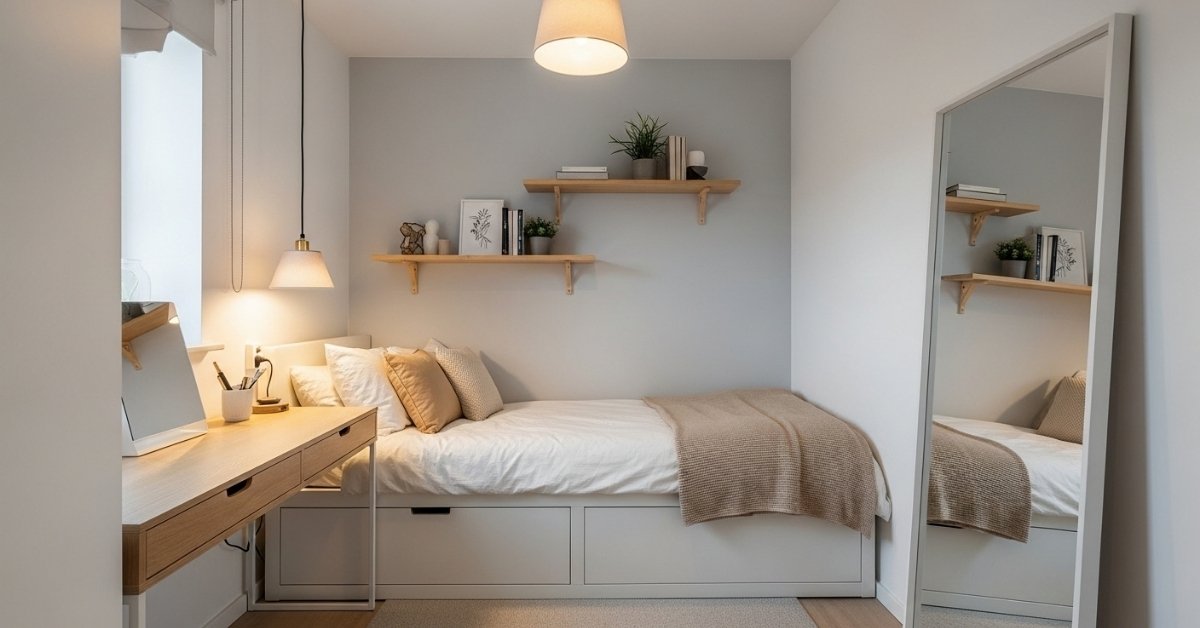
Small bedrooms have a way of feeling either cozy or cramped and the difference usually comes down to layout, not square footage. If your room feels tight the moment you walk in, or you’re constantly navigating around the bed just to reach the closet, the problem isn’t the size of the room. It’s how the space is being used.
For anyone working with a compact bedroom whether it’s a studio ,Small Bedroom Layout Ideas a spare room doing double duty, or just a bedroom that never quite feels right, these ideas focus on what actually works: furniture placement, light direction, and setups that give you more usable floor space without sacrificing comfort.
In 2026, the shift in small bedroom design is moving away from “minimal at all costs” and toward intentional layering rooms that feel complete, not stripped down. These 21 small bedroom layout ideas reflect that shift, with practical setups you can actually pull off in a real home.
Push the Bed Into the Corner for an Instant Layout Reset

Corner placement is one of the most underused moves in small bedrooms. When the bed sits in the middle of a wall, it eats up walking space on both sides space that, in a small room, you simply don’t have. Sliding the bed into a corner frees up a full side of the floor, which opens the room considerably for movement and furniture placement. It works especially well in square rooms or bedrooms where the door opens directly into the space. The tradeoff is accessibility from one side, but for single sleepers or kids’ rooms, that’s rarely an issue. Add a wall-mounted lamp on the corner side to replace a bedside table and you’ve recovered even more floor space.
Float the Bed on the Longest Wall to Anchor the Room
When corner placement isn’t an option, especially in shared bedrooms, centering the bed on the longest wall creates the most balanced layout. This positioning gives the room a clear focal point and distributes walking space evenly on both sides. It’s the setup that makes a small room feel intentional rather than accidental. Pair it with low-profile nightstands to keep the sightlines open, and avoid anything bulky above bed height on that same wall. The visual balance alone makes the room feel more settled.
Read More About : 27 Cozy Bedroom Ideas Aesthetic That Make Your Space Feel Like a Real Retreat
Use a Platform Bed to Lower the Visual Ceiling Line

Height is everything in a small bedroom. A tall bed frame with a thick mattress stack pushes the visual weight of the room upward and makes ceilings feel lower than they are. A platform, especially one with a low, clean-lined frame keeps everything grounded. The room reads as more spacious because there’s more visible wall above the bed. This is one I’d actually recommend trying first if your bedroom feels boxy or tight, because it’s a single furniture swap that shifts the entire spatial feel of the room without moving a single wall.
Build a Floating Shelf System Above the Bed Instead of a Headboard
Headboards take up visual space without adding function. In a small bedroom, replacing the headboard with a set of floating shelves solves two problems at once: it adds storage and display space, and it draws the eye upward, making the wall feel taller. Keep shelves shallow around 8 to 10 inches deep so they don’t intrude on the sleeping space. Use them for books, a small lamp, or a plant or two. The result is a setup that feels considered and purposeful, not like you ran out of room for a real headboard.
Place a Slim Desk Behind the Bed for a Sleep-Work Layout

Honestly, this is one of the more clever small bedroom layout ideas for people working from home in tight spaces. A slim desk (around 20 inches deep) positioned directly behind the headboard against the wall the bed faces creates a dedicated work zone without stealing floor space from the sides of the room. The key is using a wall-mounted or pendant light for the desk area so you’re not adding another surface item. When you’re not working, the desk reads as a console, not a home office crammed into a bedroom.
Use a Murphy Bed to Reclaim the Full Room During the Day
Murphy beds have come a long way from the clunky fold-down frames of older apartments. Modern wall bed units integrate shelving, cabinets, and even sofas into one built-in system so when the bed is up, you have a fully functional living or work space. This layout makes the most sense in studio apartments or guest rooms that need to serve multiple purposes. The upfront cost is higher than a standard bed, but the amount of usable floor space it returns during waking hours is significant, especially in rooms under 150 square feet.
Angle the Bed in a Corner to Break Up a Boxy Layout

This one gets overlooked because it feels counterintuitive angling anything in a small room seems like it would make things feel more cramped. But in a square bedroom with no clear “feature wall,” a 45-degree bed placement breaks the boxy feel and creates two distinct zones on either side of the bed. The triangular space behind the headboard can hold a basket, a small side table, or just stay empty as negative space. It works best in rooms where the standard against-the-wall placement leaves awkward gaps you can’t fill sensibly.
Mount the TV on the Wall Opposite the Bed to Clear the Dresser Top
A TV on a dresser means the dresser is doing two jobs and doing neither well. Wall mounting the TVat eye level from the bedfrees the dresser top entirely for actual use: a mirror, a tray, a lamp. It also drops the visual weight of that wall, which makes the room feel less cluttered even if the total amount of furniture hasn’t changed. Run the cables through the wall or use a slim cable management channel for a clean finish. In my experience, this is one of the fastest changes you can make to a small bedroom that immediately shifts how organized the room feels.
Swap a Standard Wardrobe for a Full-Wall Closet System

A freestanding wardrobe takes up floor space and creates a visual block. A built-in closet system that runs floor to ceiling and wall to wall uses the same square footage but returns far more storage and keeps the room feeling open. Sliding doors (rather than hinged) are critical here they eliminate the door-swing clearance that eats into your walking space. This layout works especially well on the wall directly across from the bed, where it anchors the room without interrupting traffic flow.
Use Under-Bed Storage to Eliminate the Need for Extra Furniture
Every piece of furniture in a small bedroom needs to justify its presence. A bed frame with built-in drawers consolidates what would otherwise be a dresser, a storage ottoman, or an extra shelf unit into one footprint. It’s not the most exciting design move, but it’s one of the most practical for rooms where square footage is genuinely limited. Look for frames with drawers on both sides for maximum capacity, and pair with a low-profile mattress so the overall bed height stays reasonable.
Read More About : 27 Living Room Wall Decor Above Couch Ideas That Actually Work in Real Homes
Create a Reading Nook in a Dead Corner With a Single Chair and Lamp

Most small bedrooms have at least one corner that isn’t doing anything useful, usually opposite the bed or near the window. A small armchair (look for chairs under 28 inches wide) with a floor lamp and a side table turns that corner into a functional spot without crowding the room. The chair doesn’t need to be large. It just needs to be comfortable enough to actually use. This setup adds a layer of purpose to the room and breaks the “everything is just for sleeping” feel that makes small bedrooms feel one-dimensional.
Mirror One Full Wall to Visually Double the Space
A single large mirror or a floor-to-ceiling mirror panel on one wall is one of the most effective spatial tricks in a small bedroom not because it “fakes” more space (which sounds gimmicky), but because it literally doubles the reflected light and creates visual depth. The room doesn’t look like it has a mirror in it; it looks like it continues. Position it on the wall adjacent to the window for the strongest light reflection. Avoid mirroring the wall directly across from the bed unless you’re intentional about it, some people find it disorienting.
Use Curtains Floor-to-Ceiling to Make Windows Feel Larger

Hanging curtains at ceiling height rather than just above the window frame makes the window appear taller and the ceiling appear higher, both of which help a small room feel less boxed in. The curtains should pool very slightly on the floor for a relaxed, finished look. Choose a fabric in a similar tone to the walls so they blend rather than break up the wall into sections. This works in any small bedroom but is especially effective in rooms with standard 8-foot ceilings that feel low.
Add a Bench at the Foot of the Bed for Storage Without a Footboard
A footboard closes off the end of the bed and makes the room feel more confined. Replacing it with a slim storage bench opens up that sightline while adding a practical surface for getting dressed, setting down bags, or storing extra bedding inside. Keep the bench proportional; it should be no wider than the bed and no taller than the mattress height. For small bedrooms, a bench around 42 to 48 inches wide and 16 to 18 inches deep hits the right balance of usefulness without being bulky.
Use Vertical Space With Tall, Narrow Shelving Instead of Wide Units

Wide, low shelving spreads horizontally and eats into the perceived floor area of a room. Tall, narrow shelvingthink 12 to 14 inches deep and 70 or more inches tall uses vertical space that’s otherwise wasted while keeping the floor footprint minimal. In a small bedroom, this kind of unit can replace a dresser for folded items or serve as a display and book shelf alongside the bed. The vertical emphasis also draws the eye upward, which helps the room feel taller.
Layer Lighting With Three Sources to Make the Room Feel Bigger
Single-source overhead lighting flattens a small room. When everything is lit from the same point, there’s no depth or dimension; the room just looks like a box. Layering three light sources, an overhead fixture, a bedside lamp, and either a floor lamp or wall sconce creates pools of light that give the room visual depth. The shadows between the light sources actually make the space feel larger, not darker. Stick to warm-toned bulbs (around 2700K) to keep the atmosphere settled and calm.
Place a Low Dresser Under the Window to Use Dead Space

The wall under a window is often completely wasted in small bedrooms. A low dresser or chest of drawers (under 36 inches tall) fits neatly beneath most standard window heights and reclaims that zone for storage. It keeps the window unobstructed, so natural light still floods in, and it gives you a surface for a small plant or a lamp without crowding the rest of the room. This layout is particularly useful in bedrooms where wall space is limited and you’re struggling to find a logical spot for storage.
Use a Lofted Bed to Create a Work or Lounge Zone Below
Lofted beds are the obvious solution for very small rooms but the execution matters. The space below needs a clear purpose: a desk, a reading chair, or a small sofa. Without that, the loft just feels like a bunk bed missing its lower bunk. Make sure the ceiling height is at least 9 feet before lofting a bed you need enough clearance above the mattress to sit up comfortably (at minimum 30 to 36 inches). This setup works best in kids’ rooms, studio apartments, or college-style spaces where floor space is the main constraint.
Add a Room Divider to Separate Sleep and Work Zones

When a bedroom has to function as both a sleep space and a home office, the lack of physical separation makes it harder to mentally switch off. A low bookshelf, a curtain panel on a ceiling-mounted track, or even a strategically placed wardrobe can define two distinct zones without closing off the room entirely. The divider doesn’t need to be solidpartial separation is enough to create the psychological shift between “work” and “rest.” This is especially relevant now, as more people are designing small bedrooms to serve both functions without sacrificing either.
Keep the Color Palette Tight to Expand the Space Visually
A bedroom with too many competing colors feels smaller than it is, because the eye keeps moving between contrasting elements instead of resting. A tonal palette where the walls, bedding, and major furniture sit within the same color family creates a sense of continuity that reads as more spacious. This doesn’t mean the room needs to be white. Warm beige, soft sage, or dusty blue all work well when the tones are kept close together. The variation in texture (linen vs. wood vs. cotton) provides visual interest without the spatial cost of color contrast.
Use Furniture Legs to Keep the Floor Visually Open

This is a detail that changes the feel of a room more than most people expect. Furniture that sits directly on the floor creates a heavy, grounded look in large rooms, but in a small bedroom it makes everything feel more solid and space-consuming. Furniture with legs (even short, tapered ones) lets you see the floor beneath, which tricks the eye into reading the room as more open. Apply this across the bed frame, nightstands, and dresser for the most consistent effect. Even 4 to 6 inches of clearance makes a difference.
What Actually Makes Small Bedroom Layout Ideas Work
The ideas above cover a range of setups, but the underlying principle is consistent: small bedrooms work best when every decision serves more than one purpose. Furniture that stores, walls that do double duty, and light that creates depth, these aren’t aesthetic choices, they’re functional ones.
The other factor most people overlook is traffic flow. Before placing any furniture, walk the path from the door to the bed, from the bed to the closet, and from the closet to the bathroom if there’s an en suite. Every layout needs at least 24 inches of clear walking space along those routes. If a piece of furniture interrupts that path, it’s not the right placement regardless of how it looks in a photo.
Proportion matters just as much as placement. A large bed in a small room isn’t always avoidable, but it becomes a problem when the surrounding furniture is also large. Scale down nightstands, choose low-profile dressers, and keep decorative items sparse enough that the room doesn’t feel like it’s competing with itself.
Small Bedroom Layout Comparison Guide
| Layout Idea | Best For | Room Type | Problem It Solves | Difficulty |
| Corner bed placement | Single sleepers, kids | Very small rooms | Limited floor space | Easy |
| Longest wall centering | Couples, shared rooms | Standard small rooms | Layout imbalance | Easy |
| Platform bed | Any | Low ceiling rooms | Visual heaviness | Easy |
| Murphy bed | Multipurpose rooms | Studios, guest rooms | Floor space during the day | Moderate |
| Lofted bed | Solo occupants | Very small or high-ceiling rooms | Need for desk or lounge zone | Moderate |
| Full-wall closet system | Anyone needing storage | Rooms without built-in closets | Wardrobe footprint | High |
| Under-window dresser | Any | Rooms with low windows | Wasted dead space | Easy |
| Three-source lighting | Any | Dark or boxy rooms | Flat, claustrophobic lighting | Easy |
| Tonal color palette | Any | Rooms with mixed furniture | Visual clutter and contrast | Easy |
Common Small Bedroom Layout Mistakes That Make the Space Feel Worse
Pushing all furniture against the walls.
This feels logical in a small room to get it out of the way but it actually makes rooms feel more awkward, not more spacious. Furniture pushed flat against walls with no breathing room creates a rigid, institutional feel. Allowing even a few inches of space between a piece of furniture and the wall, or floating a small nightstand slightly away from the bed, softens the layout.
Choosing furniture that’s too large for the room.
A king bed in a 10×10 room leaves almost no floor space for anything else. If the bed takes up more than 60% of the floor area, it’s worth considering whether a queen or even a full one might give you back enough room to breathe. This is especially worth evaluating in rooms where you also need storage or a desk.
Ignoring the door swing.
The arc of an inward-opening door is floor space you can’t use for furniture. Before finalizing any layout, map out where the door swings and treat that zone as off-limits. Rooms with doors that open into awkward positions often benefit from switching to a barn door or a sliding panel.
Over-decorating to compensate for size.
Small rooms don’t need more stuffthey need better stuff. A single piece of art, a well-placed mirror, and one or two plants will do more for a small bedroom than a gallery wall, three rugs, and a collection of decorative pillows. Edit ruthlessly.
Blocking natural light with furniture placement.
A tall wardrobe or shelving unit placed in front of or beside a window blocks the light before it can spread into the room. Natural light is the most effective spatial tool in a small bedroom every layout decision should protect access to it.
FAQ’s
What is the best bed placement in a small bedroom?
The best placement depends on the room shape, but in most small bedrooms, centering the bed on the longest wall gives the most balanced layout. For very tight rooms, a corner placement frees up more floor space on one side and works well for single sleepers or children’s rooms.
How do I make a small bedroom feel bigger without renovating?
Focus on three things: furniture scale, lighting, and color. Choosing lower-profile furniture, layering light from multiple sources, and keeping the color palette tonal (similar tones throughout) will expand the perceived space without any structural changes.
Can a small bedroom have both a bed and a desk?
Yes, but placement is everything. A slim desk positioned behind the headboard, against the wall the bed faces, is one of the most space-efficient setups. Alternatively, a lofted bed frees up the floor below for a full desk area in rooms with ceiling height to spare.
Is a queen bed too big for a small bedroom?
A queen bed fits comfortably in rooms that are at least 10×10 feet, as long as you maintain 24 inches of walking space on the sides and at the foot. In rooms smaller than that, a full or double mattress on a low-profile platform frame is a more practical choice.
What furniture should I avoid in a small bedroom?
Avoid large freestanding wardrobes with hinged doors (they eat floor space with the door swing), oversized dressers, and bulky upholstered bed frames with footboards. These pieces take up more visual and physical space than their storage capacity justifies in a compact room.
How do I add storage to a small bedroom without making it feel cluttered?
Build storage into existing furniture rather than adding more pieces. A bed with built-in drawers, floating shelves above the bed, and a storage bench at the foot of the bed cover most bedroom storage needs without adding new footprint items to the floor.
Does the color of a small bedroom really affect how big it feels?
It does, but not always in the way people expect. Light colors open up the space, but a tonal approachwhere walls, bedding, and furniture are all in the same color family tends to work better than just painting everything white. Contrast between elements is what makes a room feel fragmented and smaller.
Conclusion
Small bedrooms don’t require a complete overhaul to feel functional and livable. Most of the changes that make the biggest difference placement, lighting layers, furniture scale are decisions you can revisit and adjust without major cost or effort.
Start with one or two ideas that address your most immediate frustration, whether that’s a lack of storage, an awkward traffic flow, or a room that just never feels settled. Get those working first, then build from there. The right layout for a small bedroom is the one that makes you stop noticing the size.
