

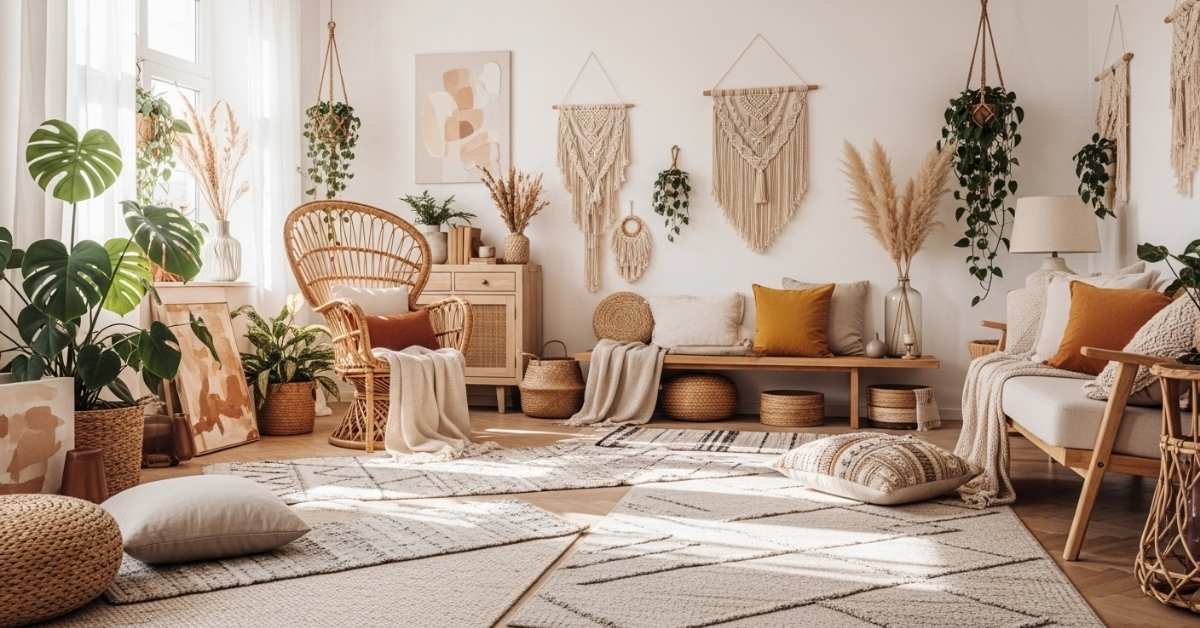
Boho decor in 2026 isn’t about throwing a macramé wall hanging over a white wall and calling it done. The style has matured, it’s warmer, more grounded, and a lot more intentional than the maximalist free-for-all it used to be. What people are going for now is that specific feeling of a room that looks collected over time, not styled in an afternoon.
If your space feels a little cold, a little bare, or just weirdly uninspiring despite having furniture, boho layering is genuinely one of the most effective ways to fix that without a renovation. Boho Decor Ideas You’re working with texture, warmth, and organic shapes, which means even a rental with builder-grade everything can start to feel like somewhere you actually want to be.
If your style leans eclectic, cozy, or globally-inspired or you just want a space that feels personal without being chaotic this list is for you.
Layer a Jute Rug Over a Flatweave for Depth Without Bulk

Most rooms with a single rug on a hard floor feel oddly flat like the furniture is just floating. Layering a natural jute rug over a thinner flatweave gives the floor visual weight and texture without raising the height enough to cause tripping hazards. Place the flatweave first (a solid or subtle pattern works best), then offset the jute by about six inches on the longer sides. The overlap creates dimension. It works especially well in living rooms where the sofa sits partially on both layers, anchoring the whole seating area. Bonus: it’s one of the most budget-friendly ways to make a room feel designed rather than furnished.
Use a Rattan Headboard to Anchor a Neutral Bedroom Without Paint
Rattan headboards do something drywall and paint can’t they add organic texture at eye level, which is where the room reads first when you walk in. Against white or off-white walls, the warm honey tone of rattan creates contrast without requiring a single paint swatch. Pair it with linen bedding in warm white or oatmeal, a wooden nightstand, and a plug-in wall sconce instead of a table lamp (saves surface space and looks more intentional). This setup is especially practical in rental bedrooms where you can’t touch the walls; the headboard does the visual heavy lifting.
Create a Floor Seating Nook With Oversized Cushions and a Low Table

Floor seating isn’t just an aesthetic choice in small apartments or multi-use rooms, it genuinely frees up visual space because low furniture makes ceilings feel taller. Stack two or three large floor cushions in complementary earth tones (terracotta, dusty sage, warm taupe) around a low coffee table or tray table. Add a plug-in pendant lamp or a tall floor lamp just outside the nook to create a lit zone that feels separate from the rest of the room. This works particularly well in studio apartments where you need a lounge area that doesn’t compete with a sofa.
Build a Gallery Wall Using Woven Art, Botanical Prints, and Driftwood Frames
Gallery walls fail when everything matches too perfectly they end up looking like a store display. The boho version works because it intentionally mixes mediums: a small macramé panel next to a framed botanical print, a vintage-style mirror, a piece of driftwood mounted horizontally. The key is sticking to a cohesive color story (warm neutrals, greens, terracotta) while letting the shapes and textures vary. I’ve noticed this style works best when the largest piece is hung first and everything else builds around it, rather than starting from the center out. Great for empty walls above a sofa or bed where a single piece would look lonely.
Hang Sheer Linen Curtains Floor-to-Ceiling to Fake Height

Mounting curtain rods close to the ceiling even when your window sits much lower makes the room feel taller and the window feel larger than it actually is. Sheer linen in warm white or sand is the right call for boho spaces because it filters light softly rather than blocking it, which keeps that airy, sun-warmed feel intact. In small rooms, this single change does more for the perception of space than most furniture moves. It’s also renter-friendly if you use removable adhesive hooks rated for curtain rod weight.
Read More About : 27 Minimalist Decor Ideas That Make Any Room Feel Calmer, Bigger, and Intentionally Designed
Place Plants at Three Heights to Create a Living, Layered Corner
A single plant on a windowsill reads as decoration. Plants at multiple heights floor, mid-level, and shelf read as an environment. In a corner, this looks like: a tall floor plant (fiddle leaf fig, bird of paradise, or even a large snake plant), a medium plant on a wooden stool or side table, and a trailing variety (pothos or string of pearls) on a shelf or hanging planter above. The vertical variation draws the eye upward, which helps low-ceiling rooms feel less compressed. Honestly, this is one of the most cost-effective ways to fill an awkward empty corner without buying more furniture.
Use a Macramé Room Divider to Define Zones in an Open Layout

Open-plan apartments often have a layout problem: the living space bleeds into the sleeping or dining area with no visual break. A large macramé panel hung from a ceiling-mounted rod creates a soft divider that filters light rather than blocking it; you get zone definition without losing openness. Look for panels with longer fringe (at least 60 inches) so they have enough presence to register as a boundary. This works especially well between a sleeping and living area in studios, or between a dining nook and a living room.
Layer Throw Blankets by Weight and Texture Across a Sofa
The goal isn’t to cover the sofa, it’s to give it weight and warmth in a way that looks natural rather than staged. Use three throws in different textures: a chunky knit draped over one armrest, a woven cotton folded loosely on the seat, and a lighter linen throw casually pulled over the back cushion. Vary the neutral tones slightly (cream, warm gray, camel) so they complement without being identical. This gives the sofa visual richness that a single blanket can’t replicate, and it solves the very real problem of sofas that feel too formal or too minimal for a relaxed boho space.
Mount Open Wooden Shelves for Storage That Doubles as Display

Floating wooden shelves pull double duty in boho interiors; they solve storage while becoming part of the room’s visual texture. The trick is intentional styling: one-third books, one-third organic objects (pottery, baskets, driftwood), one-third negative space. Don’t fill every inch. The breathing room between objects is what makes the shelf feel curated rather than cluttered. In small apartments, this is a practical alternative to a bookcase or sideboard, since it keeps floor space open while using vertical wall space that would otherwise go unused.
Style a Bedroom Corner With a Vintage Armchair and a Floor Lamp
An armchair in the bedroom sounds like a luxury reserved for larger rooms, but a compact vintage-style rattan or cane chair takes up roughly the same footprint as a laundry basket and does significantly more for the room’s atmosphere. Position it in a corner with a tall arc lamp angled over it and a small side table or stack of books beside it. The setup creates a reading zone that visually breaks the bedroom from being purely a sleeping room, which matters in small apartments where the bedroom also has to feel livable during the day.
Introduce Terracotta and Warm Clay Tones Through Pottery and Ceramics

Terracotta is still one of the strongest accent tones in boho interiors going into 2026 but the way it’s being used has shifted. Rather than painting a wall, the current approach is layering it through objects: handmade ceramic mugs, a terracotta planter on a shelf, a clay bowl on a coffee table. The warmth it brings to a neutral room is significant; it counters the coolness of white walls without overwhelming them. This works in any room, but it’s especially effective in kitchens and living rooms where flat surfaces can carry a few pieces without feeling cluttered.
Use Woven Baskets as Functional Storage Throughout the Room
Woven baskets solve a problem that most homes have: storage that looks good sitting out. A large seagrass basket next to the sofa holds throws and extra cushions. A smaller one on a shelf corrals remote controls or small items. A tall one in a corner hides a laundry pile or yoga mat. The natural material brings warmth and texture to spots that would otherwise look utilitarian. In rentals especially, this is a smarter approach than buying extra furniture baskets that don’t take up floor space in any significant way, and they’re easy to move.
Hang a Woven Wall Hanging Above the Bed Instead of Art

A large textile piece above the bed solves the scale problem that most bedroom walls have single prints and small frames look lost above a queen or king. A woven hanging with fringe gives the wall texture that reflects light differently depending on time of day, which makes it feel more alive than a flat print. Go for something that spans at least two-thirds of the headboard width. Warm neutrals and earthy tones (rust, ochre, cream) work in almost any bedroom palette. It’s also a renter-safe upgrade since it only needs a couple of nails.
Create a Boho Dining Nook With Mismatched Chairs and a Wooden Table
Matching dining sets can feel stiff and in smaller spaces, a fixed set with too many chairs crowds the room. The boho approach is a solid wooden table (raw edge or mango wood both work well) paired with two to four mismatched chairs: maybe two rattan, one wooden, one upholstered in a neutral fabric. The variety creates visual interest without needing any additional decor. A woven pendant light above the table pulls the whole setup together. This works particularly well in open-plan spaces where the dining area needs its own character without a physical divider.
Add Dried Botanicals and Pampas Grass for Low-Maintenance Texture

Dried botanicals have staying power both literally and in terms of their role in boho interiors. A large floor vase with pampas grass, dried cotton stems, or tall dried grasses fills a corner or empty wall space the way furniture can’t. They bring movement (the fronds shift with air currents) and a softness that hard surfaces and furniture don’t provide. Unlike fresh plants, they need zero maintenance, which makes them a practical choice for rooms with poor natural light or for people who travel frequently. Pair them with a simple ceramic or terracotta vase for maximum effect.
Read More About : 29 Modern Decor Ideas That Actually Work in Real Homes (Not Just Pinterest Boards)
Use an Arched Mirror to Bounce Light and Add Visual Structure
Arched mirrors became a staple for good reason: the curved top softens a room full of straight edges (furniture legs, door frames, shelf lines) while the height draws the eye upward. Leaning one against a wall rather than hanging it keeps it casual, which fits the boho aesthetic better than a rigidly mounted piece. Position it where it can reflect a window or a warm light source the reflection amplifies both light and perceived depth. In narrow rooms or dark corners, this is genuinely one of the more effective spatial tricks available without any structural changes.
Swap Overhead Lighting for Layered Warm-Toned Sources

Overhead lighting flattens a room. Boho interiors rely on layered, warm light sources: a floor lamp in one corner, a table lamp beside the sofa, maybe a string of Edison bulbs along a shelf or window. Each source creates a warm pool of light, and the variation between lit and slightly dim areas gives the room depth. In my experience, this works best when the bulbs are all the same color temperature (2700K is the sweet spot warm but not orange). This setup is especially useful in apartments with harsh fluorescent overhead fixtures that can’t be changed.
Ground the Room With an Oversized Vintage-Style Rug
Rug sizing is where most rooms go wrong too small, and the furniture looks like it’s floating on an island. A vintage or vintage-style rug sized so that at least the front legs of every piece of furniture sit on it anchors the seating area and makes the room feel intentionally put together. Faded, muted Persian or tribal patterns work especially well in boho spaces because they bring pattern and color history without competing with other textures. The worn look also makes new furniture feel less “just bought.”
Style a Windowsill With Trailing Plants and Collected Objects

Windowsills are underused; they’re prime real estate for building a small, layered vignette that catches natural light throughout the day. A trailing pothos or string of pearls spilling down from a pot, a small ceramic or terracotta piece, and one or two collected objects (a stone, a piece of driftwood, a small candle) is enough. The key is keeping it sparse three to five objects maximum so it doesn’t read as clutter. This is especially effective in kitchens and small bedrooms where wall and floor space is limited.
Bring in a Hammock Chair for a Relaxed Focal Point
A hammock or swing chair hung from a ceiling hook creates an immediate focal point and a functional seating option that takes up minimal floor space. In rooms with high ceilings, it fills vertical space that would otherwise feel empty. In smaller rooms, it works as a secondary seat that can be pushed aside when not in use (unlike a fixed chair). The macramé or rope style fits naturally into a boho space without needing any additional styling around it. Pair it with a nearby floor plant and a small side table or basket for a complete corner setup.
Use Linen Slipcovers to Soften a Boxy or Formal Sofa

A sofa with a rigid silhouette especially in a dark or cool fabric can work against the relaxed quality that boho rooms need. A linen slipcover changes both the visual weight and texture of the piece without replacing it. The natural wrinkle of linen reads as intentional in this aesthetic, not sloppy. Go for off-white, warm stone, or a muted sage. This is particularly useful for renters who inherited or bought an affordable sofa that doesn’t quite fit the direction they want to go; slipcovers are a fraction of the cost of reupholstering.
Build a Bedside Vignette With a Stack of Books, a Candle, and a Plant
The bedside table is often styled as an afterthought, a lamp and a phone charger. Building a small vignette there makes the bedroom feel more personal and complete. A short stack of two or three books, a small potted plant (succulents or a small trailing variety), a pillar candle in a clay or ceramic holder, and a handmade ceramic piece is enough. The variety of heights keeps it visually interesting without crowding the surface. This is one I’d actually recommend trying first, because it requires no spending if you already have most of these items.
Line a Hallway With a Narrow Console Table and Earthy Decor

Hallways are transitional spaces that most people ignore, but they set the tone for the rest of the home. A narrow console table ideally with an open lower shelf or legs rather than a solid base keeps the space from feeling cramped while adding warmth. Style the top simply: a small mirror or art piece above, one plant, one or two objects. Use the lower shelf for a woven basket or shoes. The setup welcomes you into the home and gives the hallway a reason to exist beyond being a passageway.
Incorporate Raw Wood Furniture for Organic Warmth
Raw or live-edge wood furniture brings an organic irregularity that manufactured pieces can’t replicate and in boho spaces, that imperfection is exactly the point. A live-edge coffee table, a raw wood bench at the foot of the bed, or a simple mango wood side table all bring that quality. The natural grain and irregular edges contrast well with softer textiles like linen and cotton, creating a balance between hard and soft that makes a room feel layered. These pieces also tend to age well, developing patina over time rather than showing wear.
Hang a Pendant Light With a Woven or Rattan Shade

Rattan or woven pendant shades do two things simultaneously: they warm up the light quality (the natural material filters the bulb, creating dappled rather than direct light) and they add texture at ceiling height, which most rooms completely ignore. Over a dining table or in a bedroom corner, this shade style fits naturally into a boho room without requiring any other changes to the space. Go for a shape that fits the room’s scale: a wider, flatter shade for low ceilings, a taller lantern-style for rooms with more height.
Mix Patterned Cushions Using the 60/30/10 Proportion Rule
Mixing cushion patterns without it looking chaotic comes down to proportion. Use the 60/30/10 rule: 60% solid or very subtle texture, 30% a medium pattern (stripe, simple geometric), and 10% a bolder or more complex print (tribal, floral, ikat). Stick to a color family of warm neutrals, earthy tones, or muted jewel tones so the patterns can vary without fighting each other. In a room that feels too plain, this is one of the quickest shifts you can make. In a room that already has patterns elsewhere (rug, curtains), keep cushions closer to the solid end of the spectrum.
Add a Canopy or Draped Fabric Above the Bed for a Cocooned Feel

A fabric canopy above the bed creates a sense of enclosure that’s particularly useful in large, open bedrooms that feel slightly too exposed or cavernous. A single length of sheer cotton or linen fabric hung from a ceiling hook positioned just above the headboard and draped down both sides is enough. It doesn’t need to be a structured canopy frame. The drape itself adds softness, height, and intimacy to the sleeping space. In smaller rooms, choose a very light, sheer fabric so it adds visual softness without making the space feel compressed.
What Actually Makes Boho Decor Work in Real Homes
The reason boho interiors fail when they do is almost always a texture or scale problem. Rooms that lean too hard into pattern without enough solid relief feel visually exhausting. Rooms that go all-natural (too much jute, linen, and wood with nothing else) can feel flat despite having “the right pieces.”
What holds the look together is variation: vary texture, vary scale, vary material weight. A rattan chair feels balanced next to a soft linen sofa. A chunky knit throw adds relief to smooth wood surfaces. Tall plants ground the room when the furniture sits low. None of these pairings are accidental; they’re contrasts that resolve each other visually.
Lighting is the other underused variable. Boho spaces photographed beautifully almost always have layered, warm light not a single ceiling fixture. That warm, distributed glow is what makes a room feel “lived-in” rather than staged, and it’s achievable with plug-in lamps alone.
Boho Decor Setup Guide: Space Type vs Key Element
| Space Type | Most Effective Boho Element | Problem It Solves | Budget Level |
| Small Living Room | Layered rugs + low furniture | Makes room feel taller and anchored | Low–Mid |
| Studio Apartment | Macramé room divider + floor cushions | Defines zones without walls | Low |
| Rental Bedroom | Rattan headboard + textile wall hanging | Adds character without paint | Mid |
| Open-Plan Layout | Oversized vintage rug + pendant light | Grounds the space and separates zones | Mid |
| Narrow Hallway | Console table + mirror + single plant | Creates warmth in transitional spaces | Low–Mid |
| Large Bedroom | Fabric canopy + layered lighting | Reduces emptiness, adds intimacy | Low |
| Living Room (Any Size) | Layered cushions + woven baskets | Adds texture and function simultaneously | Low |
Common Boho Decor Mistakes That Make the Space Feel Cluttered Instead of Layered
Stacking too many patterns at the same visual level.
If your rug, cushions, curtains, and wall art all carry patterns at roughly the same visual intensity, the room has nowhere to rest. Fix it by pulling back in one area, usually the curtains or the rug and letting it be a background rather than a feature.
Treating every surface as a display opportunity.
Boho styling works because of restraint as much as abundance. A shelf styled with breathing room between objects feels curated; a shelf with every inch filled reads as clutter regardless of how nice each individual piece is.
Ignoring scale.
A small macramé hanging on a large wall looks like an afterthought. A single small plant in a large corner disappears. Scale is where most boho rooms lose their impact, go larger than you think you need for the primary elements, and use smaller pieces as supporting details.
Only adding texture through textiles.
Texture should come from multiple material types: natural fiber (jute, rattan, linen), organic forms (plants, driftwood, pottery), and surface variation (raw wood, matte ceramics). Rooms that rely only on throw blankets and cushions for texture feel soft but shallow.
Mixing too many wood tones without intention.
Boho interiors work well with warm, natural wood, but five different wood finishes in the same room start to feel disjointed. Aim for two dominant tones (e.g., warm honey and dark walnut) and let the rest be neutral.
FAQ’s
What is boho decor exactly?
Boho (short for bohemian) decor is an eclectic, layered interior style that draws from global textiles, natural materials, and organic forms. It prioritizes warmth, texture, and a relaxed, collected feel over matching or formal arrangements. The defining elements are natural fibers, warm lighting, plants, and a mix of patterns and materials.
How do you make a room look boho without it feeling cluttered?
Focus on texture variation rather than object quantity you don’t need more things, you need more contrast between what’s already there. Stick to a warm, cohesive color palette (neutrals, earth tones, muted greens and terracotta) and leave deliberate negative space on shelves and surfaces. Restraint is actually part of the style.
Can you do boho decor in a small apartment?
Yes and it often works better in smaller spaces than large ones. Low furniture keeps ceilings feeling taller, layered rugs add dimension without taking up additional space, and plants fill corners that furniture can’t. The key is scale: choose a few well-sized statement pieces rather than many small ones.
What’s the difference between boho and maximalist decor?
Boho is layered but edited; maximalist is intentionally abundant with less filtering. Boho has a color logic (warm, earthy, organic) and a material logic (natural fibers, wood, ceramics). Maximalism may pull from any palette or material without the same cohesion. You can have a maximalist boho room, but they’re not the same thing by default.
What colors work best for boho interiors?
Warm neutrals are the foundation: cream, oatmeal, warm white, camel. From there, add earthy accents terracotta, dusty sage, ochre, rust, and muted teal. Avoid cold whites and cool grays they work against the warmth the style relies on. Pattern can introduce more color, but the base palette should stay grounded.
Do you need a lot of plants to pull off boho decor?
Not necessarily, but plants are one of the most effective elements because they add organic form, scale, and life to a space in a way objects can’t. Even two or three well-placed plants one tall, one mid-height make a significant difference. If you don’t have a green thumb, dried botanicals and pampas grass give you the visual effect without the maintenance.
Is boho decor expensive to do well?
It doesn’t have to be. Many of the most impactful boho elements: woven baskets, dried botanicals, layered throws, jute rugs are relatively affordable. Thrift stores and vintage markets are genuinely useful sources for the mismatched ceramics, wooden furniture, and textile pieces the style relies on. The look is built on layering, not on any single expensive piece.
Conclusion
Boho decor works because it builds warmth through accumulation not accumulation of things, but accumulation of texture, light, and organic material. Even modest adjustments to how a room is lit, what’s on the floor, or what’s hanging on the walls can shift the feel of a space significantly. The key is working with contrast: soft against hard, natural against refined, warm against neutral.
Start with one or two ideas that fit your actual space and budget the layered rug, the rattan headboard, the floor lamp swap. Give them time to settle before adding more. Boho interiors are meant to look like they evolved naturally, and that’s easier to achieve when you’re building gradually rather than styling everything at once.
