

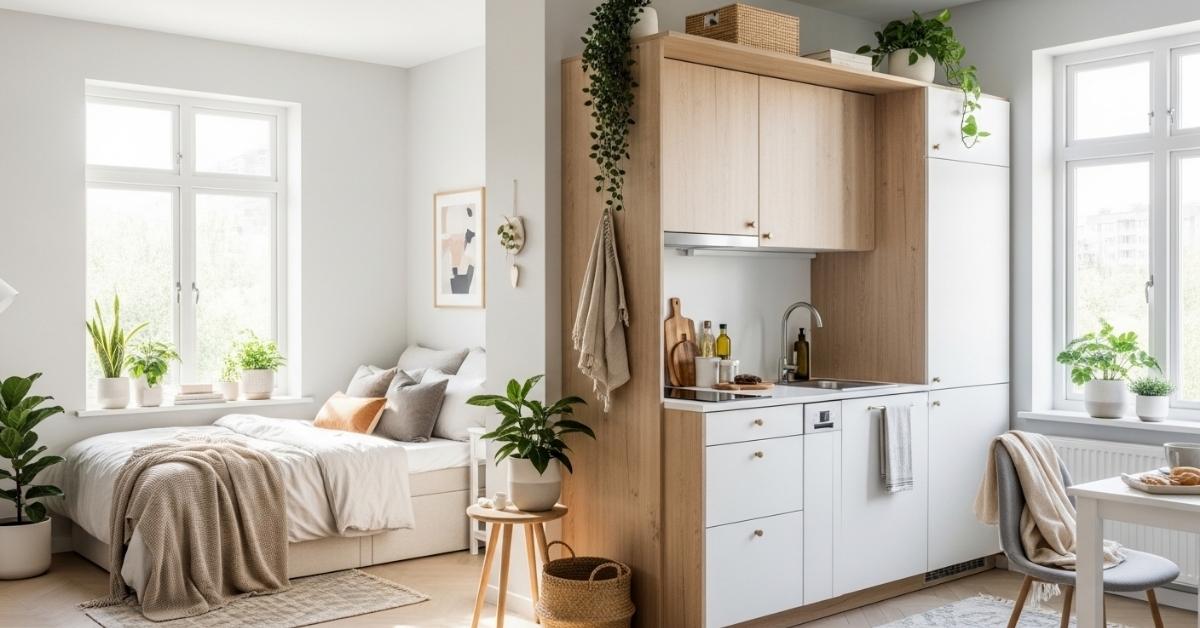
Somewhere between “it’s just temporary” and “I actually love it here” is the sweet spot most studio apartments never reach and usually, the gap has nothing to do with square footage.
Studio living has had a genuine rethink in 2026. More people are treating compact spaces as intentional rather than provisional, and the design world has caught up. The most compelling small spaces today Studio Apartment Ideas aren’t cramped compromises; they’re tightly edited, deliberately layered, and honestly better organized than most larger apartments.
If you’re working with a studio and every decision feels like a trade-off between function and personality, this list is for you. These ideas solve real layout problems: awkward sleeping zones, dead corners, poor lighting, no storage without requiring a gut renovation or a massive budget.
Build a Bed Nook With Curtains Instead of Walls

Dividing a studio doesn’t require drywall. A ceiling-mounted curtain track running parallel to one wall lets you section off the sleeping area using floor-length linen or cotton panels. During the day, pull them back and the room reads as one open space. At night, close them and you have a genuine sense of a separate bedroom. The visual weight of the fabric also adds texture to what might otherwise be a flat, bare room. This works especially well in studios where the bed is the first thing visible from the entry something most people find immediately uncomfortable. The curtain creates a soft visual buffer without blocking natural light when open.
Use a Sofa With a High Leg Clearance to Open Up the Floor
Furniture that sits directly on the floor or appears to visually compress a room. A sofa lifted on tapered or hairpin legs reveals a strip of floor beneath it, which reads as more open space to the eye even if the actual square footage is identical. Pair it with a slim coffee table that doesn’t block sightlines across the room. In a studio where the living and sleeping areas share one wall, that continuous visible floor line is what keeps the space from feeling sectioned into tight zones. This is one of the more underestimated tricks in compact layout design: the perception of space changes dramatically when the floor isn’t visually interrupted at every corner.
Float Your Desk Against a Window for a Natural Light Workstation

Placing a slim desk perpendicular to or directly beneath a window does two things at once: it gives you the best natural light in the apartment for screen work and reading, and it keeps the desk from consuming valuable wall space that would otherwise be used for storage or art. In a studio that doubles as a work-from-home setup, the challenge is making the desk feel like it belongs without visually taking over the living space. A window placement creates a natural boundary work happens there, rest happens elsewhere. The view also gives your eye somewhere to go during breaks, which matters more in a single-room setup than most people realize.
Add a Room Divider Bookcase to Create a Functional Zone Separation
A freestanding bookcase placed perpendicular to a wall not pushed against it creates two distinct zones while serving as active storage on both sides. One face becomes your living room’s display wall. The other faces the sleeping area and can hold books, a lamp, or a bedside setup on a lower shelf. The key is keeping it open or partially open so light still passes through a solid-back bookcase of the same size that would feel like a wall and shrink both zones. This setup is particularly useful in studios with a rectangular floor plan, where one long axis gives you room to run a divider without cutting the space too tightly.
Layer Three Light Sources Instead of Relying on One Overhead

The single overhead light is the biggest visual mistake in most studio apartments. It casts flat, even light across the entire room, which flattens depth and makes the space feel institutional rather than residential. Replacing or supplementing it with three sources: a floor lamp in one corner, a table lamp near the sofa or desk, and either under-cabinet or LED strip lighting near a shelf or TV console creates pools of warmth that section the room visually without any physical separation. In the evening, this layering makes a studio look notably more composed and settled. I’ve noticed this style of lighting tends to make even the smallest rooms photograph and feel significantly larger.
Mount Your TV on the Wall to Free Up Surface Space Below
A floor-standing TV unit in a studio takes up real estate at floor level where it competes with furniture sightlines and limits how you can arrange seating. Mounting the TV eliminates the stand entirely, and pairing it with a slim floating console at hip height gives you storage without visual weight. The wall behind becomes a feature; it can stay clean or hold a piece of art beside the screen. In studios with limited wall runs, this arrangement also frees up a full corner that can be used for a reading chair, plant shelf, or floor lamp.
Read More About : 21 Small Space Living Ideas That Actually Make Cramped Rooms Feel Bigger and Better
Use a Murphy Bed With an Integrated Desk for a True Multipurpose Wall

A murphy bed gets dismissed as a quirky throwback, but the newer configurations with a fold-down desk built into the face of the closed unit are genuinely practical for studio living. During the day, the bed is completely hidden and the desk is your workspace. At night, the desk folds up and the bed comes down in under a minute. The wall reads as a custom built-in rather than a fold-out mechanism. This is the right setup for anyone whose studio truly needs to serve as both a living space and a dedicated workspace throughout the day; the bed-and-desk combo means you’re not compromising either function. Go for this if your square footage is under 400 sq ft and work-from-home is a daily reality.
Place Your Bed Platform on Storage Drawers for Hidden Bedroom Organization
Dressers eat floor space in a studio in a way that’s hard to recover from because they’re wide, they require clearance for opening drawers, and they add visual bulk to what should be the most open part of the room. A platform bed with integrated storage drawers underneath solves this without adding any additional footprint. Pull-out drawers on the sides or front can hold folded clothing, extra bedding, or seasonal items that would otherwise require closet space. The bed sits slightly higher, which actually reads well in a studio; it gives the sleeping area a slight elevation that subtly differentiates it from the rest of the room.
Create a Dining Zone With a Fold-Down Wall Table

Dining in a studio is often an afterthought: a barstool at the kitchen counter, or meals on the coffee table. A wall-mounted fold-down table changes that without occupying permanent floor space. Folded flat against the wall, it’s nearly invisible. Open, it seats two comfortably and functions just as well for work, eating, or projects. Pair it with slim stools that tuck flush against the wall when not in use. This is especially practical in studios where the kitchen runs along one wall and there’s a strip of clear wall space beside or opposite it enough for a 90cm table without interrupting traffic flow through the main space.
Use a Round Dining Table to Improve Traffic Flow
Rectangular tables have corners that jut into traffic paths in tight spaces. A round table, even a small 60–70cm one removes those sharp edges and makes it significantly easier to move around the dining area. In a studio where the dining zone sits adjacent to the kitchen or living area, a round table also reduces the sense that the room is being divided into hard rectangular blocks. Visually, it reads as a softer anchor. Two chairs around it are all you need for daily use, and additional folding chairs can be stored nearby for when guests arrive.
Install Floating Shelves at Varying Heights to Replace a Bookcase

A single large bookcase is often too visually heavy for a studio wall; it draws attention in a way that can make the room feel smaller. Installing three to five floating shelves at staggered heights instead distributes the visual interest more evenly and allows the wall to breathe between them. You can style each shelf independently: one for books, one for plants, one for a lamp or framed art. This approach also works well around windows or doorframes, where a freestanding unit wouldn’t fit. The wall reads as curated rather than cluttered, which is difficult to achieve with a single large piece.
Anchor Your Living Area With a Large Area Rug
In a studio where the living, sleeping, and dining areas share one continuous floor, a large area rug is the simplest way to define where the living room begins and ends. The rug doesn’t need to be oversized, it needs to be large enough that the front legs of the sofa sit on it, which grounds the whole seating arrangement as one intentional zone. Without this, the furniture placement can feel arbitrary, like pieces pushed around without logic. A jute, wool, or low-pile rug in a neutral tone works well because it adds warmth and texture without competing with the rest of the room.
Hang Curtains at Ceiling Height to Elongate the Walls

Curtains hung at window-frame height make the window and the wall look shorter. Hanging them from the ceiling changes the entire proportion of the room. The eye follows the fabric from floor to ceiling, reads the room as taller, and the window itself appears significantly larger even if it hasn’t changed. In studios where windows are modest in size which is common in older urban apartments this is one of the most effective adjustments you can make for almost no cost. Use a simple track or rod at ceiling level and let floor-length panels hang loose.
Use a Console Table Behind the Sofa as a Room Divider
Positioning a slim console table directly behind the sofa creates a low visual barrier between the living and sleeping zones. The sofa faces the living area. The console faces the sleeping side and can hold a lamp, books, or a small plant functioning essentially as a narrow bedside surface. Because it’s low (console tables typically sit at 75–90cm), it doesn’t block sightlines across the room, so the space doesn’t feel subdivided. This is a particularly clean solution for studios where the bed and sofa share the same open room and there’s no natural architectural break between them.
Mirror a Wall to Double the Perceived Depth of the Room

A well-placed mirror in a studio does more than add light; it literally doubles the visible depth of the room by reflecting the space behind you. Leaning a large mirror against the wall opposite a window is the most effective placement: it bounces daylight back across the room and the reflection makes the room appear to extend further than it does. A mirror propped at a slight angle also avoids the flat, dead-wall effect of a perfectly hung piece. Avoid mirroring a wall that reflects clutter or a less-composed corner; the reflection becomes part of the room’s visual story.
Build Vertical Storage in a Narrow Entryway
Most studios have a short entry corridor or a front door that opens almost directly into the main room, with very little buffer space. A slim vertical shelving unit placed here one that goes up rather than out captures the full height of the wall for storage without consuming floor area. A hook rail at shoulder height handles bags and coats. Lower shelves handle shoes. Upper shelves handle items used less frequently. This entry setup also creates a subtle psychological transition between the door and the rest of the living space, which matters in a studio where that separation doesn’t exist architecturally.
Separate Sleeping and Living With a Canopy Frame Above the Bed

A canopy frame, particularly a slim metal one at standard bed height creates a visual “room within a room” around the sleeping area without any walls or curtains required. The frame alone is enough to signal that this zone is distinct from the rest of the apartment. Adding lightweight sheer panels that drape from the corners softens the look further. In a studio with high ceilings, this is especially effective because the vertical line of the frame draws the eye upward, creating a sense of architectural intention in what might otherwise feel like an open, undefined space.
Use Kitchen Pegboards for Vertical Tool Storage
Counter space in a studio kitchen is almost always limited, and the instinct is usually to add more shelving which ends up filled quickly and then cluttered. A pegboard mounted directly above or beside the cooking area keeps utensils, small pans, and tools off the counter entirely. The pegboard itself can be styled neatly or left utilitarian depending on the aesthetic of the rest of the apartment. Hooks can be repositioned as your needs change without putting new holes in the wall. This is one I’d actually recommend trying first if your kitchen lacks drawer depth; it takes about an hour to install and immediately clears a significant amount of surface clutter.
Read More About : 27 Nursery Decor Ideas That Make Small Spaces Feel Calm, Cozy, and Completely Thought-Through
Use a Daybed Instead of a Sofa for Flexible Seating and Sleeping

A daybed bridges the gap between sofa and bed in a way that a regular sofa can’t. Styled with a bolster cushion along the back and throw pillows at the sides, it reads convincingly as a seating piece during the day. At night, the pillows come off and it functions as a full bed. This is particularly useful in studio setups where the bed is positioned in the main living zone by necessity and you want it to blend visually rather than dominate. The key is choosing a daybed at sofa height, not something that sits too low to the ground so it visually matches the scale of the rest of the living area furniture.
Add a Freestanding Wardrobe With Sliding Doors to Maximize a Tight Bedroom Area
Standard hinged wardrobe doors require clearance in front of them, typically 60cm of empty floor space which is simply not available in many studio layouts. A freestanding wardrobe with sliding doors solves this by eliminating that clearance requirement entirely. The doors move laterally across the front of the unit rather than swinging out into the room. In a compact sleeping zone where every centimeter between the bed and the wall counts, this difference is significant. Choose a unit with a neutral or woodgrain finish that reads more like a built-in than a moveable piece; it helps the sleeping area feel more settled.
Create a Gallery Wall That Fills Dead Space Above Furniture

An empty wall in a studio often reads as unfinished rather than minimal. There’s a difference between intentional breathing room and space that just hasn’t been addressed. A gallery wall above the sofa or desk does multiple things at once: it fills the vertical space, draws the eye upward, and adds personality to what might otherwise be a plain surface. The arrangement doesn’t need to be symmetrical, mixing frame sizes and keeping a consistent mat or frame color pulls it together without looking rigid. This is one of the most budget-flexible improvements in a studio: a mix of printed art, postcards, and a couple of framed higher-quality pieces can look cohesive if the framing style is consistent.
Choose a Glass or Acrylic Coffee Table to Reduce Visual Bulk
Every piece of furniture in a studio occupies visual space, not just physical space. A solid wood or upholstered coffee table sits in the center of the room and reads as a substantial object. A glass or clear acrylic table of the same dimensions takes up almost no visual weight the eye passes through it to the floor below. In a studio living area where the coffee table sits in the most central and visible part of the room, this substitution makes the seating zone feel significantly more open without removing any function. The table is still usable, still defines the seating area, but stops competing with the rest of the room for attention.
Install Under-Bed LED Lighting for Ambient Warmth

LED strip lighting tucked beneath a platform bed frame casts a soft glow across the floor at night without requiring any overhead light at all. In a studio where the living and sleeping zones share space, having a dedicated low-light option for the sleeping side allows you to wind down without the whole apartment being lit. The light isn’t bright enough to read by its ambient, like nightlights with intent. It also gives the bed a slightly elevated, hotel-like quality that’s subtle but effective. Installation is straightforward: a strip light on a dimmer, adhered to the underside of the bed frame’s edge.
Use Tall Plants to Add Visual Height and Divide Zones Naturally
A single tall plant, a fiddle leaf fig, olive tree, or large snake plant placed at the edge of the living area works as a natural room divider without any structure at all. It adds vertical interest, draws the eye upward, and creates a soft boundary between zones. In a studio where you want the space to feel alive and layered without adding more furniture, a large plant does the job with almost no footprint. The key is choosing a plant that grows vertically rather than the wide you want height, not spread. Placed in a simple planter at floor level, a 150–180cm plant has a surprisingly significant presence in a small room.
Opt for a Bar Cart Instead of a Sideboard for Flexible Storage

A sideboard is a fixed piece once placed, it stays put and consumes a section of wall regardless of whether you need it there. A bar cart on casters moves. You can pull it to the table when entertaining, roll it to a corner when you need the space, or park it at the edge of the kitchen zone during the week. It also adds a lifestyle element to a studio that a storage cabinet wouldn’t be styled with a couple of bottles, glassware, and a small plant, it reads as intentional decor as much as functional storage. In a studio with limited wall runs, the flexibility to reposition furniture makes a genuine difference.
Use Neutral Colors as a Base and Add Warmth With Textiles
A studio painted in a single neutral warm white, soft greige, or pale stone gives every zone a visual continuity that makes the room feel larger than its individual parts. The color doesn’t stop the space from feeling personal: textiles do that work instead. A linen throw in terracotta, cushions in a muted rust or olive, and a wool rug in oat or cream layer warmth onto the neutral backdrop without adding visual complexity. This approach also makes it easier to update the room over time, change the textiles and the entire character of the space shifts without repainting or replacing furniture.
Use Mirrored Cabinet Doors in the Bedroom Zone for Dual Function

Mirrored wardrobe doors in a studio sleeping area serve two functions simultaneously: they reflect light across the room, which is particularly valuable in studios with north-facing windows or limited natural light, and they provide a full-length mirror that would otherwise need its own dedicated wall space. The reflection also creates the impression of a slightly wider room; the sleeping zone appears to extend beyond its actual boundary. Choose doors with slim frames rather than frameless panels if you want the look to feel more fitted and less contractor-standard.
What Actually Makes These Ideas Work
Most studio advice focuses on individual furniture choices, but the real gains come from understanding how a few underlying principles operate together.
Zone logic comes before furniture selection.
Before choosing a sofa or a bed frame, map out where each function lives sleeping, working, eating, lounging. These zones should be physically separated where possible (even by 60–90cm), and each zone should have its own light source. A studio that’s laid out with intentional zones reads as more spacious than one where everything is pushed to the walls.
Vertical space is almost always underused.
Most studio residents arrange furniture at floor level and leave the upper half of the walls untouched. Floating shelves, ceiling-height curtains, tall plants, and wall-mounted storage all shift attention upward, making the room feel taller and giving the eye more surface area to process. This visual expansion is free and doesn’t require more square footage.
Dual-function furniture only works when both functions are actually usable.
A Murphy bed that takes 20 minutes to set up doesn’t get used as a bed, it stays closed and the studio loses its sleeping zone. A fold-down table that catches on a wall handle gets left folded and abandoned. When choosing dual-function pieces, test the mechanism in person if possible, and choose designs that transition easily.
Light management is more important than paint color.
Painting a room white helps, but adding warm layered light sources has a greater impact on how the space feels at different times of day. A studio lit only by overhead fluorescent light looks institutional at 8pm regardless of its wall color. Three warm light sources make almost any space feel intentionally designed.
Studio Apartment Setup Comparison Table
| Setup | Best For | Space Type | Problem It Solves | Difficulty |
| Curtain room divider | Renters | Any size studio | Sleeping zone privacy | Easy |
| Murphy bed + desk wall | WFH residents | Under 400 sq ft | No dedicated workspace | Moderate |
| Platform bed with drawers | Anyone needing storage | Small sleeping zones | Dresser footprint | Easy |
| Floating shelf arrangement | Minimalists | Any size | Bookcase visual weight | Easy |
| Daybed setup | Social spaces | Main room layouts | Bed dominates living area | Easy |
| Bookcase room divider | Larger studios | 450+ sq ft | Zone separation | Easy |
| Fold-down dining table | Limited dining area | Compact kitchens | No dedicated dining spot | Moderate |
| Ceiling-height curtains | Any budget | Any size | Short-feeling windows | Easy |
Common Studio Layout Mistakes That Make the Space Feel Smaller
Pushing everything against the walls.
This is the most instinctive arrangement in a small space and often the most counterproductive. Floating furniture, particularly a sofa pulled 30–40cm away from the wall creates a more intentional floor plan and makes the room feel designed rather than merely filled.
Using too many different wood tones and metal finishes.
A studio where every furniture piece has a slightly different finish reads as accidental. Choosing one dominant wood tone (light oak, walnut, or painted) and one metal finish (black, brass, or brushed silver) and applying it consistently across pieces creates cohesion without requiring matching sets.
Ignoring the entry point.
The moment someone enters a studio, they see the full room. If there’s no visual separation, no shelf, rug, or furniture arrangement that reads as an entry zone the whole space feels exposed and unstructured. Even a simple rug inside the door, a coat hook, and a small bench changes how the apartment reads from the first step inside.
Under-lighting the sleeping area.
Studios often have one main floor lamp positioned near the sofa and no dedicated light in the sleeping zone. This makes the sleeping area feel like an afterthought. A bedside lamp or sconce mounted to the wall creates the sense that the sleeping zone was planned, not just placed.
Choosing a sofa that’s too large for the space.
A three-seater sofa in a 35 sq m studio dominates the room in a way that limits almost every other layout decision. A loveseat or two-seat sofa, or an L-shaped sectional only if the proportions allow it, gives you the seating function without commanding the room.
FAQ’s
What is the best way to divide a studio apartment into separate zones?
The most practical approach is using a combination of rugs, furniture placement, and soft dividers rather than any single element. A large rug anchors the living zone, a console table or bookcase perpendicular to a wall creates a visual break, and ceiling-mounted curtains section off the sleeping area. These three together define distinct spaces without permanent alteration.
How do I make my studio apartment feel bigger without renovating?
Focus on three areas: lighting, furniture height, and vertical space. Add layered warm light sources, choose furniture on legs rather than solid bases, and install floating shelves or hang curtains at ceiling height. These changes don’t require structural work and have a notable effect on how spacious the room feels.
Is a murphy bed actually practical for everyday living?
It depends entirely on the quality of the mechanism and whether both functions: bed and desk or sofa are genuinely easy to switch between. Modern murphy bed units with integrated desks or sofas work well when the transition takes under a minute and the hardware is smooth. For studios under 400 sq ft where you work from home, a murphy bed with a built-in desk is one of the highest-value investments available.
How do I separate work and sleep in a studio apartment?
Physical separation works better than willpower. Position the desk near a window away from the bed, use a curtain or bookcase to create a visual break between zones, and choose a dedicated lamp for the desk so you’re not using the same lighting for both activities. Even a 90cm gap between the desk chair and the bed makes a psychological difference.
What furniture should I avoid in a studio apartment?
Bulky upholstered sofas, solid-base coffee tables, floor-standing TV units, and dressers are the main culprits that consume disproportionate floor and visual space. Pieces with visible legs, glass or acrylic surfaces, and wall-mounted alternatives to floor-standing storage are generally better choices for compact layouts.
Does painting a studio white actually make it look bigger?
Light neutral tones, warm whites, greige, pale stone do help by reflecting more light and creating visual continuity across zones. But the effect is smaller than most people expect compared to improving the lighting itself. A studio with layered warm light sources and medium-tone walls often feels more spacious than one with brilliant white walls and harsh overhead lighting.
How do I style a studio apartment on a low budget?
Prioritize changes with the highest visual impact per dollar: ceiling-height curtains, a large area rug, layered lamps, and floating shelves. These four elements account for most of the visual difference between a styled studio and an unstyled one. Furniture can be updated gradually, the light and textiles tend to have the biggest immediate effect.
Conclusion
The most functional studio apartments aren’t the ones with the most clever storage; they’re the ones where every zone has been considered, the light has been layered properly, and the furniture has been chosen for both scale and flexibility. You don’t need to address all of that at once. Even fixing the lighting alone, or adding a room-dividing bookcase, can change how the entire space reads and feels to live in.
Start with one or two ideas that match your current biggest frustration whether that’s a cluttered entry, an undefined sleeping zone, or a living area that feels cramped. Try one change, live with it for a week, and build from there. The key is finding what works for your specific layout, not replicating a setup designed for a different floor plan entirely.
