

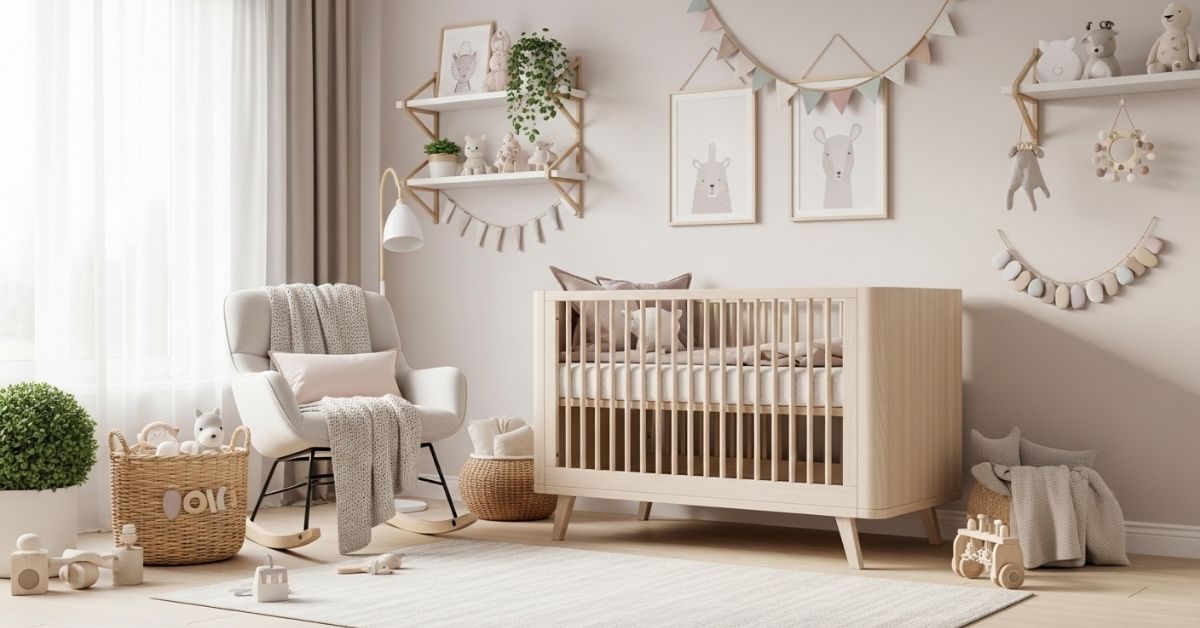
There’s something different about decorating a nursery. Unlike any other room, it has to work on two levels at once: soft and sensory for a newborn, practical and durable for a tired parent at 3 a.m. Getting that balance right isn’t about picking the cutest theme. It’s about making smart decisions with your layout, Nursery Decor Ideas lighting, and storage before you touch a single paint swatch.
If you’re working with a compact bedroom or a converted space that wasn’t originally designed as a nursery, the challenge is real. You need a crib, a changing station, somewhere to sit, somewhere to store, and you need it all to feel calm rather than cramped. That’s a design problem and a solvable one.
The ideas below cover everything from wall treatments and lighting layers to furniture placement and storage logic. Whether you’re going minimal, natural, or a little more playful, these setups are grounded in real-room constraints.
A Soft Neutral Crib Corner with Layered Warm Lighting

When the crib sits flush against one wall with a rattan floor lamp angled behind it and a linen Roman shade filtering light from the window beside it, the corner stops feeling like a corner and starts feeling like a designated zone. The key is layering two light sources: an overhead dimmer for late-night feeds and a warm-toned lamp for ambiance so the room isn’t relying on one harsh ceiling light to do everything.
This setup works especially well in rectangular rooms where the crib placement is limited to one end. In my experience, pushing the crib fully into the corner (rather than centering it on the wall) opens up more floor space and creates a more intentional visual anchor. The light layering solves one of the most common nursery problems: a room that’s either too bright for sleep or too dim for safety.
Floor-to-Ceiling Bookshelf as the Statement Wall
A tall, narrow bookshelf unit Billy-style or custom running from floor to ceiling turns a blank wall into the room’s focal point while adding serious storage. Style the upper shelves with books spine-out and small woven baskets; keep the lower two shelves accessible for board books and soft toys. The verticality draws the eye up, which creates the illusion of height even in rooms with low or standard ceilings.
This layout is particularly useful in square rooms that lack a natural focal point. The shelf functions as both décor and organization; you’re not adding something decorative and then hunting for storage separately. A few small framed prints tucked between baskets on the upper shelves add texture without crowding the wall.
A Neutral Gallery Wall That Grows With Your Child

Gallery walls in nurseries tend to fall into one of two camps: overly themed (all elephants, all safari) or so neutral they read as an afterthought. The version that actually works mixes frame sizes asymmetrically, uses three to four print styles (watercolor, simple line art, a typography piece), and keeps the color palette to two or three soft tones throughout.
Go for this if you want something that won’t feel dated by the time your child is two. Avoiding character-driven or heavily themed prints means you can swap one or two frames as the room evolves without having to rethink the whole wall. Honestly, the arrangement matters more than the prints themselves cluster frames with no more than two inches between them, and the grouping reads as intentional rather than random.
The Dresser-as-Changing-Table Setup
Using a wide dresser as your changing station instead of buying a dedicated changing table is one of the most practical decisions you can make in a small nursery. A dresser with a secured changing pad on top gives you storage below, a surface for a small lamp and a framed print above, and a piece of furniture that stays functional well past the diaper stage.
This works in any nursery under 10 by 10 feet where a dedicated changing table would eat too much floor space. The dresser stays. The changing pad comes off when the time is right. You’re not buying a piece of furniture that has a one-year useful life.
Soft Arch Wallpaper as a Crib Backdrop

An arch-shaped wallpaper panel applied directly to the wall behind the crib rather than across the whole room frames the crib without overwhelming a small space. The arch creates a visual headboard effect and gives the crib area a sense of intentional composition. Sage green, dusty terracotta, and soft ochre are the colors showing up most in 2026 nursery design, and all three work especially well behind white or natural wood cribs.
This is a renter-friendly approach if you use peel-and-stick wallpaper in a geometric panel shape. The effect reads custom even when it isn’t.
A Reading Nook with a Low Floor Chair and Wall-Mounted Light
A low floor chair, not an armchair, not a glider positioned at the corner of the room with a wall-mounted swing arm lamp directly above it creates a compact reading and feeding setup that doesn’t require the floor space a traditional glider takes up. A small rattan side table beside it holds a water bottle, burp cloth, and a book. A woven circular rug underneath grounds the zone.
This is one I’d actually recommend trying first because it solves two problems at once: the room gets a dedicated quiet corner, and you’re not sacrificing square footage to a piece of furniture that only gets used while the baby is small. Wall-mounted lighting is the detail that makes the setup functional rather than just aesthetic.
Cloud-Shaped Pegboard for Diaper Organization

A cloud-shaped pegboard mounted above the changing area keeps diapers, wipes, creams, and a small changing mat cover all within arm’s reach without occupying dresser space. Hook-style baskets hold diapers by size; small shelves on the board hold wipes and a small succulent or spray bottle.
What this solves is the specific annoyance of a changing station where everything you need is in a drawer, which means one hand holding the baby and one hand rummaging. The vertical pegboard puts every supply at eye level.
Read More About : 27 Home Office Decor Ideas That Actually Make You Want to Work From Home
Sheer Curtain Panels for Soft Natural Light
Sheer linen or cotton curtain panels hung close to the ceiling rather than at window frame height diffuse afternoon light into something warm and even, which is easier on a newborn’s eyes and more flattering on soft wall colors. The length creates the visual impression of taller walls.
This setup works in east- or west-facing nurseries where afternoon sun can get harsh. Pair sheers with a blackout roller blind on the same window for a two-layer system: filtered light during the day, total darkness for naps.
A Crib Canopy with a Simple Wooden Hoop

A wooden hoop canopy suspended above the crib two to three meters of sheer fabric knotted over a 30cm ring, ceiling hook above is the fastest way to add a sense of enclosure and warmth to a plain crib without any built-in architectural detail. It reads softer than a traditional canopy frame and takes ten minutes to put up.
This is primarily visual rather than functional, but it does help define the crib as its own zone in an open room. Go for this if your ceiling is blank and you want something that feels considered without adding more furniture.
Floating Shelves with Intentional Negative Space
Three staggered floating shelves not six, not one at different heights on a blank wall create visual rhythm without clutter. The trick is restraint: one basket per shelf, one small plant, one framed print. The negative space between items is part of the composition.
This is the setup that tends to look best in photos, but also one that requires the most discipline. Resist the temptation to fill every shelf surface. If something doesn’t have a specific purpose, it probably doesn’t belong on the shelf.
A Minimal Mobile That Actually Enhances Visual Tracking

High-contrast mobile black and white geometric shapes rather than pastel felt animals are more visually engaging for newborns, who see contrast before they see color. They also tend to photograph better and look less busy against a neutral nursery ceiling.
Hang the mobile so the lowest point is about 30 cm above the mattress surface. Once your baby is pushing up on their arms (around four months), the mobile comes down so don’t invest heavily in something that has a 16-week window.
Wainscoting or a Painted Lower Panel Instead of Full Wallpaper
Painting just the lower third of the nursery wall in a soft sage, warm white, or dusty clay with the upper two-thirds in white creates a two-tone effect that’s cheaper than wallpaper, easier to change, and surprisingly sophisticated. A simple chair rail (painted or applied) at the color break point makes the division look intentional.
This is particularly effective in rooms with low natural light because the dark lower panel visually grounds the room without making it feel closed in. I’ve noticed this style tends to work better in rooms with white or very light furniture. The contrast between the wall panel and the furniture creates the composition.
Under-Crib Storage with Fabric Bins

Most cribs have 20 to 30cm of clearance underneath enough for flat fabric bins holding extra sheets, seasonal clothes, and swaddles. A few square fabric bins, matching the room’s palette, keep overflow storage out of sight while keeping the room clutter-free.
This is specifically useful in studio apartments or small rooms where there’s no closet dedicated to the nursery. The under-crib storage functions as a second dresser without taking up wall space.
A Mounted Star or Cloud Night Light at Low Level
A low-mounted wall night light star or moon-shaped, with a warm amber bulb rather than white gives enough visibility for a feed or a check-in without flooding the room with light that disrupts sleep cycles. Mount it at adult waist height rather than standard switch height.
The warm amber tone matters more than the design of the fixture. Cool or bright white night lights are disruptive to melatonin production for both parent and baby. This is one of those small decisions that makes a measurable difference at 2 a.m.
A Nature-Inspired Mobile Using Dried Botanicals

A DIY or handmade mobile using dried cotton branches, eucalyptus stems, or preserved leaves on a wooden dowel is both more visually distinctive and more durable than most store-bought options. The texture creates movement even in still air, and the muted organic tones work in almost any neutral nursery palette.
Because it’s non-functional as a visual tracking tool (older babies need bright contrast), treat this as a décor element positioned higher than the crib. It works best hung in the reading corner or near a window where it catches natural light.
A Gender-Neutral Color Palette Built Around Earth Tones
Building a nursery palette around warm earth tones terracotta, warm white, sand, and clay creates a room that reads as current in 2026 without committing to any specific theme. Earth tones work across furniture styles (mid-century, Scandinavian, organic modern) and photograph well in natural light.
The advantage beyond aesthetics is longevity. A room in sage green, natural wood, and cream works as a toddler room with minor additions. You’re not repainting in two years.
Tension Rod Curtain Divider for Nursery-in-a-Shared-Room

If the nursery is a corner of a shared bedroom or studio, a ceiling-mounted tension rod with a floor-length linen panel creates visual separation without a permanent wall. The curtain is drawn during naps and sleep, open during the day. It’s not soundproof but the visual signal of separation helps the brain register the two zones as distinct spaces.
Go for a curtain in the same color family as your bedroom walls so the division feels cohesive rather than partitioned.
An Accent Rug to Define the Feeding Corner
A round jute or wool rug under the feeding chair and side table defines the zone without needing any additional furniture or visual indicators. It grounds the seating area and makes the room feel spatially organized even when you’re standing at the door looking in.
Round works better than rectangular in most nursery corners because it doesn’t conflict with the angular lines of the crib and dresser. A diameter of 120 to 150cm is usually right for a standard floor chair plus side table setup.
Peel-and-Stick Mural Behind the Crib for Renters

Peel-and-stick murals have genuinely improved in quality over the last few years. The current generation uses matte finishes that don’t reflect light, and the adhesive is stable enough to last the full length of a typical tenancy. A soft forest or botanical mural behind the crib creates a backdrop that functions like an architectural feature.
Measure the wall carefully and order 20% extra. Apply panel by panel from the center out, and don’t rush the alignment on the first two panels that’s where most application errors happen.
Woven Basket Collection as Open Toy Storage
A collection of woven seagrass or rattan baskets in three sizes, the same material on the floor beside the bookshelf creates open storage that’s functional from infancy (folded blankets, extra diapers) through toddlerhood (soft toys, blocks). No lid required; the texture reads as décor even when the baskets are in active use.
The “collection” matters more than any individual basket. Three baskets of the same material in varying sizes read as curated. One basket looks like an overflow.
Soft Rope Wall Art Above the Crib

A medium-scale macramé or knotted rope wall hanging so its bottom edge is at least 50cm above the crib rail adds texture without color and reads well in both minimal and natural-style nurseries. The fiber absorbs sound slightly, which is a minor but real acoustic benefit in hard-surfaced rooms.
Scale is the variable that makes or breaks this. A piece that’s too small for the wall looks like an afterthought. Width should be roughly half the width of the crib it hangs above.
Read More About : 24 Kids Room Ideas That Actually Work in Real Homes (Without the Chaos)
A Printed Name Sign with Shadow or Layered Effect
A laser-cut wooden name sign with enough wall clearance to cast a shadow creates depth and dimension that a flat printed sign doesn’t. The shadow effect requires about 2cm of standoff mounting small adhesive bumpers or a thin wooden frame behind the letters works.
This functions best as a single wall element, not competing with a gallery wall or heavy textile. Give it its own dedicated wall space.
Blackout Liner Behind Linen Drapes for Sleep Quality

Hanging a basic blackout liner behind a linen or cotton drape gives you two environments in one window: soft filtered light during waking hours, complete darkness for nap time. The linen drape in front keeps the window looking intentional; the liner behind it does the functional work.
The mistake most people make is mounting the blackout curtain at the window frame. Mount it at ceiling height or as close as possible and ensure it overlaps the wall on both sides by at least 8cm. Light leaks at the edges completely undermine the blackout effect.
A Pegboard Command Center for Parents Above the Changing Area
A standard rectangular pegboard painted the same color as the wall to feel built-in above the changing station holds diapers, wipes, a small whiteboard for feeding tracking, a hook for the baby carrier, and a spare onesie rolled into a bin. It’s a command center for the part of the room that gets the most daily use.
The visual camouflage of painting the pegboard to match the wall is underused. It reads as intentional storage architecture rather than a hardware-store solution.
A Linen Canopy Above the Reading Chair

A ceiling hook above the feeding chair with a length of natural linen gathered and draped over it creates a loose overhead canopy that makes the chair feel like a defined space within the room. It’s a softer, more casual version of a baldachin and works in rooms where a full crib canopy feels like too much.
This is especially effective in open-plan spaces or nurseries that open into a hallway, where defining zones through soft overhead elements makes the layout feel more intentional.
A Cactus or Trailing Plant for Texture at Low Risk
A small trailing pothos or hardy succulent adds organic texture to the dresser or floating shelf without any allergen concern, assuming the pot is well-drained and not positioned where a toddler can reach it. Plants introduce a matte, irregular texture that softens the visual effect of hard furniture surfaces.
The low-risk plant list for nurseries includes pothos, spider plants, and most succulents. Avoid anything with milky sap (ficus varieties) and anything with sharp edges or toxic properties at child height.
Dimmable Overhead Light with a Warm Bulb Temperature

The single most impactful change in a nursery’s functional lighting is replacing a standard ceiling fixture with a dimmable pendant or semi-flush mount paired with a 2700K bulb. The 2700K temperature reads as warm candlelight at low settings, calm and non-stimulating and is bright enough at full to see clearly during daytime care.
Dimmer compatibility requires both a dimmer switch and a compatible LED bulb. Check both before buying. A non-compatible combination hums or flickers not what you want in a sleep environment.
What Actually Makes These Ideas Work
How to Design Your Nursery Layout for Better Function and Less Chaos
Most nursery design problems come down to flow, not aesthetics. Before placing any furniture, map the three paths you’ll walk dozens of times a day: crib to changing station, changing station to storage, door to feeding chair. Each of those routes should be clear of furniture legs, open drawer paths, and trip hazards in low light.
The crib goes on the interior wall not under a window (temperature fluctuation), not adjacent to an exterior wall in cold climates (condensation risk), and not directly beside a heating or AC vent. Once the crib position is fixed, everything else builds around it.
The changing station should be within arm’s reach of its own dedicated storage. If you’re walking three steps to get a diaper at 3 a.m., the setup isn’t working. A wall-mounted pegboard or a small mounted shelf directly above the changing surface solves this without expanding the footprint.
Feeding chair placement matters more than most people expect. It needs a surface beside it (for water, a phone, a burp cloth), a light source above it that can be dimmed, and enough clearance to get in and out without stepping around anything. In small rooms, a low floor chair frequently works better than a glider or rocking chair because it requires less clearance.
If the room is under 10 by 10 feet, keep all furniture against walls. Floating furniture works in larger rooms in small nurseries, it creates a bottleneck in the center of the room that’s difficult to navigate with a baby in your arms.
Nursery Decor Setup Comparison
| Setup | Best Room Size | Problem It Solves | Budget Level | Renter-Friendly |
| Dresser as changing table | Small (under 10×10) | Limited furniture budget + space | Mid | Yes |
| Floor-to-ceiling shelving | Any | Storage + focal point | Mid–High | No (wall anchors) |
| Peel-and-stick arch mural | Small–Medium | Blank wall behind crib | Low–Mid | Yes |
| Tension rod room divider | Studio/shared | Visual separation | Low | Yes |
| Layered curtains (blackout + linen) | Any | Sleep quality + aesthetics | Mid | Yes |
| Pegboard command station | Any | Changing area organization | Low | Yes |
| Low floor chair + wall lamp | Small | Feeding zone without large furniture | Mid | Yes |
| Earth-tone neutral palette | Any | Longevity, resale, versatility | Low (paint) | Partial |
FAQ’s
What is the safest wall color for a nursery?
Soft, muted tones with no VOC paint are the safest choice. Warm whites, sage greens, and pale terracotta are popular because they’re visually calm and compatible with natural light. Always use low-VOC or zero-VOC paint in any nursery standard paint off-gases for weeks after application, which is a real concern in a small, enclosed room.
How do I decorate a small nursery without making it feel crowded?
Choose multi-functional furniture first a dresser that doubles as a changing station, a crib with under-storage clearance. Keep furniture pushed against walls, limit décor to two or three intentional wall elements, and use vertical space (floating shelves, tall bookcases) instead of spreading items across the floor. Light colors on walls and a single large rug also help the room read as more open.
Glider vs. floor chair for a small nursery which is better?
A low floor chair wins in most rooms under 100 square feet. Gliders require clearance in front and behind, plus beside the arms, which quickly consumes a 10×10 room. A floor chair (like a bouclé cube or a low linen armchair) requires roughly half the clearance and reads better visually in minimal nurseries.
Do nursery themes make the room harder to update?
Yes, in most cases. Heavy character-driven themes (dinosaurs, safari, nautical) require coordinating replacement items if you want to evolve the room as your child grows. Neutral, nature-based, or color-blocked nurseries are significantly easier to update if you swap out a few textile items or prints rather than replacing bedding, wall art, and accessories simultaneously.
What lighting setup is best for nighttime feeds?
A two-layer system: a dimmable overhead (2700K bulb) at 10 to 20% brightness, plus a low-mounted warm amber night light at waist height. Avoid cool-white bulbs and overhead-only lighting. The goal is enough light to see clearly and safely, without bright light that signals daytime to a baby’s developing circadian system.
How high should floating shelves be in a nursery?
Keep the lowest shelf at least 150cm from the floor to prevent a curious toddler from accessing items on it. For display purposes only, shelves at 160 to 180cm read best visually and stay out of reach until school age. Anything lower functions better as accessible toy storage which is a different setup entirely.
Is peel-and-stick wallpaper really reliable enough for a nursery?
Current-generation peel-and-stick murals and wallpapers are significantly better than they were five years ago. Matte finishes, improved adhesive, and breathable backing mean most quality products hold well for two to three years without peeling or bubbling in normal humidity conditions. Avoid applying in very humid rooms or directly before a cold season when walls contract prime conditions for adhesion failure.
Conclusion
A well-designed nursery doesn’t come from buying more things, it comes from making smarter decisions about the things you do bring in. Layout, lighting, and functional storage do most of the work. Décor fills in the rest.
Not every idea here will suit your space or budget, but even picking two or three that directly address a problem you’re facing: poor lighting, limited storage, an empty wall that needs direction will make the room feel significantly more intentional. Start with the furniture placement, get the lighting right, then layer in the details.
