

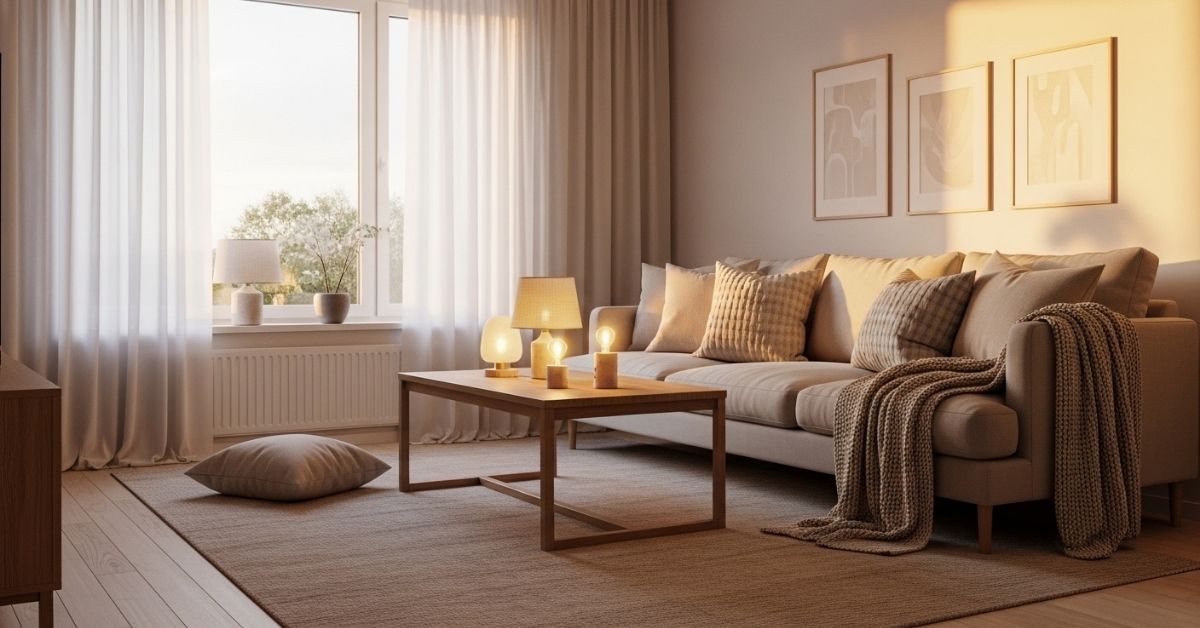
There’s a moment usually right after you’ve rearranged your furniture for the third time when you realize the layout isn’t the problem. The lighting is. Cozy living room lighting isn’t about adding more lamps; it’s about understanding how light layers, where it falls, and what it does to a room at 7pm when you’re finally sitting still.
If your living room feels a little flat, a little cold, or just never quite warm enough Cozy Living Room Lighting Ideas no matter what throw blankets you add, this is likely the issue. The good news: most of these fixes don’t require rewiring anything or spending a lot.
For anyone working with a small living room, a rented apartment, or a space that does double duty as an office and a lounge these ideas are built around real-world constraints, not editorial photo shoots.
A Floor Lamp Behind the Sofa to Break the Overhead Habit

Overhead lighting flattens a room. When you place a floor lamp, especially an arched or curved one directly behind one end of your sofa, the light pools over the seating area at eye level rather than washing everything from above. The result is a warmer, more contained glow that makes the sofa feel like the center of the room. This works especially well in rentals since you’re not touching the ceiling fixture at all. It solves the “bright but not cozy” problem almost immediately.
Layered Table Lamps at Uneven Heights for Depth
Matching lamp pairs on either side of a sofa is a classic look, but it can feel symmetrical to the point of being sterile. Instead, try placing two different-height lamps, one on a side table, one on a lower console or stacked books on the same side of the room. The contrast in height creates visual depth and makes the light feel more organic. In my experience, this setup works best when both lamps share the same bulb color temperature (2700K or lower) so the difference in height reads as intentional, not mismatched.
Warm Pendant Lighting Over a Seating Corner

A pendant lamp doesn’t have to hang over a dining table. Dropped low over an armchair around 5 to 5.5 feet from the floor it creates a dedicated reading or lounging zone that feels distinct from the rest of the room. This is especially useful in open-plan spaces where you want to visually anchor a corner without using a room divider. Choose a shade that directs light downward rather than diffusing it in all directions; a drum or cone shade in linen or rattan works well here.
Dimmable Recessed Lights Set to Low in the Evening
If you already have recessed lighting, a dimmer switch is one of the highest-ROI changes you can make to a living room. The mistake most people make is treating recessed lights as all-or-nothing. At full brightness, they’re efficient; at 20–30% brightness paired with a floor lamp, they become ambient fill rather than the main event. The room feels warmer without losing functional light. This approach works in any size space, but it’s particularly effective in larger rooms where a single lamp wouldn’t carry the whole room on its own.
LED Strip Lighting Behind the TV for Bias Lighting

Bias lighting the soft glow behind a TV reduces eye strain by adding ambient light around the screen, but it also does something interesting to a room: it adds a low, warm halo that makes the media area feel intentional and finished. Use a warm white strip (2700–3000K), not RGB color-changing. The goal isn’t a gaming setup; it’s a subtle backlight that reads as coziness rather than entertainment. This is a budget-friendly fix that costs under $20 and takes about 20 minutes to set up.
A Tripod Lamp in an Empty Corner to Fill Dead Space
Corners are where cozy living room lighting earns its keep. A tall tripod lamp pulls the eye toward vertical space, makes a corner feel occupied rather than neglected, and adds a warm pool of light that reflects off adjacent walls. The wooden or metal legs of a tripod also add a visual element on their own; they’re not just functional, they contribute to the room’s material story. Go for this setup if your room has an awkward dead corner that furniture can’t fill without blocking a pathway.
Candles Grouped in a Cluster for Low-Level Warmth

There’s no bulb on the market that replicates candlelight, and honestly, I’d recommend grouping real candles on a coffee table or hearth before reaching for any other lighting solution in the evening. Three pillar candles at staggered heights placed on a small tray so wax drips are contained create a flicker that no electric light can match. This solves the problem of a living room that looks “nice” in photos but feels flat in person. The movement of flame changes the room in a way that’s almost impossible to achieve with static lighting.
Sconces on Either Side of a Fireplace or Feature Wall
Wall sconces add lighting without taking up floor or surface space, which makes them ideal for smaller living rooms where every square foot counts. Positioned at about 60 inches from the floor and flanking a fireplace or a large piece of art, they create a symmetrical warmth that feels architectural rather than accessorized. For renters, plug-in sconces with a fabric cord are a good workaround; they require no wiring and can be dressed up with a matching hook or mounted plate for a cleaner look.
A Salt Lamp or Himalayan Glow Light as Ambient Accent

Salt lamps are often dismissed as wellness accessories, but from a pure lighting standpoint, the amber glow they emit sits at around 2200K warmer than almost any standard bulb. Placed on a side table or bookshelf, a large salt lamp functions as a secondary ambient source that adds warmth without any directional glare. It solves the problem of a room that needs “one more thing” to feel complete in the evening, without adding visual clutter during the day when it’s off.
Fairy Lights Draped Inside a Glass Vase for a Diffused Glow
This is a styling trick that’s simple to execute and surprisingly effective: fill a clear glass vase or jar with a battery-powered fairy light string, coiled loosely rather than packed tightly. The glass diffuses the light outward in all directions and creates a warm, glowing sculpture that functions as both decor and ambient lighting. It works especially well on a console table or bookshelf where you want a soft point of interest without a traditional lamp. Use warm white lights (not cool white) and keep the vase between 10 and 18 inches tall for the best proportions.
Read More About : 27 Minimalist Living Room Setup Ideas That Actually Work in Real Homes
Rattan or Woven Lamp Shades for Patterned Ambient Light

The shade matters as much as the bulb. A rattan or woven shade casts the most interesting ambient light in any living room; the gaps in the weave project a soft pattern onto the wall and ceiling, which adds texture to the room without any additional decor. This is especially effective in neutral or minimal rooms that feel a little bare. The light that spills through the weave shifts slightly depending on where you stand, which gives the room a sense of warmth and movement. It’s a functional piece that doubles as a material texture element.
Under-Sofa LED Strips for Floating Visual Effect
Mounting a warm LED strip along the underside of a sofa frame creates a floating effect that makes the furniture feel lighter visually the sofa appears to lift off the floor. More importantly, it adds a layer of ground-level lighting that you almost never get in a standard living room setup. This low-angle light is particularly flattering in the evening and makes the floor area feel larger. Use a warm white strip and avoid full-brightness settings; at 30–40% brightness, this is one of the most understated cozy lighting tricks available.
A Bedside-Style Table Lamp on a Low Coffee Table

If your living room is set up low on a platform sofa, floor cushions, or a sunken seating arrangement, a small lamp placed directly on the coffee table reads completely differently than it would on a side table. The light source sits at sitting-eye-level, which makes it feel much more intimate. Go for a lamp with a small base and a linen or cotton shade that diffuses light softly in all directions. This solves the issue of a room that feels too “tall” ceiling fixtures and high lamps can exaggerate vertical space in a way that works against coziness.
Warm Bulbs Throughout (2700K or Lower) for Color Consistency
This one isn’t glamorous, but it matters more than almost anything else on this list: color temperature consistency. If your floor lamp runs at 3000K and your table lamp runs at 4000K, the room will feel visually fragmented even if both lamps look fine on their own. Switching everything to 2700K or below including any smart bulbs creates a cohesive warmth that reads as intentional and cozy rather than assembled from different sources. It’s the kind of thing you don’t notice until you do it, and then you can’t un-notice it.
A Dimmer on Your Existing Floor Lamp Using a Plug-In Dimmer

Most floor lamps don’t come with a built-in dimmer, but inline plug-in dimmers are inexpensive and widely available; they sit between the plug and the outlet and let you adjust brightness manually. This is one of the easiest living room lighting upgrades that requires zero tools and zero permanent changes. The ability to dial your lamps down from full brightness to a warm low glow in the evening is what separates a living room that’s usable from one that actually feels cozy. Works best with incandescent or compatible LED bulbs.
Bookshelf Lighting With Small Puck Lights or LED Strips
A bookshelf lit from within reads completely differently from one that’s just visible under overhead lighting. Small battery-powered puck lights placed on each shelf or an LED strip run along the back of the shelves creates a warm display that makes the bookshelf feel like part of the room’s lighting design rather than just storage. This works especially well in rooms without a fireplace, where the bookshelf can become the visual anchor of the space. The books and objects become design elements rather than clutter when they’re warmly lit.
Statement Floor Lamp With an Oversized Drum Shade

In 2026, oversized drum shade lamps are having a clear moment and the reason is practical, not just aesthetic. A wide drum shade diffuses light over a much larger area than a standard shade, which means one lamp can light an entire seating zone without the harsh directionality of a spotlight. It makes the lamp feel generous rather than functional. The larger the shade, the softer the light. This is especially useful in rooms with high ceilings where smaller lamps tend to get “swallowed” by the vertical space and lose their coziness.
Low-Voltage Pendant Clusters Over a Coffee Table
The dining room concept of pendant lighting over a table translates remarkably well to the living room when done at the right scale. A cluster of two or three small pendants hung at varying heights around 36 to 40 inches above a coffee table creates an intimate overhead zone that feels deliberate and considered. Use exposed Edison or globe bulbs if you want the fixture to read as a design element, or go with small fabric-shaded pendants for something more understated. This setup works best in rooms with 9-foot ceilings or higher, where the pendants have room to hang without feeling claustrophobic.
Table Lamps on Bookshelves at Different Heights for Vertical Interest

Rather than using a bookshelf purely for storage, placing small table lamps on different shelves, one on the second shelf, one on the fourth creates layered vertical lighting that draws the eye up the wall and adds warmth at multiple levels simultaneously. This is a good solution for narrow living rooms where floor lamps take up too much walking space, or for renters who want flexible lighting without committing to wall fixtures. The lamps become part of the shelf styling rather than standalone pieces.
A Paper or Linen Lantern Pendant for Diffused Soft Light
Paper lanterns and linen-wrapped pendant globes are some of the most effective diffusers available and among the most affordable. A single oversized paper lantern (40–50cm diameter) hung in the center of a living room creates a soft, even glow that’s flattering to faces and materials alike. It’s a particularly useful solution in rooms where recessed lighting feels too harsh and a traditional chandelier feels too formal. This works well in Japandi-influenced spaces and minimalist rooms where the simplicity of the fixture is part of the aesthetic.
Smart Bulbs Set to a Warm “Evening” Scene for Effortless Mood

Smart bulbs earn their cost specifically in living rooms because the ability to shift color temperature and brightness throughout the day from a brighter, cooler 3000K in the morning to a warm 2200K in the evening changes how the room feels without physically touching anything. Set an “evening” or “cozy” scene that triggers automatically at 7pm, and your living room transitions from functional to relaxing without any effort on your part. The convenience factor is real, but the deeper value is that you’re no longer choosing between a room that’s bright enough to use and one that’s warm enough to relax in.
What Actually Makes Cozy Living Room Lighting Work
Cozy lighting isn’t about any single fixture, it’s about how light layers in a space. The most effective setups typically combine three types: ambient (general fill), accent (directed at objects or surfaces), and task (functional, like a reading lamp). When all three come from sources at different heights overhead, mid-level, and ground level the room feels dimensional rather than flat.
Color temperature is the other variable most people overlook. Warm light (2700K or below) reads as cozy because it mimics the golden hour light we’re biologically primed to find calming. Cool light (4000K and above) is energizing, useful in a home office, and counterproductive in a living room at 9pm.
The most common mistake is relying too heavily on a single overhead source. Even with a dimmer, a ceiling fixture alone will always make a room feel less intimate than a combination of floor lamps, table lamps, and accent lighting at a lower brightness.
Living Room Lighting Setup Comparison
| Lighting Setup | Works Best For | Space Type | Problem Solved | Approximate Cost |
| Arched floor lamp behind sofa | Apartments, rentals | Small to medium rooms | Harsh overhead lighting | $60–$200 |
| Layered table lamps at uneven heights | Minimal aesthetic rooms | Any size | Flat, one-dimensional light | $40–$150 per lamp |
| Pendant over seating corner | Open-plan spaces | Medium to large rooms | Undefined seating zones | $50–$250 |
| Dimmable recessed + supplemental lamps | Rooms with existing recessed lighting | Any size | All-or-nothing overhead light | $15–$40 for dimmer |
| LED strips behind TV | Media-focused rooms | Any size | Eye strain, dark media area | $15–$35 |
| Candle cluster on coffee table | Evening ambiance | Any size | Artificial, flat evening lighting | $20–$50 |
| Smart bulbs with warm evening scene | Tech-friendly households | Any size | Manually adjusting light daily | $40–$120 for starter kit |
How to Layer Cozy Lighting Without Overcrowding Your Living Room
The goal of layered lighting is depth, not quantity. Adding seven lamps to a room doesn’t make it cozier, it makes it cluttered with cords. Instead, start with two anchor sources: a floor lamp near the sofa and a table lamp on the opposite side of the room. These two points of warm light already create more dimension than a single overhead fixture at any brightness.
From there, add one accent layer bookshelf lighting, candles, or an LED strip behind the TV that adds visual interest without adding another freestanding piece. This three-layer approach (two anchor lamps plus one accent) works in almost any living room size.
One thing worth noting: the placement of your lamps relative to reflective surfaces matters. A lamp placed near a mirror or a glossy wall bounces light further into the room. A lamp placed in the corner of a dark-walled room absorbs more of that light. This is why identical lamps in different rooms can feel completely different. It’s not the lamp, it’s the surface behind it.
Finally, always evaluate your lighting from a seated position, not standing. The way a room feels when you’re sitting on the sofa is the metric that matters for cozy lighting, and it’s often very different from what you see when you walk in.
FAQ’s
What type of lighting makes a living room feel cozy?
Warm, low-level lighting in the 2700K or lower color temperature range creates the most cozy atmosphere in a living room. The key is layering multiple sources floor lamps, table lamps, and accent lights rather than relying on a single overhead fixture. This creates depth and warmth that a ceiling light alone can’t achieve.
How many lamps does a cozy living room need?
A good starting point is three to four light sources at different heights: one floor lamp, one or two table lamps, and one accent source like candles or bookshelf lighting. The number matters less than the placement sources at varying heights and positions create the layered effect that makes a room feel warm and dimensional.
Can I make a living room cozy with just floor lamps and no overhead lighting?
Yes, and honestly this is often the better setup for evenings. Turning off your overhead light entirely and using two or three warm floor and table lamps typically results in a much cozier atmosphere. The key is ensuring the lamps are warm-toned (2700K or below) and positioned to cover different areas of the room.
What’s the difference between warm white and soft white bulbs for a cozy living room?
Soft white bulbs typically fall around 2700–3000K and produce a warm, slightly yellow-toned light. Warm white is usually 3000K, which is slightly cooler. For cozy living room lighting, aim for 2700K or below, sometimes labeled “extra warm white” or “warm glow.” This range most closely mimics the golden, relaxed feel of candlelight or early evening sun.
Is LED lighting good for a cozy living room?
Yes, provided you choose the right color temperature. LED bulbs at 2700K or below are excellent for cozy living rooms; they’re energy-efficient, long-lasting, and come in dimmable versions. Avoid cool-white LEDs (4000K and above), which produce a blue-toned light that feels clinical rather than warm. Always check the Kelvin rating on the packaging, not just the wattage.
Read More About : 23 Living Room Wall Decor Above Couch Ideas That Actually Work in Real Homes
How do I make a small living room feel cozy with lighting?
In a small living room, avoid overhead lighting as your main source. It flattens the space and makes it feel like a functional room rather than a relaxing one. Instead, use one floor lamp behind or beside the sofa and a small table lamp on the opposite end. Keeping light sources below eye level (when seated) creates intimacy without making the room feel smaller.
Is a dimmer switch worth it for a living room?
Yes a dimmer switch is one of the highest-value lighting upgrades you can make for very little cost. Being able to reduce your main overhead or floor lamp to 20–30% brightness in the evening changes the entire character of the room. Many plug-in dimmers are available for under $15 and work without any electrical installation.
Conclusion
Good living room lighting isn’t about finding one perfect lamp, it’s about building a system of warm, layered light that you can adjust based on how the room is being used. A few thoughtful changes, swapping bulbs to a warmer color temperature, adding a floor lamp behind the sofa, or simply turning off your overhead light in the evening can make a more noticeable difference than rearranging furniture.
Start with one or two ideas that match your space, your budget, and your current setup. You don’t need to do all 21 things at once. Pick the fix that addresses your most specific problem whether that’s a corner that feels dead, a room that’s bright but not warm, or overhead lighting you rely on too much and build from there.
