

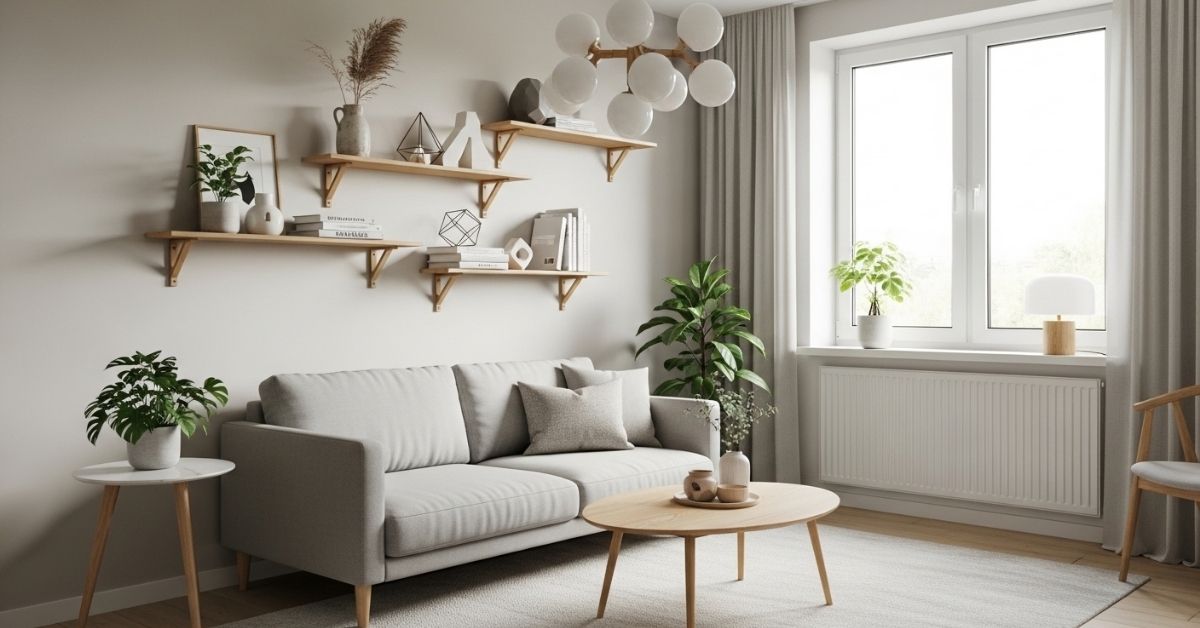
If your living room feels like it’s working against you furniture placed randomly, no real flow, and a layout that just doesn’t quite work you’re not imagining it. Small Living Room Layout Ideas Small living rooms have real spatial logic to them, and once you understand it, even a 10×12 room can feel deliberate and comfortable.
The ideas here aren’t about making a room look bigger in photos. They’re about making it function better for everyday life whether you’re dealing with an L-shaped sofa that blocks a doorway, a TV wall that’s too far from the seating, or a layout that leaves you dodging furniture just to sit down. If you’re working with a compact apartment or a multipurpose room that needs to do double duty, these setups are for you.
Float Your Sofa Away From the Wall

Pushing furniture against the walls feels logical in a small space, but it often creates a hollow, gymnasium effect furniture around the perimeter with an empty void in the middle. Pulling your sofa even 10–12 inches away from the wall creates a defined seating zone that reads as intentional. The space behind the sofa can hold a slim console table for lamps or a small plant, which adds depth without adding bulk. This layout works especially well in square rooms where you’re trying to create zones rather than one large unorganized space. The sofa essentially becomes a room divider that signals “this is the living area.”
Use a Rug to Anchor the Layout Before You Place Any Furniture
Most small living room layouts fail before the furniture is even moved in because there’s no clear anchor. Start with the rug. In a small room, an 8×10 rug works better than most people expect: it should sit under at least the front two legs of your sofa, with the coffee table fully on it. This creates a visual container that tells the eye where the room “lives.” Without it, even nice furniture reads as scattered. In an open-plan apartment where the living and dining areas blur together, a well-placed rug is the clearest way to define the boundary without adding a wall.
Put the TV on the Shorter Wall
This is one of those layout decisions that feels counterintuitive until you live it. In a narrow room, mounting the TV on the shorter wall and placing the sofa along the longer wall means you’re looking across the width of the room rather than its length. The result is a better viewing distance and a room that feels wider than it actually is. It also frees up more usable wall space on either side of the sofa for shelving, side tables, or a reading lamp setup. In my experience, this adjustment alone resolves about half the awkward layout complaints people have in narrow rooms.
Try a Loveseat + Two Chairs Instead of a Full Sofa

A standard three-seat sofa in a room under 200 square feet often leaves almost no walkway space and nothing left over for additional seating. A loveseat paired with two accent chairs gives you the same number of seats sometimes more with better flexibility. The chairs can be pulled closer for conversation or angled outward to open the space. This arrangement also lends itself well to a round coffee table in the center, which improves movement flow compared to a rectangular one with sharp corners. Go for this if you entertain occasionally but still want the room to feel open when it’s just you.
Build Vertical Storage Instead of Spreading Horizontally

Floor space is what’s limited in a small room wall height usually isn’t. A tall shelving unit (think: floor-to-ceiling, or close to it) does triple duty: storage, visual interest, and a way to draw the eye upward, which makes the ceiling feel higher. The key is keeping the lower sections more functional (bins, baskets, closed storage) and the upper sections lighter and more decorative so the shelving doesn’t feel heavy. This setup solves the clutter problem without needing more square footage, and it works particularly well in rental apartments where you can’t add built-ins freestanding bookcases achieve the same effect.
Place a Mirror Behind the Sofa to Expand the Sightline

The spatial mechanic here is straightforward: a large mirror hung directly opposite or adjacent to a window doubles the visible light and creates the illusion of a second room behind the wall. Position it behind the sofa centered, at sofa-back height or slightly higher and it reflects the room back toward you rather than a piece of furniture or a dark corner. A frameless or thin-framed mirror reads more expansive than a heavily decorated one in a small space. This is one of the most practical tools for a dark, narrow room that gets limited natural light.
Use a Bench or Ottoman as a Coffee Table
A traditional rectangular coffee table in a small room can turn a walkway into an obstacle course. Replacing it with a storage ottoman or a low upholstered bench solves two problems at once. You get a soft surface that doubles as extra seating when needed, and the rounded or upholstered edges don’t present the same traffic hazard as wooden corners. A tray on top keeps it functional as a surface for drinks or books. This is honestly one of the highest-value swaps in a compact living room, especially if the layout requires walking around the center of the room frequently.
Read More About: 27 Living Room Ideas That Actually Work in Real Homes (Not Just on Pinterest)
Create a Reading Corner With a Single Chair and Floor Lamp

A corner that isn’t doing anything not anchoring a seating arrangement, not holding a plant, not serving a function reads as wasted space and makes the whole room feel unfinished. A chair and a floor lamp solve this instantly. The arc lamp swings overhead without needing a surface, the chair defines a secondary zone within the room, and together they create a sense that the room has distinct areas rather than one undifferentiated blob of furniture. This setup is especially useful in open-layout apartments where you want to make the living area feel less like a waiting room.
Use a Sofa With Exposed Legs to Keep the Floor Visible
The amount of floor you can see in a room directly affects how spacious it feels not the actual square footage, but the visible square footage. A sofa with solid base panels that sit flush to the floor hides the ground and creates a visual wall of upholstery. A sofa with tapered or angled legs lets light travel underneath, revealing more floor and making the piece feel lighter. Combined with a low-profile silhouette, this choice can noticeably shift the room’s proportions without changing the layout at all.
Angle the Sofa in a Corner Layout for Odd-Shaped Rooms

Square rooms and perfectly rectangular rooms are the exception most small living rooms have at least one awkward feature: a door in an unexpected place, a window that interrupts the wall, or proportions that don’t lend themselves to straight-on furniture placement. Angling the sofa at 45 degrees in a corner creates a conversation-friendly setup and frees the center of the room for the coffee table and circulation space. It’s one of those layouts that feels wrong until you see it in person. I’ve noticed this style tends to work best in rooms between 130 and 160 square feet where a straight-on layout leaves one wall completely unused.
Add a Slim Console Table Behind the Sofa as a Divider
In a studio or open-plan apartment, the back of the sofa is often what you see when you walk in which means an unfinished, flat surface reads as the room’s “face.” A slim console table (10–12 inches deep) slipped directly behind the sofa does two things: it gives the sofa a finished backing that anchors it in the room, and it creates a soft divider between the living zone and whatever is behind it a dining area, kitchen, or entryway. Add a lamp and a plant, and suddenly that awkward in-between space has a clear identity.
Position Seating Facing the View, Not the TV

Not every living room layout should be organized around the television and for small rooms with a genuinely good window, orienting the seating toward that view (with the TV on an adjacent wall) creates a more open, breathable feeling. You’re seated looking out rather than facing inward toward a screen, and the natural light fills the room from the front rather than silhouetting the furniture. The TV can still be viewed comfortably by slightly angling chairs, or adding a swivel mount that adjusts position when needed.
Use Nesting Tables Instead of a Bulky Coffee Table
Nesting tables two or three small tables that slide under one another when not in use are one of the most practical furniture solutions for tight spaces. When guests arrive, pull them out for drinks. When you need floor space for a workout, yoga mat, or just to move around, stack them together and push to the side. They take up roughly the footprint of one end table when nested, but can cover the function of a full coffee table when expanded. The payoff is proportional to how often you need to reconfigure your space, which makes this especially relevant for multipurpose rooms.
Paint the Walls and Ceiling the Same Color

This is one of those 2026 interior design shifts worth taking seriously: treating the ceiling as a continuation of the wall same color, no distinction removes the visual “lid” effect that makes low-ceilinged rooms feel compressed. The room reads as a single envelope rather than a box, and with a warm neutral (think: linen, warm white, pale greige), the effect is cozy rather than clinical. It’s most effective in rooms where the ceiling is under nine feet and feels noticeably low relative to the floor plan.
Add an Accent Chair in a Contrasting Material to Break Monotony
A room furnished entirely in one material or texture tends to read as flat everything blends into itself and there’s nothing for the eye to land on. A single accent chair in a contrasting material (rattan against linen, velvet against cotton, leather against wool) introduces enough visual tension to make the room feel considered. This is a detail-level decision that doesn’t change the layout at all, but it makes a significant difference in how the room reads as a whole. Keep it to one contrast rather than several the goal is a focal point, not a patchwork.
Place Lighting at Multiple Heights to Layer the Room

Rooms that rely solely on overhead lighting especially recessed or central ceiling fixtures tend to feel flat and institutional after dark. Layering light means having at least three light sources at different heights: something overhead, something at standing height (floor lamp), and something lower (table lamp or sconce). In a small room, this creates depth and zones even when the floor plan is compact. The reading corner gets its arc lamp, the sofa gets a side table lamp, and the overhead provides ambient fill. Together they make the room feel larger at night than a single strong overhead light ever would.
Use Curtains Hung Close to the Ceiling to Elongate the Walls
Curtain placement is one of the most consistently underused layout tools in small rooms. Hanging curtain rods at ceiling height rather than directly above the window frame and letting the fabric fall to the floor makes the wall feel taller and the window appear larger than it actually is. In a room with 8-foot ceilings, this can add several inches of perceived height. Use a lightweight, semi-sheer fabric to preserve daylight, or linen for a warmer feel. The visual effect is most pronounced when the curtains are the same tone as the wall same family, slightly different texture.
Create a Gallery Wall on a Single Narrow Wall to Add Depth

A blank wall in a small living room doesn’t read as minimalist it reads as unfinished. But overcrowding every wall creates visual noise. Pick one wall ideally a narrower one or the one you face from the sofa and treat it as the room’s focal point with a gallery arrangement. Keeping frames in a cohesive finish (all black, all wood, all white) while varying sizes creates visual interest without chaos. The spatial effect is that the wall recedes and the room reads deeper, because your eye travels across the arrangement rather than stopping at a flat surface.
Replace Overhead Lighting With a Statement Pendant Over the Seating Area
A statement pendant positioned above the coffee table does something a ceiling fixture can’t: it defines the seating area from above, creating a canopy effect that makes the grouping feel intimate and intentional. In a small room, this also pulls the eye downward rather than across the room, which is useful if the room has proportional or architectural issues you’d rather not emphasize. Size matters here a pendant that’s too small in a small room reads as an afterthought. Go slightly larger than feels comfortable; it usually looks right in person.
Use a Sectional Strategically to Define the Room’s Shape
A sectional in a small room sounds like too much furniture but an L-shape placed in a corner actually works efficiently because it uses corner space that a straight sofa ignores. The L creates its own sense of enclosure, giving the seating area a defined boundary on two sides. This is useful in studio apartments where the living area needs to feel contained rather than bleeding into the rest of the space. Keep the sectional low-profile and choose a color that’s close to the wall or floor tone so it doesn’t dominate the room visually.

Add a Single Large Plant to Anchor an Unused Corner

A corner without furniture or a specific function is almost always the room’s weakest spot it draws attention to itself by doing nothing. A tall, structured plant (fiddle leaf fig, bird of paradise, olive tree, or similar) in a simple planter fills that vertical space without adding visual weight the way furniture would. It also softens the geometry of the corner two flat walls meeting at a right angle is one of the more visually harsh features of any room, and a plant interrupts that line in a way that feels natural rather than decorative. Place a floor lamp nearby and the corner becomes a proper vignette.
What Actually Makes These Layouts Work
Small living room design comes down to a few consistent principles that the best layouts share. The first is traffic flow: before considering anything else, trace the paths you walk daily from the sofa to the kitchen, from the entryway to the bathroom, from the TV to the coffee table. Any layout that interrupts those paths more than once will feel cramped regardless of the actual square footage.
The second is visual weight. Not every piece of furniture should be the same visual mass. Anchor pieces (sofa, media console) should be heavier; surrounding pieces (side tables, chairs, lamps) should be lighter. This creates hierarchy and prevents the room from reading as equally dense everywhere.
The third is ceiling perception. In rooms under nine feet, anything that draws the eye down low furniture, low art, low lamps compresses the space. Vertically placed items (tall shelving, high curtains, tall plants) restore the sense of height.
Finally: negative space is not wasted space. A small room doesn’t need to be fully furnished to feel complete. Some of the most livable small living rooms have one or two pieces of well-chosen furniture and significant open floor space, rather than multiple smaller pieces trying to fill every corner.
Small Living Room Layout Quick Reference
| Layout Idea | Best Room Type | Core Problem Solved | Difficulty |
| Float sofa from wall | Square or rectangular | Hollow perimeter feel | Easy |
| Rug as anchor first | Any open-plan space | Undefined zones | Easy |
| TV on shorter wall | Narrow rooms | Poor viewing distance + cramped feel | Easy |
| Loveseat + 2 chairs | Rooms under 180 sq ft | Sofa takes too much floor space | Moderate |
| Vertical shelving | Any small room | Floor clutter, storage needs | Moderate |
| Mirror behind sofa | Dark or narrow rooms | Limited light, short sightlines | Easy |
| Ottoman as coffee table | Heavy-traffic rooms | Navigation obstacles | Easy |
| Sofa on exposed legs | Any small room | Floor visibility, visual heaviness | Easy |
| Angled corner layout | Oddly-shaped rooms | Awkward proportions | Moderate |
| Console as room divider | Studios / open-plan | Undefined living vs other zones | Easy |
| Nested tables | Multipurpose rooms | Flexibility vs. bulky furniture | Easy |
| Ceiling-height curtains | Low-ceiling rooms | Compressed vertical space | Easy |
| Statement pendant | Any compact space | Flat overhead lighting | Moderate |
How to Avoid the Most Common Small Living Room Layout Mistakes
Centering everything symmetrically when the room isn’t.
Perfect symmetry requires the room itself to be symmetrical same window placement, same door position, same wall lengths. Most rooms aren’t. Forcing a symmetric layout in an asymmetric room creates visual tension rather than balance. Work with the room’s geometry instead: anchor the sofa to the room’s longest uninterrupted wall, and let the surrounding pieces respond to that anchor rather than mirror it.
Buying furniture before measuring traffic paths.
The issue isn’t always room size it’s often that a piece of furniture sits exactly where a natural walking path exists. Before purchasing anything, walk your room and note the paths you take. A sofa or coffee table sitting in one of those paths will feel intrusive every single day regardless of how good it looks.
Using multiple rugs at different scales.
In a small room, two rugs compete for the eye’s attention and create visual fragmentation. One well-sized rug that anchors the main seating area does more spatial work than two smaller ones placed separately.
Treating lighting as an afterthought.
Layout is what you arrange; lighting is what you experience. A room can be perfectly arranged and still feel flat, clinical, or cold at 8pm with a single overhead fixture. Even one additional lamp strategically placed near the seating area changes the experience of the room after dark substantially.
Overfilling to compensate for emptiness.
This is the most common mistake in small rooms, and it usually comes from discomfort with open space. An empty corner isn’t a problem to solve with another side table it’s breathing room. The key is finding what works for your space and resisting the impulse to fill every gap.
FAQ’s
What is the best furniture layout for a small living room?
The most functional layout for a small living room anchors a sofa against the longest uninterrupted wall, places the coffee table within easy reach (18–24 inches from the sofa), and keeps at least one clear walkway of 36 inches or more. From there, the TV wall, secondary seating, and accent pieces fill in around that core arrangement.
How do you make a small living room feel bigger?
Focus on sightlines and visual weight rather than literal size. Keep furniture legs visible (avoid solid-base pieces), hang curtains at ceiling height, use a large-format rug instead of a small one, and position a mirror to reflect natural light. Each of these increases perceived space without changing the room’s actual dimensions.
Is a sectional a good idea in a small living room?
It depends on placement. An L-shaped sectional placed in a corner can actually be efficient in a small room because it uses corner space a straight sofa ignores. The key is keeping it low-profile and ensuring there’s still a clear walkway of at least 30 inches on the open sides of the L.
How many light sources should a small living room have?
Aim for at least three one overhead source for ambient light, one at standing height (floor lamp), and one lower (table lamp or sconce). This layered approach creates depth and zones in the room, which makes it feel more spacious and more comfortable than a single bright overhead light.
What size rug works best in a small living room?
An 8×10 works in most small rooms and is often better than going smaller. The rug should sit under at least the front two legs of the sofa with the coffee table fully on it. A rug that’s too small floats in the middle of the room without anchoring anything, which actually makes the space feel more fragmented.
Should furniture touch the walls in a small living room?
Not necessarily. While it can help in very tight spaces, pulling the sofa 10–12 inches from the wall creates a more defined seating zone and avoids the perimeter-furniture effect that makes rooms feel like waiting rooms. The space gained behind the sofa can accommodate a slim console table, which adds function and a finished look.
What’s the best way to divide a studio apartment into a living room and other zones?
Use a combination of a back-facing sofa, a rug, and a console table behind the sofa. These three elements together create a soft boundary between the living area and whatever is behind it kitchen, sleeping area, or workspace without walls or physical partitions.
Conclusion
Small living rooms reward deliberate decisions not more furniture, not more decor, but clearer thinking about how the space actually gets used. The layouts that consistently work best are the ones built around traffic flow first, seating comfort second, and visual interest third. Start with those priorities and most of the common problems cluttered feel, awkward proportions, poor lighting resolve themselves.
If you’re ready to try something, pick one or two ideas that fit your room’s specific limitations: a narrow layout, a studio, a room with an awkward window. Rearranging furniture costs nothing, and even a single layout change floating the sofa, swapping to an ottoman, moving a floor lamp can shift how the room feels on a daily basis. Start simple and build from there.
