

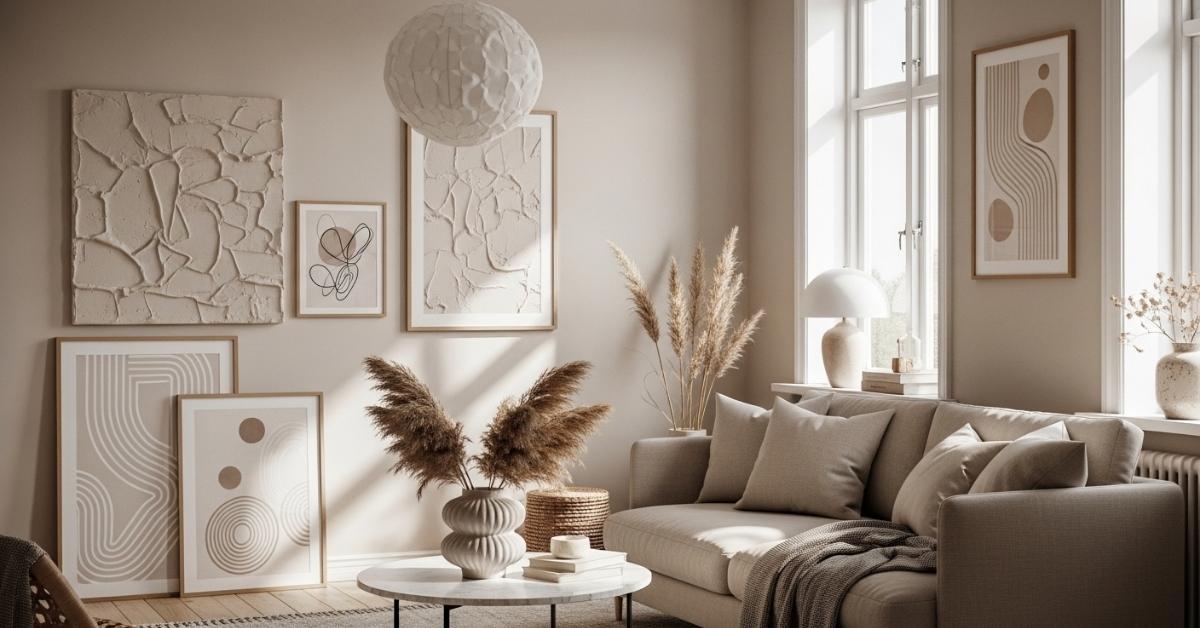
Neutral living rooms are having a real moment not the sterile, all-white kind, but the kind that feels genuinely calm and considered. Neutral Aesthetic Living Room Wall Decor Ideas If your walls currently feel bare or you’re stuck in that awkward middle ground where nothing quite ties together, wall decor is usually the fastest fix that doesn’t require moving furniture or repainting.
If your style leans warm, minimal, or nature-inspired, this list is built for you. These are ideas that hold up in compact apartments, rental-friendly spaces, and rooms that need to work hard every day, not just look good in a photo.
Oversized Linen-Wrapped Canvas Above the Sofa

The sofa wall is the most viewed surface in your living room and in a neutral space, a single large-format piece does more work than a cluster of smaller ones. Linen-wrapped canvases (either blank or subtly textured) feel collected rather than purchased. Place it so the bottom edge sits roughly 6–8 inches above the sofa back, and centered over the piece, not the wall. This works especially well in rooms where the sofa floats away from the wall, because it visually anchors the seating zone without adding visual weight through color.
Arched Mirror With a Thin Natural Wood Frame

A tall arched mirror does something most wall art can’t: it expands the room optically. In a narrow living room or one without a lot of natural light, leaning an arched mirror against the wall rather than hanging it gives a more casual, layered feel that suits a neutral aesthetic without looking overly formal. The thin natural wood frame reads warm but restrained. Position it where it can catch existing light beside a window or across from a table lamp and you’ll effectively double the room’s brightness without touching the light switch.
Read More About : 23 Modern Living Room Decor Ideas That Actually Work in Real Homes
Gallery Wall in a Restricted Palette
Gallery walls get a bad reputation for looking chaotic and they can, if there’s no organizing principle. In a neutral space, the fix is simple: restrict the palette entirely. Work within a range of cream, warm white, oatmeal, and soft terracotta. Mix frame finishes (bleached wood, raw brass, natural rattan) rather than matching them, but keep the matting consistent white or off-white throughout. This approach works best with a mix of mediums: a botanical print beside a woven textile piece beside a gestural pencil sketch. The variation in texture keeps it interesting; the tonal restraint keeps it cohesive.
Single Statement Shelf With Curated Objects

Not every wall solution needs to be art. A single floating shelf oak, walnut, or painted white depending on your floor tones styled with three to five objects creates a grounded, editorial feeling that’s harder to achieve with framed prints alone. Keep it sparse: a small stack of books, a ceramic vase in an earthy glaze, one dried botanical stem. The key is negative space. In my experience, this works best when placed on the wall beside the sofa rather than directly behind it, so it functions as part of the room’s movement path rather than a static backdrop.
Woven Wall Hanging in Natural Fibers
Woven wall hangings have moved well past their boho-only phase. In 2026, the versions worth looking at are tighter in weave, more sculptural in shape, and made from materials like undyed cotton, jute, and linen rather than chunky yarn. In a neutral room, they add tactile contrast that a flat canvas print simply can’t. The material catches light differently at different times of day, which gives the wall a subtle dynamism. This works particularly well in rooms that are heavy on smooth surfaces marble, plaster, glass because the woven texture breaks up what can otherwise feel clinical.
Plaster or Limewash Accent Treatment on One Wall

If you rent, skip this one. But if you own, a limewash or plaster treatment on a single wall does something no art piece can replicate: it makes the entire room feel architecturally considered. The key is keeping the tone within two shades of your existing walls you’re not going for contrast, you’re going for depth. A warm mushroom or aged plaster tone reads differently in morning light versus evening lamplight, which is exactly what makes it interesting. Pair it with minimal artwork one or two pieces max because the wall treatment is already doing the heavy lifting.
Oversized Abstract Print in Earth Tones
Abstract art in a neutral room lives or dies by color temperature. Warm-toned abstracts think burnt sienna, raw umber, dusty ochre, soft white integrate into a neutral palette rather than cutting through it. Scale matters: the print should feel proportionally significant to the wall and the furniture beneath it. A 40-by-60 print above a three-seat sofa works; a 20-by-24 on the same wall looks decorative rather than intentional. For renters, large-format prints can be leaned against the wall or propped on a thin ledge shelf rather than hung, which also allows for easy rearranging.
Vertical Stack of Two Coordinated Art Prints

In rooms where the sofa is pushed against the wall and there’s limited horizontal space to spread a gallery wall, a vertical stack of two coordinated prints works better than a single piece at standard hanging height. The vertical movement draws the eye upward, which makes low-ceilinged rooms feel slightly taller. Choose two prints that share a tonal relationship one could be botanical, one abstract with matching or complementary frames. The gap between them should be tighter than you’d expect: 3–4 inches, not 8–10, so they read as a pair rather than two separate decisions.
Rattan or Bamboo Woven Round Mirror
Round rattan mirrors are one of the more versatile pieces in the neutral decor toolkit they work across Japandi, coastal, and organic minimalist spaces without looking out of place in any of them. The circular shape softens rooms with a lot of rectangular furniture, and the woven frame introduces natural material contrast without color. Hang it at eye level on a wall that doesn’t already have a strong visual anchor, and leave space around it it needs breathing room to register properly. Where it tends to fall flat: on very large walls or in high-ceilinged rooms, where it reads small and decorative rather than considered.
Minimalist Line Drawing in a Thin Brass Frame

A single fine-line drawing botanical, figure, or architectural in a thin brass or gold frame is one of the quietest wall decor choices that still lands with a sense of deliberateness. In a neutral room, the brass frame adds warmth without competing with the palette, and the white or off-white mat keeps it clean. This works best in rooms that are already well-layered through textiles and objects, because a single minimal print on an otherwise bare wall can read as incomplete. Think of it as punctuation useful once the sentence already makes sense.
Ledge Shelf With Rotating Art Display
A picture ledge the shallow rail shelf that lets you lean prints without committing to holes is genuinely one of the better solutions for neutral spaces because it makes the wall feel curated but flexible. You can swap prints seasonally, layer different scales against each other, and add objects like small ceramics or plants to break up the two-dimensional surface. In practice, a ledge works best on the wall behind a console table or sideboard the furniture grounds the wall, and the shelf creates the vertical layer above it without being hung at an arbitrary height.
Natural Material Grid Wall Panel

A grid of four matching woven panels seagrass, reed, or natural jute creates a more structured alternative to a gallery wall that suits minimal, Japandi, or nature-forward spaces. The texture reads quietly from a distance and more interestingly up close, which makes the wall feel dynamic without being visually loud. This arrangement works particularly well on wide, unbroken walls behind a sofa where a single piece would feel too small and a full gallery wall would feel too busy. Panels in the 12-by-12 or 16-by-16 inch range, spaced evenly with about 4 inches between, give a clean grid that reads as intentional.
Dried Botanicals Arranged in Slim Stem Vases on a Ledge
This is one I’d actually recommend trying first for anyone building a neutral wall moment on a tight budget. A floating ledge shelf holding three slim stem vases with dried botanicals pampas grass, eucalyptus, dried lavender creates a living wall moment without the maintenance of real plants. The organic height variation from the stems gives vertical movement. Keep the vases in a narrow tonal range all white, all cream, or all terracotta and the arrangement looks purposeful rather than assembled from whatever was on sale.
Read More About : 27 Living Room Decor Ideas for an Aesthetic Cozy Space That Actually Feels Like Home
Architectural Plaster Wall Sconces

Wall sconces are still underused in living rooms outside of bedroom applications, which is a missed opportunity. A pair of plaster or ceramic sconces the kind with a simple bowl or flared shape and no obvious “light fixture” presence adds both ambient lighting and sculptural texture to the wall. In a neutral room, matte white or raw plaster finishes blend into the wall while still reading as objects. Evening light through these creates the kind of warm ambient glow that’s difficult to achieve with overhead lighting alone, and the architectural quality makes them a long-term investment rather than a trend piece.
Map or Blueprint Print in a Neutral Color Wash
Vintage maps and architectural blueprint prints treated in warm tones sepia, off-white, aged parchment work well in neutral rooms because they carry historical texture without introducing competing color. A large-scale map print above a console table gives the wall depth through the illustration detail rather than through color saturation. This is a solid choice for rooms that need the wall to feel personalized and layered without going fully abstract. Pair it with simple framing a wide mat in off-white and a thin natural wood frame and it reads as considered rather than decorative.
Framed Vintage Pressed Botanical Specimens

Pressed botanical specimens ferns, leaves, flowers are one of the few “vintage” decor approaches that sit naturally in modern neutral spaces without tipping into a country aesthetic. The key is in the framing: wide off-white or cream mats, simple natural wood or thin black frames, and consistent sizing across the set. Three matching frames arranged horizontally above a sofa or sideboard create a quiet, scientific elegance that works well in Japandi and organic modern rooms. The organic irregularity of the plant specimens contrasts beautifully with the rigid frame structure.
Raw Canvas With Subtle Texture Treatment
Raw or unprimed canvas either hung unstretched and pinned at corners or wrapped loosely over a simple stretcher is a quieter alternative to traditional art that suits ultra-minimal neutral rooms where framed prints feel too finished. The material itself is the point: the texture of the weave, the natural off-white tone, the slight irregularity. Some versions have a wash of diluted ochre or chalk applied in loose strokes, which adds dimension without a strong color story. This approach works best in rooms that already have strong visual texture through other materials a plaster wall, a jute rug, a linen sofa.
Tall Narrow Tapestry Beside a Window

A long narrow tapestry approximately 12 inches wide by 40–48 inches tall placed beside rather than above a window creates a layered curtain-adjacent moment that makes single windows feel more architecturally complete. In a neutral room, choose a tapestry in undyed or naturally dyed fibers so it reads as part of the material language of the space rather than a statement piece. This is particularly useful in rooms where the window is asymmetrically placed and the wall beside it feels awkward the tapestry fills the space vertically without the commitment of additional furniture.
Simple Floating Shelf Trio in Staggered Heights
Three floating shelves in a staggered arrangement different heights, consistent depth creates the kind of layered, lived-in wall moment that feels curated without being gallery-like. In a neutral space, keep the shelving material consistent (all white, all oak, all walnut) and vary the objects: a small plant at one height, a stack of books at another, a ceramic piece at the third. The staggered layout works better than a uniform horizontal alignment because it allows the eye to move vertically across the wall, which makes the overall composition feel more dynamic. Best for wide, unbroken walls in open-plan spaces.
Macramé Panel in an Undyed Cotton

Modern macramé in contrast to the heavy knotted versions of five years ago has evolved toward tighter, more architectural patterns in undyed or lightly bleached cotton. The result is a wall piece that reads more like sculpture than craft. In a neutral room, this is one of the few handmade pieces that introduces genuine texture without pattern or color. The slight variation in fiber and knot tightness catches light in a way that shifts through the day, which gives the wall subtle movement. Keep the rest of the wall bare to let the piece breathe.
Architectural Salvage Fragment Mounted as Art
A section of carved wood, a decorative plaster molding, or a fragment of iron detailing mounted on a simple linen-backed frame reads as architectural art with material history. Antique markets and salvage yards are the best source. The key is in how it’s mounted: a clean frame, a plain textile backing in cream or linen, and directional lighting from a nearby lamp or sconce to cast a shadow and emphasize the three-dimensionality. This works best in otherwise simple rooms the object is interesting enough that it doesn’t need company.
Full-Length Leaning Panel Mirror

A full-length panel mirror leaning rather than mounted does something standard art doesn’t: it makes a wall feel active rather than static. The slight lean creates an informal, unlabored quality that suits modern neutral rooms. In a smaller living room, it functions as a spatial illusion reflecting the room back at itself doubles the sense of depth. The slim metal or natural wood frame keeps the piece from being visually heavy. Lean it against the narrowest available wall beside a door or in a corner to maximize its spatial contribution without it becoming the main event.
Dried Floral Wreath in Muted Earth Tones
Dried wreaths have moved well beyond seasonal use in neutral spaces. A large wreath (18–24 inches) in dried pampas, bunny tail grass, and dried floral stems in muted tones dusty rose, antique cream, faded ochre reads as organic wall art rather than holiday decor. Hang it on a plain wall where it can sit in isolation, not surrounded by frames or shelves that compete with its organic, irregular silhouette. The textural complexity within a restrained palette is what makes it work in a neutral room specifically.
Gridded Photo Print Display in Matching Frames

A tight grid of matching frames all the same size, same frame finish, same mat color brings graphic clarity to a neutral room without introducing color. Black and white or sepia-toned photography works best because it keeps the tonal discipline. A nine-print grid above a sideboard or console creates a wall moment that feels deliberate and editorial. The key difference from a casual gallery wall: everything matches. Same frame, same mat, same spacing. The uniformity is the point.
Single Large Nature-Inspired Oil Print
A single large-format oil painting print landscape, seascape, or abstract nature-inspired in a limited palette of sand, stone, grey, and warm white is one of the highest-impact options for a neutral living room wall. It fills the space with depth and material reference without adding color competition. Look for prints with visible brushstroke texture or linen canvas texture rather than flat photographic reproductions the tactile quality reads better in person and in natural light. In rooms where the sofa is the statement piece, let the art be restrained in palette but significant in scale.
Kinetic Paper or Textile Hanging

Textile or paper hangings designed with overlapping layers thin cotton voile, handmade paper panels, or cut linen add a three-dimensional quality to the wall that shifts with air movement in the room. In a neutral space, white-on-white or ivory-on-cream layering creates depth through shadow rather than color. This is a niche choice that works particularly well beside an open window or in rooms with good cross-ventilation, where the subtle movement of the piece adds life to an otherwise still room. Avoid in rooms with strong air conditioning drafts the constant movement becomes distracting rather than atmospheric.
Bespoke Wall Mural in a Tonal Wash
A bespoke wall mural or a carefully chosen removable mural wallpaper in a tonal wash of soft sage, warm sand, or muted terracotta is one of 2026’s stronger interior trends, specifically because it replaces the bold feature wall of the previous decade with something quieter and more architectural. Unlike a painted accent wall, a tonal mural with organic cloud-like or geological movement gives the wall texture without imposing pattern. Removable mural papers make this fully renter-accessible. It works best in living rooms with generous natural light, where the tonal variation in the mural becomes visible rather than reading as a flat color.
What Actually Makes These Neutral Wall Decor Ideas Work
The ideas that consistently land well in real homes not just in styled photos share a few structural qualities worth understanding before you commit to anything.
Scale is the most underestimated factor.
Neutral wall decor reads very differently than bold-colored pieces because it can’t rely on color contrast to assert presence. A piece that would hold its own in a gallery needs to be meaningfully larger in a neutral room to achieve the same visual weight. As a general rule: if you think a piece is large enough, go one size up.
Lighting is doing half the work.
Neutral rooms depend heavily on light quality to show material depth. A linen canvas, a plaster sconce, a woven panel all of these look significantly different under warm lamp light versus harsh overhead light versus natural morning light. Before finalizing any wall decor placement, evaluate it at three different times of day: morning, afternoon, and evening with lamps on. If it only looks good in one condition, it’s working harder than it should have to.
Material contrast matters more than style matching.
In a neutral palette, the way to create visual interest without color is through material contrast. Smooth plaster walls with a rough-weave textile hanging. A matte ceramic piece against a satin-painted wall. Organic dried botanicals against a clean architectural frame. The contrast in surface quality is what keeps a neutral room from feeling flat.
Avoid the empty-feeling trap by anchoring, not filling.
The instinct in a neutral room is to add more to make it feel complete. Usually, the opposite approach is more effective: choose fewer, larger, more materially interesting pieces and give them space to breathe. A wall with one oversized canvas and appropriate negative space reads more intentional than the same wall with five medium prints fighting for attention.
Neutral Aesthetic Living Room Wall Decor Setup Guide
| OIdea | Space Type | Primary Benefit | Renter-Friendly | Budget Level |
| Oversized linen canvas | All sizes | Anchors sofa wall | Yes (leaning option) | Mid |
| Arched wood-frame mirror | Small–medium | Light expansion | Yes | Mid |
| Gallery wall (tonal palette) | Medium–large | Personalization | Yes | Low–Mid |
| Plaster wall sconces | All sizes | Ambient lighting + texture | No | Mid–High |
| Ledge shelf with rotating art | Narrow/apartment | Flexibility | Yes | Low |
| Woven wall panel grid | Wide walls | Texture without color | Yes | Low–Mid |
| Limewash accent wall | Medium–large | Architectural depth | No | Mid |
| Full-length leaning mirror | Small/narrow | Spatial expansion | Yes | Mid |
| Bespoke tonal wall mural | Open-plan | Statement without color | Yes (removable) | Mid–High |
Common Neutral Wall Decor Mistakes That Make the Room Feel Unfinished
Hanging everything at the same height.
When multiple pieces all sit at the standard 57-inch center-height, the wall looks like a showroom rather than a home. Vary heights intentionally a tall piece beside a shorter piece, a shelf at a different level than the art beside it.
Choosing pieces that are too small for the wall.
This is the most common issue in neutral rooms. Small pieces on large walls disappear, especially without color contrast to help them read. When in doubt, go larger or group pieces into a cohesive cluster.
Ignoring the room’s light direction.
Textural wall decor woven panels, plaster pieces, sculptural elements requires directional light to read properly. If your main light source is a ceiling fixture directly overhead, textural pieces will look flat. Add a floor lamp or wall sconce nearby to create the angle needed.
Over-coordinating everything.
A neutral aesthetic doesn’t mean everything has to match perfectly. Matching all frames, all mats, all materials in a neutral room often produces something that reads more like a showroom display than a lived-in space. Introduce slight variation in frame finish, material, and scale coordination through palette, not identical pieces.
Forgetting that walls need depth, not just coverage.
Filling every wall with art doesn’t solve the problem if the pieces are all flat and similarly scaled. Depth comes from layering: a shelf in front of a print, a sculptural piece casting a shadow, a mirror reflecting the room behind it.
FAQ’
What wall decor works best in a neutral living room?
The best wall decor for a neutral living room focuses on texture and scale rather than color. Oversized linen canvases, woven textile panels, arched mirrors, and natural-material hangings all integrate into a neutral palette while adding visual depth. The key is choosing pieces with enough material interest to hold their own without relying on color contrast.
How do I make a neutral living room wall look complete without adding color?
Vary the textures and materials of what you put on the wall. A woven piece beside a framed print beside a small ledge shelf reads as layered and complete even within a strict neutral palette. Scale also matters one large piece or a tight grouping of smaller ones will feel more finished than several isolated medium-sized pieces scattered across the wall.
Is it better to use one large art piece or a gallery wall in a neutral living room?
It depends on the wall size and the room’s existing complexity. If the room already has a lot of material variation through furniture and textiles, a single large piece gives the wall breathing room. If the room is simpler in its layering, a gallery wall in a restricted palette can add visual complexity without introducing color. Both work what doesn’t work is a single small piece on a large wall.
Can I do neutral wall decor in a rental apartment?
Yes most of these ideas are renter-friendly. Leaning large mirrors or canvases against the wall avoids hanging entirely. Picture ledge shelves can be installed with minimal wall impact. Woven hangings on dowels, removable mural wallpapers, and repositionable art strips are all good options. The limewash wall treatment and permanent sconces are the only ideas here that require ownership.
How do I choose the right size art for a neutral living room wall?
A general rule: art above a sofa should be roughly two-thirds the width of the sofa. For a standalone wall, the art or grouping should cover about half to two-thirds of the available space. In a neutral room, err toward larger rather than smaller without color contrast, undersized pieces disappear into the wall rather than reading as intentional decor.
What materials work best for neutral aesthetic wall decor?
Natural and organic materials tend to work best: undyed linen, raw cotton, jute, seagrass, natural wood, unglazed ceramic, plaster, and dried botanicals. These introduce texture and warmth without color complexity. Avoid highly reflective or synthetic materials chrome, lacquered surfaces, plastic frames which sit in tension with the organic warmth that neutral spaces tend to build toward.
Does wall decor in a neutral room need to be expensive to look good?
Not at all. Some of the best neutral wall moments come from inexpensive choices executed with good spatial judgment: a single large dried botanical arrangement, a grouping of coordinated prints from a digital download service, or a simple picture ledge styled with a few well-chosen objects. The spending goes further when the decisions around scale, placement, and material contrast are solid.
Conclusion
A neutral living room wall doesn’t need to be complicated to feel complete. The ideas here work because they lean into what neutral spaces do naturally; they let material quality, texture, and proportion carry the room rather than color doing all the lifting. Even two or three of these ideas, chosen to work together and scaled correctly for your space, can shift a wall from background noise to an actual design decision.
Start with what fits your constraints: renter-friendly and budget-conscious, or a more permanent investment if you own and plan to stay. A leaning mirror and a ledge shelf styled with a few objects is a solid starting point for most spaces from there, you can build in layers as the room develops. The key is finding what works for your specific walls, your light conditions, and your furniture arrangement. Start simple and see what the room needs from there.
