

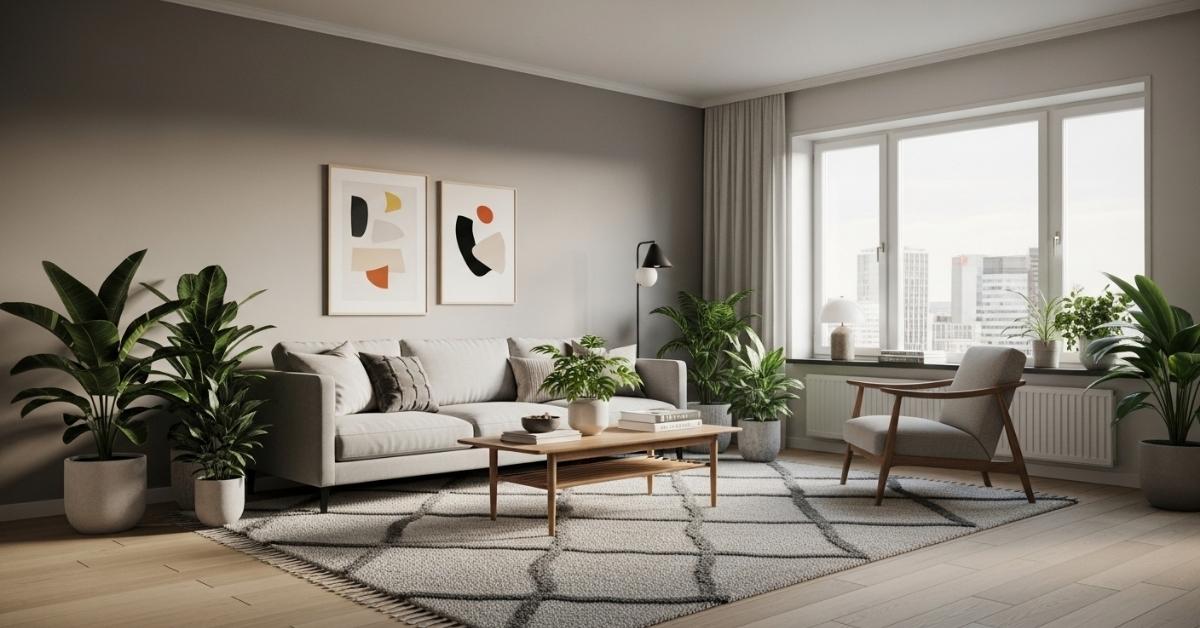
Renting doesn’t have to mean settling. That’s the mindset shift most small apartment living rooms need and once you make it, the possibilities open up fast. The real challenge isn’t budget or square footage. It’s figuring out which apartment living room ideas will actually stick in a space you can’t permanently alter. No painting the walls. No drilling into tiles. No built-ins you’ll have to reverse when your lease ends.
If you’re working with a small apartment living room or any compact space that needs to feel more intentional this list is built around what genuinely works. Not just what looks good in a styled photo shoot.
These are layouts, setups, and layering tricks that hold up in real homes: studios, open-plan units, oddly shaped rooms, east-facing apartments that never get great light. I’ve organized them by function as much as by look, because the best renter-friendly setups solve a real problem first and look great second.
Float Your Sofa Away from the Wall

Most renters push furniture to the perimeter instinctively it feels like it saves space. It usually does the opposite. When the sofa hugs the wall, the center of the room becomes a dead zone and the space feels unanchored. Pulling it forward even 12–18 inches creates a defined seating conversation zone and actually makes the room look larger by giving the eye a clear stopping point. This works especially well in open-plan apartments where you need the living area to read as its own room without any physical dividers.
Use a Large Area Rug to Define the Zone
One of the most common layout mistakes in apartment living rooms is going too small with the rug. A rug that only sits under the coffee table floats in space and makes everything feel disconnected. Go large enough that the front legs of every seating piece land on it this anchors the group into a cohesive zone. In studio apartments, a rug is doing architectural work: it tells the eye “this is the living room” without needing a wall to say it.
Layer Lighting Instead of Relying on Overhead Fixtures

Overhead lighting is almost always the enemy of atmosphere in an apartment. It’s bright, it’s flat, and it illuminates everything equally which isn’t what you want in a room that needs to feel warm and livable. Layering floor lamps and table lamps instead gives you directional light that creates depth. One floor lamp angled toward a corner, one table lamp on a side table that’s already a different room. This requires zero installation and is one of the highest-impact changes you can make for under $100.
Add a Tall Bookshelf to Draw the Eye Upward
Vertical storage does two things in a compact apartment living room: it solves clutter and it tricks the eye into perceiving more ceiling height. A tall, narrow bookshelf in a corner especially when styled with a mix of books, small plants, and a few objects at different depths becomes a focal point and functional storage in one. For renters, this is also a completely reversible setup. No damage, no anchoring required if the shelf is freestanding. This is one I’d actually recommend trying first because the visual payoff is immediate and the cost is relatively low.
Use Curtains Mounted High and Wide

You can’t change the size of your windows, but you can change how they read. Hanging curtains close to the ceiling (rather than just above the window frame) and extending the rod 8–12 inches past each side makes the window look significantly larger. It also draws the eye upward and creates the impression of height. In apartments where light is limited, choosing light-filtering linen or cotton in a soft neutral keeps the room feeling airy even when the curtains are closed. Command hooks or tension rods make this completely renter-safe.
Choose Furniture with Legs
This is one of the most underrated space-expanding choices in apartment living rooms. Furniture that sits directly on the floor creates a visual barrier the eye stops at the base and the room feels lower and heavier. Pieces with legs let light pass underneath, which creates a sense of openness that’s hard to manufacture any other way. A sofa on tapered legs, a coffee table with a slim metal base, chairs that show the floor beneath them these all contribute to a room that feels airier without losing any seating capacity.
Read More About : 27 Neutral Aesthetic Living Room Wall Decor Ideas That Actually Work in Real Homes
Create a Gallery Wall with Removable Adhesive Strips

Blank walls are one of the most common complaints in rented apartments, and most renters feel stuck because drilling isn’t allowed. Adhesive mounting strips (the heavy-duty kind rated for framed artwork) handle most standard frames without issue. The key is composition: a gallery wall needs intention. Pick a clear shape a loose rectangle, an asymmetrical cluster and lay it out on the floor first. Mixing frame sizes within a consistent color palette (all black, all natural wood, or all white) keeps it cohesive without being rigid.
Use a Console Table Behind the Sofa as a Room Divider
In studios and open-plan apartments where one space has to function as both living room and everything else, a slim console table behind the sofa does serious structural work. It creates a visual back to the seating zone, effectively anchoring the room. Place a lamp and a couple of objects on top and it becomes a lighting station and display area simultaneously. The furniture footprint is minimal most consoles are 10–14 inches deep but the spatial effect is significant.
Invest in a Multi-Functional Coffee Table

In a small apartment living room, a coffee table that only functions as a surface is a missed opportunity. Storage ottomans with lift tops hold blankets, remotes, and extra cushions while doubling as seating for guests. Nesting tables give you surface space that tucks away completely. A coffee table with a shelf underneath adds display and storage without changing the footprint. The goal is eliminating the visual clutter that accumulates in compact rooms by giving everything a place to go.
Use Mirrors to Expand Light and Space
A well-placed mirror in an apartment living room isn’t a styling cliche it’s applied spatial logic. When a large mirror is positioned to reflect a window, it effectively doubles the light in the room and creates the impression of an additional opening in the wall. The key is placement: the mirror needs to face a light source, not a dark corner or a piece of furniture. A round mirror at eye level on the wall opposite your main window is the most efficient version of this setup.
Choose a Sofa in a Neutral That Works With the Floor

Color contrast between your sofa and your floor can visually chop a small room in half. In apartment living rooms with lighter floors, a sofa in a warm beige, greige, or soft white reads as part of the same tonal family the room flows rather than segments. This isn’t about matching exactly. It’s about reducing the number of competing visual breaks across a compact space. If your floor is darker, a medium-toned sofa in camel, warm gray, or soft terracotta will create a smoother relationship than anything very light or very dark.
Add Texture to Work Harder Than Color
When you’re working with a landlord-white wall and can’t paint, texture becomes your primary design tool. A linen sofa, a jute rug, a rattan accent chair, a chunky knit throw these all read as distinctly different in the room without introducing color complexity that might clash with the fixed elements (floor color, tile, trim). In my experience, rooms that feel “finished” in apartments almost always have this textural layering happening, even when the palette is nearly monochrome.
Use Peel-and-Stick Wallpaper on One Accent Wall

This is one of the bigger moves on this list in terms of visual impact and it’s fully reversible. Peel-and-stick wallpaper has improved significantly in the past few years, and the better brands apply cleanly and remove without damage to standard painted surfaces. One accent wall behind the sofa or media console creates a focal point and makes the room feel designed rather than default. Keep the rest of the room neutral so the wallpaper does its work without competing with other elements.
Use Plant Stands to Add Vertical Greenery
A cluster of plants on the floor reads as floor clutter in small spaces. Moving them to stands at varying heights some low, some at sofa arm level, one taller creates a vertical layered element that works like a piece of sculpture. This also keeps plants closer to light sources without sacrificing floor space. Trailing plants like pothos or heartleaf philodendron work especially well here because they extend the visual downward from the stand without requiring additional surface space.
Anchor the Room with One Strong Focal Point

One of the clearest indicators of a room that feels unsettled is the absence of a focal point. In apartment living rooms where you usually can’t add a fireplace or a built-in you need to manufacture one. A console table with a large piece of art or a mirror above it, lit by a floor lamp from the side, creates exactly that. Every other piece of furniture then has something to orient toward, which is what gives a room its sense of intention.
Use Throw Pillows Strategically, Not Generously
Throw pillows are one of the most overused elements in apartment living rooms. More isn’t better it just means the sofa becomes unusable without removing several items first. A sofa arrangement of two matching pillows plus one contrasting accent in a different texture reads as intentional and is actually usable day to day. If you want pattern, this is where to bring it in: one patterned pillow among neutrals has significantly more impact than four patterns fighting each other.
Try a Daybed in Studios That Double as Bedrooms

In a studio apartment or a true open-plan space, a daybed is one of the most practical furniture decisions you can make. It functions as a sofa during the day with the right pillow arrangement, it reads completely as one and as a bed at night. The key is treating it architecturally: position it against the wall, style it like a sofa with bolster pillows along the back, and pair it with a coffee table in front. Honest and functional without looking like a compromise.
Hang a Floating Shelf Instead of Using Side Tables
Side tables solve a specific problem you need a surface next to your seating but they consume floor space that small apartment living rooms often can’t afford. Floating shelves at sofa arm height give you the same functionality with zero floor footprint. In rental apartments, adhesive shelf systems that can hold 20–30 pounds exist and are damage-free when removed. Two shelves, one on each side of the sofa, each holding a small lamp and a few objects, creates the same visual effect as side tables without crowding the walkways.
Work With the Room’s Architecture, Not Against It

Every apartment has some architectural feature that most renters treat as an obstacle a radiator cover, a bay window, an awkward alcove. These are actually the most useful anchoring points in the room. A bay window becomes the natural focal point if you orient seating toward it. An alcove becomes a reading nook with a small chair and a floor lamp. Working with what the room already has, rather than trying to impose a layout that ignores it, almost always produces a more functional result.
Choose a Glass or Lucite Coffee Table in Tight Spaces
In a living room where square footage is tight, a glass or acrylic coffee table is genuinely functional rather than just aesthetic. The transparency means the eye reads through it rather than stopping at it so the floor space it occupies feels visually unoccupied. This works especially well in rooms where the sofa faces another seating piece or a media console, because the clear surface doesn’t interrupt the sightline between the two.
Use Baskets as Closed Storage

Open shelving in apartment living rooms has a constant maintenance problem: it shows everything. Closed-top baskets solve the visual noise of everyday objects remotes, blankets, kids’ toys, charging cables without requiring any cabinetry. Two or three baskets in the same material (woven seagrass, cotton rope, rattan) beside or below a coffee table keep the floor-level zone tidy without sacrificing access. They also function as textural elements in a room that might otherwise read as too smooth.
Introduce a Second Seating Zone in Larger Apartments
If your apartment living room is on the larger side say, above 200 square feet a single sofa group often leaves a lot of dead space. A second smaller zone in a corner (one accent chair, a small side table, a floor lamp) makes the room feel considered rather than abandoned. It also expands the room’s function: the primary sofa group handles TV and group conversation, the chair handles reading, solo time, or overflow seating when you have guests.
Read More About : 27 Living Room Decor Ideas for an Aesthetic Cozy Space That Actually Feels Like Home
Mount Your TV on the Wall with a Tilt Mount

A TV that sits on a piece of furniture takes up significant surface space that a small apartment living room can’t spare. Wall mounting creates a cleaner profile, frees up the console surface, and reduces the visual weight at eye level. Most apartment landlords allow wall mounting with proper anchoring just check beforehand and use appropriate anchors for the wall type. Tilt mounts are specifically useful in apartments where the viewing angle isn’t perfect from the sofa.
Style Your Bookshelves with Depth in Mind
A bookshelf styled entirely with forward-facing spines reads as a wall of information rather than a decor element. Varying the arrangement some books horizontally stacked, some objects pushed toward the front, some plants at different shelf heights creates a visual depth that makes the shelf feel curated. This setup is especially effective in apartment living rooms where the bookshelf is doing double duty as storage and focal point. The goal is hierarchy: some elements advance, some recede, which is what gives the shelf its three-dimensional quality.
Use a Bench at the End of a Daybed or Sofa

A slim bench at the end of the sofa is one of those dual-function pieces that earns its square footage. It provides additional surface space (not every apartment has room for a full coffee table), extra seating when you have people over, and visual structure at the far end of the sofa grouping. In studios, it also helps delineate the living zone from the sleeping zone without using a room divider that would make the space feel closed.
Curate Rather Than Fill
[Image: apartment living room with deliberately minimal decor, three objects on a shelf, one plant, clear surface on coffee table, restrained but warm]
The instinct in small apartment living rooms is often to fill the available surface space if there’s a shelf, it gets populated. If there’s a wall, it gets artwork. This usually works against the space. Curation means choosing fewer objects with more intention. Three objects on a shelf with clear breathing room between them reads as more styled than nine objects crammed together. This applies to everything: walls, shelves, the coffee table surface. Restraint, honestly, is harder than it looks but it’s the difference between a room that feels composed and one that feels accumulated.
Update Hardware and Fixtures Without Permission
[Image: apartment living room adjacent to entry hall, with updated light switch plates, new hardware on built-in storage, small changes visible on approach]
Most rental leases allow cosmetic changes that can be easily reversed and hardware falls into this category. Swapping out builder-grade light switch plates for brushed brass or matte black versions costs very little and changes the register of the room significantly. Same with updating any visible hardware on built-in storage or closet doors in the living area. These are small moves, but they remove the visual cues that identify a space as generic rental housing and replace them with something that reads as chosen.
What Actually Makes These Apartment Living Room Ideas Work
There’s a pattern across every effective renter-friendly setup: they address the room’s actual constraints rather than working around them aesthetically. A rug that’s too small doesn’t just look wrong it fails spatially because it can’t anchor the furniture. Curtains hung at window height fail because they cap the room at the wrong point. Furniture pushed to the walls fails because it creates a dead center.
The ideas that work in apartment living rooms solve a legible problem: lack of definition, poor light distribution, limited storage, visual clutter, or scale mismatch between furniture and space. When you approach the room with that lens what is this room’s specific problem? the solutions become clearer than they are when you’re just browsing for inspiration.
One practical framing
before adding anything to your apartment living room, ask whether it solves a real problem or just fills a space. The rooms that feel intentional aren’t usually the ones with the most in them.
Apartment Living Room Setup Comparison Table
| Setup | Best For | Space Type | Problem It Solves | Renter-Safe? |
| Floating sofa | Open-plan layout | Medium–large | Room feels undefined | Yes |
| Large area rug | Studio/open plan | Any | No visual zone separation | Yes |
| Layered lighting | Low-light apartments | Any | Flat, harsh overhead light | Yes |
| Tall bookshelf | Limited storage | Small–medium | Clutter, blank walls | Yes |
| High-hung curtains | Any window size | Any | Windows feel small | Yes |
| Legged furniture | Compact rooms | Small | Heavy, cramped feel | Yes |
| Gallery wall | Blank or boring walls | Any | Personality deficit | Yes (with strips) |
| Console room divider | Studios | Small | No zone definition | Yes |
| Storage ottoman | Any | Small | Clutter, no storage | Yes |
| Mirror opposite window | Low-light rooms | Small | Dark, enclosed feel | Yes |
| Floating shelves | Tight walkways | Small | Side tables crowd floor | Yes (adhesive) |
| Lucite coffee table | Cramped seating zones | Small | Visual weight, blocked sightlines | Yes |
Common Apartment Living Room Mistakes That Make Your Space Feel Smaller
Furniture pushed entirely against the walls.
This is the most counterintuitive mistake because it feels spatial-minded. In practice, it creates a large empty center that makes the room feel unmoored. Floating the sofa forward creates a defined zone even in compact rooms.
Rugs that are too small.
A rug that only fits under the coffee table isolates the furniture grouping rather than anchoring it. The rug needs to be large enough to contain the conversation zone at minimum, front legs of the sofa and chairs should land on it.
One overhead light source.
This is almost universal in apartments, and it’s almost always unflattering. A single overhead fixture creates flat, directionless light that makes rooms feel like they’re waiting to be furnished rather than lived in. Adding even two lamps changes this completely.
Scale mismatch.
Oversized sofas in small rooms, or a 5×7 rug in a 12×16 space these disrupt the proportional logic the room needs to feel balanced. Before buying any large piece, tape out its footprint on the floor and live with that for a day.
Treating vertical space as irrelevant.
Apartment living rooms with low ceiling height or limited square footage benefit significantly from drawing the eye upward tall shelves, high-hung curtains, tall floor lamps, vertical artwork. When everything sits at the same horizon line, the room feels compressed.
Over-decorating as a response to plain walls.
Landlord-white walls read as blank, and the instinct is to fill every surface. The better response is selective: one strong gallery wall, one deliberate shelf, one focal point. Filling every available surface distributes attention rather than focusing it
FAQ’s
What’s the easiest renter-friendly change I can make in my living room?
Lighting. Swapping your usage pattern from overhead-only to a combination of floor and table lamps takes under an hour and no installation. It changes the feel of the room more than almost any other single change.
How do I make my apartment living room feel bigger without removing furniture?
The most effective techniques are: pulling the sofa away from the wall, using a large area rug that anchors the full furniture grouping, placing a large mirror opposite a window, choosing furniture with visible legs, and hanging curtains from near the ceiling. All of these work independently and compound when combined.
Can I have a gallery wall if I can’t drill into the apartment walls?
Yes. Heavy-duty adhesive mounting strips (Command Large Picture Hanging Strips or equivalent) support most standard frames and remove cleanly from painted surfaces. The key is using the correct strip rating for your frame weight and following the cure time before hanging.
What’s the best rug size for a small apartment living room?
For a sofa grouping without a chair, a 5×8 is typically the minimum front legs of the sofa on the rug, front legs of any accent pieces on the rug. For a full conversation group (sofa + two chairs), a 8×10 or 9×12 is usually necessary. Going too small is consistently the more common mistake.
How do I create visual zones in a studio apartment living room?
Use a large rug to define the seating area, position the sofa with its back facing the sleeping zone (rather than the wall), add a console table behind the sofa as a visual divider, and differentiate the lighting between the two zones. These create definition without physical walls or room dividers.
Is it worth furnishing a rental apartment properly?
Practically: yes. You’re spending significant time in the space and the quality of a room how organized it feels, how well the light works, how usable the layout is has a real effect on daily life. Most of the setups on this list are portable and will move with you, making them an investment in your furniture, not the landlord’s property.
What apartment living room trends are actually worth following in 2026?
The shift toward warm neutrals and tactile materials (boucle, linen, rattan, soft wood tones) is holding and has more longevity than trend-specific colors or styles. Curved furniture continues to perform well in small spaces because it avoids the hard-corner feeling of boxy pieces. Layered, ambient lighting rather than recessed or overhead is increasingly the standard rather than a style choice.
Conclusion
The apartment living room is one of the harder design briefs because the constraints are real no permanent changes, limited light in many units, spaces that weren’t necessarily designed with livability in mind. But the gap between a room that feels functional and one that feels finished is almost always smaller than it looks. A few layout decisions, one or two pieces chosen for dual function, and a consistent approach to lighting and texture will take most spaces a significant way forward.
Start with what’s most specific to your situation: if the layout feels off, address the rug and sofa placement first. If the room feels dark, add two lamps before anything else. If storage is the problem, work on baskets and vertical shelving. Pick two ideas from this list that match your actual constraint, try them, and build from there.
