

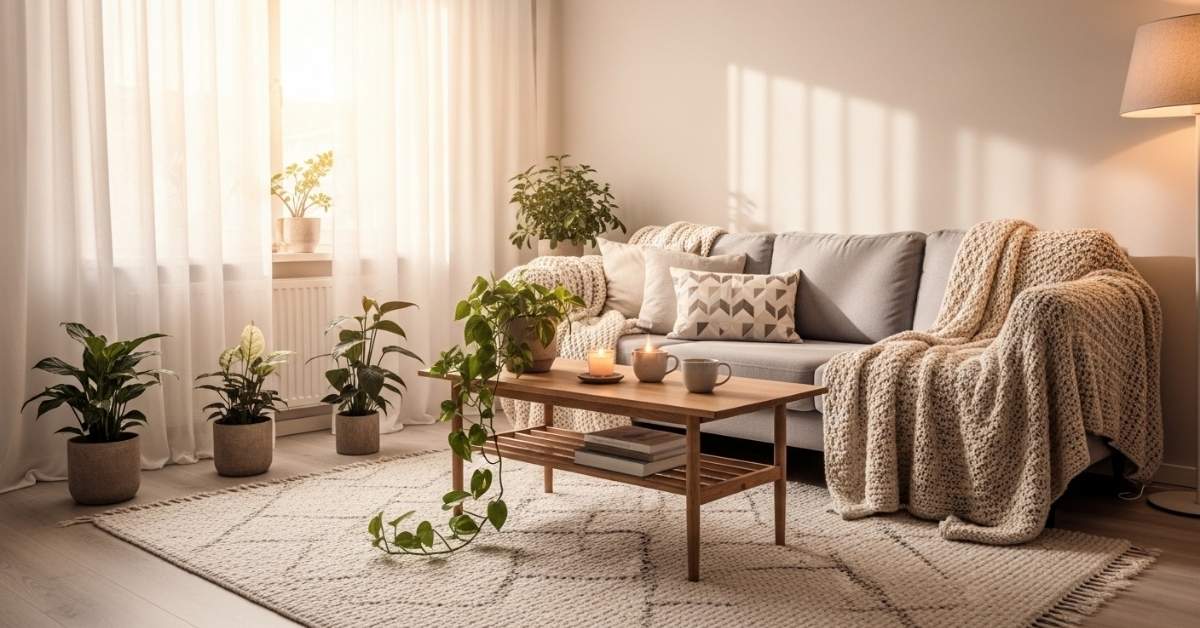
Soft textures, warm light, a sofa you actually want to sink into that’s what a cozy aesthetic living room feels like when it works. Living Room Decor Ideas But a lot of rooms have the pieces without the feeling. The sofa’s there, the throw pillows are there, and still something reads cold or cluttered or just… off.
If your living room feels functional but not really livable, this is for you. Whether you’re in a compact apartment, a rental you can’t paint, or a space that needs personality without a full renovation these ideas are built around real constraints, not showroom fantasy. Most of them work without major furniture purchases, and all of them are designed to create a specific spatial or atmospheric effect, not just look pretty in a photo.
Layer Your Lighting Instead of Relying on One Overhead Source

The fastest way to make a room feel cold and flat is a single overhead light. When the only source comes from directly above, it flattens texture, kills shadow depth, and makes even a beautifully decorated room feel like a waiting room. The fix is layering: a floor lamp in one corner, a table lamp on a side table, a small accent light near a bookshelf. Each source creates a warm pool of light rather than uniform brightness, and the overall effect is a room that feels enclosed and inviting rather than exposed.
This works best in medium to large living rooms where a single lamp would leave corners too dark. For smaller rooms, two sources are usually enough. The goal is to eliminate overhead lighting as your primary source, especially in the evening. It costs almost nothing if you already own lamps.
Use a Low-Profile Sofa to Make Ceilings Feel Taller

There’s a specific spatial trick that interior designers use in small rooms: keeping furniture low makes the vertical space above it feel more generous. A low-profile sofa one where the backrest sits around 28–30 inches from the floor leaves more wall visible and tricks the eye into reading the room as taller. Pair it with a low coffee table to extend that horizontal line.
This works especially well in apartments with standard 8-foot ceilings where taller furniture competes with the room visually. It’s also a good choice for rooms with statement windows, since a lower sofa doesn’t block the view or interrupt natural light. Bonus: these sofas tend to read as more modern and architectural than traditional roll-arm styles.
Add a Vintage Rug Underneath All the Main Furniture

A rug that’s too small is one of the most common issues in living rooms. When furniture floats around a rug rather than on it, the seating area looks like it was placed randomly rather than intentionally designed. An oversized vintage-style rug one where at least the front legs of all seating land on it anchors the whole area into a unified zone. It also adds color, warmth, and texture that painted walls and upholstered sofas alone can’t match.
Vintage rugs (or vintage-look reproductions) work particularly well in cozy aesthetic rooms because their muted, worn tones feel lived-in rather than staged. They also absorb sound slightly, which makes the room feel quieter and more settled. This is one of those changes that reconfigures how the whole room reads without moving a single piece of furniture.
Build a Reading Nook in an Underused Corner

Most living rooms have at least one dead corner a spot where nothing quite fits or where the furniture arrangement just stops. That corner is actually the ideal spot for a reading nook setup: a single armchair angled toward the center or toward a window, a narrow side table at arm height, and a floor lamp behind or beside it. This creates a clearly defined secondary zone within the room, which makes the space feel more layered and purposeful rather than like everything just fills a rectangle.
This setup works particularly well in rooms where the sofa dominates and there’s no other seating moment. The nook adds visual interest from across the room and gives the space a cozy, bookish character that a single sofa arrangement rarely achieves. For renters, it’s entirely moveable no installation, no commitment.
Read More About : 21 Small Living Room Layout Ideas That Actually Make the Most of Your Space
Use Curtains That Go From Floor to Ceiling

Mounting curtain rods at or very near the ceiling not just above the window frame is one of the easiest ways to make a room feel significantly taller. The curtain draws the eye up, and when the fabric reaches the floor (or just barely grazes it), it creates a soft, architectural frame that makes windows look more substantial than they are.
This is especially useful in rooms with standard windows that feel too small for the wall they’re on. Heavy linen or cotton curtains in cream, warm white, or terracotta add texture without pattern, which keeps the look calm rather than busy. For renters, tension rods or adhesive hooks near the ceiling make this work without drilling.
Mix One Dark Accent Piece Into a Light Room

An all-light room can feel washed out and a little anonymous. One dark-toned anchor piece a walnut coffee table, a black metal shelving unit, a deep navy armchair gives the eye something to land on and creates contrast that makes everything else in the room look more intentional. It also adds a sense of weight and permanence that lighter rooms often lack.
The key is limiting it to one or two pieces. More than that and the room starts to feel heavy. Less than that and the room feels flat. In my experience, the coffee table is the easiest place to introduce this it sits at the center of the seating area and reads as the anchor point whether you want it to or not.
Use Bookshelves as Display + Storage in the Same Wall Zone

Freestanding or built-in bookshelves that hold both books and decorative objects serve a dual purpose in a cozy living room: they add depth and visual complexity to a wall that would otherwise be flat, and they give you functional storage without looking utilitarian. The setup works best when you break the shelving into sections dense areas with stacked books next to open areas with a plant or a few ceramics. All books, all the time reads as chaotic; all objects reads as a showroom.
This kind of shelf styling also gives you somewhere to put things that would otherwise clutter surfaces: candles, small trays, a trailing pothos. It pulls objects off the floor and off the sofa table and gives them a home that’s visible but contained.
Place a Coffee Table Tray to Corral Surface Clutter

Surface clutter is one of the main things that makes a room feel unfinished even when it’s decorated. A large tray on the coffee table acts as a visual boundary everything inside it reads as a curated display, and everything outside it reads as mess. It’s a psychological trick as much as a design one. A round tray in natural wood, marble, or rattan works well in cozy aesthetic rooms and gives you permission to keep candles, remotes, and plants on the same surface without it looking chaotic.
This is also an easy reset system. When the room gets lived-in, you’re just clearing back to the tray, not to an empty surface. For small coffee tables, a tray that takes up roughly a third of the surface area is the right proportion.
Hang Artwork at Eye Level, Not High on the Wall

Most people hang art too high. The standard gallery rule is 57–60 inches from the floor to the center of the piece roughly eye level when standing. When artwork hangs significantly above that, it disconnects from the furniture below and the room starts to feel like the top half and bottom half weren’t planned together. Hung correctly, art feels like part of the seating area rather than floating above it.
For a cozy aesthetic, a single large piece tends to work better than a busy gallery wall it gives the room a focal point without visual noise. But if you want a gallery wall, keep the spacing tight (3–4 inches between frames) and maintain a consistent baseline along the bottom edge.
Use Warm-Toned Throw Blankets, Not Decorative Ones
There’s a difference between a throw that’s there to be photographed and one that actually invites someone to use it. Decorative throws the ones that stay perfectly folded don’t contribute to a cozy atmosphere the way a chunky knit or a worn linen blanket does. Drape one over the arm of the sofa, let another one live in a basket nearby. The slightly imperfect placement signals that the room is actually used, which reads as comfort rather than staging.
Stick to warm tones cream, rust, amber, warm grey and natural materials like cotton, linen, or wool. Synthetic throws look flat and pill quickly, which undermines the whole effect.
Float the Sofa Away From the Wall

Pushing furniture flush against the walls is a common instinct in smaller rooms, but it usually makes the space feel like a waiting area rather than a living room. When the sofa floats even 8–12 inches from the wall, it creates a sense of depth and makes the seating arrangement feel like a deliberate grouping rather than furniture arranged around the edges. It also leaves room to run cords and adds a sense of circulation around the room.
This works in rooms that are at least 12 feet wide smaller than that and floating the sofa starts to block movement. But in most average living rooms, this single shift changes the feel of the layout more than almost anything else.
Introduce Plants at Multiple Heights

A single plant on a table doesn’t do much for a room. But plants placed at three different heights floor level, surface level, and shelf level create a visual rhythm that makes the room feel layered and alive. A large floor plant in a corner near a window, a trailing plant on a shelf, and a small potted plant on the coffee table reads as intentional rather than incidental.
I’ve noticed this style works best when the pots share a color family terracotta, cream, and natural wood tones all read together without competing. Mixed pot styles can make the greenery look random rather than considered.
Create a Focal Point With a Textured Accent Wall
An accent wall works best when it marks a specific function the wall behind the sofa, or the wall opposite the main entrance rather than just being a random wall that got a different color. In cozy aesthetic rooms, texture works better than flat paint: limewash, plaster effect, or even a large-scale grasscloth wallpaper add dimension that catches and diffuses light differently throughout the day.
For renters, peel-and-stick versions of textured wallpaper have improved significantly they’re removable and don’t leave residue on most surfaces. A warm terracotta, clay, or deep sage reads immediately cozy without needing much else on the wall.
Use a Round Coffee Table in Smaller Rooms

Sharp corners on coffee tables in small rooms are a practical issue as much as a design one they cut into walking space and feel more imposing than a table of the same diameter in round form. A round coffee table with a diameter between 36–42 inches works well for most sofa lengths and creates better visual flow around the seating area. It also anchors the rug underneath it naturally, since round and square interact without the proportional awkwardness of two rectangles.
This is a particularly good choice for rooms where the sofa and armchairs are arranged in an L or U shape, since a round table doesn’t favor one side over another.
Use Mirrors to Reflect Light, Not Just to Look Decorative

Mirrors are most effective when they’re placed opposite or at an angle to a natural light source. A mirror that reflects a blank wall back at you doesn’t do much, but one that catches daylight from a window opposite it can noticeably brighten a room without adding any artificial lighting. In dim living rooms or north-facing spaces, this can make a real difference.
Arched and oval mirrors are popular in cozy aesthetic rooms right now (2026 is still heavy on the organic shape trend) and they tend to feel less formal than rectangular frames, which suits lived-in spaces better.
Mix Textures in Your Cushion Selection
Cushions in the same material, even if they vary in color, read flat. Cushions in the same color family but different textures linen, velvet, boucle, knit create visual interest that photographs well and feels genuinely touchable in person. The texture is what signals comfort; color alone doesn’t do it.
Stick to a palette of two or three tones and let the material variation carry the interest. Odd numbers work better than even: three cushions on a standard two-seater, five on a three-seater. Overfilling a sofa with cushions is a staging look, not a livable one.
Read More About : 27 Living Room Ideas That Actually Work in Real Homes (Not Just on Pinterest)
Add a Narrow Console Table Behind the Sofa

In open-plan spaces where the living area needs to be defined without walls, a narrow console table behind the sofa does three things at once: it marks the back edge of the seating zone visually, gives you a surface for a lamp (which solves the layered lighting problem), and adds a second visual layer to the room when viewed from the kitchen or entryway. Consoles that are 10–14 inches deep work without making the space feel crowded.
This is one of the most practical setups for studio apartments or open-plan layouts where the sofa faces into the room rather than against a wall. It also solves the awkward floating-sofa-with-no-backdrop issue.
Use Linen or Velvet Curtains to Frame a Large Window
Large windows are an asset in any living room, but without curtains to frame them, they can read as architectural holes rather than features. Curtains that extend beyond the window frame on both sides 8–12 inches wider than the window opening on each side make the window appear larger and give the room a sense of height and softness that bare glass doesn’t. In cozy aesthetic rooms, linen reads airy and relaxed; velvet reads warmer and more dramatic. Both work, depending on the overall tone of the room.
The key is hanging them high as close to the ceiling as possible and letting them reach the floor. Half-height curtains cut the room in a visually awkward place and make ceilings feel lower.
Create Visual Depth With a Gallery Wall Behind the Sofa

A gallery wall works best as a single composition rather than a collection of random pieces scattered across a wall. The most effective approach: start with your largest piece, center it roughly where you want the gallery’s visual center, and work outward from there. Keep spacing consistent 3–4 inches between frames and mix sizes rather than using all the same dimensions.
For cozy aesthetic rooms, mixing frame materials (some black, some natural wood, some white) in a consistent size range reads more collected and organic than matchy-matchy frame sets. Include at least one piece that has a story a photo, a market find, a piece of art you made because the warmth of a gallery wall comes from specificity, not just quantity.
Use a Bouclé or Textured Armchair as a Statement Piece
A single statement armchair in a textured fabric bouclé, sherpa, or velvet adds a visual anchor to a living room that a standard matching armchair can’t. Bouclé in particular has dominated cozy aesthetic interiors and shows no signs of slowing down heading into late 2026. It reads warm, expensive-looking without necessarily being expensive, and the texture adds a tactile quality that’s obvious even in photos.
Place it in a corner with a floor lamp and a small side table and it becomes a full secondary seating moment. This is the move for anyone who wants their living room to read as designed without doing a full renovation.
Add a Woven Basket for Visible Storage

A large woven basket near the sofa is one of the few storage solutions that actually improves the look of a room rather than hiding something in it. When it holds throw blankets, it keeps them accessible without draping them permanently over the sofa, and the organic texture of seagrass or rattan adds warmth to a space that might otherwise be reading too smooth or too polished.
This is especially useful in smaller living rooms where a blanket box or storage ottoman would take up floor space. Keep one basket visible and use it the lived-in look is part of the cozy aesthetic
Use Scented Candles as Decor That Does Double Duty

Candles on a coffee table serve a specific atmospheric function that no amount of ambient lighting can replicate: they create a moving, close-to-eye-level light source that makes a seating area feel genuinely intimate. Grouped in sets of two or three (in the same tonal family cream, terracotta, beeswax) on a tray, they also solve the coffee table styling problem without feeling contrived.
Pillar candles or unscented beeswax candles work best visually; the visual warmth they add is separate from any scent benefit. For a cozy aesthetic room, even unlit candles in a warm-toned holder contribute to the overall atmosphere.
Use a Performance Fabric Sofa for a Family-Friendly Cozy Look
Cozy aesthetic and practical living aren’t mutually exclusive. Performance fabrics particularly in caramel, warm grey, or ivory tones now come in textures that closely mimic linen or cotton, without the susceptibility to staining or fading. For homes with kids, pets, or heavy daily use, a performance fabric sofa means you can maintain the lived-in cozy look without the lived-in smell or permanent marks.
This is one I’d actually recommend trying first for families or anyone who’s avoided lighter sofas out of practicality. The category has improved significantly and the cozy aesthetic doesn’t have to mean a sofa you can’t actually use.
Place a Plant Stand Near a Window to Maximize Growth and Decor

A plant stand with multiple tiers uses vertical space rather than horizontal, which is the right move in any small to medium living room where floor space is limited. Positioning it near the room’s best natural light source also means the plants actually thrive which eliminates the dead plant problem that undermines the whole aesthetic faster than anything else.
Choose plants with different leaf shapes for the same stand: a trailing plant for the top tier, a structural plant (like a small snake plant or rubber plant) for the middle, and a low-growing trailing variety for the bottom. The visual effect is lush and layered without being overgrown.
Use a Neutral Area Rug With Subtle Texture Over a Plain One
A plain flatweave rug in a neutral color is fine, but a rug with a subtle texture jute, chunky loop wool, a boucle weave, a textured geometric adds to the layered quality of a cozy room without introducing color or pattern. The texture is most visible in raking light (late afternoon sun across the floor) and adds warmth underfoot that a flat rug can’t replicate.
For open-plan spaces, a textured neutral rug in the living zone acts as a soft divider between the seating area and adjacent dining or kitchen space particularly useful in apartments where the rooms aren’t defined by walls.
Style a Bookshelf With the Spine-In Technique for Calm Walls

If your bookshelf reads as visually noisy too many bright spines competing with the rest of the room turning books spine-in creates an immediately calmer backdrop. The creamy or off-white pages facing outward create a consistent neutral that works with almost any room palette. It’s a slightly editorial move, and it does make finding specific books harder, but for display shelves in a cozy aesthetic room, the visual calm is worth it.
This works best on shelves where books aren’t your primary storage system decorative shelves with a mix of objects and books where the visual effect matters more than easy access.
Add a Daybed or Chaise to a Single-Sofa Layout

A single sofa facing a TV is the default living room layout, and it works fine but it doesn’t feel especially cozy because there’s only one place to sit and one direction to face. Adding a chaise or daybed perpendicular to the sofa creates an L-shaped seating moment that allows different kinds of use: lying down, reading, hosting more people, or just breaking the formal seating arrangement. It makes the room feel like a space for living rather than a room built around a screen.
In smaller rooms, a chaise attached to the sofa does the same work without adding a separate piece. The key is making sure the total footprint fits the rug and doesn’t block the primary circulation path through the room.
What Actually Makes These Cozy Aesthetic Ideas Work
The cozy aesthetic living room trend gets misread constantly. It’s not about adding more stuff more throws, more pillows, more plants until the room looks full. The actual mechanism behind cozy aesthetic rooms is controlled layering: texture variation, light at multiple levels, a defined layout that creates zones within the room, and a limited color palette that makes different materials feel related rather than random.
The rooms that consistently read as genuinely cozy have three things in common: warm-toned lighting that comes from at least two sources, a layout where furniture is arranged around a focal point or zone rather than against the walls, and enough texture variation in soft furnishings to give the eye somewhere to move.
What they don’t have: matching furniture sets (reads as showroom, not lived-in), cold white lighting, bare floors in the seating area, or a sofa that’s the only place to sit.
Cozy Living Room Setup Guide
| Idea | Best For | Space Type | Problem It Solves | Difficulty |
| Layered lighting | Evening atmosphere | All sizes | Harsh overhead lighting | Easy |
| Low-profile sofa | Ceiling height illusion | Small to medium rooms | Room feels cramped | Medium |
| Oversized vintage rug | Anchoring seating zone | Floating furniture layouts | Disjointed arrangement | Easy |
| Reading nook corner | Secondary seating | Medium to large rooms | Single-use layout | Easy |
| Floor-to-ceiling curtains | Visual height | Standard-height rooms | Windows feel small | Easy |
| Floating sofa | Better flow | Rooms 12ft+ wide | Perimeter furniture layout | Easy |
| Gallery wall | Focal point behind sofa | Any room | Blank wall syndrome | Medium |
| Plant stand by window | Greenery + light use | Small to medium rooms | Dead plant problem | Easy |
| Console behind sofa | Open plan zones | Studio/open floor plans | Seating area lacks definition | Easy |
| Daybed or chaise | Multi-use seating | Medium to large rooms | One-direction layout | Medium |
How to Design Your Cozy Living Room Without Starting From Scratch
The most common mistake when trying to create a cozy aesthetic living room is approaching it as a full redesign. Most rooms don’t need new furniture they need different placement and better light.
Start with the layout. Float the sofa if it’s against a wall. Pull the area rug to the right size if it’s too small (or layer a smaller rug on top of a larger neutral one to test the proportion). Look at where your light comes from at 7 PM on a normal evening that’s the most common use window and add at least one warm-toned lamp at a different level than your current sources.
Then address the texture problem. A room can have a great layout and warm lighting and still feel incomplete if every surface is the same material. Mixing linen, wood, ceramic, and a soft rug gives the eye something to move through rather than a room that reads as flat.
Scale matters more than most people realize. Too many small accessories on a big coffee table read as clutter; a few large ones read as intentional. One large mirror does more than three small ones. One large plant does more than five small ones. When in doubt, edit down to the piece you’d keep if you could only keep one and then build outward from there.
FAQ’s
What makes a living room feel cozy and aesthetic at the same time?
The combination works when warmth (soft textures, warm lighting, natural materials) is paired with intentional layout and restraint. A cozy aesthetic room doesn’t mean a cluttered one it means layers of texture and light within a calm, curated arrangement. The key elements are warm-toned lighting from multiple sources, a limited neutral palette, and furniture placement that creates a defined seating zone.
How do I make a small living room feel cozy without cluttering it?
Focus on texture over quantity. In a small room, one chunky knit throw, one textured rug, and one plant do more than many small accessories scattered around. Use low-profile furniture to preserve vertical space, keep the coffee table surface edited to a tray with a few items, and choose lighting that creates warm pools rather than bright overhead coverage.
What’s the best sofa color for a cozy aesthetic living room?
Warm neutrals tend to work best cream, warm ivory, caramel, warm grey, or a muted terracotta. These tones read comfortable and lived-in without requiring careful color coordination around them. Cool greys or bright whites can look sleek but tend to read cold rather than cozy, especially in natural or evening light.
Should I use a rug in my living room even if I have hardwood floors?
Yes and the size matters more than the style. An undersized rug that sits only under the coffee table leaves the seating area feeling disconnected. The right rug should have at least the front legs of all seating pieces on it. A jute, wool loop, or vintage-style rug in a neutral tone adds warmth without competing with the rest of the room.
How is the cozy aesthetic different from maximalist design?
Cozy aesthetic focuses on sensory warmth (soft textures, warm light, natural materials) within a relatively controlled palette, while maximalism embraces color, pattern, and abundance. A cozy aesthetic room can still feel calm and uncluttered it’s about depth and comfort, not volume. The difference is that cozy is selective: it layers intentionally rather than filling space comprehensively.
Is it worth investing in blackout curtains for a cozy living room?
Not necessarily blackout, but lined curtains yes. Lined curtains hang better (they drape more cleanly and hold their shape), insulate the room slightly, and block more ambient street light in the evenings. The visual improvement alone is usually worth the cost over cheap unlined panels, which tend to look thin and flat.
How do I add a cozy feel to a rental living room without painting walls?
Curtains, rugs, and lighting are the three highest-impact changes that require no installation. Floor-to-ceiling curtains on a tension rod, an oversized rug to anchor the seating zone, and warm-toned lamps in multiple corners will change the feel of the room more than almost any wall treatment. Add textured throw blankets and a few plants for the finishing layer.
Conclusion
A cozy aesthetic living room isn’t a style that requires a specific budget or a certain apartment size it’s an atmosphere built from specific choices about light, layout, and texture. Getting it right means understanding which combinations of elements create warmth and which ones just add more stuff to a room that already has plenty.
The key is finding what works for your space first the layout, the light sources, the scale of your furniture relative to the room and then layering in texture and personality from there. Start with one or two ideas that match your current constraints: float the sofa, add a floor lamp, size up the rug. Let those changes settle, then build outward. The rooms that feel most cozy rarely happened all at once.
