

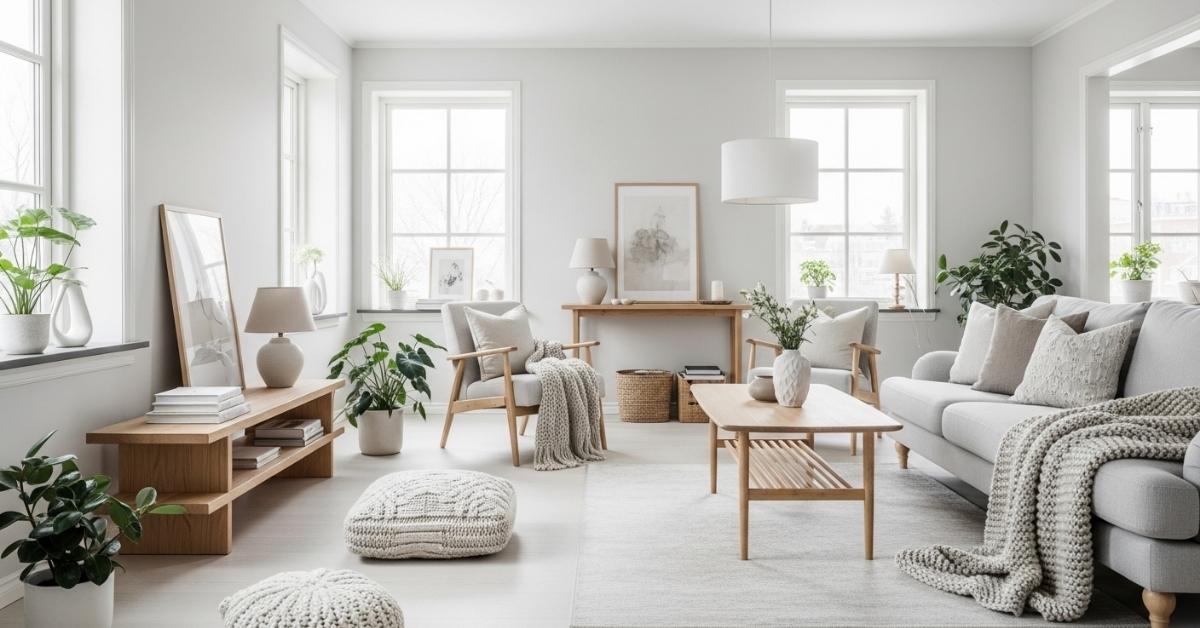
Soft neutrals, honest materials, and just enough breathing room to make a space feel like you actually thought about it; that’s the quiet appeal of Scandinavian design. It doesn’t rely on statement pieces or Scandinavian Style Ideas trend-chasing. Instead, it works through restraint: fewer objects, better placed, in rooms that feel genuinely livable rather than staged.
If your space currently feels cluttered, visually noisy, or just hard to relax in, Scandinavian style gives you a clear framework to work with. It’s not about buying Scandinavian furniture specifically, it’s about how light moves through a room, how materials relate to each other, and how much empty space you’re willing to let stay empty.
For anyone working with a small apartment, a rented space, or a room that pulls double-duty (living and working, sleeping and studying), these ideas are especially practical. Most of them cost very little to implement and don’t require major changes, just a shift in how you arrange, layer, and edit what’s already there.
Build Around a Neutral Base with One Warm Accent

The classic Scandi palette isn’t just white it’s white layered with off-white, linen, and one carefully chosen warm tone. Start with a neutral sofa (oatmeal, cream, or warm grey), keep walls white or a soft greige, then bring in one accent a terracotta cushion, an amber glass vase, a dusty sage throw. That single warm note is what keeps the room from reading as cold or clinical. The contrast is subtle but it does a lot of visual work. This setup is especially effective in north-facing rooms that don’t get direct sunlight, because the warm accent counterbalances the cooler light without requiring you to repaint.
Use a Low-Profile Sofa to Make Ceilings Feel Higher
Low furniture is one of the most underused tools in small-space design. A sofa with a seat height of 15–17 inches creates a strong horizontal line across the room, which visually pushes the ceiling upward. Pair it with a floor lamp rather than a ceiling pendant, and the eye travels from floor to wall to ceiling without obstruction. This works especially well in rooms with standard 8-foot ceilings that feel boxed-in. You don’t need a designer piece; many budget-friendly options follow the same low profile. The key is keeping the surrounding furniture proportional: a chunky, tall bookshelf next to a low sofa breaks the visual logic entirely.
Layer Textiles Instead of Adding More Furniture

In Scandinavian interiors, warmth comes from texture, not from filling every corner. A bed dressed in white cotton, topped with a waffle-knit blanket, with a sheepskin draped at the foot that’s three different textures working together without a single extra piece of furniture. On the floor, layering a smaller wool or sheepskin rug over a flat jute adds depth without visual weight. This approach directly solves the problem of rooms that feel sparse but where adding furniture would make them feel crowded. I’ve noticed this works particularly well in bedrooms under 120 square feet, where you want warmth without sacrificing floor space.
Choose Wood Tones That Run Warm, Not Orange
There’s a common mistake in trying to achieve Scandi style by grabbing whatever “light wood” furniture is available and ending up with honey pine that pulls orange and suddenly looks like 1990s country decor instead. The wood tones that actually work in Scandinavian spaces run ash, birch, or light oak: all pale to medium in tone with a slightly grey or cool undertone. These sit next to whites and linens without creating contrast that feels jarring. When shopping secondhand or painting furniture, look for pieces with straight, simple grain. The material honestly matters more than the brand or price point.
Leave Deliberate Empty Space on Shelves

Scandinavian shelf styling isn’t about having fewer things on display, it’s about treating empty shelf space as a design element in its own right. A shelf with three objects and generous breathing room around each one communicates intention. A shelf crammed with books, photos, and trinkets communicates chaos, regardless of how nice each individual item is. The practical rule: remove everything, then add back only what you’d actively want a guest to notice. Group objects in odd numbers (one, three, or five), leave at least 30–40% of the shelf empty, and mix heights one tall, one low, one mid. This is one of the easiest zero-cost changes you can make.
Hang Curtains High and Wide to Expand Windows
The curtain placement you see in most apartments is at window frame height, panels that barely clear the sill makes windows look small and rooms feel low. In Scandinavian interiors, curtains are hung as close to the ceiling as possible and extend 8–12 inches beyond the window frame on each side. When the curtains are open, the entire window is visible and the rod disappears into the wall. When closed, the wall reads as one large fabric panel rather than a small window covered up. White or linen sheers work best for this because they filter light rather than blocking it, keeping the room bright even when privacy is needed.
Introduce a Single Statement Plant in a Grounded Pot

One large plant in a heavy ceramic pot does more for a Scandinavian space than six small ones scattered around. A fiddle-leaf fig, a rubber plant, or an olive tree in a dark matte or terracotta pot placed in a corner next to a window creates a natural focal point without requiring any wall decor. The visual logic is straightforward: the plant draws the eye upward (adding height) while the weighted pot grounds it. This setup also solves the “empty corner” problem that a lot of minimalist rooms struggle with; the space reads as intentional rather than unfinished.
Read More About : 24 Farmhouse Style Ideas That Actually Work in Modern Homes (Without Looking Dated)
Use a Single Pendant Lamp to Define a Zone
Overhead lighting in Scandinavian design almost always does two things: it hangs low (closer to the surface than you’d expect), and it defines a specific zone in the room. A pendant above a dining table, hung at about 28–32 inches above the tabletop, creates a dedicated social zone visually separating it from the living area even in an open-plan layout. Woven rattan, matte black metal, or paper pendants all work within the aesthetic. Avoid anything with chrome or high-gloss finish; those read as too contemporary and hard-edged for the style’s warmer intentions.
Go with a Platform Bed Frame and Skip the Box Spring

Platform beds are functionally practical and visually essential in Scandinavian bedrooms. Without a box spring adding height, the bed sits low, making even a small bedroom feel more spacious because more walls are visible above the headboard. A simple slatted oak or birch frame, white or linen bedding, and a nightstand at mattress level create a setup that’s clean without feeling sparse. This layout also makes the bed easier to style. Lower beds require less bedding to look made, which matters if you’re not someone who wants to spend ten minutes arranging throw pillows every morning.
Add a Reading Nook with Just a Chair, Lamp, and Shelf
You don’t need a dedicated room to create a reading nook, just a corner, one chair, and a light source positioned correctly. An armchair with a low profile and linen upholstery, placed at a 45-degree angle to the wall, with an arc floor lamp positioned so the bulb sits just above seated eye level, and a small floating shelf within arm’s reach that’s a complete reading zone in about 20 square feet. The setup solves the common problem of open-plan spaces that have no defined function in their corners. It also gives the room a reason to have a second light source, which dramatically improves the evening atmosphere.
Keep the Kitchen Counter Mostly Clear

Scandinavian kitchens are defined not by what’s on the counter but by what’s not. The functional rule is to keep only the three most-used items on the surface, typically a kettle, a cutting board, and one cooking tool and store everything else. This isn’t just aesthetic; it’s practical. Clear counters make cooking prep faster, cleaning easier, and the kitchen feels larger than its actual square footage. If you have open shelving, style it with grouped items (all glasses together, all ceramics together) rather than spreading things out. The visual logic is the same as shelf styling: negative space communicates order.
Use a Round Table in Small Dining Areas
Square or rectangular tables in small rooms create dead corners; you can’t pull a chair into a corner, so that space becomes permanently wasted. A round table solves this immediately. A 36-inch round seats two comfortably and four in a pinch, fits into tighter rooms without the corners colliding with walls, and creates better conversation flow since everyone is equidistant. In Scandinavian interiors, round tables also reinforce the style’s preference for soft forms over rigid geometry. Ash, birch, or white lacquer are the most common finishes. If you’re in a rented space and can’t make permanent changes, a round table is one of the highest-impact furniture swaps available.
Layer Warm and Cool Whites Instead of Using One Shade

This is the detail that separates Scandinavian interiors that feel considered from ones that feel flat. Pure, cool white on every surface reads as institutional. Instead, use a warm white or soft off-white on walls, pure white on trim and ceilings, and introduce cream or linen through soft furnishings. The tonal variation creates subtle depth without introducing color. This is especially important in rooms with mixed light (some natural, some artificial) because the slight warmth in the walls prevents the space from feeling washed out under artificial lighting in the evening.
Bring In Natural Materials That Age Well
One of the more forward-thinking aspects of Scandinavian design increasingly relevant in 2026 is its preference for materials that develop character rather than showing wear. Linen upholstery softens with use. Raw oak develops a patina. A wool rug gets denser with foot traffic. These aren’t just aesthetic choices; they’re practical ones. Materials that age well save money long-term and reduce the pressure to keep everything looking “new.” This is a direct contrast to fast-furniture finishes (high-gloss laminates, faux leather) that look good on purchase day and deteriorate visibly within two years.
Use Mirrors to Move Light, Not Just Reflect It

Most people use mirrors for visual depth making a room feel larger. That’s valid, but the more useful function in a Scandinavian space is light distribution. A large mirror placed on the wall opposite or adjacent to a window catches and redirects natural light across the room, brightening corners that the window itself doesn’t reach. A simple, thin-frame or frameless mirror works best within the aesthetic ornate frames that introduce visual noise that competes with the restraint of everything else. Leaning a large mirror against the wall rather than mounting it is an especially good solution for renters.
Design a Hallway Entry That Sets the Tone Immediately
The entry is the first room that sets the tone of a home. In Scandinavian interiors, even the smallest hallway gets a few key elements: a narrow bench or shelf at seat height for bags, a row of wall hooks (not a bulky coat rack), a small plant, and a runner rug that leads the eye inward. The setup solves an actual functional problem: a place to sit and remove shoes, a clear place to hang coats while immediately communicating the home’s design intention. A well-edited entry also makes the rest of the space feel more intentional by contrast, even if the adjacent rooms are still works in progress.
Choose Furniture with Exposed Legs for Open Floor Space

Furniture that sits directly on the floor (no legs, or flush-to-floor platform styles) cuts the visual field at a low point and makes rooms feel smaller. Furniture on tapered or hairpin legs allows the eye and natural light to travel beneath the pieces, which creates the impression of more floor space even when the square footage hasn’t changed. In small or narrow rooms, this is one of the most effective non-structural changes available. Sofas, armchairs, sideboards, and even beds can all follow this principle. The legs themselves work best in wood tones (oak, walnut) or thin black metal both within the Scandinavian aesthetic.
Add a Wool or Jute Rug to Define Living Areas
In open-plan spaces, a rug is the most practical way to define a zone without building a wall or rearranging architecture. A large wool or jute rug placed under the full sofa arrangement, not just under the coffee table, anchors the seating area and clearly separates it from an adjacent dining zone. The standard mistake is sizing too small: the rug should be large enough that all front legs of the sofa and chairs sit on it. In Scandinavian interiors, solid or subtly textured rugs in warm neutrals work better than bold patterns, which compete with the restrained palette rather than complementing it.
Use Floating Shelves Instead of Bookcases in Tight Rooms

Full bookcases in small rooms take up floor footprint and create visual bulk at eye level. Floating shelves do the opposite; they use wall space without touching the floor, which keeps the lower half of the room open and light-feeling. In a Scandinavian bedroom or home office, three or four floating oak or white shelves arranged at varying heights give you functional storage without the heaviness of case furniture. The asymmetric arrangement also adds subtle visual interest to an otherwise plain wall. This is particularly useful in spaces where every square foot of floor space counts.
Read More About : 26 Boho Decor Ideas That Make Any Room Feel Warm, Layered, and Lived-In
Create a Work Corner That Disappears When Not in Use
Multi-use rooms are increasingly common, and Scandinavian style handles them better than most aesthetics because it’s built around restraint. A wall-mounted folding desk, a simple chair that tucks in completely, and one shelf above for work essentials creates a functional workspace that visually disappears when the laptop is closed. This matters in living rooms or bedrooms where you don’t want work to dominate the room’s atmosphere. Keep the desk surface bare except for current work; everything else goes in a lidded box or drawer on the shelf above. The separation between “work mode” and “not work mode” is mostly about object visibility.
Go Minimal with Art One Large Piece, Low-Hung

Gallery walls can work, but they require a level of curation that’s genuinely difficult to get right. In Scandinavian spaces, the more practical and visually effective approach is one large piece of art: a print, a photograph, or an abstract in a thin black or natural wood frame, hung slightly lower than typical convention suggests (center at about 55–57 inches from the floor rather than the standard 60). This eye-level-or-slightly-below positioning makes the art feel like part of the room rather than something mounted for display. It also keeps the upper wall area open, which reinforces the sense of height in the space.
Use Black as a Grounding Accent, Not a Dominant Tone
Black in Scandinavian interiors functions like punctuation; it gives the eye a place to stop and provides visual structure without becoming the focus. The key is using it consistently in small, functional elements: window frames, pendant lamp shade, cabinet hardware, a single thin-frame mirror. When black appears in multiple small places rather than one large surface, it reads as deliberate rather than heavy. This grounding effect is especially useful in all-white or very pale rooms that start to feel formless or flat; a few black accents immediately add definition and hierarchy to the visual composition.
Layer Lighting Never Rely on One Overhead Source

Single overhead lighting is one of the most common reasons rooms feel clinical at night, even when they’re beautifully furnished. Scandinavian interiors almost always use at least three light sources in a living room: a floor lamp in one corner, a table lamp on a side table or console, and low candles or a small lamp on the coffee table. This creates a warm, diffused glow rather than flat top-down illumination. Honestly, this is the change I’d recommend trying first, because it’s free if you already own lamps. It’s just about turning the overhead off and using what you have more intentionally.
Style a Bedroom Around One Anchor Material
Rooms that feel cohesive usually have one dominant material that recurs in multiple places. In a Scandinavian bedroom, that anchor might be linen bedding, curtains, and lamp shade all in linen with oak and white as secondary materials. Or it might be oak: bed frame, nightstand, floating shelf all in the same pale wood tone. The repetition of a material creates visual rhythm without requiring additional objects or color. This approach also makes shopping and updating easier when you know your anchor, every new purchase decision becomes more straightforward.
Use a Bench at the Foot of the Bed for Storage and Style

A bench at the foot of the bed is one of the most functional pieces a bedroom can have and in a Scandinavian setup, it’s also one of the cleanest-looking. A simple slatted oak bench with a folded blanket on top gives you a surface for getting dressed (shoes, clothing decisions), visual balance at the foot of the bed, and a storage possibility if the bench has a hinged seat. It also acts as a visual buffer in rooms where the bed dominates, the bench provides a horizontal counterpoint that grounds the composition. Works best in rooms 10 feet wide or more; in very tight spaces, a storage ottoman does the same job with less visual footprint.
Incorporate Hygge Without Making It Look Like a Pinterest Cliché
The Danish concept of cozy, intentional comfort has become so associated with specific objects (candles, knit blankets, mugs) that it’s easy to over-style it into the very thing it’s meant to counter. In practice, hygge in a space is less about adding cozy objects and more about reducing stimulation: dimmer lighting, fewer visible objects, soft materials within arm’s reach. Three candles on a coffee tray, one blanket folded over the sofa arm, and the overhead light off that’s it. The restraint is what makes it feel calm rather than cluttered-with-intention.
Edit Ruthlessly the Final Idea Is Subtraction, Not Addition

The most consistently underestimated Scandinavian design principle is that better rooms usually happen through removal, not addition. Most spaces start feeling better when something comes out: a side table that’s just a surface for clutter, a second lamp that creates visual noise, a shelf of objects that nobody looks at. In my experience, the fastest way to get a room closer to the Scandinavian ideal is to walk in, identify the three things that draw your eye for the wrong reasons, and remove them. Live with the room emptier for a week. Add back only what you genuinely miss.
What Actually Makes Scandinavian Style Work in Real Homes
The ideas above work individually, but Scandinavian interiors feel coherent when a few underlying principles are operating simultaneously.
Proportion matters more than quantity.
One well-scaled piece of furniture does more for a room than three small ones trying to fill the same visual role. Before adding anything, assess whether the existing furniture is correctly sized for the room: oversized sofas in small rooms and undersized rugs in large rooms are the two most common proportion mistakes.
Natural light is a design material.
The reason Scandinavian design developed such a careful relationship with light is geographic Scandinavian countries have extreme seasonal light variation, and homes needed to maximize brightness. That same logic applies anywhere: the position of furniture relative to windows, the choice of sheer versus blackout curtains, and the placement of mirrors all affect how light moves through a space, which in turn affects how large and how inviting it feels.
Restraint is a skill, not a default.
Editing a room down to its essentials is harder than filling it up, because you have to make decisions about what stays. The most useful framework: keep what you use, keep what you genuinely like the look of, and question everything that’s there by habit. Most clutter is habitual, not intentional.
Scandinavian Style Setup Guide by Room Type
| Room | Best Idea to Start | Space Type | Key Material | Common Mistake |
| Small living room | Low-profile sofa + legged furniture | Under 150 sq ft | Linen + light oak | Oversized sofa, undersized rug |
| Open-plan space | Large rug to define zones | Any size | Wool rug + pendant | No zone definition |
| Bedroom | Platform bed + layered textiles | Any size | Linen + birch | Too many decorative pillows |
| Dining area | Round table + low pendant | Under 100 sq ft | Ash wood + rattan | Rectangular table in tight room |
| Home office | Wall-mounted desk + floating shelves | Corner/small room | Oak + white | Desk that dominates the room |
| Hallway/entry | Bench + hooks + runner rug | Narrow or small | Natural materials | No functional setup, just decor |
| Kitchen | Clear counters + grouped open shelving | Any size | Marble-effect + wood | Counter clutter, mixed wood tones |
Common Scandinavian Style Mistakes That Work Against the Look
Using too many “Scandi” objects without a coherent layout. A sheepskin rug, a rattan pendant, and candles are all Scandinavian-adjacent but placed in a room without a consistent layout logic; they look like a mood board rather than a space. The objects are not the style; the spatial decisions are.
Choosing the wrong white.
Not all whites work in Scandinavian interiors. Cool, blue-toned whites feel harsh in artificial light and can make a room feel cold rather than calm. Test paint samples in the actual light conditions of the room morning, afternoon, and evening before committing.
Over-accessorizing open shelves.
The most common DIY mistake in Scandi-inspired homes is shelf over-styling. Every shelf trying to look “styled” is the visual equivalent of everyone in a room talking at once. Some shelves should just hold books.
Ignoring scale. A tiny rug under just the coffee table, a small lamp on a large sideboard, a narrow shelf on a wide wall; these scale mismatches break the visual coherence of the room even when the individual objects are right.
Treating it as a fixed look rather than a framework.
Scandinavian style works best when it’s adapted to the specific room its size, light, and function rather than applied as a template. A house that has followed all the “rules” but ignored its own spatial logic will always feel slightly off.
Frequently Asked Questions
What is Scandinavian style, exactly?
Scandinavian interior design is a design approach originating from Nordic countries that prioritizes simplicity, functionality, and natural materials. It typically uses a neutral palette (whites, greys, warm beiges), light wood tones, and minimal ornamentation. The underlying principle is that a well-designed space should be both visually calm and practically functional.
How do I make a room look Scandinavian without buying new furniture?
Start with what you have: remove non-essential objects from surfaces and shelves, switch to warmer, lower lighting in the evening, and rearrange furniture so there’s clear movement through the room. Swapping out heavy or patterned textiles for plain linen or cotton versions makes a significant difference at low cost.
Is Scandinavian style suitable for small apartments?
It’s one of the best approaches for small spaces. The emphasis on low-profile furniture (which makes ceilings feel higher), exposed legs (which keep floor space visually open), and deliberate editing (which prevents clutter) directly addresses the challenges of compact rooms.
Scandinavian vs. minimalist, what’s the difference?
Minimalism is about reducing objects to the absolute minimum, often with an emphasis on stark simplicity. Scandinavian style is warmer and more livable; it allows for texture, layering, and coziness (hygge), as long as everything serves a purpose. Scandi rooms can feel cozy; minimalist rooms typically aim to feel spare.
What materials are most associated with Scandinavian interiors?
Light oak, birch, and ash wood; linen and wool textiles; natural stone (particularly in kitchens); ceramic and stoneware; and occasionally rattan or woven natural fibers. The preference is for materials that feel honest and age well rather than synthetic or high-gloss finishes.
Do I need to stick to an all-white palette?
No and in fact, all-white rooms often feel colder and less inviting than intended. Scandinavian interiors work best with layered neutrals: warm white walls, cream textiles, one or two muted warm accents. Soft sage, dusty blue, and terracotta all appear in modern Scandinavian spaces without breaking the aesthetic.
How much empty space is “enough” in a Scandinavian room?
A useful benchmark: if every surface has something on it and every corner has a piece of furniture, the room needs editing. Aim for at least one wall with nothing on it, visible floor space between furniture pieces, and no more than three objects on any given shelf or surface. The goal is that the eye has somewhere to rest.
Conclusion
Scandinavian style works because it’s a framework, not a formula. The ideas here from furniture height to shelf editing to lighting layers are all grounded in the same underlying logic: that a room functions better and feels better when space, light, and materials are used with intention. Small, incremental changes add up faster than most people expect.
Start with one or two ideas that fit your current space and budget. Adjusting your lighting setup costs nothing if you already own lamps, and editing your shelves takes an afternoon. From there, build outward as pieces need replacing or updating. The style rewards patience: rooms that develop gradually over time almost always feel more genuine than ones that are decorated all at once.
