

Creating a dedicated outdoor play area for kids sounds straightforward until you’re staring at an awkward strip of lawn, a shaded corner, or a yard that doubles as a dog run and a garden. The challenge isn’t finding inspiration; it’s finding setups that hold up to real use, real budgets, and real kids who will absolutely test every decision you make.
If you’re working with a small backyard, a rental property, or just a space that never quite came together, these ideas are designed around practical constraints not magazine spreads. The goal is a space that kids want to be in, parents can maintain, and the yard can actually accommodate.
Whether your priority is keeping it low-maintenance, adding structure without permanent installation, or creating zones that grow with your kids, there’s a setup here worth starting with.
A Defined Ground Zone With Rubber Mulch or Artificial Turf

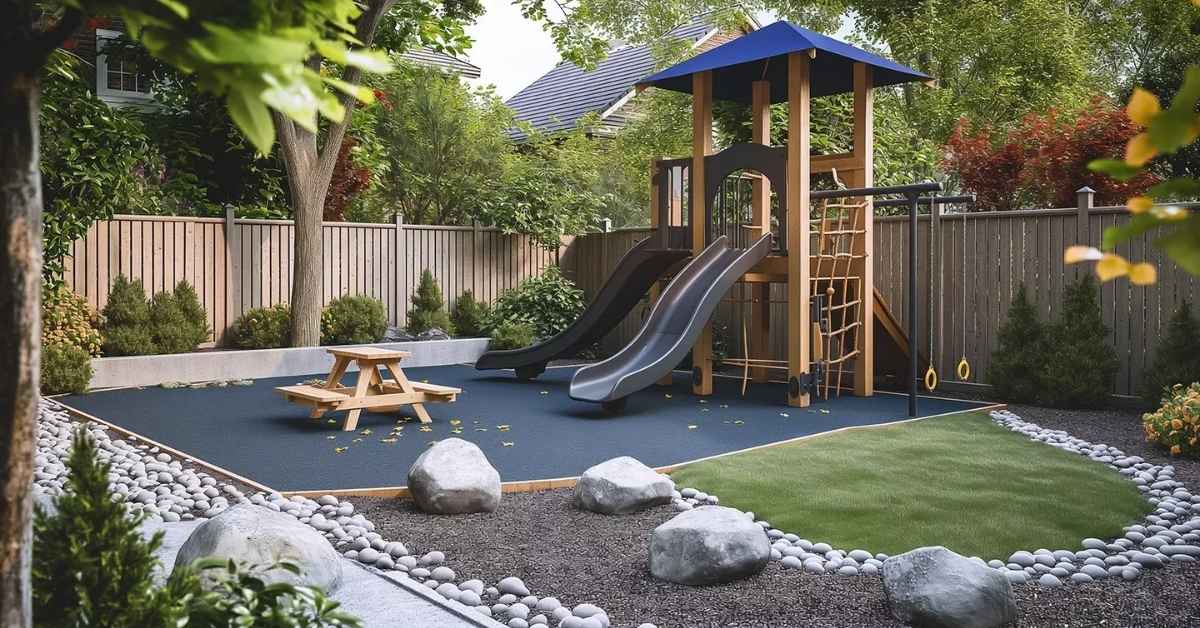
Most yards fail as play spaces because there’s no defined zone kids scatter, equipment sinks into grass, and everything feels temporary. Laying rubber mulch or a patch of artificial turf within a simple wooden or metal border edge creates immediate visual structure. The ground material absorbs impact, drains well after rain, and holds its shape through seasons of use. This setup works especially well under swing sets or climbing frames where grass gets worn to dirt within a few weeks anyway. Renters can use interlocking turf tiles that lift and move cleanly without altering the property.
A Low Climbing Frame With Built-In Slide for Tight Spaces
Big play structures overwhelm small yards and often end up used for about 18 months before kids outgrow them. A compact A-frame climber with a single slide fits into a 10×10 footprint and holds attention longer than you’d expect because the physical challenge scales with the child. Cedar or pressure-treated wood holds up outdoors without constant resealing if sealed once properly at installation. Position it with the slide facing away from direct afternoon sun so the metal doesn’t overheat. This is one I’d actually recommend trying first because it solves the “where do I even start” problem without overcommitting space or budget.
A Sand Play Station With a Lid That Doubles as a Seat

Open sandboxes invite every neighborhood cat in a five-block radius. A covered sandbox, especially one where the lid flips up to function as bench seating solves the hygiene issue and gives adults somewhere to sit while supervising. Cedar construction resists rot naturally and doesn’t require chemical treatment, which matters when kids are digging around in it daily. Keep it positioned in partial shade: full sun makes sand uncomfortable by midday, and full shade holds moisture and encourages mold. Sand play supports fine motor development in ways that screen-based toys don’t, and kids return to it far more consistently than most parents expect.
A Mud Kitchen Built From Repurposed Outdoor Furniture
Mud kitchens have become one of the most consistently used outdoor setups for kids aged 2–8, and they don’t require a kit. An old side table, a plastic basin, and a few cooking utensils from a thrift store get the job done. Mounting it against a fence or exterior wall keeps it from migrating around the yard and gives kids a defined “station” which matters more than most adults realize boundaries create engagement. Add a small shelf above for jars, scoops, and containers. The mess stays mostly contained, cleanup is a hose-down, and the imaginative play it generates is genuinely open-ended in a way most structured toys aren’t.
A Water Play Table Set Into a Shaded Pergola Corner

Water play needs two things adults often skip: shade and drainage planning. A water table positioned under a pergola or large patio umbrella stays usable even in peak summer heat, and placing it on a slightly sloped patio or gravel area means water drains rather than pooling. Raised-leg water tables work better for toddlers; older kids (5+) engage longer with sensory bins at ground level where they can crouch and really dig in. For renters or small spaces, a collapsible silicone bin on a folding table works almost as well and stores flat in winter.
A Swing Set Positioned Along a Fence Line to Preserve Lawn
Most people install swing sets in the middle of the yard, which destroys usable lawn and makes the rest of the space feel segmented. Running a swing set along a fence line with the frame parallel to the fence keeps the center of the yard open while maintaining safe swing clearance. The fence itself can serve as a visual backdrop and windbreak, which actually makes the swing feel more enclosed and calm for younger kids. Ensure at least 6 feet of clear swing-out space from the fence on the user side. This layout works especially well in rectangular yards where maximizing open central space matters.
A Chalkboard Fence Panel for Creative Play Without Permanent Installation

One flat fence panel painted with outdoor chalkboard paint creates a drawing wall that kids use independently without supervision. It costs under $30 in materials, applies to any wood or concrete surface, and washes clean with rain or a light spray. Positioning it at two heights, a lower section for toddlers, a full-height section for older kids means it works across age groups simultaneously. This is especially practical for renters who want to add activity without drilling or building. In my experience, this gets more consistent daily use than most structured equipment because it requires zero setup and kids approach it on their own terms.
A Tiered Garden Bed Where Kids Grow Their Own Snacks
Giving kids their own growing space even a single 2×4 raised bed creates a reason to be outside that isn’t dependent on equipment or screen avoidance. Keep it at a height they can actually reach (24–30 inches is ideal), plant things that produce quickly and visibly (radishes, lettuce, strawberries, cherry tomatoes), and let them manage it themselves with minimal adult intervention. The lack of perfectionism in kids’ gardens is actually an advantage; they’ll water inconsistently and still get results, which builds confidence. Position the bed where it gets 6+ hours of sun and within reach of a hose or rain barrel.
A Balance and Stepping Stone Path Across the Lawn

A series of stepping stones, balance logs, or varying-height wooden stumps laid across the lawn creates a gross motor course that blends into the garden rather than dominating it. Kids naturally navigate these differently depending on age: toddlers step carefully between them, older kids jump gaps, and teenagers use them for balance challenges or parkour-style movement. The key is variation mixing flat stones, round log slices, and slightly raised platforms keeps the challenge interesting. This setup requires almost no maintenance, works in any yard size, and can be rearranged seasonally. Honestly, it’s one of the most underused ideas in backyard design given how little it costs and how much use it gets.
Read More About : 22 Educational Playroom Setup Ideas That Make Learning Feel Like Play
A Shaded Reading Nook With an Outdoor Bean Bag and Book Box
Not every outdoor moment needs to be physical. A quiet corner with a weather-resistant bean bag, a waterproof storage crate for books, and a simple canopy or shade sail gives kids a reason to be outside even when they want downtime. Position it under an existing tree canopy or install a sail shade above a corner of the patio. The transition from energetic play to calm reading outdoors is easier when there’s a defined space for it kids don’t naturally settle unless somewhere signals “this is a settling spot.” Use UV-resistant outdoor fabric and keep the book selection rotating so the spot stays interesting.
A Sensory Path With Different Ground Textures

A sensory path, a series of different ground surfaces laid in sequence gives toddlers and young children proprioceptive input that genuinely supports development. Alternate between smooth paving stone, pea gravel, soft grass, bark chip, and rubber matting in a winding path across a section of yard. It’s easy to install in stages and doesn’t require a contractor. The path also doubles as a visual border between lawn and garden beds, which helps define the space spatially. This setup is especially well-suited to yards where the goal is stimulation without equipment clutter.
A DIY Obstacle Course With PVC Pipes and Pool Noodles
A semi-permanent obstacle course built from low-cost materials, pool noodles, hula hoops, PVC pipes, and rope can be reconfigured weekly to maintain novelty. Drive PVC pipes into the ground as hurdle posts, weave rope between them, add a cargo net section, and finish with a ring toss or balance beam. The modular nature is the real value: the course evolves as kids’ skills improve rather than becoming something they’ve mastered and abandoned. Store components in a labeled bin so kids can set it up themselves, which extends engagement significantly. Works best in longer rectangular yard sections or along a side yard.
A Hammock Between Two Trees as a Calm-Down Zone

Hammocks aren’t just for adults. Hung low between two trees (or using a freestanding frame), a hammock gives kids a vestibular movement experience, the gentle swinging motion that is genuinely calming for most children, particularly those who seek sensory input. Cotton rope hammocks handle outdoor conditions better than fabric ones in humid climates; in dry climates, canvas holds up well. Positioning matters: a bit of afternoon shade makes it usable in summer heat, while full sun exposure means it’s mostly decorative by noon. Keep the base height low enough that falling out isn’t a concern 18 inches off the ground is plenty.
A Vertical Garden Wall Kids Help Maintain
A pallet garden or modular vertical planter mounted at child height (with a few pockets at ground level) turns plant care into a shared outdoor activity rather than an adult chore kids watch. Assign each child specific pockets, herbs, flowers, or trailing plants and give them a small watering can. The vertical footprint means it works in tiny spaces, including narrow side yards or patio areas with no lawn. It also introduces kids to plant cycles, care routines, and the patience of watching something grow, which is a different kind of engagement than play equipment provides. This is a particularly good setup for urban yards where horizontal space is extremely limited.
A Tire Swing on a Single Tree Branch

A well-hung tire swing is one of the highest-use, lowest-cost outdoor additions a backyard can have. The key is installation: use a thick-stranded rope rated for outdoor use, protect the branch with a rubber sleeve, and hang it at a height where the tire clears the ground by 12–18 inches. Unlike rigid swings, the multi-directional movement of a tire swing holds attention longer across age groups. It also handles multiple kids at once in a way that a standard swing doesn’t. Honestly, few things beat the simplicity of this: no assembly, no parts to replace, and it works in a yard with a single suitable tree.
A Small-Scale Ninja Warrior Course Along a Side Yard
Side yards are usually wasted as storage strips or ignored entirely. A low-profile ninja warrior course, monkey bars, a rope climb, a balance beam, and a peg wall runs naturally along the length of a side yard without consuming main garden space. Keep the height modest (4–5 feet maximum) for younger kids, and build in modular sections so elements can be added as skills develop. Pressure-treated lumber and galvanized steel hardware handle weather exposure without constant maintenance. This setup channels kids who need intense physical activity into a defined space rather than redirecting them indoors.
A Loose Parts Play Station With Crates, Ramps, and Planks

Loose parts play a collection of open-ended physical materials kids can combine, stack, and rearrange consistently outperforms fixed equipment for sustained engagement across age groups. A set of sturdy wooden crates, a few 6-foot planks, some lengths of rope, and a collection of large blocks gives kids the raw material to build structures, ramps, obstacle courses, and whatever else they invent. The materials need to be durable and splinter-free; sanded pine or birch works well. Store everything in one large bin or corner of the shed. This setup actively develops problem-solving and spatial thinking in ways that climbing structures, as good as they are, don’t quite replicate.
A Pergola-Covered Play Zone for Year-Round Use
Covering part of the play area with a pergola or polycarbonate roof panel means it stays usable in light rain and heavy sun dramatically extending the hours and seasons kids actually use the space. Position the covered section over a rubber mat or paving base so it doesn’t become muddy. Hang a few sensory elements from the rafters: rope ladders, fabric panels, hanging planters, or a simple trapeze bar. The structure gives kids a different kind of spatial feeling than an open lawn, a sense of enclosure that many children find grounding. This is especially worthwhile in climates with unpredictable summers or cooler springs.
A Night Play Setup With String Lights and Solar Lanterns

Outdoor play shouldn’t end at sunset. String lights mounted on a pergola or fence line, combined with a few solar-powered lanterns along pathways, transform the yard into a usable evening space which is genuinely valuable during hot summer months when kids can’t comfortably play in midday heat. Keep the lighting warm-toned rather than bright white, which creates a calming rather than activating atmosphere as evenings wind down. This setup costs very little beyond the initial string light purchase, runs on solar without ongoing electricity cost, and extends family outdoor time well into the evening.
A Willow Tunnel or Living Structure for Natural Play
A willow tunnel created by planting young willow rods in two parallel rows and weaving them overhead as they grow creates a natural play space that evolves with seasons. In summer it’s a leafy green tunnel; in winter it’s an architectural structure kids use as a fort frame. Willow roots aggressively in moist conditions and grows faster than most plants, meaning a planted tunnel becomes usable within a single season. It requires no maintenance beyond occasional weaving and trimming. This is a particularly good choice for yards where parents want play infrastructure that looks like landscaping rather than playground equipment.
Read More About : 24 Kids Room Wall Decor Ideas That Actually Work in Real Homes
A Weather-Resistant Art Station on the Patio

A dedicated outdoor art space, a simple table with a wipeable surface, weatherproof storage bins for supplies, and a roll of kraft paper on a dowel gives kids a creative outlet that belongs outside. Keeping supplies accessible without adult mediation means kids initiate art sessions independently. Use outdoor acrylic paints and chalk markers rather than standard craft supplies, which degrade in humidity. Position the table under a patio cover or awning so sun doesn’t dry materials too quickly. The mess factor outdoors is almost entirely a non-issue, which removes the psychological friction that often limits indoor art sessions.
A Raised Deck Platform With Under-Deck Storage
A low raised platform, essentially a deck at 12–18 inches off the ground, creates a stage, a fort base, a performance space, or a simple elevated seating area depending on what kids decide it is that week. The real value for parents is the under-deck cavity: a clean, covered storage zone for bikes, outdoor toys, garden tools, and play equipment that otherwise ends up scattered across the yard. Use composite decking for low maintenance or cedar for a more natural look. This setup consolidates storage, defines a focal point in the yard, and gives kids a sense of ownership over a distinct space without requiring a full playset.
A Bug Hotel and Nature Discovery Station

A bug hotel, a structured stack of natural materials (bamboo tubes, pine cones, bark, straw) in a wooden frame turns a garden corner into an ongoing science station. Kids who use one regularly start to notice seasonal patterns, learn to identify insects, and develop a genuinely different relationship with outdoor space than kids whose yards are purely equipment-based. Pair it with a small table, magnifying glasses, and a nature journal for a complete discovery zone. Position it near a garden bed or flower border where insects already gather. The whole setup costs very little, requires no ongoing maintenance, and supports learning that feels like play.
A Low Trampoline Sunk Into the Lawn
An in-ground trampoline set into a dug recess so the jump surface sits at lawn level solves almost every complaint about traditional above-ground trampolines. There’s no frame at height to fall from, the aesthetic integrates cleanly into the lawn, and kids can roll off safely if they lose balance. It requires excavation, which adds cost and commitment, but the result is a permanent feature that doesn’t visually dominate the yard. Air circulation underneath isn’t an issue if the recess is properly shaped. This setup suits families who want trampolining available without the visual impact or safety concerns of a traditional structure. In my experience, this is the one piece of outdoor equipment adults most consistently say they don’t regret installing.
A Tent or Teepee Dedicated to Outdoor Quiet Play

A canvas outdoor teepee or bell tent creates an enclosed space that immediately reframes how kids use the yard. It’s not just shelter, it’s a destination. Kids who use one consistently treat it as a play room that happens to be outside: bringing books, small toys, soft furnishings, and their imagination into a bounded space they feel they own. Use canvas rather than polyester for breathability and durability. Stake it properly and weigh the base in windy climates. Position it in a corner or against a hedge for natural windbreak support. As a setup for kids who need “their space,” this works better than most parents expect.
A Zipline Across the Full Yard Length
A residential backyard zipline mounted between two posts or trees at a gentle downward angle is one of those setups that sounds ambitious but installs in an afternoon. The key variables are height (low starting point reduces risk significantly), angle (5–10 degrees is enough for motion without dangerous speed), and landing zone (soft mulch or turf at the end point). Most residential ziplines top out around 50 feet, which suits average backyards. Kids return to ziplines repeatedly across years because the experience scales with confidence; younger kids go slow and cautious, older kids learn to add momentum. This is especially well-used in yards with length to spare where a swing set would feel undersized.
A Dedicated Bike and Scooter Track Around the Yard Perimeter

Turning the yard perimeter into a simple loop track for bikes and scooters gives kids a reason to ride without leaving the property. A compacted gravel or bark chip path around the lawn edge works for most surfaces; paving stones create a smoother track if budget allows. Add simple corner markers or low painted kerbs for visual definition. The path doubles as a garden border, which means it serves two functions simultaneously separating lawn from planting beds while creating a circuit. This setup is especially practical for families where bike-riding age spans multiple children, since the loop works for balance bikes up through full pedal bikes without changing anything.
What Actually Makes These Outdoor Play Areas Work
The difference between an outdoor space kids use every day and one that’s mostly looked at from the window usually comes down to three things: access, variety, and ownership.
Access means kids can get to the space and initiate play without adult help. Equipment that requires setup, retrieval from storage, or permission creates friction and friction kills independent play. If the sand tools live in an unlocked bin next to the sandbox, kids use the sandbox. If they’re in the garage, they often don’t bother.
Variety doesn’t mean more equipment, it means different types of play are available simultaneously. A yard with a physical challenge (climbing, swinging), a creative element (chalkboard, art station, loose parts), and a quiet zone (hammock, teepee) supports a full range of moods and energy levels. Kids who have one option when they’re not in the mood for it often choose screens instead.
Ownership is underrated. When a section of the yard is genuinely theirs, a garden bed they tend, a mud kitchen they’ve decorated, a teepee they’ve furnished, kids relate to the outdoor space differently. It stops being “the yard” and starts being somewhere they actually want to be.
Outdoor Play Area Ideas by Space Type and Function
| Setup | Best Space Type | Primary Function | Problem It Solves | Approx. Cost Level |
| Rubber mulch zone | Any yard size | Safety surfacing | Grass wear, muddy patches | Low–Medium |
| In-ground trampoline | Medium–large yard | Physical play | Visual clutter of above-ground units | High |
| Mud kitchen | Small yard or patio | Creative/sensory play | Unstructured outdoor engagement | Low |
| Willow tunnel | Medium–large yard | Nature play | Equipment-heavy aesthetic | Very Low |
| Sensory path | Any yard size | Developmental play | Lack of toddler-specific features | Low |
| Pergola-covered zone | Patio or garden corner | All-weather usability | Rain/heat limiting outdoor time | Medium–High |
| Loose parts station | Open lawn area | Open-ended creative play | Single-use equipment boredom | Low |
| Zipline | Long rectangular yard | High-energy physical play | Undersized or boring equipment | Medium |
| Bike track perimeter | Medium–large yard | Active outdoor movement | Kids leaving property to ride | Low–Medium |
| Bug hotel + nature station | Garden corner | Educational outdoor play | Passive yard engagement | Very Low |
Common Outdoor Play Area Mistakes That Limit How Much Kids Actually Use the Space
Installing everything in the center of the yard.
It feels logical to place equipment where there’s the most space, but central placement fragments the rest of the yard into awkward unusable strips around the edges. Zone equipment to one side or perimeter, and preserve open central lawn for unstructured play which kids actually need as much as structured equipment.
Buying for the age they are now, not the age they’ll be.
A toddler-height climbing frame bought for a 3-year-old is often outgrown by 5. Equipment that grows with kids or that can be modified with added components delivers significantly better value. The ninja warrior course, for example, can have sections added and difficulty increased as kids develop.
Underestimating shade.
A play area with full afternoon sun exposure in summer is genuinely unusable between roughly 11am and 4pm in most climates. A single shade sail, strategic pergola placement, or even a large market umbrella changes the usable hours significantly. Before installing anything permanent, spend a week observing where shade falls in your yard at different times of day.
Ignoring storage.
Play equipment left out permanently degrades faster, collects weather damage, and makes the yard feel cluttered. A simple storage solution, a weatherproof deck box, a shed corner, or under-deck space means equipment gets used appropriately and the yard stays functional for adults too.
Skipping the transition zone.
A direct lawn-to-play zone transition gets muddy fast. Even a narrow border of stepping stones or a rubber mat strip at the play area entrance keeps mud from tracking across the lawn and into the house.
FAQ’s
What’s the best outdoor play area surface for kids?
Rubber mulch and artificial turf are the two most practical choices for high-use zones. Rubber mulch absorbs impact, drains well, and doesn’t harbor pests; artificial turf stays clean and dry quickly after rain. Standard lawn works fine for low-intensity use but wears out under swing sets and climbing frames within a season.
How do I create an outdoor play area in a small backyard?
Prioritize vertical and wall-mounted setups: a chalkboard fence panel, a vertical garden, a wall-mounted mud kitchen. Use the perimeter of the lawn rather than the center for any fixed equipment. Freestanding and collapsible items water tables, teepees, folding art stations give you flexibility without a permanent footprint.
How much does a backyard play area cost to set up?
Costs range from under $100 for DIY setups (mud kitchen, sensory path, chalkboard wall) to $2,000–$5,000+ for built structures like pergolas, in-ground trampolines, or large climbing frames. Most families can create a functional, varied play space for $300–$800 using a mix of DIY and purchased items.
What outdoor play equipment holds kids’ interest the longest?
Open-ended setups loose parts play, mud kitchens, sand areas, and art stations consistently hold attention longer than single-function equipment because they support different types of play each time. Physical challenge equipment (ziplines, ninja courses) holds interest when the difficulty can be increased as kids improve.
Is an in-ground trampoline worth it compared to a standard one?
For families who want a long-term installation and have the budget for excavation, yes. In-ground trampolines are safer (no height to fall from), aesthetically cleaner, and more durable since the frame isn’t exposed to UV at height. The main trade-off is cost and the fact that relocation is difficult once installed.
How do I design an outdoor play area that works for multiple age groups?
Include at least one setup for each developmental stage: sensory or sand play for toddlers, climbing and balance for 4–8 year olds, and skill-based physical challenge (ninja course, zipline) for older kids. Loose parts play is the one setup that genuinely works across all ages simultaneously.
Can I create a play area in a rented backyard without permanent changes?
Yes. Freestanding climbing frames, collapsible teepees, interlocking turf tiles, and bolt-free chalkboard paint (on a moveable panel) all avoid permanent installation. Confirm with your landlord before any ground anchoring, but surface-level setups are typically unproblematic in standard rental agreements.
Conclusion
A well-designed outdoor play area doesn’t need to be large or expensive, it needs to be accessible, varied, and suited to the actual constraints of your space. Small changes in layout, surface material, and available play types can shift how often and how independently kids use the yard, which matters more than the presence of any single piece of equipment.
Start with one or two ideas that match your yard size, budget, and the ages of your kids right now. A mud kitchen and a defined ground zone will serve a family with toddlers better than a full climbing structure they can’t use safely yet. Older kids with a long yard get more from a zipline than from a sandbox. Match the setup to the actual space and the actual children and build from there.
