

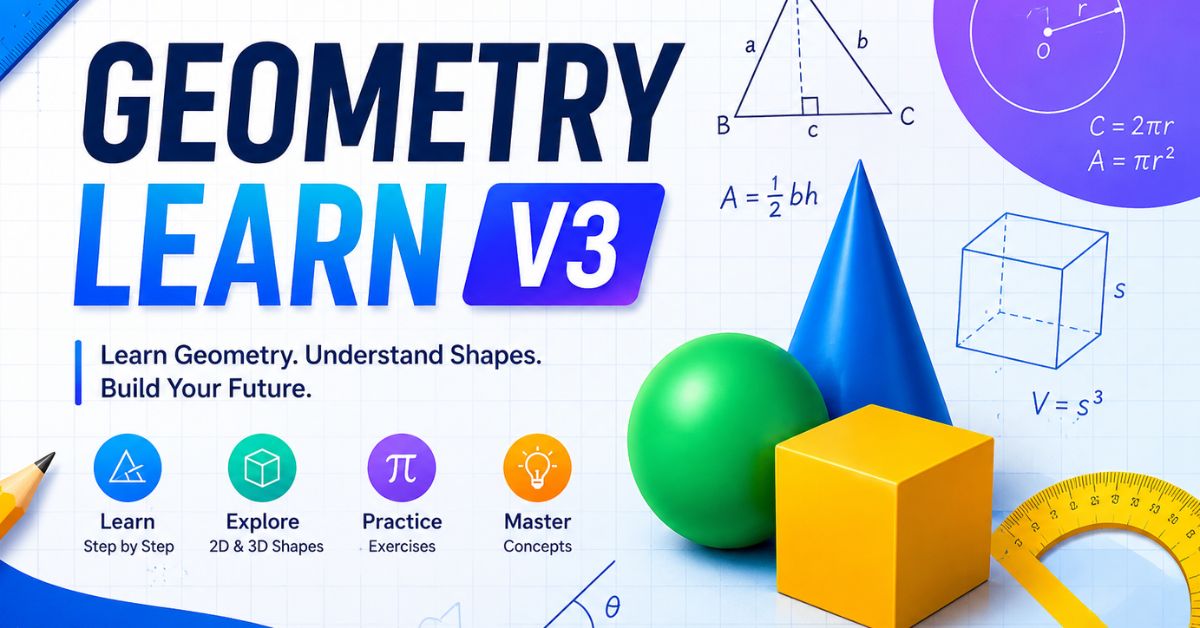
Geometry sits all around you. You see it in your phone screen, your kitchen tiles, and even the shape of your morning coffee cup. Most people never notice how much math shapes their daily choices. That’s where Geometry Learn V3 comes in. This guide helps you learn geometry step by step, without drowning in confusing formulas. You’ll walk away with real basic geometry concepts, clear examples, and the confidence to solve problems on your own.
This article covers everything from simple points and lines to full 3D shapes. It also shows you how geometry in everyday life connects to architecture, sports, and even nature. Let’s get started.
What Does Geometry Learn V3?
Geometry Learn V3 is a fresh approach to teaching geometry basics. Instead of forcing you to memorize formulas, it focuses on visual understanding first. You see the shape. You understand why the formula works. Then the math sticks.
This method works well for geometry for beginners because it builds knowledge slowly. You don’t jump into hard triangle proofs on day one. You start with points and lines, then move up. Many learners say this approach feels more like geometry made easy than a stiff, old-school textbook.
How Geometry Learn V3 simplifies learning
Traditional geometry lessons often throw formulas at students without context. Geometry Learn V3 flips that order. It uses visual learning in geometry to show relationships between shapes before any calculation begins. Picture a triangle. Before you learn its area formula, you see how its sides connect and why its angles behave a certain way. This builds real mathematical thinking, not blind memorization. As one longtime math tutor put it, “Students don’t fail geometry because it’s hard. They fail because nobody showed them the picture first.“
Who should use Geometry Learn V3?
This geometry guide fits many types of learners. Students who need extra help with geometry for school students will find it useful. Parents helping kids with homework can use it as a quick reference. Teachers can pull sections for lesson plans. Even adults brushing up on old math skills benefit from a beginner geometry tutorial that doesn’t feel condescending.
Skills you can build with Geometry Learn V3
You’ll walk away with stronger spatial reasoning skills, better formula recall, and sharper problem-solving speed. You’ll also build logical reasoning and visual reasoning, two skills that help far beyond math class. These skills carry into engineering, design, and even everyday planning tasks like measuring a room for new furniture.
What Is Geometry? A Beginner-Friendly Explanation

Geometry is the branch of math that studies shapes and angles, along with size, position, and distance. It’s different from algebra, which works mostly with numbers and variables. Geometry deals with space itself. This field traces back to Euclidean geometry, the classical system built on points, lines, and logical proofs.
Geometry answers real questions. How far apart are two buildings? How much paint covers a wall? How tall is a tree based on its shadow? These aren’t abstract puzzles. They’re practical problems that geometry solves every single day.
Why geometry matters in everyday life
You use geometry more than you think. Parking a car requires judging angles and distance. Decorating a room means calculating floor space and furniture placement. Even folding a pizza box uses basic geometric folding logic. This is real-world geometry in action, not just classroom theory.
The role of geometry in mathematics
Geometry connects closely to algebra and trigonometry. Many advanced math topics build directly on geometric foundations. Engineers use engineering mathematics rooted in geometric principles daily. Without a solid geometry base, later math topics become much harder to grasp. So this subject isn’t just a stepping stone. It’s the backbone of many mathematical concepts you’ll meet later.
Geometry Basics Every Beginner Must Master
Before tackling triangles or circles, you need the core vocabulary. These basics form the foundation for every shape you’ll study. Think of them as the alphabet before you write full sentences.
Read More About : Stay Updated Always TXEPC (2026): The Smart Guide to Never Miss Critical Updates
Points
A point marks an exact location in space. It has no length, no width, and no height. We usually label points with capital letters like A, B, or C. Points form the starting block for every geometric figure you’ll ever draw.
Lines
A line stretches forever in both directions. It has no thickness and no endpoints. Two points always determine exactly one line. This idea sits at the heart of points lines and planes, the three basic elements of flat geometry.
Line Segments
Unlike a full line, line segments have two fixed endpoints. You can measure their length. A ruler’s edge is a perfect real-world example of a line segment.
Rays
Rays in geometry start at one point and stretch endlessly in a single direction. A flashlight beam captures this idea well. Light starts at the bulb and travels outward without stopping.
Planes
A plane is a flat surface that extends infinitely in every direction. A tabletop or a sheet of paper represents a small piece of a plane. This concept matters heavily in plane geometry, which studies flat, two-dimensional shapes.
Parallel, Perpendicular, and Intersecting Lines
Parallel lines never meet, no matter how far they extend. Railroad tracks show this clearly. Perpendicular lines cross at exactly 90 degrees. Intersecting lines simply cross at any angle. Understanding these geometric relationships helps you solve angle problems faster later on.
Geometry Symbols and Notation
Learning symbols saves time and confusion. Here’s a quick table for reference.
| Symbol | Meaning |
| • | Point |
| ↔ | Line |
| — | Line segment |
| → | Ray |
| ∠ | Angle |
| ≅ | Congruent |
| ∥ | Parallel |
| ⊥ | Perpendicular |
Understanding Angles Step by Step
Angles form whenever two rays share a common starting point, called the vertex. This section teaches you how to measure angles and identify different types of angles with confidence.
Angles use degrees to measure their size. A full circle equals 360 degrees. A straight line equals 180 degrees. A right angle equals exactly 90 degrees. These numbers stay fixed no matter the size of the drawing.
What an angle is
Every angle needs two rays and one shared vertex. The size of the opening between the rays determines the angle’s degree measurement. Bigger openings mean bigger angles.
Types of angles
Here’s a breakdown of common angle types.
| Angle Type | Measurement |
| Acute Angle | Less than 90° |
| Right Angle | Exactly 90° |
| Obtuse Angle | Between 90° and 180° |
| Straight Angle | Exactly 180° |
| Reflex Angle | Between 180° and 360° |
How to measure angles using a protractor
Protractor use follows three simple steps. First, place the center dot on the angle’s vertex. Second, line up one ray with the zero mark. Third, read where the second ray crosses the number scale. Many beginners misread the scale by picking the wrong number line. Always double check before writing your final answer.
Real-life examples of angles
Skateboard ramps, roof pitches, and clock hands all show angles in action. Even a slice of pizza demonstrates an angle at its pointed tip.
Important Angle Relationships You Must Know
Angle relationships save time on tricky problems. Once you spot the pattern, the math becomes far simpler.
Adjacent angles share one vertex and one side. Vertical angles form when two lines cross, and they’re always equal. Complementary angles add up to exactly 90 degrees, while supplementary angles add up to 180 degrees. A linear pair sits on a straight line and always totals 180 degrees too.
An angle bisector splits one angle into two equal halves. Architects and engineers use bisectors often when designing balanced structures. These angle relationships appear constantly in geometry problems, so memorizing them pays off quickly.
Parallel Lines and Transversals Made Easy

A transversal is a line that crosses two parallel lines. This creates several predictable angle patterns that show up again and again on tests.
When a transversal cuts through parallel lines, corresponding angles stay equal. Alternate interior angles also stay equal, as do alternate exterior angles. Consecutive interior angles, sometimes called same-side interior angles, always add up to 180 degrees. These rules make solving transversal problems much faster once you know them by heart.
Corresponding angles
These sit in matching positions at each intersection point. They’re always equal when the lines are parallel.
Alternate interior angles
These sit between the two parallel lines, on opposite sides of the transversal. They’re equal too.
Alternate exterior angles
These sit outside the parallel lines, on opposite sides of the transversal. Just like their interior cousins, they stay equal.
Consecutive interior angles
These sit on the same side of the transversal, between the parallel lines. Their sum always equals 180 degrees.
Real-world applications
Road design, window grids, and bridge trusses all rely on these angle patterns. Builders use them constantly to keep structures level and stable.
Polygons Explained Simply
A polygon is a closed shape made entirely from straight line segments. Polygons come in many forms, and knowing their properties makes solving geometry problems much smoother.
What is a polygon?
Any closed shape built from straight sides counts as a polygon. Circles don’t qualify since their edges curve.
Common polygons
| Polygon | Number of Sides |
| Triangle | 3 |
| Quadrilateral | 4 |
| Pentagon | 5 |
| Hexagon | 6 |
| Heptagon | 7 |
| Octagon | 8 |
Regular vs. irregular polygons
Regular polygons have equal sides and equal angles. Irregular polygons have sides or angles that differ from each other. A stop sign is a regular octagon, while a randomly drawn shape with uneven sides counts as irregular.
Convex vs. concave polygons
Convex polygons have every interior angle under 180 degrees. Concave polygons cave inward at one or more points, creating at least one angle greater than 180 degrees.
Triangles Explained from Every Angle
Triangles rank among the strongest shapes in engineering. That’s why bridges and roof trusses lean on triangular designs so often. This section breaks down triangle properties by both sides and angles.
Types of triangles by sides
An equilateral triangle has three equal sides and three 60 degree angles. An isosceles triangle has two equal sides and two equal angles. A scalene triangle has no equal sides or angles at all.
Types of triangles by angles
An acute triangle has all angles under 90 degrees. A right triangle has exactly one 90 degree angle, and this is where the famous Pythagorean theorem applies: a² + b² = c². An obtuse triangle has one angle greater than 90 degrees.
Triangle Angle Sum Theorem
Every triangle’s interior angles add up to exactly 180 degrees. This rule never changes, no matter the triangle’s size or shape. This is a core part of the triangle angle sum theorem, and it’s one of the most tested rules in geometry class.
Exterior Angle Theorem
An exterior angle always equals the sum of the two opposite interior angles. This shortcut saves time on many theorem applications during problem solving.
Triangle Inequality Theorem
The sum of any two sides must exceed the length of the third side. Without this rule, the triangle simply cannot exist.
Everyday examples of triangles
Roof trusses, bicycle frames, and transmission towers all rely on triangle strength. This stability makes triangles a favorite shape in construction and design.
Read More About : Playing Games Blog PlayBattleSquare Complete Guide 2026 to Improve Your Gaming Experience
Quadrilaterals Made Simple
Quadrilaterals are four-sided shapes, and their interior angles always add up to 360 degrees. Each type carries unique quadrilateral properties worth knowing.
A square has four equal sides and four right angles. A rectangle has opposite sides equal, also with four right angles. A parallelogram has opposite sides that are equal and parallel. A rhombus has four equal sides but doesn’t require right angles. A trapezoid has exactly one pair of parallel sides. A kite has two pairs of adjacent equal sides, with diagonals meeting at right angles.
| Shape | Equal Sides | Right Angles | Parallel Sides |
| Square | 4 | Yes | 2 pairs |
| Rectangle | Opposite | Yes | 2 pairs |
| Rhombus | 4 | Not always | 2 pairs |
| Parallelogram | Opposite | No | 2 pairs |
| Trapezoid | Usually none | Not always | 1 pair |
| Kite | Adjacent | No | None |
Picture frames, credit cards, and solar panels all show quadrilateral shapes in daily life.
Circles and Their Parts Explained
A circle has no corners or straight sides. Every point on its edge sits the same distance from the center. This section covers circle properties and circle formulas explained in simple terms.
The center marks the exact middle of the circle. The radius and diameter describe distance measurements, where the diameter always equals twice the radius. Circumference measures the distance around the circle, using the formula C = 2πr. A chord connects two points on the circle’s edge, while an arc represents part of that edge. A sector looks like a pizza slice, bordered by two radii and an arc. A tangent touches the circle at exactly one point, always meeting the radius at 90 degrees. A secant crosses through the circle at two points.
| Measurement | Formula |
| Diameter | 2r |
| Circumference | 2πr |
| Area | πr² |
Coins, wheels, and clocks all show circles doing real work in the world around you.
Perimeter, Area, Volume, and Measurement Basics
These three measurements often confuse beginners, but each answers a different question. Understanding perimeter vs area clears up most of the confusion right away.
The perimeter measures the distance around a flat shape, like a fence around a yard. Area measures the space inside that shape, like carpet covering a floor. Volume measures the space inside a 3D object, like water filling a tank. Surface area and volume work together when figuring out how much material covers or fills an object.
| Measurement | Common Formula |
| Rectangle Perimeter | 2(l + w) |
| Rectangle Area | l × w |
| Triangle Area | ½ × base × height |
| Circle Area | πr² |
| Cube Volume | s³ |
Always match your measurement units. Area uses square units, volume uses cubic units, and perimeter uses plain linear units. Mixing these up is one of the most common mistakes students make on tests.
Coordinate Geometry for Beginners
Coordinate geometry blends algebra with geometry to pinpoint exact locations on a graph. This section covers coordinate plane basics in plain, simple language.
The Cartesian plane uses two number lines that cross at the origin point (0,0). The horizontal line is the x-axis, and the vertical line is the y-axis. Together, they split the plane into four quadrants. Graph plotting starts at the origin, moves horizontally first, then vertically.
The distance formula calculates the straight-line gap between two coordinates. The midpoint formula finds the exact halfway point between them. These tools power navigation and GPS, digital maps, video game design, and robotics. When your phone calculates the fastest route somewhere, it relies on precise graph coordinates pulled from satellite signals.
Symmetry, Transformations, and Similarity
Geometric transformations show how shapes move or change while keeping certain properties intact. This field, sometimes called transformation geometry, covers several key motions.
Line symmetry splits a shape into two identical halves using a straight line. Rotational symmetry means a shape looks the same after spinning by a certain angle. Reflection flips a shape across a line, creating a mirror image. Translation slides a shape without changing its size or orientation. Rotation turns a shape around a fixed point. Dilation resizes a shape while keeping it proportional.
Congruent figures share the exact same size and shape. Similar figures share the same shape but differ in size. Two photos printed at different sizes are similar, not congruent.
Three-Dimensional Shapes Explained
3D shapes have length, width, and height, which gives them volume. This branch falls under solid geometry, distinct from flat, two-dimensional shapes.
A cube has six square faces, twelve edges, and eight vertices. A cuboid looks similar but uses rectangular faces instead of square ones. A sphere keeps every point the same distance from its center, like a basketball. A cylinder has two circular bases connected by a curved surface. A cone has one circular base and one pointed vertex. A pyramid has a polygon base with triangular faces meeting at a single point. A prism has two matching polygon bases connected by rectangular faces.
| Solid | Faces | Edges | Vertices |
| Cube | 6 | 12 | 8 |
| Cuboid | 6 | 12 | 8 |
| Cylinder | 3 surfaces | 2 curved edges | 0 |
| Cone | 2 surfaces | 1 curved edge | 1 |
| Sphere | 1 curved surface | 0 | 0 |
Essential Geometry Formulas You Should Memorize
Memorizing geometry formulas becomes far easier once you connect each one to its shape. Here’s a quick reference table covering the most common formulas.
| Shape | Formula |
| Triangle Area | ½ × base × height |
| Square Area | side² |
| Rectangle Area | length × width |
| Circle Area | πr² |
| Circle Circumference | 2πr |
| Cube Volume | side³ |
| Cylinder Volume | πr²h |
Geometry in Everyday Life
Geometry powers far more than classroom exercises. Architects rely on it for architecture design, ensuring buildings stay both attractive and structurally sound. Engineers use engineering applications daily when designing bridges, aircraft, and machinery. Interior designers use it to arrange furniture and balance room space.
Sports also lean on geometry constantly. Basketball bank shots, soccer passing angles, and golf swing alignment all rely on spatial judgment. Video game developers use polygons to build entire 3D worlds through computer graphics. Robotics engineers calculate distances and angles so machines can move safely. Doctors even use geometry in medical imaging tools like CT scans and MRIs.
Geometry Patterns Found in Nature
Nature used geometry long before humans wrote it down in textbooks. Geometry examples from nature reveal just how deeply these patterns run.
Honeybees build hexagonal honeycombs because hexagons store the most honey while using the least wax. Snowflakes almost always show six-sided symmetry, with each one still unique. Sunflower seeds grow in spiral patterns that pack space efficiently. Spider webs combine circles, triangles, and radial lines for maximum strength with minimal silk. Seashells often grow in logarithmic spirals, allowing continuous growth without changing shape. Crystals like quartz and salt form predictable geometric patterns during their natural growth process.
Proven Strategies to Learn Geometry Faster
Learning geometry doesn’t need to feel overwhelming. These tips help you improve geometry skills steadily over time.
Master the basics first before jumping into harder proofs. Draw every problem, since geometry is highly visual by nature. Visualize the shape before grabbing your calculator. Memorize formulas by connecting them to their real purpose, not through blind repetition. Practice a little every single day rather than cramming once a week. Use digital tools that let you rotate and manipulate shapes on screen. Review your mistakes closely, since each wrong answer teaches something valuable.
Common Geometry Mistakes and How to Avoid Them
Even strong students slip up sometimes. Watch for these common traps during geometry problem solving.
Never assume a diagram is drawn to scale unless the problem states it directly. Don’t mix up formulas, especially between area and volume equations. Remember that perimeter measures distance around a shape, area measures the space inside, and volume measures space within a 3D object. Double check angle relationships before finalizing an answer. Always include correct measurement units in your final response, since dropping them can cost marks even with correct math.
Geometry Learn V3 Practice Guide
A structured routine builds steady progress without burnout. This geometry study guide breaks practice into three stages.
Beginners should focus on naming shapes, identifying angle types, and practicing basic perimeter and area problems. Intermediate learners should move into triangle theorems, circle properties, and coordinate geometry. Advanced learners can tackle composite figures, angle proofs, and multi-step word problems that combine several concepts at once. A weekly checklist covering angles, triangles, quadrilaterals, circles, and volume keeps your geometry practice on track.
Geometry Learn V3 Quick Reference Tables
These geometry revision notes work well for quick review before a test or quiz.
| Relationship | Rule |
| Complementary | Sum = 90° |
| Supplementary | Sum = 180° |
| Vertical | Equal |
| Linear Pair | Sum = 180° |
Frequently Asked Questions
Is Geometry Learn V3 suitable for complete beginners?
Yes. It introduces every concept step by step, making it perfect for learners with no prior geometry background.
Can Geometry Learn V3 help with school exams?
Absolutely. It covers core topics taught in middle school, high school, and early college courses.
How long does it take to learn basic geometry?
Most learners build a solid foundation within a few months by studying just 20 to 30 minutes daily.
Which geometry formulas should beginners memorize first?
Start with perimeter, basic area formulas, circumference, and volume for cubes and rectangular boxes.
What are the most important geometry concepts?
Focus on points, lines, angles, triangles, quadrilaterals, circles, coordinate geometry, and basic measurement rules.
Conclusion
Geometry isn’t just a school subject. It’s a practical skill that shapes how you see buildings, nature, and even sports. Geometry Learn V3 gives you a clear, step-by-step path through every major concept, from simple points to full 3D shapes. Keep practicing a little each day, and these patterns will start showing up everywhere you look. Start with one shape today, and the rest will follow naturally.
