

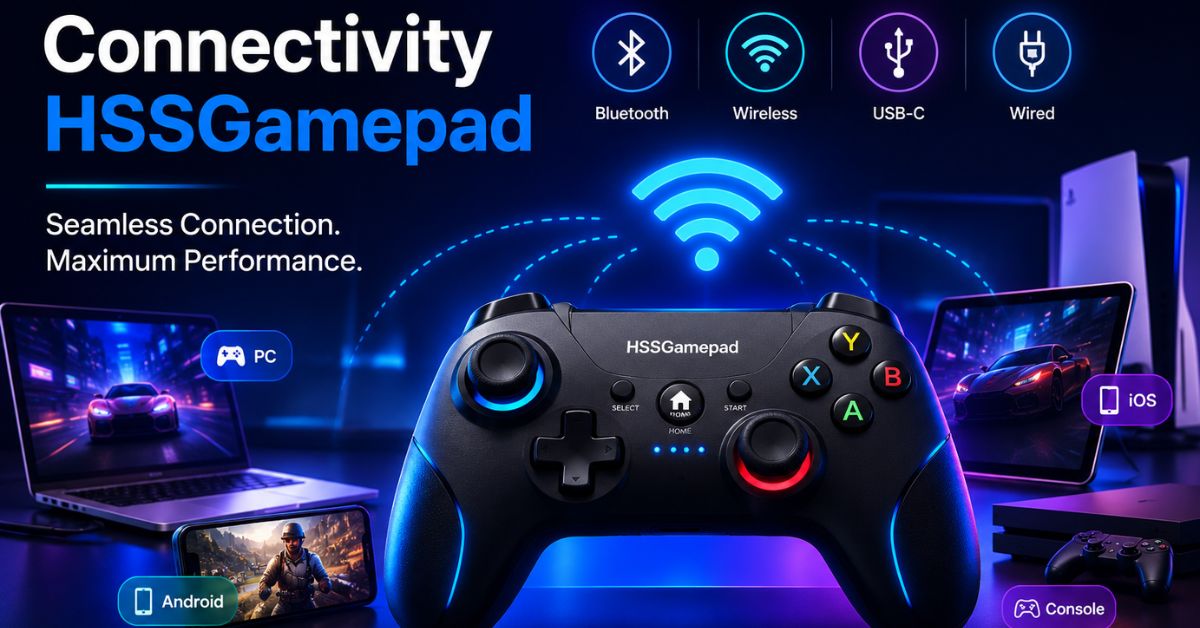
You press a button. Nothing happens. Then, half a second later, your character finally jumps. By then, you’re already dead. Sound familiar? This is the reality of poor HSS gamepad connectivity, Connectivity HSSGamepad and it’s the single biggest reason gamers lose matches they should have won.
This guide breaks down everything about connectivity HSSGamepad setups. Connectivity HSSGamepad You’ll learn how the connection works, why it breaks, and how to fix it for good.Connectivity HSSGamepad No jargon. No fluff. Just clear answers you can use today.
What Is Connectivity HSSGamepad?
Connectivity HSSGamepad simply means how your controller talks to your device during gameplay.Connectivity HSSGamepad It’s not just one cable or one signal. It’s a full chain of events that starts the moment you press a button and ends when your character moves on screen.
Think of it like passing a note in class. Your hand writes the note (input), it travels through the room (transmission), and the teacher reads it (the game engine). If any part of that chain slows down, Connectivity HSSGamepad the whole message arrives late. That’s exactly what happens with a wireless gamepad or wired USB controller when the connection isn’t stable.
Understanding HSSGamepad Connectivity
The HSS controller connection works in three layers. First, the controller processes your input through its internal chip. Second, it sends that signal out, either through Bluetooth technology, a wireless receiver, or a physical USB cable. Third, your device receives and interprets that signal, then acts on it inside the game.
Each layer adds a tiny bit of delay. On its own, that delay is nothing. But stack a slow chip, Connectivity HSSGamepad a crowded wireless channel, and an old driver together, and suddenly you’ve got real, noticeable input delay. Most players blame the controller itself. In reality, the problem usually lives somewhere in this three-step chain.
Why Connectivity Is Essential for Gaming
Here’s the truth nobody tells you: your reflexes don’t matter if your Connectivity HSSGamepad gaming controller latency is high. You could have the fastest hands in the room, but if your signal takes 150 milliseconds to reach the screen, you’ll still lose to someone with an average reaction time and a stable gamepad connection.
This matters most in fast games. In shooters, a low latency controller means you land your shot before the enemy lands theirs. In racing games, it means your turn happens exactly when you steer, not a beat later. Connectivity HSSGamepad In fighting games, timing is everything, and even small delays throw off your combos completely.
Types of Connectivity Supported by HSSGamepad

Not all connections are equal. The HSSGamepad supports three main types, and each one fits a different kind of player. Picking the right one changes your gaming controller performance more than any other setting you’ll touch.
Below is a quick breakdown of what each type offers, so you can match it to how you actually play.
Bluetooth Connectivity
A Bluetooth game controller connection is the easiest to set up. You turn on Bluetooth pairing mode, Connectivity HSSGamepad select your device, and you’re in. It’s great for casual play on the couch, watching Netflix between rounds, or gaming from across the room.
But Bluetooth has a downside. It shares its frequency band with routers, phones, and other wireless gaming accessories. That crowding causes wireless signal interference, Connectivity HSSGamepad which slows your response time. For relaxed, low-pressure gaming, it’s fine. For anything competitive, it can hold you back.
Read More About : Xendit Gamification Summit Work How Xendit Built an Engaging Employee Experience
Wired USB Connection
A wired USB controller skips the wireless step entirely. Your inputs travel through a physical cable straight to your device. There’s no signal to lose, no interference to fight, Connectivity HSSGamepad and no battery to worry about.
This is the gold standard for competitive gaming. Response times drop to single-digit milliseconds, and they stay that way no matter how many other devices are running nearby. If you’re serious about ranked matches or tournaments, a USB gamepad connection removes one more excuse for losing.
2.4GHz Wireless Dongle
A 2.4GHz wireless gamepad connection uses a small USB dongle controller instead of Bluetooth. It creates a direct, dedicated link between your controller and your device, which cuts out a lot of the crowding that Bluetooth suffers from.
This option gives you the freedom of wireless play with performance that’s close to wired. Connectivity HSSGamepad It’s a smart middle ground for players who want mobility without giving up speed. Many competitive setups actually prefer this over standard Bluetooth for exactly that reason.
Which Connection Type Is Best?
It depends on how you play. Connectivity HSSGamepad Casual gamers do fine with Bluetooth. Competitive players should lean toward wired or the 2.4GHz dongle. Here’s a simple table to help you decide.
| Connection Type | Best For | Average Latency |
| Bluetooth | Casual, couch gaming | 80–250 ms |
| 2.4GHz Dongle | Balanced wireless play | 2–10 ms |
| Wired USB | Competitive, ranked play | 1–5 ms |
How Connectivity HSSGamepad Works
Now let’s look under the hood. Understanding how HSSGamepad connectivity works helps you spot problems faster when something goes wrong.
Every input follows the same basic path, whether you’re using wireless or wired mode. Connectivity HSSGamepad The controller reads your press, translates it into data, sends it out, and your device turns that data back into an action on screen.
How Controllers Communicate with Devices
When you press a button, a micro-switch inside the controller activates. The controller’s controller firmware processes that signal and encodes it into digital data. That data then travels through your chosen connection method, whether it’s Bluetooth pairing, a wireless receiver, or a USB interface.
Once your device receives the signal, it decodes the data and passes it to the game engine, Connectivity HSSGamepad which finally executes the action. This entire process happens in milliseconds, but every single step adds a small amount of time. Add them all up, and you get your total controller response time.
Latency and Response Time Explained
Latency is the gap between your button press and the action appearing on screen. Connectivity HSSGamepad Lower is always better. A delay under 10 milliseconds feels instant. Anything above 100 milliseconds starts to feel sluggish, and you’ll notice it immediately in fast-paced games.
Input delay builds up from multiple sources: the controller’s internal processing, the transmission method, and even your display’s own refresh rate. Wireless connections naturally Connectivity HSSGamepad add more steps to this chain than wired ones, which is why wired vs wireless gamepad debates always come back to speed.
Wired vs Wireless Performance
Wired connections win on raw speed every time. There’s no signal to decode, no battery drain, and no interference to fight through. Wireless connections win on convenience and freedom of movement, but they ask you to trade a little speed for that comfort.
For most players, this trade-off is fine. But if you’re chasing every possible millisecond in ranked play, wired mode is worth the extra cable.
How to Connect HSSGamepad to Different Devices

Setting up your controller looks a little different depending on your device. Below, we’ll walk through Windows controller setup, mobile pairing, and console connections step by step.
Each device has its own quirks, but the core process stays the same: turn on Bluetooth pairing mode, Connectivity HSSGamepad find your controller, and confirm the connection.
Connect to Windows PC
To connect the HSS gamepad to the Windows PC, open your Bluetooth settings and select “Add a device.” Connectivity HSSGamepad Put your controller into pairing mode by holding the sync button until the light flashes. Connectivity HSSGamepad Once it appears in your device list, click to pair.
If you’re using a wired or dongle connection instead, plug in the cable or USB dongle controller, and Windows should install the correct controller driver installation automatically. Connectivity HSSGamepad If it doesn’t detect the device, check for a driver update through Windows Update or the manufacturer’s website.
Connect to Android
To connect HSS gamepad to Android, open your phone’s Bluetooth settings and enable Android compatibility mode on the controller. Connectivity HSSGamepad Hold the pairing button until it starts blinking, then select the controller from your phone’s available devices list.
Most modern Android phones support Android gamepad connections without extra apps. If your controller doesn’t show up right away, try restarting Bluetooth on your phone or moving closer to reduce gamepad signal interference.
Connect to iPhone (iOS)
To connect the HSS gamepad to the iPhone, go to Settings, then Bluetooth, and make sure it’s turned on. Put your iPhone game controller into pairing mode, then tap it once it shows up on your screen.
Apple devices generally handle iOS compatibility well with MFi-certified controllers. If pairing fails, forget the device in Bluetooth settings and try again from scratch. This clears out any leftover connection data that might be causing conflicts.
Connect to Gaming Consoles
Console pairing usually follows a similar pattern across most systems. Hold the sync button on your controller, then use your console’s controller menu to search for new devices. Once found, select it to complete the pairing.
Console compatibility varies by brand, so check your specific console’s manual if the standard steps don’t work. Some consoles also support wired connections through a direct USB port, which skips the pairing process entirely.
Step-by-Step HSSGamepad Setup Guide
Once you understand the basics, actually setting up your controller only takes a few minutes. Connectivity HSSGamepad Here’s the full controller pairing process, broken into simple steps.
Follow these in order, and you’ll Connectivity HSSGamepad have a working connection before your coffee gets cold.
Pair the Controller
Turn on your controller and hold the sync button for about three seconds. Connectivity HSSGamepad Watch for the pairing light to start flashing. On your device, open Bluetooth settings and select the controller once it appears in the list. Confirm the connection, and you’re done.
Switch Between Bluetooth and Wired Mode
Most HSSGamepad models let you switch modes without a full reset. Simply plug in a USB cable to Connectivity HSSGamepad switch to wired mode automatically, or unplug it to return to wireless. Some models require holding a mode button briefly to toggle between the two manually.
Verify the Connection
After pairing, test your controller in a game menu or a controller test tool. Connectivity HSSGamepad Press every button and move both sticks to confirm everything registers correctly. If inputs feel delayed or don’t register at all, revisit your pairing steps before jumping into a match.
Common Connectivity HSSGamepad Problems
Even a great controller runs into trouble sometimes. Connectivity HSSGamepad Here are the most common gamepad connection problems players report, and what they actually look like in practice.
Recognizing these symptoms early saves you from blaming the wrong thing during a match.
Input Lag and Delay
This is the most annoying issue by far. Your movements feel like they’re happening a beat behind your actual button presses. It makes your character feel disconnected from your hands, Connectivity HSSGamepad and it’s especially painful in fast reaction games.
Read More About : Exploring goralblue com A Growing Platform for Travel, Lifestyle & SEO Content
Random Disconnects
Your controller just stops responding, sometimes mid-match. You might hear a disconnect beep, or your character simply freezes in place until the connection comes back. This is one of the most frustrating controller disconnect fix situations to deal with.
Bluetooth Pairing Issues
Sometimes your device just won’t find the controller, or it gets stuck in pairing mode without connecting. Connectivity HSSGamepad This usually points to leftover pairing data or a Bluetooth controller troubleshooting issue on your device’s end.
Signal Interference
Modern homes are full of wireless signals. Routers, phones, smart TVs, Connectivity HSSGamepad and other wireless gaming accessories all compete for the same frequency space, and that competition causes dropped or delayed signals.
Controller Freezing or Stuttering
This feels like short, sudden freezes during gameplay. Your inputs might skip a frame or two, making movement feel jerky instead of smooth.
Controller Not Detected
Your device simply doesn’t recognize the controller at all. This is often a driver problem, though it can also point to a hardware fault or an outdated firmware version.
Why Your HSSGamepad Connection Becomes Unstable

Now that you know the symptoms, let’s dig into the actual causes. Most connection problems trace back to one of five root issues.
Understanding these causes helps you fix problems permanently instead of just working around them every time you play.
Wireless Interference
The 2.4GHz band is crowded. Wi-Fi routers, other Bluetooth technology devices, Connectivity HSSGamepad and wireless peripherals all fight for the same space, which creates the wireless signal interference that ruins your connection quality.
Low Battery
A controller running low on power can’t transmit a strong signal. This shortens your wireless range, delays your response time, and increases the odds of a random disconnect mid-game.
Distance from the Device
Distance matters more than most players realize. Staying within two to three meters keeps your Bluetooth connection strong. Walls, furniture, and other obstacles weaken the signal even further.
Outdated Firmware or Drivers
Old controller firmware or outdated controller drivers cause communication errors Connectivity HSSGamepad between your controller and device. This shows up as pairing failures, sudden lag spikes, or inconsistent timing.
Too Many Connected Devices
Every device sharing your wireless channel eats into available bandwidth. A headset, phone, keyboard, and mouse all running at once can quietly choke your controller’s signal without you even noticing.
How to Fix Connectivity HSSGamepad Issues
Time for solutions. These fixes solve the vast majority of connection problems, and most of them take less than five minutes.
Work through them in order, starting with the simplest fix first.
Recharge the Controller
Charge your controller fully before any long session. Avoid playing once your battery drops below twenty percent, since low power directly weakens your controller signal strength.
Re-Pair the Controller
Remove the device from your Bluetooth list, restart the controller, and pair it again from scratch. This clean reset solves a surprising number of stubborn connection issues.
Update Firmware and Drivers
Check for the latest update HSS gamepad firmware release, along with your system’s Bluetooth drivers. Manufacturers release these updates specifically to patch known bugs.
Reduce Bluetooth Interference
Move your router away from your gaming area, turn off unused Bluetooth devices, and keep your controller close to the receiver. These small changes make a real difference.
Switch Between Wired and Wireless Modes
If wireless keeps failing you, switch to wired mode temporarily. It’s a fast, reliable way to reduce controller input lag while you troubleshoot the wireless side.
Restart the Connected Device
Sometimes the fix is that simple. Restarting your PC, phone, or console clears out temporary glitches that might be blocking a stable connection.
Advanced Troubleshooting for Better Performance
If the basic fixes didn’t solve your problem, it’s time to dig deeper. These advanced steps target more stubborn controller troubleshooting cases.
They take a little more effort, but they solve issues that basic fixes usually can’t touch.
Clear Bluetooth Pairing History
Old, duplicate, or “ghost” device entries confuse your system. Remove every old controller entry from your Bluetooth list, then pair fresh.
Optimize Power Settings
Power-saving modes often throttle Bluetooth performance without you realizing it. Disable USB selective suspend and turn off aggressive battery optimization settings on your device.
Match Bluetooth Version Compatibility
Older Bluetooth versions add more lag. Bluetooth 5.0 and above gives you the best performance, 4.x is moderate, and anything below that carries a high risk of noticeable delay.
Use Wired Mode for Competitive Gaming
For ranked matches or tournaments, skip wireless entirely. A wired USB controller removes interference completely and gives you the lowest possible latency.
Optimize Your Gaming Setup
Keep a clear line of sight between your controller and receiver. Minimize obstacles, and keep the distance short. Small changes in your gaming setup often solve big problems.
Compatibility and System Requirements
Before you troubleshoot further, make sure your setup even supports what you’re trying to do. Gaming controller compatibility varies across platforms, so it’s worth double-checking.
Here’s a quick compatibility breakdown to save you some guesswork.
| Platform | Requirement |
| Windows | Windows 10 or later, Bluetooth 4.0+ |
| Android | Android 8.0 or later |
| iOS | MFi certification recommended |
| Consoles | Native Bluetooth or USB support |
Supported Operating Systems
The HSSGamepad works across Windows, Android, and iOS, along with most modern consoles. Always check for the latest OS updates, since older versions sometimes lack full device compatibility.
Bluetooth Requirements
For the best performance, your device should support Bluetooth 5.0 or higher. Older versions still work, but they come with higher latency and weaker connection stability.
USB Compatibility
Any standard USB port supports wired connections. USB-C and USB-A both work fine, though USB-C ports on newer devices tend to offer slightly better data transfer speeds.
Console Compatibility
Most consoles support both wireless and wired HSSGamepad connections. Check your console’s official accessory list to confirm full support before buying any adapters.
Wired vs Wireless HSSGamepad: Which Is Better?
This is the question every gamer eventually asks. The honest answer is: it depends on what you’re playing and how seriously you’re playing it.
Let’s break down the real differences so you can make the right call for your own setup.
Performance Comparison
Wired connections consistently beat wireless in raw speed. There’s no signal to decode and no interference to fight. Wireless connections are close enough for most casual play, but they can’t quite match wired performance under pressure.
Battery Life
Wireless mode drains your controller’s battery over time. Wired mode, on the other hand, often charges your controller while you play, which means you never have to worry about controller battery life mid-session.
Best Option for Competitive Gaming
For ranked play, tournaments, or anything where milliseconds matter, wired wins every time. For relaxed, casual sessions, wireless gives you comfort without a real performance cost.
Common Connectivity Problems, Causes, and Solutions
Here’s a consolidated table pulling together everything covered so far, so you can find your specific issue fast.
| Problem | Real Cause | Fix |
| Input lag | Wireless delay | Switch to wired or 2.4GHz dongle |
| Random disconnects | Low battery | Recharge the controller fully |
| Pairing issues | Old device memory | Clear and reset Bluetooth list |
| Stuttering | Signal interference | Reduce nearby wireless devices |
| Not detected | Driver mismatch | Update firmware and drivers |
How Stable Connectivity Improves Gaming Performance
A stable connection changes everything about how a game feels. It’s not just about avoiding annoyance, it’s about actually playing better.
Once your connection is solid, you’ll notice the difference almost immediately, especially in fast or competitive games.
Lower Input Lag
A stable HSS controller connection cuts input lag down to almost nothing. Your actions match your intentions in real time, which matters more than people think.
Faster Response Time
With reduced latency, your controller response time improves across every game genre, from shooters to platformers.
Better Multiplayer Experience
Multiplayer games punish lag hard. A stable connection keeps you competitive against players with similar skill, instead of losing to your own equipment.
Improved Gaming Accuracy
Precise aiming, tight cornering, and clean combos all depend on your inputs registering exactly when you make them. Stable connectivity makes that possible.
Pro Tips to Maintain Long-Term Connectivity Stability
Small habits prevent big problems down the road. These simple practices keep your HSS controller connection reliable for months, not just for one session.
Keep Firmware Updated
Check for firmware updates at least once a month. This one habit alone prevents most long-term connectivity issues.
Avoid Wireless Congestion
Turn off unused Bluetooth devices before gaming sessions. Fewer competing signals means a cleaner, faster connection.
Maintain Battery Health
Avoid leaving your controller charging overnight repeatedly, since this can wear down battery capacity over time.
Store the Controller Properly
Keep your controller away from routers and other electronics when not in use. This protects both the hardware and the internal battery.
Why Gamers Misdiagnose Connectivity Problems
Many players blame the wrong thing entirely, which wastes time and money on fixes that were never needed.
Understanding the real difference between these issues saves you a lot of frustration.
Controller Lag vs Internet Lag
Controller lag affects your inputs specifically. Internet lag affects the game world around you. They feel similar, but they come from completely different sources and need different fixes.
Hardware vs Software Issues
A worn-out controller is a hardware problem. A pairing glitch or outdated driver is a software problem. Telling them apart saves you from replacing a perfectly good controller.
Common Bluetooth Myths
Many players believe Bluetooth is always slow, but modern Bluetooth technology has improved massively. Version 5.0 and above performs far better than older generations, and blaming Bluetooth alone often overlooks the real cause.
Case Study: Fixing a Laggy HSSGamepad Setup
A competitive FPS player reported input lag between 150 and 200 milliseconds, along with random disconnects during ranked matches.
The Problem
Movements felt delayed, and the controller occasionally dropped connection entirely mid-fight.
Root Cause
Investigation revealed the controller was running at just twelve percent battery. The router sat right next to the console, and a Bluetooth headset was active at the same time, all competing for the same signal space.
Solution Applied
The player switched to a wired USB controller connection, moved the router two meters away, and disabled the unused Bluetooth headset during gaming sessions.
Final Results
Latency dropped below ten milliseconds. Disconnects stopped completely for two full weeks. Reaction time improved noticeably in ranked matches.
“Your aim is only as fast as your signal. If your connection hesitates, you already lost the fight.” This quote captures the core truth behind competitive gaming performance.
Expert Tips for Competitive Gaming
Serious players treat their connection setup like part of their training. Wired connections, dedicated USB ports, and a low-interference environment form the foundation of any low latency gaming setup. Fully charged batteries and updated firmware round out a setup built for consistency, match after match.
Frequently Asked Questions
Why does my HSSGamepad lag even when it’s new?
New controllers still depend on your environment, firmware version, and signal quality. A brand-new controller isn’t immune to interference or outdated drivers.
Is a wired connection always better than Bluetooth?
For competitive play, yes. For casual gaming, Bluetooth works just fine and offers more freedom of movement.
Can Wi-Fi affect HSSGamepad connectivity?
Yes, especially 2.4GHz Wi-Fi networks placed close to your gaming setup. They compete directly for the same signal space.
How often should I update the firmware?
Once a month is a solid habit for keeping your HSS gamepad connectivity stable and bug-free.
Why won’t my HSSGamepad connect to my PC?
This usually points to an outdated driver or a corrupted pairing entry. Clear your Bluetooth list and reinstall the latest driver.
How can I reduce input lag?
Switch to wired mode, keep your controller charged, and reduce nearby wireless interference for the most noticeable improvement.
Conclusion
Great gaming performance doesn’t start with expensive hardware. It starts with a stable connection. Once you understand how connectivity HSSGamepad actually works, you stop blaming random lag spikes and start fixing the real causes behind them.
Clean setup, updated firmware, and a controlled environment turn any HSSGamepad into a reliable weapon. In the end, mastering your connection matters just as much as mastering your skills. Get your signal right, and everything else falls into place.
