

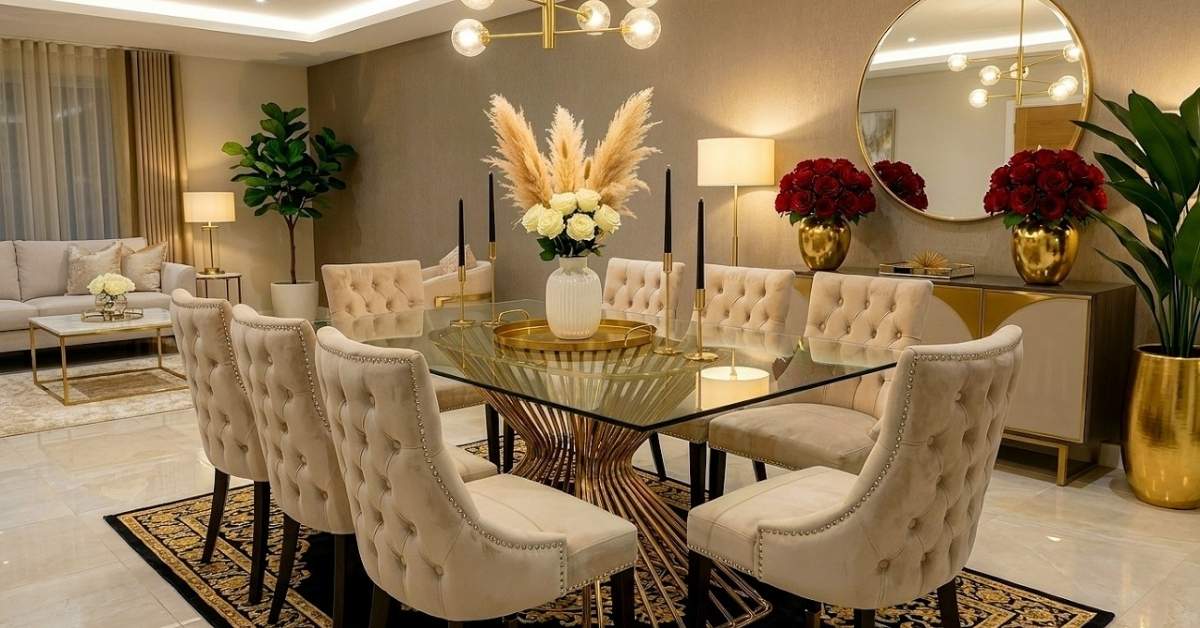
There’s a specific feeling that a well-designed dining room creates the kind where guests slow down, linger longer, and actually notice the room itself. It’s not always about expensive furniture or rare materials.Luxury Dining Room Decor Ideas More often, it’s about proportion, light, and the way elements work together to create something that feels considered rather than assembled.
If your dining room currently functions but doesn’t feel like anything in particular, that’s usually a layout or atmosphere problem not a budget one. Whether you’re working with a formal separate room or a dining area carved out of an open-plan space, the ideas here are grounded in how real rooms actually work.
For anyone who wants their dining space to feel elevated without a full renovation, this list covers everything from ceiling treatments and lighting placement to furniture arrangements that actually improve how the room flows.
A Statement Chandelier Positioned Low Over the Table

Most people hang chandeliers too high. When a fixture sits at the right drop typically 30 to 36 inches above the tabletop it defines the dining zone as its own space within the room, especially useful in open-plan layouts where the dining area needs visual boundaries. A low-hung chandelier also creates intimate, flattering light at seated eye level rather than casting harsh overhead brightness. This works particularly well in rooms with high ceilings, where a too-high fixture disappears and loses its impact. Go for a fixture roughly half to two-thirds the width of your table for a balanced proportion. A common mistake is choosing one that’s far too small for the table beneath it.
Fluted Wood Paneling on the Dining Room Accent Wall
Fluted paneling has moved well beyond the kitchen island in 2026 it’s now one of the most effective ways to add architectural texture to a dining room without structural work. A single paneled wall behind a sideboard or buffet creates immediate depth and visual weight, grounding the room in a way that paint alone doesn’t. The vertical lines draw the eye upward, which helps in rooms with standard ceiling heights that feel a little low. It works especially well in rental spaces because it can be achieved with wall-applied slat panels that don’t require permanent installation. Pair with warm white or greige walls on the remaining sides so the feature wall reads as intentional rather than busy.
Curved Upholstered Dining Chairs Around a Round Table
Round tables with curved chairs create a dining setup that feels cohesive from every angle; there’s no “wrong” seat, and the soft lines throughout the room prevent that stiff, formal atmosphere that rectangular setups can create. Boucle, velvet, or linen upholstery in warm neutrals adds texture without pattern, keeping the overall look calm and elevated. This configuration works particularly well in square rooms where a rectangular table can feel directionally awkward. The absence of sharp corners also improves flow. People move around the table more naturally, which matters in smaller dining rooms where clearance is limited. In my experience, this setup tends to make the room feel more like a gathering space than an eating-only zone.
Layered Lighting: Chandelier, Sconces, and Candlelight

Single-source lighting is one of the main reasons dining rooms feel flat. A layered approach overhead fixture for general light, wall sconces for ambient warmth, and candles on the table for intimacy allows you to adjust the atmosphere depending on the occasion. For everyday dinners, all three sources at medium intensity keep the space functional. For a dinner party, dimming the chandelier and relying more on sconces and candlelight shifts the room completely. This setup works in any sized dining room, though sconce placement matters: they should sit roughly at seated eye level, not high on the wall where they illuminate nothing useful. The combination eliminates harsh shadows and creates the kind of even warmth that makes faces and food look genuinely good.
A Dark, Moody Wall Color That Anchors the Space
Deep tones navy, forest green, charcoal, or burgundy do something interesting in dining rooms: they absorb light in a way that makes the space feel intentional and contained rather than small. In a room with good artificial lighting, a dark wall reads as sophisticated, not dim. The key is contrast: keep trim, ceiling, and chair upholstery lighter so the dark tone functions as a backdrop rather than closing the room in. This approach works best in a separate, enclosed dining room rather than an open-plan layout where dark walls can visually separate the space too aggressively from adjacent areas. Honestly, this is the single-wall treatment that transforms the room’s atmosphere more than almost any furniture purchase.
A Marble or Stone Dining Table as the Centrepiece

A stone table does something a wood or glass table doesn’t; it reads as permanent and substantial, which immediately signals luxury. Marble, travertine, and sintered stone (a more durable, budget-friendlier option) all bring natural variation that makes the surface look expensive without effort. The trade-off is weight and, in the case of natural marble, maintenance sintered stone surfaces like Neolith or Lapitec offer the same aesthetic with far greater durability, which matters in a room that sees daily use. Round or oval stone tables work especially well in smaller rooms because the softer shape reduces the table’s visual dominance. Pair with chairs in a contrasting material metal, wood, or upholstered to break up the heaviness of the stone.
Read More About : 21 Minimalist Dining Room Setup Ideas That Make Small Spaces Feel Intentional
Floor-to-Ceiling Curtains Flanking a Dining Room Window
Hanging curtains at ceiling height rather than window height is one of the most effective visual tricks in room design. It draws the eye upward, makes ceilings feel taller, and gives the room a sense of scale that’s hard to achieve otherwise. In a dining room, full-length curtains also soften what can be a hard-surfaced space; stone, wood, and metal are common materials, and fabric brings acoustic warmth (less echo) alongside visual softness. Linen and velvet both work well; linen keeps the space feeling airy, while velvet adds richness for a more formal room. This setup is especially useful in older apartments where windows sit at awkward heights and the curtains effectively reframe the entire wall.
A Long Sideboard or Buffet With Intentional Styling

A sideboard serves double duty storage for dining linens, serving pieces, and glassware, while also functioning as the room’s styling surface. The key is not over-styling it. A lamp on one end, a piece of art or mirror above, and a small grouping of objects creates a vignette that feels considered. Avoid symmetrical styling on both ends of the sideboard; slight asymmetry reads as more natural and less like a showroom display. The lamp is particularly important: it adds a third light source to the room and creates warmth at a different height than the ceiling fixture. This setup works in dining rooms of most sizes, though the sideboard depth should be proportional; a very deep sideboard in a narrow room eats into clearance space uncomfortably.
Grasscloth or Textured Wallpaper on All Four Walls
Texture on the walls changes the acoustic and visual quality of a dining room significantly. Grasscloth, linen weave, or embossed wallpaper absorbs sound in a way that painted walls don’t, which reduces the echoey quality that hard dining room surfaces often create. Wrapping all four walls in the same texture feels cohesive and intentional rather than like a feature wall the room becomes the statement. Warm neutral tones (oat, sand, warm grey) maintain versatility across seasons and furniture updates. This approach works particularly well in formal dining rooms that feel too plain or too reverberant; it’s one of the quietest ways to make a room feel genuinely high-end.
An Oversized Mirror on the Dining Room Wall

Positioning a large mirror on the wall opposite a window reflects natural light back through the room and creates the visual impression of additional space without altering the layout. In a dining room, a mirror also reflects the table setting and chandelier both of which contribute to the room’s atmosphere. Arched mirrors are particularly popular in 2026 because the curved top softens formal dining rooms without compromising their sense of luxury. Lean it against the wall if the scale is large enough (usually 5 feet or taller) this casual placement actually reads as more styled than a hung mirror in some settings. Avoid positioning the mirror where it reflects clutter from an adjacent kitchen or hallway.
Upholstered Dining Bench Along One Side of the Table
A bench on one side of a rectangular table serves two purposes: it increases seating capacity without adding more chair legs to the floor plan, and it introduces a more relaxed, layered quality that cuts through overly formal setups. Upholstered benches in linen or leather work better in a luxury context than raw wood; the material alignment with the chairs matters for visual cohesion. This setup is particularly practical for families or households that host often, where the bench can comfortably seat two to three people depending on its length. The mixed seating arrangement chairs on one or both ends, bench on one side also creates a more interesting table dynamic than identical seating all around.
A Sculptural Pendant Over a Dining Nook or Smaller Table

Dining nooks and breakfast areas often get overlooked in favour of the main dining room, but a well-chosen pendant fixture elevates a small eating space dramatically. Sculptural pendants rattan, handblown glass, or organic ceramic forms create visual interest from above without requiring any furniture investment. The fixture becomes the design moment in the space. This works especially well in apartments or smaller homes where a full dining room isn’t an option. A thoughtfully lit nook with a small round table and two good chairs can feel more considered than a poorly styled larger room. Scale down the fixture to suit the table: a pendant that’s too large overwhelms a small nook, while one too small looks like an afterthought.
A Gallery Wall Composed of Large-Format Art Only
Gallery walls in dining rooms work best when they commit to scale. A cluster of small prints looks scattered; a single large-format piece or a curated arrangement of two to three medium-large works reads as intentional. Abstract or landscape art works better in dining rooms than photography in most cases, because it doesn’t compete with the faces and activity at the table. Position the centre of the arrangement at approximately 57 to 60 inches from the floor standard gallery hanging height which places it at a comfortable viewing level whether people are seated or standing. This is one setup I’d recommend trying before investing in wallpaper or paneling, since art can be repositioned if the scale doesn’t work.
Warm Wood Tones Mixed With Plaster or Limewash Walls

The combination of warm wood and plaster-effect walls creates a material warmth that feels organic and timeless rather than trend-dependent. Limewash paint (or plaster-effect finishes applied with a brush) adds depth to flat walls through tonal variation; no two areas read exactly the same, which gives the room a handcrafted quality. Paired with a walnut or oak table and natural linen or leather chairs, the palette stays in the warm neutral family without becoming monotonous. This combination suits both modern and traditionally influenced spaces, and avoids the cold quality that bright white walls can create under artificial lighting. The overall effect is less “designed” and more like a room that’s been lived in and refined over time.
A Bold Rug That Defines the Dining Zone
A rug under the dining table serves the same purpose as architectural walls: in an open-plan layout it defines where the dining zone begins and ends. The critical rule: the rug must be large enough that all chair legs remain on it even when chairs are pulled out. A rug that’s too small causes chairs to catch on the edge every time someone sits or stands, which is both annoying and visually disconnected. In luxury dining rooms, a hand-knotted wool rug or a flatweave with a subtle pattern brings texture and colour to what is often a hard-surface dominated space. In open layouts, the rug also reduces echo significantly which matters in rooms with stone or tile flooring.
Integrated Shelving or Display Alcoves for Glassware

Built-in or alcove shelving in a dining room functions differently from living room shelving; the display is more curated and the objects more specific: good glassware, a decanter, serving pieces, and one or two decorative objects. LED strip lighting inside the alcove or shelf recess adds a gallery-like glow to the display and contributes a warm light source to the room at large. This setup works particularly well in older homes with alcoves flanking a chimney breast; those recesses are natural display spaces that often go underused. For newer builds without natural alcoves, wall-hung open shelving in a symmetrical arrangement on one wall achieves a similar effect with less structural commitment.
Wainscoting or Dado Rail With Two-Tone Wall Treatment
Two-tone walls using a dado or wainscoting divide the wall horizontally, creating a visual proportion that makes room height feel more balanced. The lower section (typically painted in a brighter or neutral tone) grounds the room, while the upper section in a deeper colour adds atmosphere without the commitment of a full dark room. This is a particularly good solution for rooms with high ceilings that feel cavernous; the horizontal break makes the space feel more proportional. Wainscoting also adds genuine architectural detail that reads as craftsmanship, especially when combined with a complementary colour above. In rented spaces, the effect can be approximated with peel-and-stick panels on the lower wall, though painted paneling looks more convincing.
Linen or Velvet Drapes That Pool Slightly on the Floor

Curtains that just touch or slightly puddle onto the floor read as more considered than those that hang exactly to the hem. This is a detail borrowed from interior design practice: a deliberate inch or two of extra length signals intentionality and luxury in a way that precisely hemmed curtains don’t. In a dining room, where window treatments are often viewed from a seated position, pooling fabric is visible and appreciated in a way it might not be in a hallway. Velvet in a saturated tone (emerald, midnight blue, burgundy) works particularly well for formal dining rooms, while linen is better suited to casual or transitional spaces. Ensure the track or rod extends well beyond the window frame on each side so the curtains frame rather than cover the glass when open.
Read More About : 23 Dining Table Centerpiece Ideas That Actually Work in Real Homes
A Decorative Ceiling Treatment Coffered, Beamed, or Painted
The ceiling is genuinely the most underused surface in a dining room, and it’s often the detail that separates a designed room from a furnished one. Coffered ceilings, exposed beams, or even a painted ceiling in a contrasting tone (slightly deeper than the walls, or a colour altogether) draw the eye upward and create architectural interest that furniture alone can’t replicate. For rooms without existing ceiling detail, faux beam kits installed in a grid pattern add the effect of coffering without the construction cost. A painted ceiling works well in rooms where structural intervention isn’t possible. A ceiling in warm terracotta, soft sage, or pale blue shifts the atmospheric quality of the entire room significantly.
Mixed Metal Finishes Used Consistently Throughout

Using more than one metal finish in a dining room is no longer a design mistake, it’s an intentional approach, provided there’s a logic to it. The rule is to pick a dominant metal (usually the largest fixture, like the chandelier) and a secondary one that appears in smaller elements: chair legs, candle holders, the sideboard hardware. Warm metals brass, gold, and bronze tend to pair well with each other. Mixing warm and cool metals (brass with chrome, for example) requires more care and works best when the cool metal appears only in very small quantities. This approach adds visual complexity without relying on pattern or colour, which is why it suits minimalist or neutral dining rooms particularly well.
A Dining Room That Doubles as an Art-Forward Space
The most memorable luxury dining rooms often have something of the gallery about them: deliberate negative space, a single commanding artwork, furniture that doesn’t compete. This approach requires restraint: fewer pieces, better chosen, with clear visual hierarchy. The table and lighting are the functional anchors; everything else is edited. A dining room designed this way tends to work best in larger, enclosed spaces where the architecture supports the emptiness of open-plan rooms with too much activity on adjacent walls can undermine the gallery effect. What it solves, in practical terms, is the over-furnished quality that makes many dining rooms feel busy without feeling rich.
What Actually Makes These Luxury Dining Room Decor Ideas Work
Luxury in a dining room isn’t a single material or price point; it’s the result of a few specific design decisions made consistently.
Scale is the most overlooked factor.
A chandelier too small for the table, a rug that barely fits under the chairs, or a piece of art that’s too modest for the wall; these mismatches are what make a room feel assembled rather than designed. Getting scale right is often more impactful than upgrading materials.
Lighting quality matters more than lighting quantity.
A dining room with one central overhead fixture and no other light sources will feel flat regardless of how expensive the furniture is. The shift to layered lighting even just adding a table lamp on the sideboard changes how the entire room reads in the evening.
Material consistency creates the sense of luxury.
This doesn’t mean everything matching it means materials that have a logical relationship. Warm wood with warm metals and natural textiles reads as cohesive. Warm wood next to cool grey metal next to bright white upholstery creates visual noise that undermines the room’s atmosphere.
Negative space is a design tool.
Resisting the urge to fill every surface or every wall is what allows the key elements the table, the light, the one good piece of art to register properly.
Luxury Dining Room Decor: Setup Comparison Guide
| Setup | Best For | Space Type | Key Visual Effect | Problem It Solves |
| Statement chandelier (low drop) | Formal dinners, open-plan zones | Any ceiling height | Defines dining area, intimate light | Flat, undefined space |
| Dark accent wall | Moody, formal atmosphere | Enclosed dining rooms | Depth and containment | Plain, characterless walls |
| Curved chairs + round table | Small-to-medium rooms | Square or compact rooms | Soft flow, no awkward corners | Rigid, overly formal feel |
| Fluted wood paneling | Architectural interest without renovation | Rental-friendly spaces | Texture and vertical depth | Flat, featureless walls |
| Layered lighting | Evening entertaining | Any size dining room | Atmosphere and warmth control | Single-source flat lighting |
| Floor-to-ceiling curtains | Visual height and softness | Low or standard ceilings | Elongated walls, acoustic warmth | Harsh, hard surfaces |
| Oversized mirror | Light reflection and space illusion | Smaller dining rooms | Brighter, visually larger room | Dark or compact feel |
| Gallery-style art wall | Design-forward, minimal rooms | Larger enclosed rooms | Visual anchor and negative space | Over-furnished or busy feel |
Common Luxury Dining Room Mistakes That Undermine the Space
Choosing a chandelier that’s too small.
This is the single most common scale error in dining rooms. A fixture that looks substantial in a showroom can disappear above a large dining table. The chandelier should be roughly 50 to 60 percent of the table’s width for a 72-inch table, that’s a fixture 36 to 43 inches in diameter.
Placing the rug too small.
A dining rug that only fits the table legs, not the chairs, when pulled out creates a functional problem every time someone sits down. The minimum size for most dining tables is a rug that extends 24 inches beyond each side of the table, which allows full chair clearance.
Using only overhead lighting.
A single ceiling fixture creates a top-down light that can feel institutional rather than atmospheric. Dining rooms read as more elevated when there are at least two light sources at different heights.
Over-styling the sideboard.
A sideboard crowded with objects loses the sense of intention that makes styled surfaces look considered. Editing down to three to five objects with clear breathing space between them reads as more sophisticated than layering too much.
Skipping window treatments entirely.
Bare windows in a dining room make the space feel unfinished, particularly in the evening when outdoor darkness creates a mirror-like reflection. Curtains or shades add both visual warmth and acoustic softness that dining rooms with their hard surfaces genuinely benefit from.
Choosing furniture that’s too large for the room clearance.
A dining table should allow a minimum of 36 inches between its edge and the nearest wall or furniture piece. Less than that and the room becomes difficult to navigate, which undermines the entire function of a space built around gathering.
FAQ’s
What makes a dining room look luxurious without a large budget?
Scale, lighting, and editing. A correctly proportioned chandelier over the table, layered light sources, and restraint in styling (avoiding over-furnished surfaces) create a considered atmosphere that reads as expensive. Material swaps like a sintered stone table instead of natural marble also deliver the same visual result at a fraction of the cost.
How do I choose the right chandelier size for my dining table?
The chandelier’s diameter should be approximately 50 to 60 percent of the table’s width. For a 72-inch rectangular table, aim for a fixture between 36 and 43 inches wide. Drop height should position the bottom of the fixture 30 to 36 inches above the tabletop.
Is a round or rectangular table better for a luxury dining room?
Rectangular tables suit longer rooms and larger groups create a formal, directional layout. Round tables work better in square rooms and smaller spaces, improving flow and eliminating the “head of the table” dynamic. For a room that doubles as an entertaining space, round tends to feel more convivial.
What colour works best on dining room walls for a high-end feel?
Deep, saturated tones forest green, navy, charcoal, burgundy create the enclosed, intentional atmosphere most associated with luxury dining rooms. These work best in enclosed spaces with strong artificial lighting. For open-plan dining areas, warmer neutrals or limewash finishes achieve sophistication without visually separating the space.
Do I need a rug in a luxury dining room?
Not always, but in open-plan spaces or rooms with hard flooring, a rug significantly improves both the visual definition of the dining zone and the acoustic quality of the space. If you use one, ensure it’s large enough that all chair legs remain on it when chairs are pulled out.
What’s the best lighting setup for a formal dining room?
A layered approach works best: a chandelier or pendant for general illumination, wall sconces for ambient warmth at a lower height, and candles on the table for intimacy during meals. Dimmer switches on the overhead fixture allow the atmosphere to shift between functional and atmospheric depending on the occasion.
How much clearance should a dining room have around the table?
A minimum of 36 inches between the table edge and the nearest wall or piece of furniture is the standard recommendation. This allows comfortable chair movement and easy circulation around the table. In tighter spaces, 30 inches is workable but feels noticeably constrained.
Conclusion
A well-designed dining room doesn’t require starting over; it usually requires adjusting a few decisions that are currently slightly off: the scale of the lighting, the absence of layered warmth, or surfaces that are either over-styled or completely bare. The ideas here are meant to be practical starting points, not aspirational images that don’t translate to real rooms.
Start with whatever is most visually obvious in your current space if the lighting feels flat, address that first. If the walls feel bare and echoing, a textured treatment or a single large piece of art will change the room more than new furniture. Build from the most impactful change and layer from there.
