

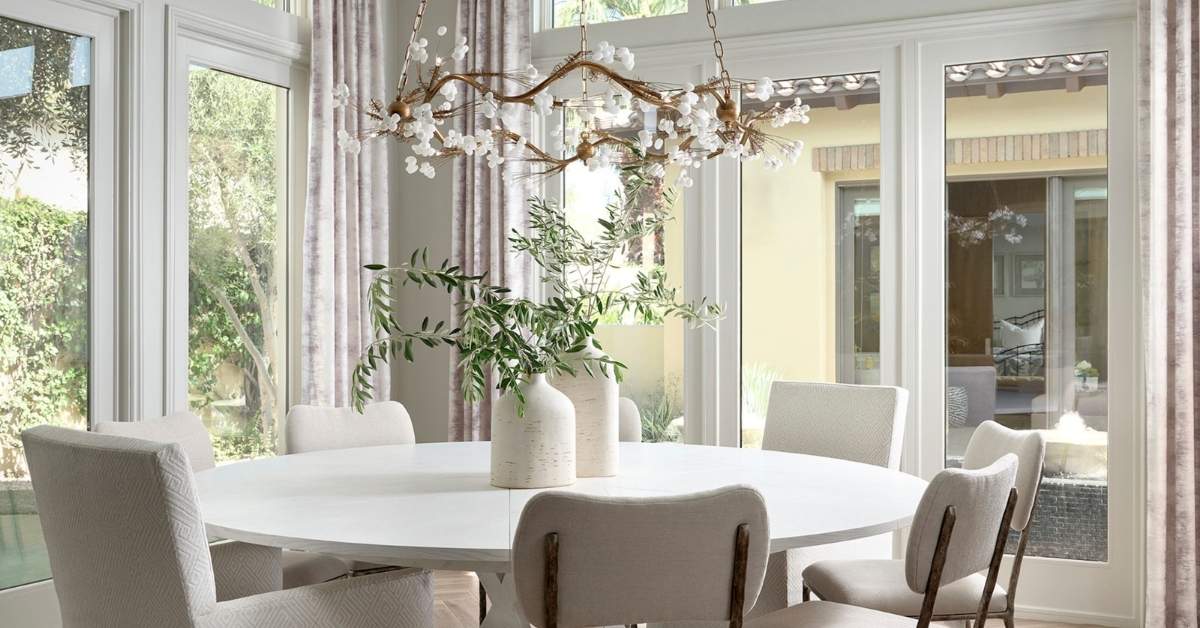
Eating areas are often the last room people think about when decorating a small home and that’s exactly why so many of them end up feeling like an afterthought. A folding table shoved in a corner, chairs that don’t pull out all the way, lighting that belongs in a hospital waiting room. Sound familiar?
If you’re working with a compact dining area whether it’s a nook off the kitchen, a studio apartment corner, or a narrow rental space there’s actually a lot of room to work with (no pun intended). The key isn’t making the space look bigger through tricks. It’s making it function better and feel more considered.
These 21 small space dining room ideas are built around real constraints: limited square footage, awkward layouts, no natural light, or the need for a space that doubles as a home office. Pick what fits your floor plan, not just what photographs well.
A Round Table Against a Half-Wall

Round tables are the most space-efficient shape for tight rooms, and this setup takes it a step further. Push a round pedestal table (no legs at the corners means more legroom) flush against a half-wall or room divider. One or two chairs face outward, and a narrow bench or banquette cushion sits against the wall to serve as seating on the other side.
This configuration works because it consolidates seating without requiring chairs to be pulled back fully into the room. The round table also eliminates awkward corner dead zones. In my experience, this is the setup I’d actually recommend trying first especially in studio apartments or eat-in kitchens where you’re working with less than 8 feet of clearance. It solves the “chairs blocking the walkway” problem that plagues most small dining areas.
A Drop-Leaf Table That Expands Only When You Need It
This is the workhorse of small dining furniture. A drop-leaf table where one or both sides fold down gives you a compact footprint on weekdays and a proper surface when guests come over. Against a wall, a closed drop-leaf takes up as little as 12 inches of depth.
The reason this works better than a fixed small table is flexibility. You’re not permanently sacrificing surface area; you’re designing around how you actually use the space. It also prevents the common mistake of buying a table that’s too small to be functional and too big to be comfortable.
Bench Seating Along One Wall

Bench seating takes up significantly less floor space than individual chairs; a bench sits against the wall, doesn’t need to be pulled out, and can slide under the table when not in use. A single wall bench paired with two chairs opposite creates a dining setup that feels much more intentional than four mismatched chairs jostling for space.
Upholstered benches add softness; bare wood ones keep it clean. This layout is especially useful in narrow rooms where the table runs parallel to a wall; it keeps one side of the room completely walkable, which is a real functional gain.
Window Nook Dining with Built-In Seating
Bay windows and alcoves are often ignored or filled with decorative objects. But a window nook is one of the best small dining opportunities. You have natural light already there, and the enclosure gives a sense of definition without using extra square footage.
Build or buy a simple L-shaped bench to fit the nook, add storage underneath (which also helps in small spaces that lack a pantry), and use a small round table to fit the curve. The result is a dining space that feels separate from the rest of the room even when it’s technically in the same open plan. It works best when the nook is at least 36 inches deep.
Wall-Mounted Folding Table for Occasional Dining

For studio apartments or rooms that need to serve multiple purposes, a wall-mounted folding table is one of the most practical decisions you can make. When folded up, it’s essentially flush with the wall freeing up floor space for a home office setup or workout area. Pull it down for dinner.
The limitation here is seating. It works best for one or two people but for solo dwellers or couples in compact apartments, it’s not a limitation at all. Look for versions that can support at least 50 pounds and anchor into wall studs. This is a setup that in 2026 is increasingly built into new micro-apartment designs for exactly this reason.
The Tall Counter-Height Table Setup
Counter-height tables and stools naturally take up less visual mass than a standard dining setup because the table legs are thinner and the stools tuck under fully. In an open kitchen-living layout, a counter-height table can work as a kitchen island extension during food prep and a dining table at mealtimes.
The height does mean not everyone is comfortable, people with mobility issues or young children may find it awkward but for renters in loft-style spaces or open-plan apartments, it’s worth considering. It’s a more relaxed dining posture that fits the way most people actually eat at home.
Two-Seater Dining Table at the Edge of a Living Room

Not every dining room needs to be a “room.” If your apartment doesn’t have a dedicated dining space, positioning a small square or rectangular two-seater table at the edge of your living area near a window or at the transition point between kitchen and living space creates an eating zone without requiring its own footprint.
The trick is using a rug (even a small 4×4 one) to anchor the dining zone and visually separate it from the sofa area. Without it, the space just looks like a table dropped in the middle of nowhere.
Mirrored Wall Behind the Dining Area
A large mirror or mirrored panel on the wall behind the dining table does two practical things: it reflects light (which helps in rooms with limited windows) and creates a sense of depth that makes the room read as larger than it is. This is especially noticeable in rooms under 100 square feet.
You don’t need a custom wall installation, a large leaning mirror or a panel of two mirrors side-by-side positioned behind the table achieves the same effect. Keep the table and chairs in front of it simple; the mirror is doing the heavy lifting visually.
Read More About : 21 LED Strip Lighting Ideas for a Bathroom Aesthetic That Actually Works
A Minimalist Two-Chair Setup with a Narrow Rectangular Table

In rooms that are longer than they are wide, like a galley kitchen extension or a hallway-adjacent dining zone, a long, narrow rectangular table with chairs at each end actually uses the space more efficiently than a standard 4-seater square. Two people can dine comfortably, and the table acts as a natural divider in open-plan layouts.
This setup works best with a slim table (no more than 24 inches wide) to keep walkable space on both sides. Honest, it’s a more considered look than it seems and it photographs really well for those of us who care about that too.
Floating Shelves Above the Dining Table for Storage + Style
When floor space is limited, the wall above the dining table becomes useful storage. Floating shelves mounted 18–24 inches above the tabletop can hold ceramics, glassware, candles, or small plants freeing up a sideboard or bar cart you don’t have room for.
The key here is keeping the shelf arrangement intentional rather than cluttered. Three or four well-spaced items on a shelf reads as styled; fifteen items read as storage. This also works as a lighting solution if you add puck lights or LED strips underneath the shelves, you get warm task lighting directly over the table.
A Kitchen Island That Doubles as a Dining Table

If you have a kitchen island or are planning one, designing it to double as your dining space eliminates the need for a separate table entirely. An island with an overhang of at least 12 inches on one side creates knee space for stools and just two or three stools give you a proper eating area without dedicating an entire room to it.
This is especially practical for renters or homeowners whose dining and kitchen are already combined. It also avoids the common layout mistake of putting a separate dining table too close to the island, which creates a cramped corridor between the two.
Pendant Lighting That Draws the Eye Inward
Lighting does more for a small dining space than most furniture choices. A low-hanging pendant positioned directly above the dining table does something specific: it creates a visual anchor that tells the eye “this is where we eat” which is especially important when the dining area isn’t architecturally distinct.
A slightly oversized pendant (counterintuitive, but effective) in a small space actually makes the ceiling feel higher because it draws the eye upward. Scale it to the table, not the room: a round table under 40 inches in diameter reads well with a 16–22 inch pendant.
Nesting Chairs That Stack Out of the Way

If you occasionally need more seating than your space allows, nesting or stackable chairs are the most practical solution. Store them in a corner, a closet, or even in a hallway and pull them out when needed no folding or disassembly is required.
The key is choosing a stack chair that doesn’t look like an afterthought. There are good-looking stackable options in natural wood, molded plastic, and powder-coated metal that blend with a dining setup rather than clash with it.
A Banquette Built Into a Kitchen Corner
A corner banquette essentially a padded bench fitted into an L-shape in the corner of a kitchen or dining area is one of the highest-density seating solutions for small spaces. An L-shaped banquette can comfortably seat four to five people in a space where a freestanding table and four chairs wouldn’t fit at all.
The trade-off is commitment: a built-in version requires carpentry, and a freestanding version can be harder to keep anchored. But even a non-built version with two benches positioned at a right angle with a table in front gives you most of the benefit. Add storage drawers underneath and it becomes genuinely multi-functional.
A Glass or Acrylic Table for Visual Lightness

Glass or acrylic tabletops are one of the few design choices where the material itself does spatial work. Because you can see through them, they don’t visually “fill” the room the way a solid wood table does. In rooms under 120 square feet, this can genuinely make the space feel less cramped.
Slim metal legs reinforce the effect. The practical downside is maintenance glass shows fingerprints and requires regular cleaning but for smaller tables used by one or two people, it’s manageable. This is a good option for renters who can’t change the layout or remove existing furniture.
Read More About : Stunning Bedroom Ideas: 50+ Stylish Design & Decor Inspirations
A Color-Blocked Dining Zone in an Open-Plan Space
When there’s no physical wall to define a dining area, paint does the job instead. Paint one section of an open-plan wall in a contrasting color, even just a half-wall or a color-blocked section and position the dining table in front of it. The color break signals “this is the dining zone” without any physical partition.
It also gives the dining area its own visual identity, which makes small open-plan apartments feel more layered and considered rather than like one continuous blob of space. In 2026, we’re seeing this technique applied with warm deep tones terracotta, olive, deep teal rather than the stark accent walls of the early 2010s.
Woven Rattan Chairs to Add Texture Without Bulk

Rattan and woven dining chairs read lighter than solid upholstered or wood chairs because your eye can see through the weave. In a small dining area, this prevents the seating from dominating the visual weight of the space.
Rattan also adds texture which is something small, neutral rooms often lack. A white or light wood table with two rattan chairs creates a naturally balanced material contrast: smooth vs. woven, flat vs. dimensional. It’s a combination that works in both minimal and more eclectic interiors.
A Sideboard Below a Window Instead of Against a Wall
Most sideboards go against an empty wall, blocking natural light. But placing a low sideboard (no taller than 30 inches) beneath a window keeps the light source unobstructed while still giving you storage for table linens, glassware, or serving pieces.
This works particularly well in rooms where the only wall with enough length for a sideboard also has the only window. It’s a simple repositioning that changes how the whole room reads more open, more light, less closed-in.
A Dining Table That Moonlights as a Desk

In smaller homes, the dining table is increasingly a multi-use surface work space during the day, eating surfaces at meals. Designing for this intentionally (rather than just cramming a laptop onto a dining table with nowhere to put it) makes both functions work better.
A table at least 60 inches long gives you room to work on one end and eat at the other without constantly rearranging. Dedicated cable management, even just a hook under the table and a small rolling cart for your work setup that tucks away at meals makes the transition practical rather than annoying.
Layered Lighting: Pendant Plus Candles
Overhead lighting alone makes any dining space feel flat and functional rather than considered. Layering a pendant above, candles at table level, and a corner lamp or sconce creates the kind of warm, directional light that makes food look better and conversation feel easier.
This costs almost nothing (candles are candles) and requires no renovation. It’s one of the simplest upgrades for any small dining space that currently relies on a single overhead bulb. The layering creates shadow and depth, which is especially effective in small rooms where the four walls can feel very close.
A Floating Table Shelf for Solo Diners in Studio Apartments

For solo dwellers in truly compact studios, a floating shelf at bar height along one wall with a single stool is a surprisingly dignified solo dining setup. It takes up almost no floor space, it doubles as a workspace, and it avoids the sad-table-for-one feeling of an undersized freestanding table.
A shelf mounted at 40–42 inches (bar height) with a stool that hits 28–30 inches at seat height is ergonomically comfortable for dining. Add a pendant above and it reads as an actual dining spot rather than a surface where you happen to eat.
What Actually Makes These Small Dining Room Ideas Work
Most small space dining problems aren’t about the room being too small, they’re about furniture that doesn’t scale correctly, layouts that create dead zones, or setups that were designed for a larger room and shrunk down.
Here’s what actually separates the dining setups that feel right from the ones that don’t:
Furniture with the right footprint.
In rooms under 120 square feet, every inch of clearance matters. You need at least 36 inches between the table edge and the nearest wall (or obstacle) for chairs to pull out comfortably. If you don’t have that, the table is too large, not the room too small.
Light that points down, not just up.
Most small dining rooms use a ceiling light that casts diffuse, flat light. A pendant that hangs lower ideally at 30–34 inches above the table puts the light where you need it and makes the space feel more intentional.
Visual anchoring.
Without a rug, a distinct wall treatment, or defined lighting, a small dining area just looks like furniture placed in a space rather than a purposeful zone. You don’t need a rug under every table, but you do need something that signals “this is where we eat.”
Avoiding the extra chair.
It’s very common to buy a 4-chair table for a space that realistically fits two. Extra chairs that can’t pull out fully become obstacles and make the room feel permanently crowded. Size the seating to the daily use, not to the occasional dinner party.
Layout Guide for Small Dining Rooms
| Setup | Best Room Shape | Seats | Floor Clearance Needed | Best Problem It Solves |
| Round pedestal + bench | Square room / nook | 3–4 | 36″ on open sides | Limited chair pull-out space |
| Drop-leaf against wall | Long narrow room | 2–4 | 24″ when folded | Need flexible surface area |
| Wall-mounted fold-down | Studio / single room | 1–2 | Zero when folded | Dual-use space |
| Corner banquette | L-shaped corner | 4–6 | 30″ on open side | Max seating in minimal space |
| Counter-height island | Open kitchen plan | 2–3 | 18″ stool space | No separate dining area |
| Two-seater at room edge | Open plan apartment | 2 | 36″ all around | No defined dining zone |
How to Arrange a Small Dining Room for Better Flow and Function
The most common small dining room layout mistake is placing the table in the center of the room by default. In a small space, center placement often means you can’t move around the table comfortably on any side.
Start with the traffic flow.
Identify where people walk into the space from the kitchen, hallway, or living area. The dining table should be positioned so that the main walking path stays clear. In most small rooms, this means pushing the table toward one wall or corner, not centering it.
Decide on the primary and secondary sides.
In a two-chair setup, one side of the table will be used for entry and one will be against the wall. Make the entry side the one with the most clearance at least 36 inches if possible, 30 inches minimum. The wall side can be closer since no one needs to walk behind it.
Consider the serving path.
If you’re cooking in an adjacent kitchen, think about how food actually gets to the table. A dining setup that blocks the kitchen exit or requires you to navigate around chairs every time you serve is a daily friction point. Position the table so the serving path is unobstructed.
Don’t furnish guests first.
The everyday use of the space, one or two people, three to four meals a day should dictate the setup. Occasional guests can be accommodated with stackable chairs or extensions. A table scaled to guests rather than daily use is too large for most small dining spaces.
FAQ’s
What size dining table works best in a small room?
For rooms under 130 square feet, a table no wider than 32–36 inches and no longer than 48–60 inches is usually the right range. Round tables between 36–42 inches in diameter are also a strong option since they eliminate dead corner space and allow more flexible seating.
How do I make a small dining room feel less cramped?
The biggest change you can make is clearing the walking path. If chairs can’t pull out without hitting a wall or another piece of furniture, the room feels tighter than it actually is. Beyond layout, lower pendant lighting, light-toned walls, and a glass or acrylic table surface all reduce the visual weight in the space.
Is a bench better than chairs for a small dining room?
In most cases, yes. Bench seating sits flush against the wall and doesn’t need to be pulled out, which preserves floor clearance on at least one side of the table. A wall bench paired with two chairs on the opposite side is one of the most space-efficient dining configurations available.
Can I use a dining table as a desk in a small apartment?
Yes, and it’s worth designing for it intentionally. A table that’s at least 60 inches long gives you enough surface to work on one end and eat on the other. The key is keeping the table clear of permanent desk clutter. A small rolling cart for your work items that tucks away at mealtimes makes this transition practical.
What lighting works best in a small dining room?
A pendant hung 30–34 inches above the table surface is the most effective choice; it creates a focal point, directs light where you need it, and makes the ceiling feel taller. Avoid ceiling-flush fixtures in small dining rooms; they cast flat, even light that flattens the space rather than defining it.
How do I create a dining zone in an open-plan studio apartment?
Use one of three approaches: a rug under the table to anchor the space visually, a pendant light directly above the table to define the zone vertically, or a color-blocked wall section behind the dining area. Any one of these signals “this is where we eat” without a physical partition.
Is a round or rectangular table better for a small dining room?
Round tables work better in square rooms or corner nooks because there are no sharp corners that jut into walkways and they seat people on all sides with equal comfort. Rectangular tables work better in long, narrow rooms where they can run parallel to the long wall. Both work the room shape should decide.
Conclusion
Small dining rooms rarely need more space; they usually need better decisions about the space they already have. Whether that’s right-sizing the table, switching to bench seating, or simply repositioning the whole setup away from the center of the room, these are changes that take an afternoon and change how you use the room every day.
Start with the one or two ideas that fit your actual floor plan first, not your inspiration board. If you have a corner, try the banquette. If you’re solo in a studio, the wall-mounted shelf or drop-leaf table will serve you better than any full dining set. Build from function and let the styling follow.
